
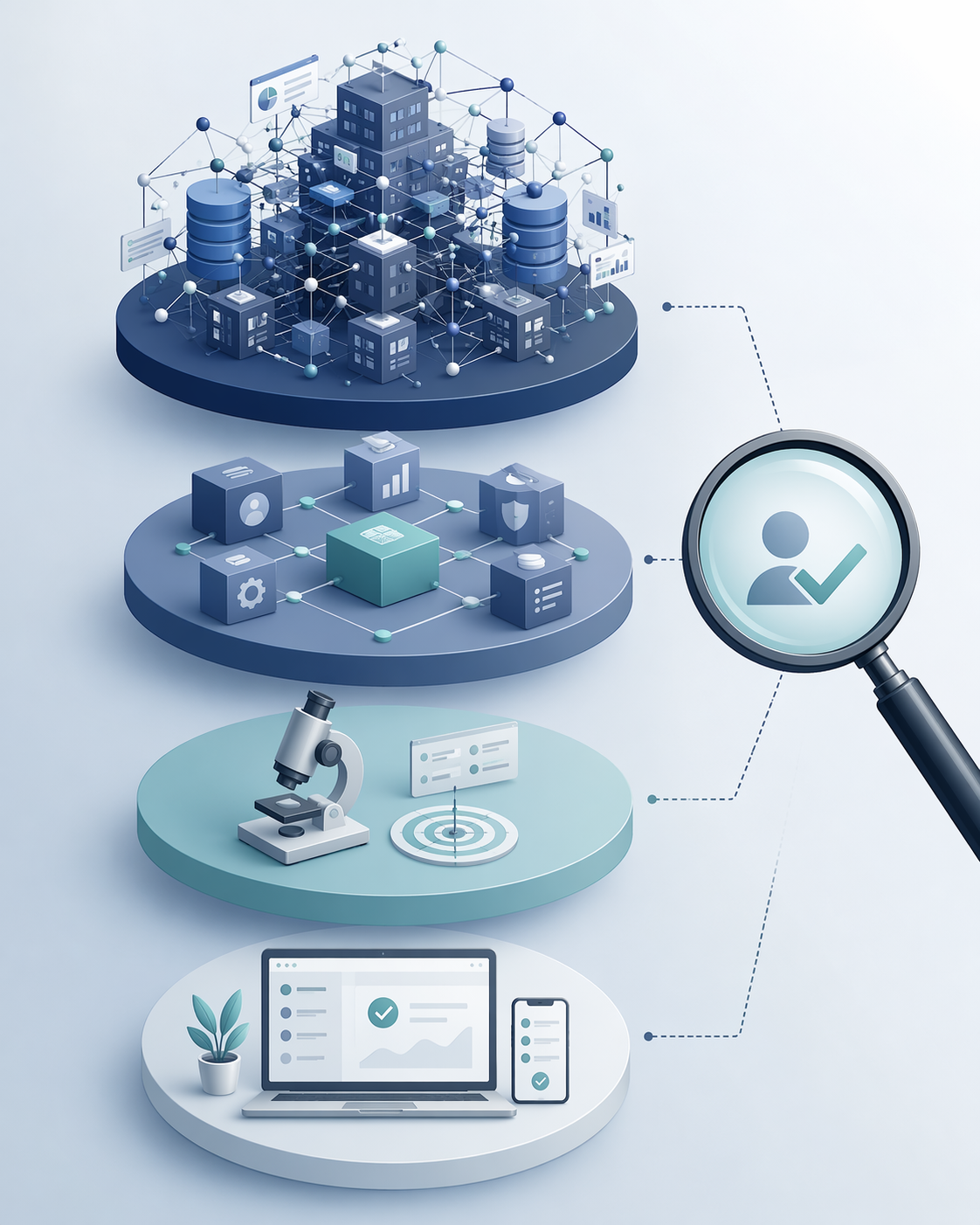
The first mistake in evaluating ai powered demand planning software is treating every platform as if it belongs in the same market. It does not. A mid-market manufacturer, a regional distributor, and a global enterprise are often comparing tools that solve different problems, demand different data, and tolerate very different implementation burdens. Horizon Solutions makes that split explicit with four categories: enterprise suites, mid-market integrated platforms, specialist tools, and SMB/lightweight solutions [1].
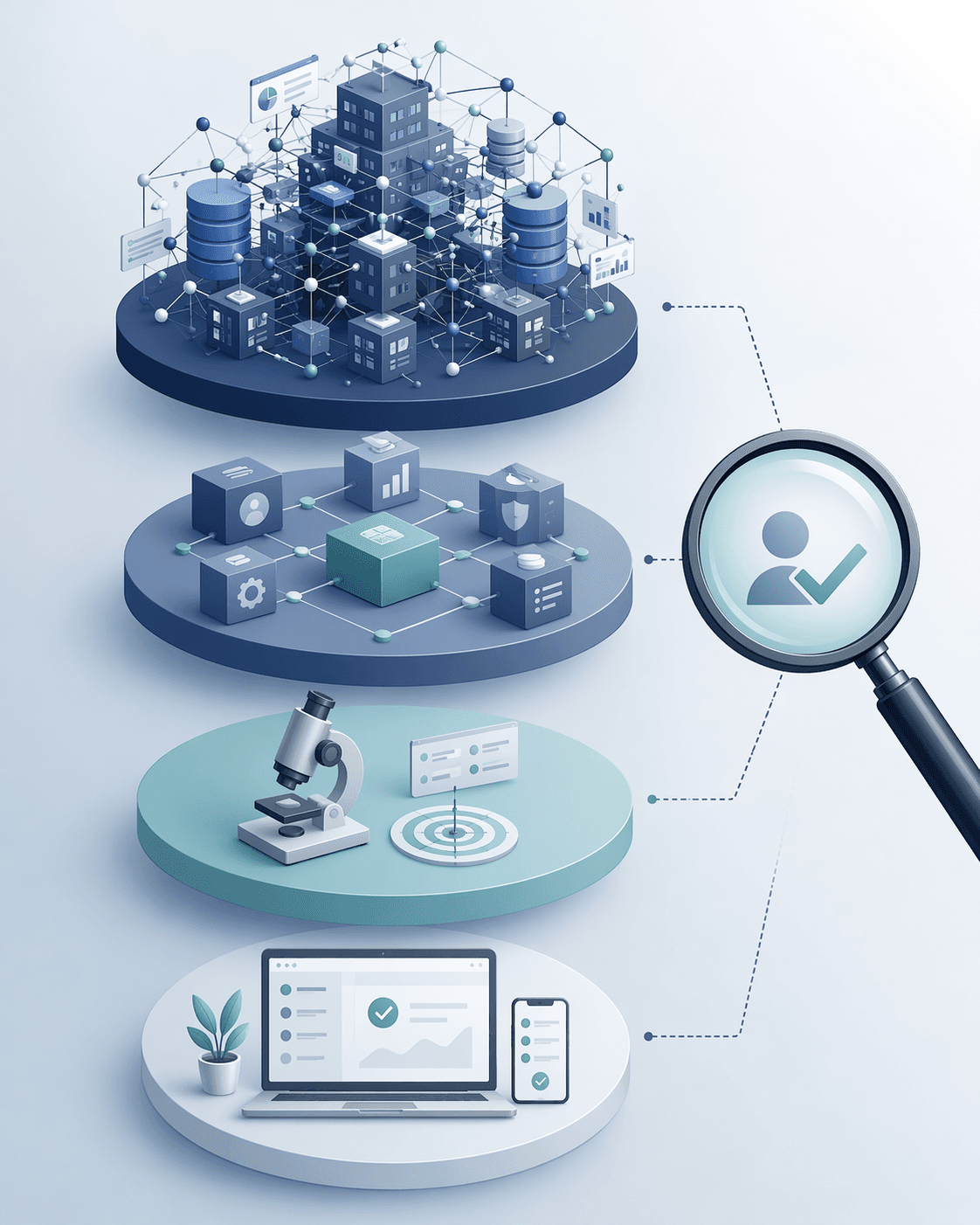
That taxonomy matters because it explains why some demos feel impressive and still lead to a bad purchase. Horizon’s warning is blunt: a mid-market manufacturer that buys a Fortune 500 platform can end up paying 2–3x what it needs, spending 12–18 months in implementation, and using only 30–40% of the capability [1]. That is not a feature problem; it is a category mismatch.
A four-category map of the market
| Category | Typical fit | Illustrative vendors | Where the fit breaks |
|---|---|---|---|
| Enterprise suite | Large, complex networks with multi-division planning, deeper governance, and long implementation tolerance | Kinaxis, o9, SAP IBP, Blue Yonder, Oracle, OMP [1] | When the team needs something faster to deploy, easier to administer, or narrower in scope |
| Mid-market integrated | Growing manufacturers, distributors, and CPG firms that need serious planning control without a Fortune 500 operating model | Horizon, Logility, RELEX, John Galt [1] | When the company is being pushed into enterprise-suite process overhead it will not sustain |
| Specialist | Teams that need depth in a narrower planning problem, often with less appetite for a full platform overhaul | Flowlity, Datup, ToolsGroup, Streamline [1] | When the buyer expects one tool to replace a broader planning operating model |
| SMB/lightweight | Smaller operations that want faster adoption, simpler governance, and lower spend | Netstock, Slimstock, StockIQ [1] | When SKU complexity, integrations, or cross-functional planning needs outgrow the tool |
The enterprise-suite column should not be read as a recommendation list. Horizon’s summary of the 2026 Gartner Magic Quadrant leaders for supply chain planning solutions places Kinaxis, o9, SAP, Oracle, Blue Yonder, and OMP in that tier [1]. That is useful for orientation, but it does not mean “leader” equals “best fit” for a buyer that lacks the data maturity, implementation bandwidth, or operating scale those suites assume.
Decide your category before the RFP
The practical question is not “Which vendor has the best AI?” It is “What class of platform can this company actually absorb?” Revenue band, SKU count, data cleanliness, ERP architecture, and deployment deadline usually answer that faster than a feature matrix does. Netstock’s published pricing range is a useful reminder of the spread: cloud tools serving about 200-SKU operations can sit around $30K a year, while enterprise platforms for 50,000-SKU global manufacturers can exceed $1M a year [2]. The software may all be called demand planning, but the operating assumptions are not remotely the same.
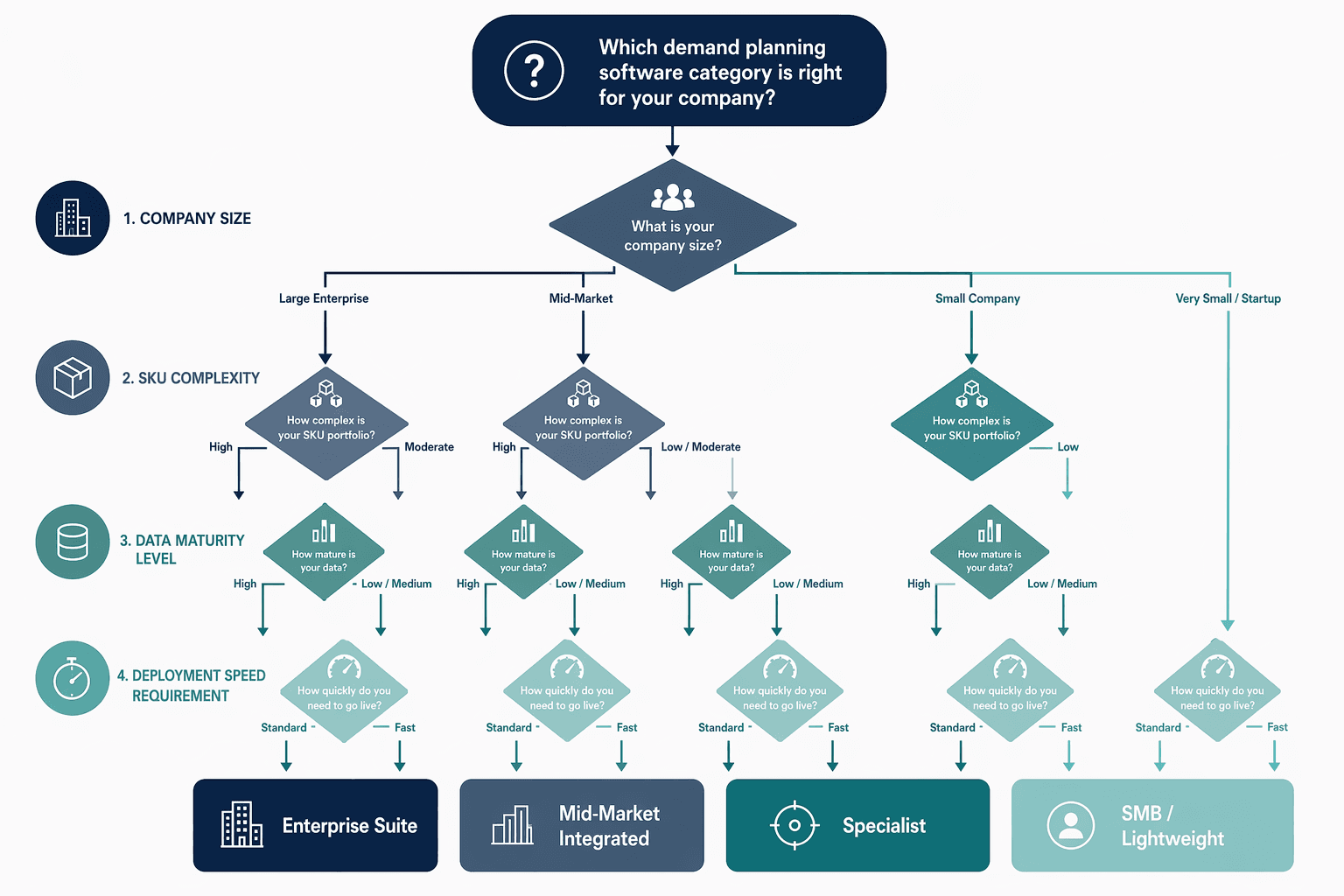
- If the team needs a full planning system across many product families, sites, and approval layers, start by testing the enterprise-suite tier.
- If the company is mid-market and wants planning discipline without a multi-year transformation, focus on integrated mid-market platforms first.
- If the pain point is concentrated in one planning problem, a specialist tool may be the cleaner choice than a broad suite.
- If speed, simplicity, and lower overhead matter more than architectural depth, the SMB/lightweight tier deserves a serious look.
This is also where implementation tolerance becomes a selection criterion, not a post-sale concern. If the organization is already replacing an ERP, changing master data rules, or centralizing planning governance, it is not neutral to add a second large transformation on top. John Galt’s resource guide warns that switching can take 6–12 months and cost 1.5–2x the original effort [4]. That is a reason to narrow the shortlist early, not a reason to stay vague until procurement is already locked in.
What to compare inside the category you actually belong to
Once the category is right, the comparison gets sharper. Within enterprise suites, the questions are about governance depth, workflow breadth, and how much planning process the company is willing to standardize. Within mid-market integrated tools, the questions shift toward implementation speed, usability, and whether the platform can cover the needed planning process without creating a new administrative burden. Specialists should be judged by the depth of the specific problem they solve, not by how many adjacent workflows they can imitate. SMB/lightweight tools should be tested on speed to value, integration simplicity, and whether they remain workable as the SKU base grows.
Architecture deserves its own filter. Kumo’s published benchmark argues that time-series-only tools can miss 25–30% of demand signal, while relational models can reduce overstock by 25% and free $2–5M in working capital per quarter [3]. Treat those figures as Kumo’s benchmark, not as an industry-wide guarantee. The point is narrower and more useful: ask whether the platform can use the data relationships your company actually has, including SKU-location-customer patterns, or whether it is collapsing those relationships into a simpler model than your business needs.
That question is often where the shortlist changes. A team may enter the process looking for the most advanced forecast engine and leave with a better reason to prioritize data model compatibility, integration effort, and planner adoption. If the business case itself still needs a broader benchmark layer, see AI Demand Forecasting ROI: Evidence, Benchmarks & Implementation Roadmap and AI Demand Forecasting vs. Traditional Methods. Here, the more immediate job is to avoid paying for architectural reach the company cannot use.
A shortlist gets better when it gets smaller
The most useful outcome of a fit-first evaluation is not a heroic universal winner. It is a narrower, more defensible shortlist. Once the buyer knows whether the real need is enterprise suite, mid-market integrated, specialist depth, or SMB/lightweight speed, the vendor conversation becomes less theatrical and more practical. The next step is not to admire every advanced feature in the room. It is to ask which class of platform matches the company’s scale, SKU complexity, data maturity, deployment tolerance, and architecture needs.
References
- Best Demand Planning Software 2026 — Horizon Solutions — Best Demand Planning Software 2026
- The Real ROI of AI in Supply Chain Planning — Netstock — The Real ROI of AI in Supply Chain Planning
- Best AI Demand Forecasting Tools for Enterprise (2026) — Kumo.ai — Best AI Demand Forecasting Tools for Enterprise (2026)
- AI in Supply Chain Planning Software: All You Need to Know — John Galt — AI in Supply Chain Planning Software: All You Need to Know
Comments
Join the discussion with an anonymous comment.