

What the finance committee is really asking
The budget conversation does not start with AI. It starts with a simpler question: what is the logistics network already paying for by staying reactive? Predictive analytics in logistics is only worth capital if it interrupts a measurable leak — disrupted revenue, excess inventory, and empty miles — not because it sounds modern.
At the minimum, predictive analytics uses historical and live operational data to anticipate demand, delay, or failure before the cost is booked. That definition matters only because the finance case depends on the losses it can interrupt.

Start with the inaction ledger
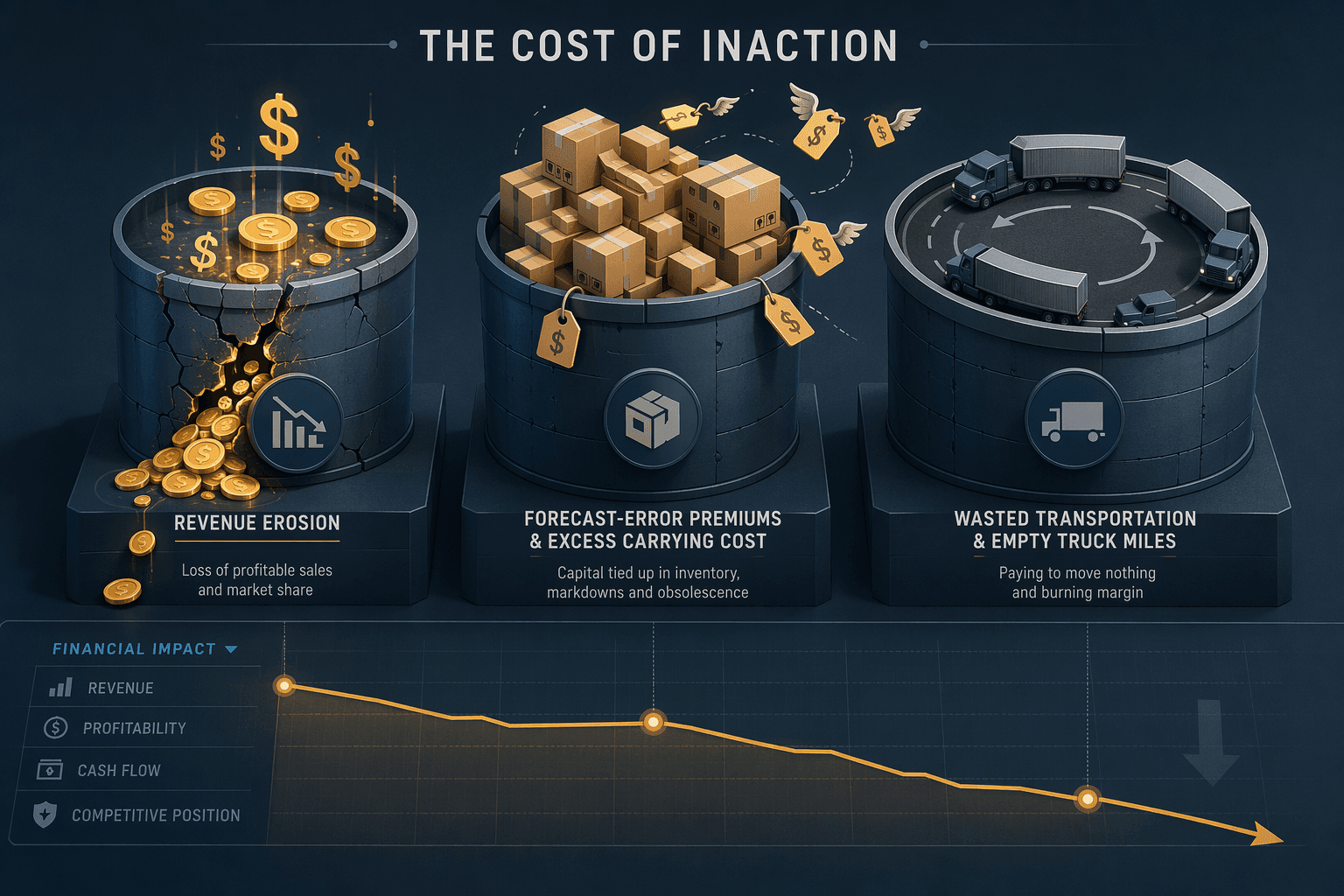
The strongest business case begins by pricing the absence of prediction. Gartner's benchmark, as cited by SR Analytics, puts annual revenue erosion from avoidable supply chain disruption at 7–12% [1]. Secondary sources also attribute to AI forecasting a 20–50% reduction in forecast error versus traditional methods, which matters because forecast error shows up as extra safety stock, premium freight, and avoidable service pressure [2]. EPA-linked data cited by Transmetrics says 35% of U.S. heavy truck miles are empty, a visible slice of transportation waste that no board deck should treat as abstract [3].
| Loss bucket | External benchmark | How to replace it with your own number |
|---|---|---|
| Disruption-driven revenue erosion | 7–12% annual revenue erosion tied to avoidable supply-chain disruption [1] | Apply only to the portion of revenue exposed to service failures, stockouts, and late delivery. |
| Forecast-error premium | 20–50% lower forecast error is the common benchmark for AI forecasting versus traditional methods [2] | Use only the inventory and service cost carried because demand is uncertain. |
| Empty-mile waste | 35% of U.S. heavy truck miles are empty [3] | Limit the baseline to lanes, regions, and backhauls where empty-mile reduction is operationally possible. |
That table is intentionally conservative. It does not assume every sale is at risk, every SKU is misplanned, or every mile can be recovered. It only asks finance to replace broad company totals with the slice that logistics can actually influence. SR Analytics also reports inventory carrying costs can fall 15–28% in client data, but that is a benchmark, not a promise, and it should be applied only to inventory value that exists because planning is uncertain [1].
Proof points from named deployments
| Company | Reported outcome | Why it matters for the business case |
|---|---|---|
| UPS | $100–200M a year saved through ORION dynamic route optimization [3] | Shows that transportation optimization can produce material savings quickly; keep this figure to route optimization alone. |
| Kärcher | 15% reduction in inventory value [1] | Useful where the budget case depends on working capital and stock exposure, not just service levels. |
| GM | 20% less unplanned downtime [4] | Relevant when maintenance and asset availability sit inside the logistics cost base. |
| DHL | $350M multi-year digitization investment [2] | Scale context only: it shows large operators fund this area, but it is not ROI proof. |
UPS is the cleanest proof point here because the savings connect directly to logistics optimization, but the conservative reading matters more than the headline. The lower Transmetrics range belongs in the model; broader claims that fold in multiple programs should stay out of a CFO deck [3]. DHL, by contrast, is evidence of commitment at scale, not a return calculation [2].
What it costs to act
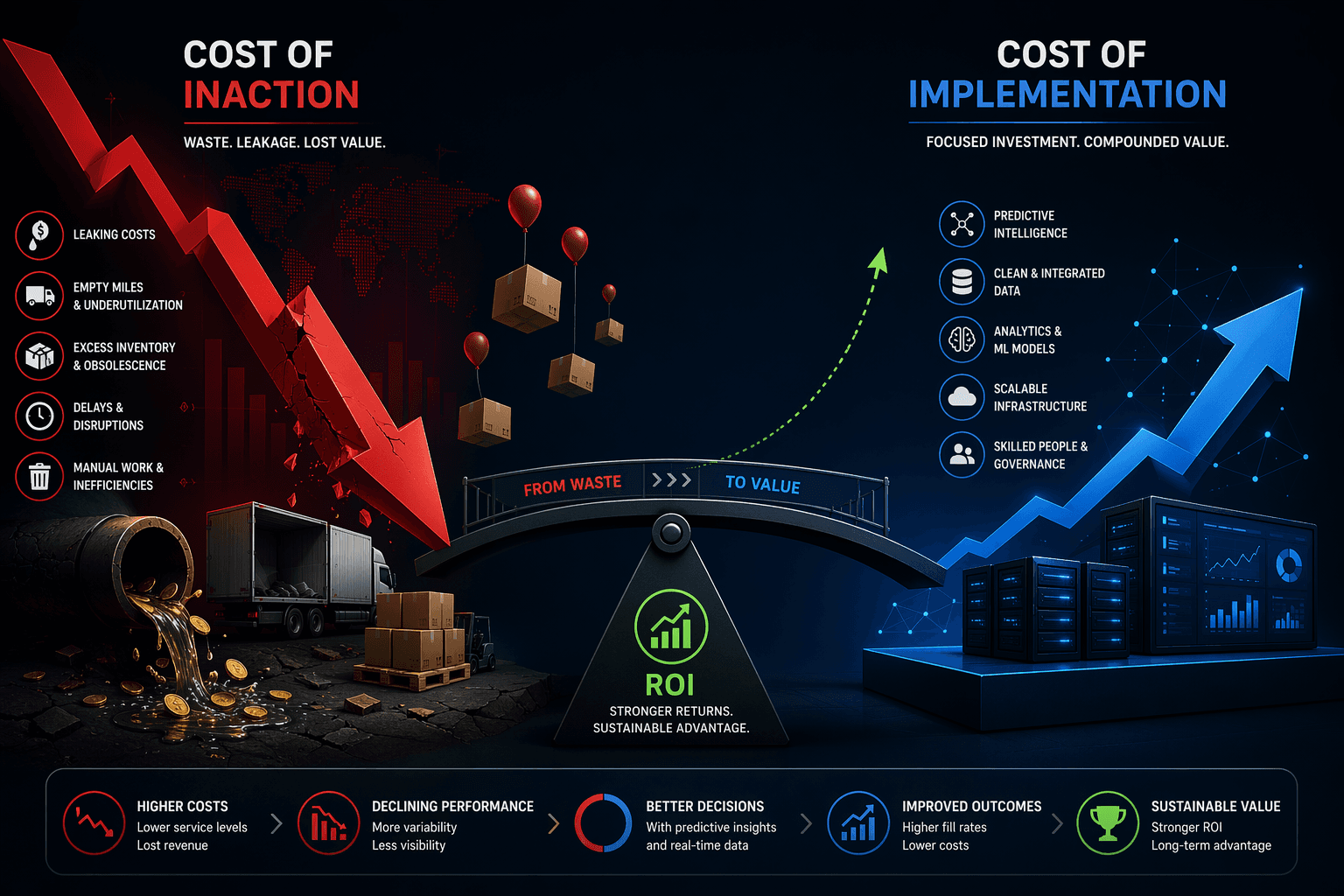
The price of entry is not uniform. SR Analytics puts mid-market pilot costs at $25K–$75K and says ROI can arrive in 6–12 months [1]. That is useful as a planning anchor, but it is not universal. Enterprise deployments can move past $500K once data cleanup, ERP/TMS integration, and model governance are added. The software path can start with open-source KNIME or Python, move through tools like Alteryx, and end in enterprise suites such as SAP IBP or Oracle SCM Cloud. The real cost driver is usually data readiness, not the label on the software.
A CFO-ready projection model
- Start with logistics-exposed revenue, not total revenue, and apply the 7–12% disruption benchmark only to the exposed slice [1].
- Treat inventory separately: isolate the value carried because demand is uncertain, then test the 15–28% carrying-cost reduction band as a scenario, not a guarantee [1].
- Translate empty miles into fuel, labor, and asset-hours only on lanes where backhaul recovery is plausible; the 35% national figure is context, not your enterprise baseline [3].
- Use named-company outcomes only where the operating pattern matches: route optimization for UPS, inventory exposure for Kärcher, maintenance risk for GM [3][1][4].
- Compare that avoided leakage with the cost of a pilot or staged rollout, then ask whether the remaining loss is large enough to justify doing nothing.
If the internal model cannot show where the current losses are, the ROI case is not ready. If it can, the budget discussion stops being speculative AI spend and becomes a comparison between recoverable operating leakage and a bounded investment.
References
- Supply Chain Predictive Analytics — SR Analytics — https://sranalytics.io/blog/supply-chain-predictive-analytics/
- Logistics and Supply Chain Trends — Trinetix — https://www.trinetix.com/insights/logistics-and-supply-chain-trends
- Predictive Analytics in Logistics — Transmetrics — https://www.transmetrics.ai/blog/predictive-analytics-in-logistics/
- Predictive Analytics in Supply Chain — RTS Labs — https://rtslabs.com/predictive-analytics-in-supply-chain/
Comments
Join the discussion with an anonymous comment.