
Eighty-five percent of AI initiatives deliver close to zero measurable value. That statistic — attributed to BCG and cited by RELEX — is the one I keep coming back to when a vendor slides a payback chart across the table. The chart always shows a tidy range: 20–50% forecast error reduction, 20–30% inventory reduction, 5–20% logistics cost reduction. The figures come from McKinsey, and they are cited by Oracle, Intuit, and a dozen other platforms. They are directionally reliable. But the 85% failure rate is the more honest number for anyone sitting across from a vendor. It tells me the documented ROI is conditional, and the conditions are not what the vendor put on the slide.
What the Benchmarks Actually Say
The numbers are real when the prerequisites are met. McKinsey’s work on AI-powered supply chain demand forecasting reports forecast error reductions of 20–50%, product unavailability reductions of up to 65%, inventory reductions of 20–30%, and logistics cost reductions of 5–20%. The same ranges appear in a separate McKinsey analysis cited by Intuit. These are not single-point claims. They are ranges from a firm that has the data to produce them, but they describe what is possible under favorable conditions — not what every adopter gets.
| Metric | Range | Source | Conditional On |
|---|---|---|---|
| Forecast error reduction | 20–50% | McKinsey (via Oracle, Intuit) | Data quality, mature planning processes |
| Product unavailability reduction | Up to 65% | McKinsey (via Oracle) | Real-time data integration, demand sensing capability |
| Inventory reduction | 20–30% | McKinsey (via Intuit) | Integrated S&OP, reliable demand signals |
| Logistics cost reduction | 5–20% | McKinsey (via Intuit) | Network visibility, automated replenishment |
Other vendor-independent sources reinforce the pattern. IBM reports that Idaho Forest Group reduced forecasting time from 80+ hours to under 15 hours and that Novolex cut excess inventory by 16%. Drivepoint notes that AI forecasting typically achieves 80–90% accuracy for established products in stable categories. These numbers are useful, but they measure different things — forecast cycle time, inventory turns, point accuracy — and they come from different operational contexts. You cannot average them into a single ROI promise.
Why 85% of Initiatives Deliver Close to Zero
Now consider the other side. The BCG statistic — 85% of AI initiatives deliver close to zero measurable value — appears in RELEX’s content citing BCG research. I have not independently verified the original BCG report, but the figure is consistent with what I observe in practice. RELEX also cites Deloitte: 84% of organizations have not redesigned roles or ways of working around AI capabilities. That second number is the more actionable one. It means the failure is not primarily technical. It is organizational.
Only 10% of supply chain leaders trust AI for critical decisions without human review, according to RELEX’s 2026 State of Supply Chain report. That trust gap is the practical expression of the readiness failure. Organizations buy the technology, deploy a model, and then find that planners do not trust the output because they cannot explain it, because they were not consulted in the design, because the data feeding the model is dirty, because the incentive structure still rewards spreadsheet-based forecasts.
The research and practitioner experience converge on a small set of failure patterns. Why 70% of Supply Chain AI Projects Fail — and How Data-First Implementation Fixes It documents that the most common mistake is starting with technology before defining the problem. But there are more specific failure modes worth naming:
- Weak data foundations. The model is only as good as the historical demand data, product hierarchies, and causal factors fed into it. Most organizations overestimate their data readiness.
- Planning processes that were designed for batch, not real-time. AI can forecast daily or hourly, but if the S&OP cycle still runs monthly, the insight decays before it reaches a decision.
- Technology platforms that are not integration-ready. AI forecasting requires connections to ERP, CRM, WMS, and external data sources. A disconnected model is a demo, not a deployment.
- People and governance gaps. The 84% role redesign statistic is the most concrete indicator. Planners who spent 60–80% of their time on data wrangling and model maintenance now need to shift to exception management and strategic judgment. That change requires training, new role definitions, and revised performance metrics.
- Skipping maturity stages. The most pernicious failure pattern. Organizations try to jump from rigid rule-based forecasting directly to autonomous agentic AI, bypassing the foundational specialized AI stage where ROI first materializes.
RELEX’s AI-to-ROI framework organizes these five dimensions into an assessment: data maturity, planning processes, technology platforms, people and governance, and AI maturity. AI Demand Forecasting Challenges and Readiness: What Supply Chain Leaders Need to Know Before Implementing provides a deeper readiness evaluation. The point is: if you score low on any of these, the ROI numbers in the table above are not available to you yet.
The Maturity Model That Explains the Gap
The RELEX maturity framework defines four stages. I dwell on it because it is the clearest explanation for why the documented ROI is real but rare.
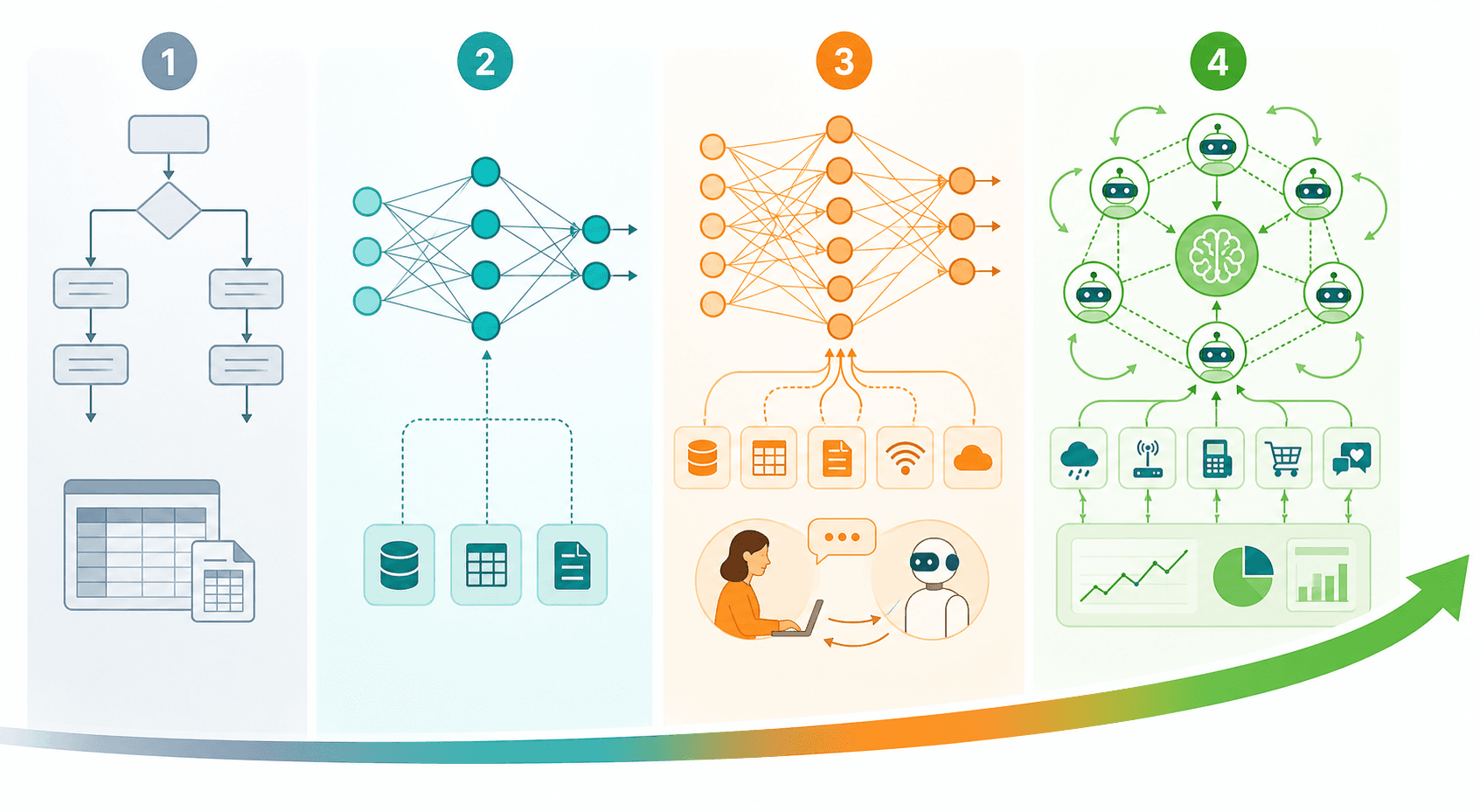
Stage 1, Rigid Rule-Based, is what most organizations still run: static rules, manual adjustments, spreadsheet-driven S&OP. Stage 2, Foundational Specialized AI, is where focused machine learning models are applied to specific forecasting tasks — one model for baseline demand, another for promotions, another for seasonality. This stage requires decent data hygiene and clear ownership, and it is where the McKinsey-level improvements first materialize. Blount Fine Foods, which achieved a 50% reduction in forecasting errors and 35% less waste after implementing ML-driven demand planning with RELEX, was operating at Stage 2. So was Rastelli Foods, which saved $3.5M in the first year from inventory visibility and hit 85% forecast accuracy.
Stage 3, Assistive & Agentic AI, introduces decision support and limited automation — the model recommends a course of action, the planner approves or overrides. Stage 4, Multi-Agent Orchestration, involves autonomous agents coordinating across planning, procurement, and logistics. Each stage builds on the previous one. The failure pattern is nearly always the same: an organization at Stage 1 buys a platform promising Stage 3 capabilities, deploys it in a disconnected silo, and gets nothing measurable.
Each of the following cases is published by the vendor that supplied the solution. That means commercial bias is present. I include them because they show what the combination of data readiness, role redesign, and staged adoption looks like in practice — and because the numbers are consistent with the independent benchmark ranges.
- Blount Fine Foods (RELEX, Stage 2): 50% forecast error reduction, 35% less waste, 20%+ CAGR. Source: RELEX, vendor-published. No independent audit identified.
- Rastelli Foods (RELEX, Stage 2): $3.5M saved in first year from inventory visibility, 85% forecast accuracy. Source: RELEX, vendor-published.
- C3 AI agribusiness (Intuit/C3 AI, Stage 3): $30M gross margin gains across facilities, 96% faster production schedule generation, 2% improvement in OTIF deliveries. Source: Intuit blog, vendor-published.
- Idaho Forest Group (IBM, Stage 2): Forecasting time reduced from 80+ hours to under 15 hours. Source: IBM, vendor-published.
- Novolex (IBM, Stage 2): 16% excess inventory reduction, planning cycles collapsed from weeks to days. Source: IBM, vendor-published.
All of these outcomes were measured in production, not in a proof of concept. The measurement horizon matters: a 50% error reduction sustained for six months after go-live is different from a 50% improvement in a controlled test on clean historical data. The Blount and Rastelli figures come from ongoing operations, which is the only kind of evidence I trust from a vendor case study.
A Roadmap That Respects the Prerequisites
RELEX’s 30/90/12-month phased transformation roadmap is the most practical framework I have seen that aligns execution with maturity stage progression. It acknowledges that you cannot skip from assessment to scaling in one step.
The first 30 days are about assessment and anchoring: audit your data quality, define the specific forecasting problem you are solving, establish governance and ownership. This is where the readiness evaluation from AI Demand Forecasting Challenges and Readiness fits. Do not start any technical work until you can clearly answer: what decision will the forecast improve, and by what measurable, compared to what baseline?
The next 90 days prove value in production on a single, high-impact use case. This is Stage 2. Implementing AI Forecasting Without the Hype provides a practical guide for this phase: data readiness, model selection, vendor evaluation, and the necessary change management. The output of the 90-day phase should be measurable, sourced, and reproducible — not a demo but a live forecast that a planner actually uses.
The 12-month phase scales and extends: apply the same pattern to adjacent categories, integrate additional data sources, introduce demand sensing, and begin moving toward Stage 3 (assistive AI). Touchless Forecasting: A Five-Part Implementation Blueprint outlines the steps for Stages 3 and 4 once the foundation is solid.
What a Supply Chain Leader Should Carry Forward
The ROI of AI demand forecasting is real. The McKinsey benchmarks, the IBM cases, the Blount and Rastelli numbers — they are not fabricated. But they are conditional. They apply only when data foundations are solid, roles are redesigned, and the organization follows a staged path that starts at Stage 1 and does not skip to Stage 3. The 85% failure rate is the reality for everyone else.
If I am in that conversation — the one where a vendor projection shows a 35% inventory reduction in Year 1 — I ask: where are you on the maturity model? Who owns the transformation, not just the technology? Which case study was independently audited? What was the forecast error before you started, and what is it now, measured six months after go-live? If the answers are vague, the ROI slide is a promise, not a plan.