

The first failure point in supply chain management AI is usually not the model. It is the assumption that clean, connected, governed data already exists. Gartner's more recent warning is blunt: 60% of AI projects are expected to be abandoned through 2026 if organizations do not have AI-ready data, and the older 85% line that still circulates should be treated as a historical citation rather than the better current benchmark [1][3].

The cost of getting the foundation wrong shows up before model work even starts. Coherent Solutions breaks AI spend into data collection and preparation at 15–25% and infrastructure at 15–20%, which means the data foundation alone can absorb 30–45% of a project's budget [2].
Why the bottleneck keeps repeating
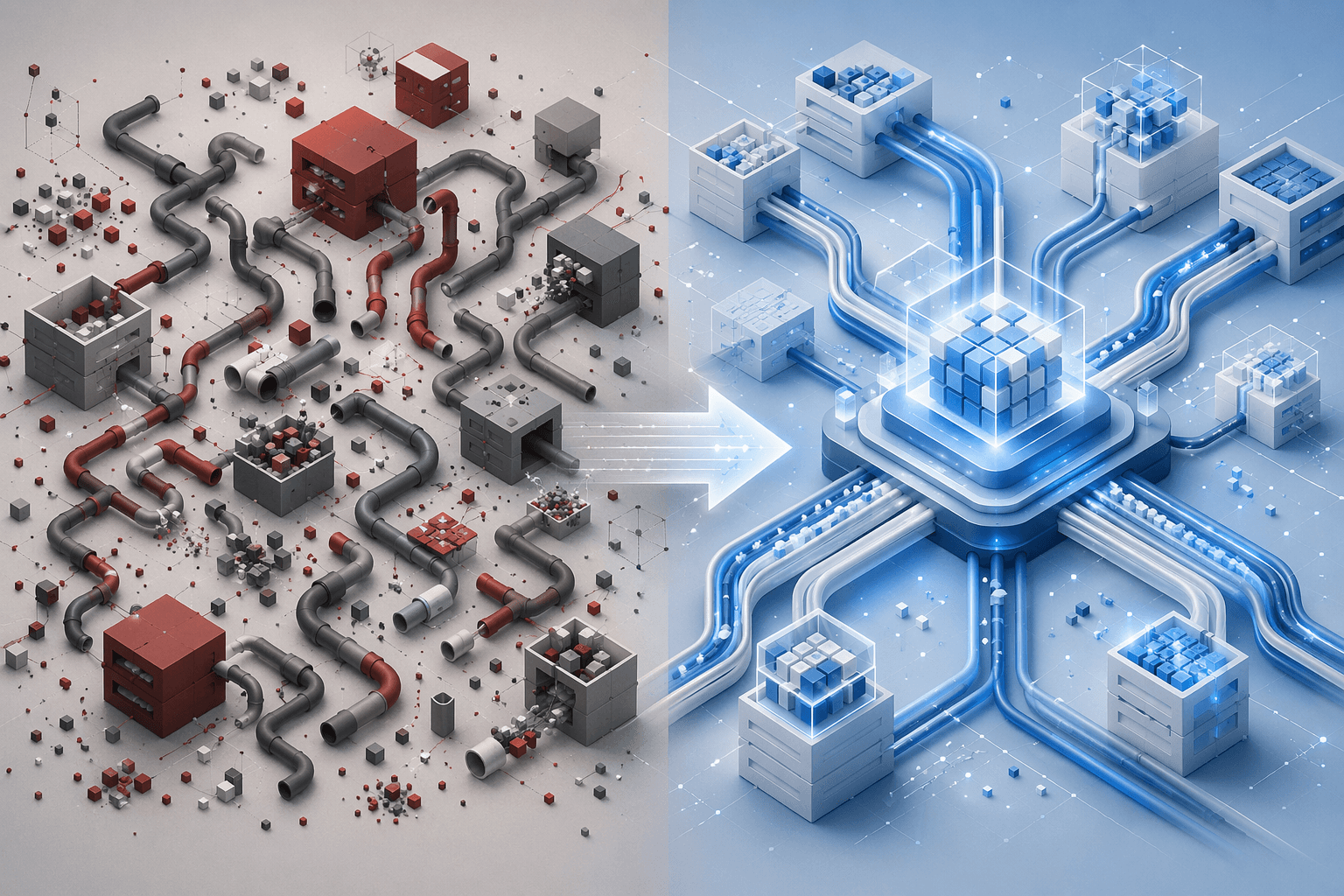
That is why this problem rarely turns out to be a vendor story. Fragmented systems, inconsistent master data, and weak governance follow the organization from planning into execution, no matter how polished the demo looked. VISEO's 2026 framework names the prerequisite work directly: data governance, unified architecture, and real-time visibility; it also notes that only 53% of supply chain leaders rate their master data quality as adequate [3].
A concrete case makes the sequence easier to see. ARC/Logistics Viewpoints reports that P&G unified more than 100 global data feeds into a central platform to support daily AI-driven demand forecasting [4]. That is not a hero story about replacing planners; it is evidence that forecasting only becomes usable after the data is harmonized enough for the system to ingest it.
The enthusiasm gap is still wide. OpenSky says 94% of supply chain firms plan to use AI within two years, yet only 23% have a formal strategy [5]. Planning to buy intelligence is not the same thing as having the master data, architecture, and ownership model that let it work.
The question to ask before any AI contract
If an organization cannot answer who owns the data, how it moves, how it is governed, and whether it is sufficiently harmonized, AI selection is premature. The better procurement question is not which platform to buy, but what must be true in the data environment before any platform has a chance to succeed.
References
- Gartner Survey Shows Just 23 Percent of Supply Chain Organizations Have a Formal AI Strategy — Gartner, 2025-06-11
- AI Development Cost Estimation: Pricing Structure & ROI — Coherent Solutions, 2026-04
- How to build the foundations of an AI-ready supply chain — VISEO, 2026-02
- Data harmonization and infrastructure requirements for AI in the supply chain — ARC / Logistics Viewpoints, 2025-10-20
- Supply Chain AI Statistics — OpenSky Group, 2026
Comments
Join the discussion with an anonymous comment.