

The published ROI evidence for C3 AI Demand Forecasting is useful, but it is not a single conversion factor that can be dropped into a budget deck. Across four enterprise deployments, C3 AI has reported forecast accuracy improvements from 8% to 20%, inventory reduction potential from $20M to $300M, and implementation timelines from roughly 6 to 26 weeks, depending on the case and source detail available.[1][2][3][4] The spread matters as much as the headline.
| Deployment | Reported forecasting improvement | Inventory / savings figure | Implementation or operating scope | Source status |
|---|---|---|---|---|
| Biopharma vaccine supply chain | 20% improvement vs. baseline statistical forecasts; 4% improvement vs. SME-adjusted forecasts | $20M annual inventory reduction potential | 450+ SKUs covering about 50% of vaccine revenue; 26-week implementation | Direct C3 AI case study page [1] |
| Fortune 100 food processor | 11.7% overall forecast accuracy lift; 15.1% lift across the 120 hardest-to-forecast SKUs | Not reported as a dollar inventory figure in the cited case | 300 SKUs, 10 distribution centers, 5 ERPs, 7 external sources, 10M rows | Direct C3 AI case study page [2] |
| Global high-tech hardware manufacturer | 70–100% WAPE reduction vs. baseline | 7% potential inventory reduction | Implementation detail not available in the summary source | C3 AI product / capabilities summary reference; thinner accessible case detail [3] |
| Global agribusiness | 8% forecast accuracy improvement | $30M+ saved | 16-week implementation; 72M rows from 18 data sources; 96% reduction in production schedule generation time | C3 AI summary reference and third-party mention; full case page not directly accessible in the provided research [3][4] |

That is the practical answer to the C3 AI Demand Forecasting ROI question: the published cases show that enterprise-scale returns are possible, but the defensible business case has to start with the company’s own baseline error, SKU and channel complexity, inventory economics, and ability to operationalize model recommendations. A 20% case-study accuracy lift is not a promise that a different portfolio will improve by 20%.
It is also important to keep the source status visible. The figures above are vendor-attributed outcomes, not independently audited performance studies. Two of the four cases, biopharma and food processing, provide enough operating texture to compare scope and burden. The high-tech hardware and agribusiness examples are still relevant, but the available evidence is less complete because the figures appear through summary references or secondhand mentions rather than directly accessible full case pages.
The biopharma case: the largest accuracy gain came with a heavy planning environment
The biopharma deployment is the cleanest example of why forecast accuracy has to be read against the baseline. C3 AI reported a 20% forecast accuracy improvement against baseline statistical forecasts, but only a 4% improvement against SME-adjusted forecasts.[1] Both numbers can be true, and they tell different stories.
Against a basic statistical forecast, the model had more room to improve. Against forecasts that had already been adjusted by subject matter experts, the incremental lift was smaller. For a supply chain finance review, that distinction is not academic. If the current process already includes strong planner intervention, the relevant comparison may be closer to the SME-adjusted baseline than to the raw statistical baseline.
The case involved more than 450 SKUs covering about 50% of vaccine revenue, and C3 AI reported $20M in annual inventory reduction potential after a 26-week implementation.[1] Those details make the result more credible as an enterprise deployment, not just a lab exercise. They also explain why the timeline was not trivial. Vaccine portfolios bring demand volatility, service-level pressure, expiry risk, and manufacturing constraints that make forecast improvement valuable only if the organization can translate it into inventory policy, production decisions, and allocation discipline.
This is where the $20M figure should be handled carefully. Inventory reduction potential is closer to cash than an accuracy metric, but it is still not the same as realized cash release unless planning parameters, safety stock logic, production commitments, and service-level targets change. The case supports the claim that improved forecasting created a material inventory opportunity. It does not prove that every organization with a similar accuracy uplift will realize the same dollar benefit.
The food processor case shows why integration burden belongs in the ROI discussion
The Fortune 100 food processor case is not the biggest dollar headline, but it may be the more useful operating reference for many planning leaders. C3 AI reported an 11.7% overall forecast accuracy lift, rising to 15.1% across the 120 hardest-to-forecast SKUs.[2] The deployment covered 300 SKUs across 10 distribution centers and integrated 10M rows from 5 disparate ERPs and 7 external data sources.[2]
Those numbers point to a different kind of difficulty than the biopharma case. The planning challenge was not just product count. It was the need to reconcile fragmented enterprise systems, distribution-center-level demand, and outside signals into a forecast process that could be used consistently. Anyone who has watched a planning team debate whether the shipment history, order history, promotional calendar, or customer forecast is the “real” demand signal will recognize the work hidden inside the phrase “integrated data.”
The hardest-to-forecast SKU result is especially relevant. A blended accuracy improvement can hide where the economic value is. If the easy, high-volume, stable SKUs get slightly better while the volatile SKUs remain noisy, the planning organization may see limited operational relief. In this case, C3 AI reported a higher lift on the 120 hardest-to-forecast SKUs than on the total SKU set.[2] That is the kind of cut that belongs in a business case, because it gets closer to where planners spend time and where buffers often accumulate.
The food processor case also makes a quieter point about implementation readiness. Five ERPs and seven external sources are not just a technical footnote. They determine who has to approve data access, how exceptions are resolved, which hierarchy becomes authoritative, and whether planners trust the output when it conflicts with their local view. A forecast model may generate the lift, but the enterprise data layer determines whether the lift survives contact with the monthly planning cycle.
Accuracy, WAPE, inventory reduction, and savings are not interchangeable ROI measures
The four deployments report different kinds of outcomes: forecast accuracy improvement, WAPE reduction, inventory reduction potential, and savings. They should not be averaged together or ranked as if they measure the same thing.
- Forecast accuracy improvement shows how much closer the forecast moved to actual demand under the case’s defined measurement method and baseline.
- WAPE reduction measures a change in weighted absolute percentage error, which may be more meaningful for portfolios where volume-weighted misses drive cost.
- Inventory reduction potential estimates what lower forecast error could make possible in working capital or stock positions, subject to policy changes and service constraints.
- Savings figures are closer to executive ROI language, but they still require scrutiny around what was counted, over what period, and whether the figure is realized or potential.
That distinction matters when comparing the biopharma case with the high-tech hardware case. The biopharma deployment reported a 20% forecast accuracy improvement versus baseline statistical forecasts and $20M in annual inventory reduction potential.[1] The high-tech hardware reference reported a 70–100% WAPE reduction versus baseline and 7% potential inventory reduction.[3] The WAPE number is striking, but the accessible source detail is thinner, so it is harder to judge the baseline, scope, and operating path from forecast improvement to inventory action.
For teams comparing AI forecasting vendors or building a first-pass ROI model, this is where broader benchmark context can help. Internal planning teams may want to compare these case outcomes with general AI demand forecasting accuracy benchmarks and with a broader view of artificial intelligence ROI in supply chain. The point is not to dilute the C3 AI evidence, but to prevent one vendor-reported metric from becoming the entire investment case.
The agribusiness case has strong operating signals, with a sourcing caveat
The agribusiness deployment deserves attention because its reported operational scope is substantial. C3 AI summary materials and a third-party Intuit article reference an 8% forecast accuracy improvement, $30M+ saved, a 16-week implementation, unification of 72M rows from 18 data sources, and a 96% reduction in production schedule generation time.[3][4]
The 8% accuracy improvement is the lowest uplift in the four-deployment set, yet the reported savings figure is higher than the biopharma inventory reduction potential. That is not necessarily inconsistent. A smaller percentage improvement applied to a larger cost base, a more constrained production environment, or a process with severe manual planning friction can produce a large business impact.
The production scheduling metric is also worth separating from forecast accuracy. A 96% reduction in schedule generation time is not the same as a forecast accuracy gain.[3][4] It points to planning-cycle compression: fewer hours spent producing a usable schedule, faster scenario iteration, and potentially less delay between demand signal and operating response. For some organizations, that speed has strategic value even before inventory reductions are fully realized.
Still, the sourcing caveat should stay attached to the case. The figures are available through summary references and a third-party mention, while the full case detail was not directly accessible in the provided research. That limits how far a buyer can go in comparing baseline definitions, deployment boundaries, and savings methodology. It is a strong signal, not an independently reconstructed ROI study.
Why the outcomes vary so much
The range across the four deployments is not noise to be smoothed away. It is the business case. C3 AI Demand Forecasting appears to have produced meaningful gains in different sectors, but the magnitude depended on the planning environment it entered.
Baseline quality determines how much improvement is available
The biopharma case makes this visible: 20% improvement versus statistical forecasts, but 4% versus SME-adjusted forecasts.[1] A company replacing a weak statistical model may see a larger measured uplift than a company replacing a mature consensus process with strong planner overrides. The same tool can look dramatically different depending on what it is measured against.
SKU complexity changes where value appears
The food processor’s 15.1% lift on the 120 hardest-to-forecast SKUs is more informative than the overall 11.7% figure for teams with long-tail volatility.[2] A portfolio dominated by stable, high-volume products may have less error to remove. A portfolio with intermittent demand, promotions, channel shifts, constrained supply, or regional mix changes may have more room for model-assisted improvement, but also more exception management.
Data integration is part of the cost, not an IT side note
The food processor integrated 10M rows from 5 ERPs and 7 external sources.[2] The agribusiness deployment reportedly unified 72M rows from 18 data sources.[3][4] Those are not just proof points for scale. They are reminders that forecast ROI often depends on work that happens before the first executive dashboard appears: mapping histories, resolving product and customer hierarchies, aligning calendars, cleaning exceptions, and deciding which external signals deserve weight.
Organizational readiness decides whether model output becomes operating behavior
A forecast improvement has to be accepted by planners, reviewed by supply teams, converted into inventory policy, and reflected in replenishment or production decisions. If the organization continues to override the model without disciplined exception rules, or if inventory targets remain unchanged because service-level fears dominate the conversation, the technical gain may not become financial impact.
This is also why the comparison between AI demand forecasting and traditional methods should be grounded in the actual planning process, not just algorithm selection. The practical question is which decisions will change if the forecast improves, who is allowed to change them, and how quickly the organization will trust the new signal.
Implementation timelines: what the published sequence implies for buyers
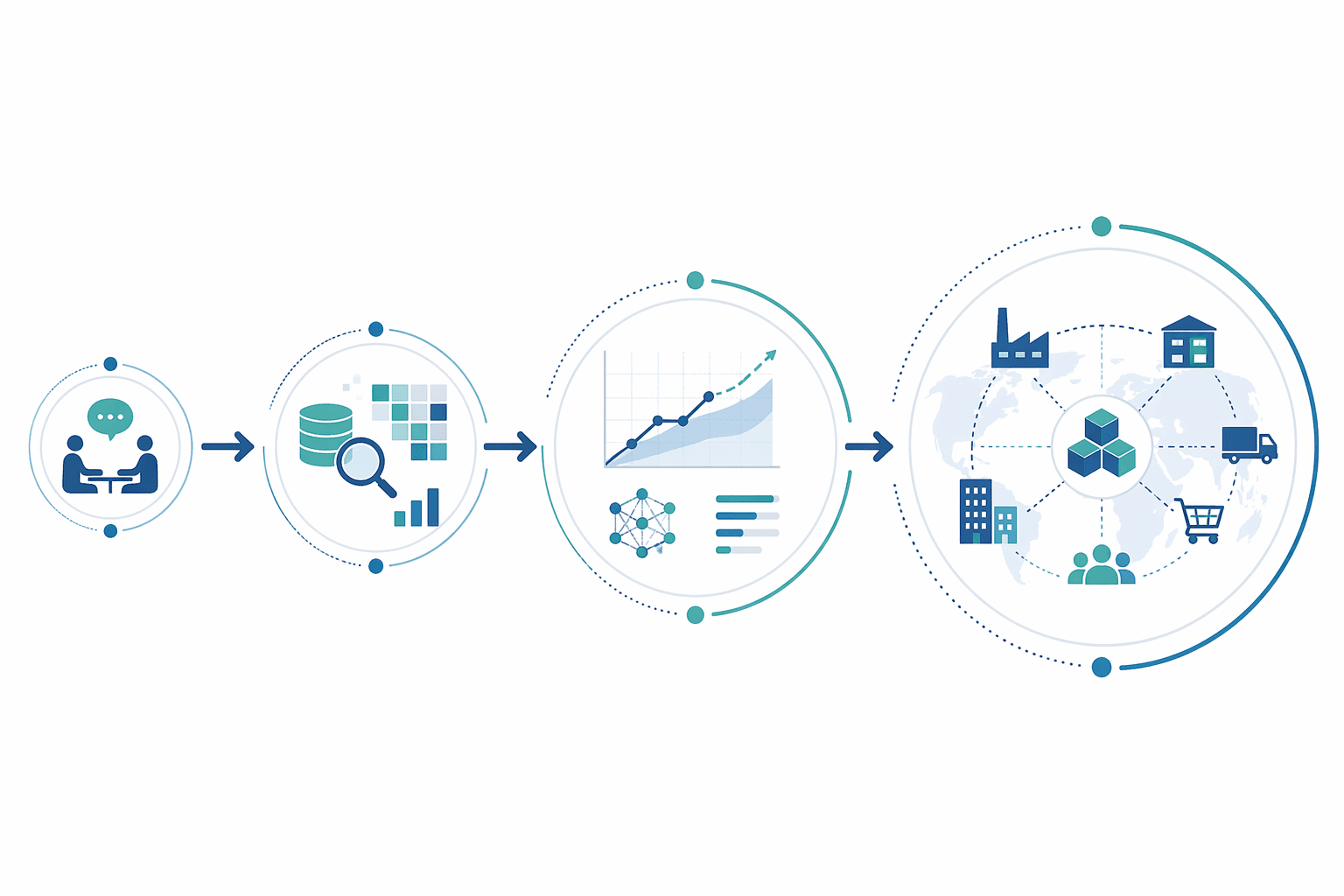
C3 AI’s published implementation sequence moves from a 2-hour briefing, to a 2–3 day assessment, to an 8–12 week trial, and then to a 3–6 month full deployment.[3] That sequence is useful less as a project plan than as a buying-process filter. Each stage should reduce uncertainty about a different part of the business case.
| Stage | What should become clearer | Why it matters for ROI |
|---|---|---|
| 2-hour briefing | Business problem, planning scope, candidate value pools | Prevents the project from being justified on generic AI interest |
| 2–3 day assessment | Data availability, system fragmentation, baseline metrics, integration gaps | Tests whether the organization can measure improvement credibly |
| 8–12 week trial | Model performance on selected SKUs, planner usability, exception workflow | Shows whether forecast lift is plausible before full rollout |
| 3–6 month deployment | Scale-up across planning scope, governance, operational adoption | Determines whether technical lift can become inventory, service, or productivity impact |
The published case timelines fit inside that broader frame, but not uniformly. The biopharma case took 26 weeks.[1] The agribusiness deployment is described as a 16-week implementation.[3][4] Those differences should not be treated as vendor inconsistency or buyer failure. They likely reflect differences in scope, data readiness, decision complexity, and the amount of change required downstream.
A buyer trying to build a credible internal plan should therefore avoid asking only, “How fast can this be implemented?” The better question is, “Which part of our forecast-to-inventory chain will be proven at each stage?” A trial that produces a promising model but never tests planner adoption, hierarchy alignment, and inventory policy implications has not de-risked the ROI case enough.
Market adoption supports urgency, not ROI proof
There is a broader market reason supply chain leaders are asking these questions now. Gartner predicted in September 2025 that 70% of large organizations will adopt AI-based supply chain forecasting by 2030.[5] That is a useful signal that AI forecasting is moving into mainstream planning technology, especially across complex enterprise environments.
It does not prove that C3 AI Demand Forecasting will deliver a specific return in a specific company. Adoption forecasts describe where the market may go; they do not validate a particular baseline, data architecture, or inventory release opportunity. For budget approval, the four deployment cases are more relevant than the adoption prediction, and the company’s own diagnostic work is more relevant still.
How to use the evidence in an internal business case
The most defensible use of these C3 AI cases is not to copy the largest number. It is to build a range that reflects the organization’s own starting point.
- Start with the current baseline forecast error by product family, channel, region, and planning level. If SME-adjusted forecasts already outperform statistical forecasts, model the incremental case against that stronger baseline.
- Separate easy-to-forecast volume from the hardest-to-forecast SKUs. The food processor case shows why the hard-SKU segment may deserve its own ROI line.
- Translate accuracy improvement into operational levers only where policy can actually change: safety stock, replenishment frequency, production schedule stability, service recovery, waste, or expedite cost.
- Put a cost and timeline around data integration. The number of ERPs, external sources, rows, calendars, and hierarchies will affect both implementation effort and confidence in the result.
- Define adoption requirements before rollout: planner review workflow, override governance, exception thresholds, and ownership of forecast-to-inventory decisions.
This is where a fit-first software evaluation matters. The same published result can be compelling for one organization and weakly transferable to another. A team evaluating C3 AI alongside other platforms should connect the case evidence to a structured AI demand planning software evaluation framework, and should use a broader AI demand forecasting ROI methodology to keep forecast metrics, inventory economics, implementation cost, and adoption risk in the same model.
Taken together, the four deployments provide credible vendor-reported evidence that C3 AI Demand Forecasting can produce enterprise-scale ROI, especially where improved forecasts can be converted into inventory reduction, planning productivity, or execution discipline. They do not support a blanket expectation that the largest published outcome will repeat. The business case should be built from the company’s own forecast error, SKU complexity, data integration readiness, and willingness to change the operating decisions that sit downstream of the forecast.
References
- Transforming Vaccine Supply Chain with Accurate Demand Forecasting — C3 AI
- Enterprise AI for Fortune 100 Food Processing Company — C3 AI
- C3 AI Demand Forecasting — C3 AI
- AI demand forecasting — Intuit
- Gartner Predicts 70% of Large Organizations Will Adopt AI-Based Supply Chain Forecasting by 2030 — Gartner, September 2025
Comments
Join the discussion with an anonymous comment.