
A wildfire does not have to burn a warehouse, close a supplier, or cross an interstate to slow freight. Smoke can do the work by itself. A lane may still look open on a fire map while visibility drops, AQI rises, drivers lose time, local congestion shifts, airport decisions tighten, and customer appointments begin to fail in places far from the flame front.
That is the practical problem behind AI supply chain wildfire smoke risk: not whether software can predict a disaster in the abstract, but whether it can warn a transportation team early enough to change a tender, a route, a mode, or a delivery commitment before the exception queue is already full.
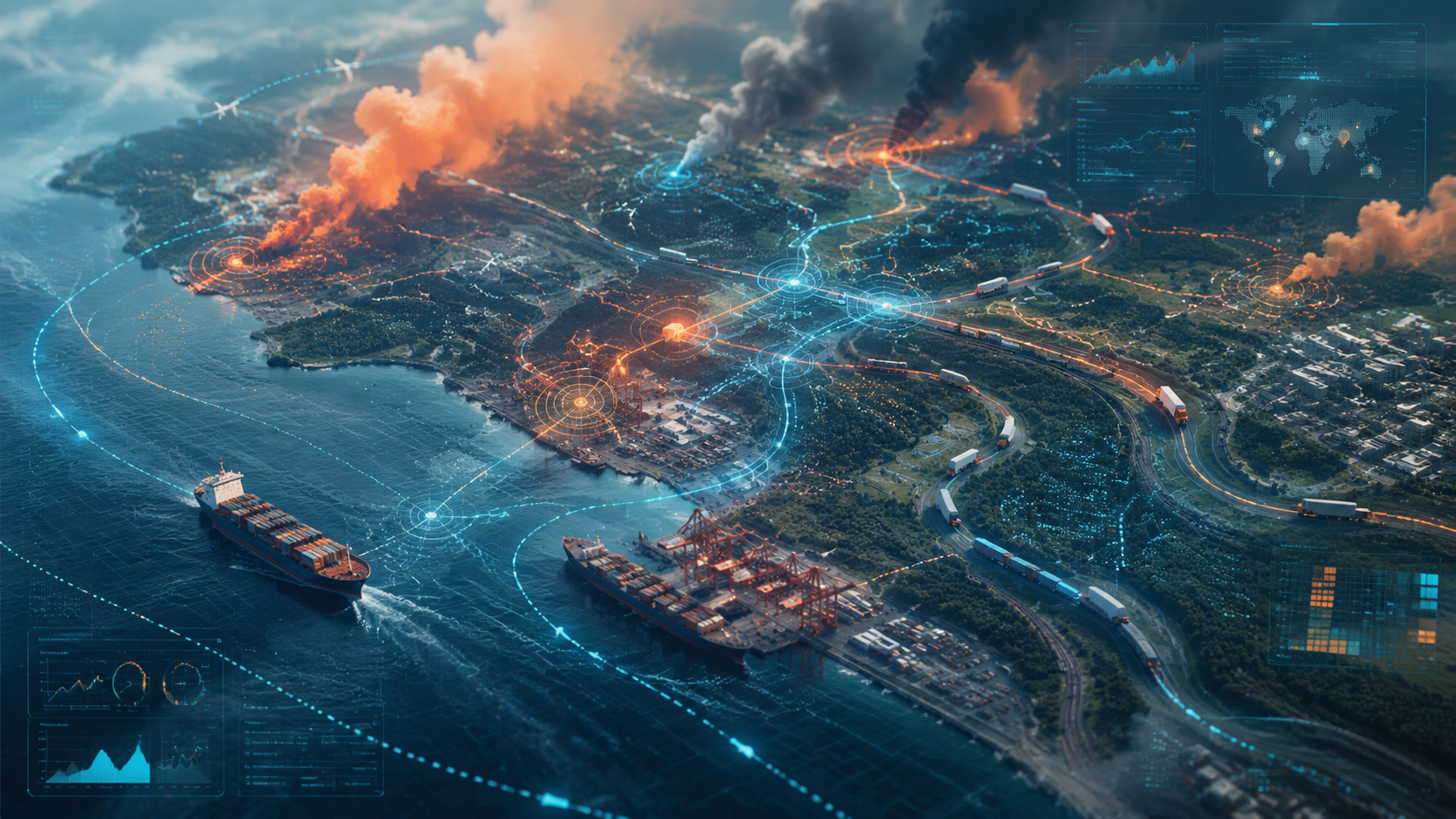
The June 2023 Canadian wildfire smoke event is the clearest operational example in the available evidence. Everstream Analytics reported that shipment volumes dropped 50-75% in affected areas during that event, with deliveries delayed up to two days in Chicago and New York City.[1] That is not a universal benchmark for every smoke episode. It is a single-event analysis. But it is enough to show why smoke belongs in lane planning, not just in environmental monitoring.
Smoke Creates A Different Logistics Failure
Fire risk usually sends supply chain teams toward familiar questions: Is a facility inside the burn area? Is a supplier down? Is a road formally closed? Smoke risk is less tidy. It can sit over a metro area, move across a corridor, degrade working conditions, and make otherwise legal routes unreliable without giving dispatchers the clean trigger of a closure notice.
The operational consequence is timing. If a team waits for a hard shutdown, it may miss the point at which risk has already moved from forecast to execution. Drivers may still be dispatched into slower corridors. Appointment windows may still be promised as if the lane were normal. Air freight may still be treated as a last-minute premium option instead of an earlier service-protection choice.
The June 2023 case matters because the disruption appeared in shipment behavior and delivery performance, not just in the environmental headline. A 50-75% volume drop in affected areas is a transportation signal. Two-day delays into major markets are customer-service signals. Neither requires a burned distribution center to become expensive.[1]
The wider economic context is serious, but it should not be asked to prove more than it can. FreightWaves and SME cited a projection that weather-related supply chain disruptions would cost the shipping industry $100 billion in 2024.[2] Stanford SIEPR, looking at U.S. labor market outcomes from 2007-2019, reported an estimated $125 billion per year in earnings losses linked to wildfire smoke exposure across sectors, including transportation and warehousing.[3] Those figures frame why smoke matters. They do not, by themselves, validate a specific routing algorithm.
What AI Adds: Lane-Level Timing
The useful AI claim is narrow: combine smoke plume forecasts, fire hotspot data, air quality readings, and active shipment data so the transportation team can see which lanes are likely to become unreliable before the shipment is already moving.
Everstream describes AI platforms that ingest NOAA HRRR-Smoke forecasts, NASA FIRMS hotspot data, real-time AQI feeds, and operational shipment data to score per-lane smoke risk up to 14 days ahead.[4] That does not mean every lane gets two clean weeks of certainty. It means the forecast window can be long enough to affect decisions that usually need lead time: carrier capacity, pickup timing, mode selection, customer communication, and appointment strategy.
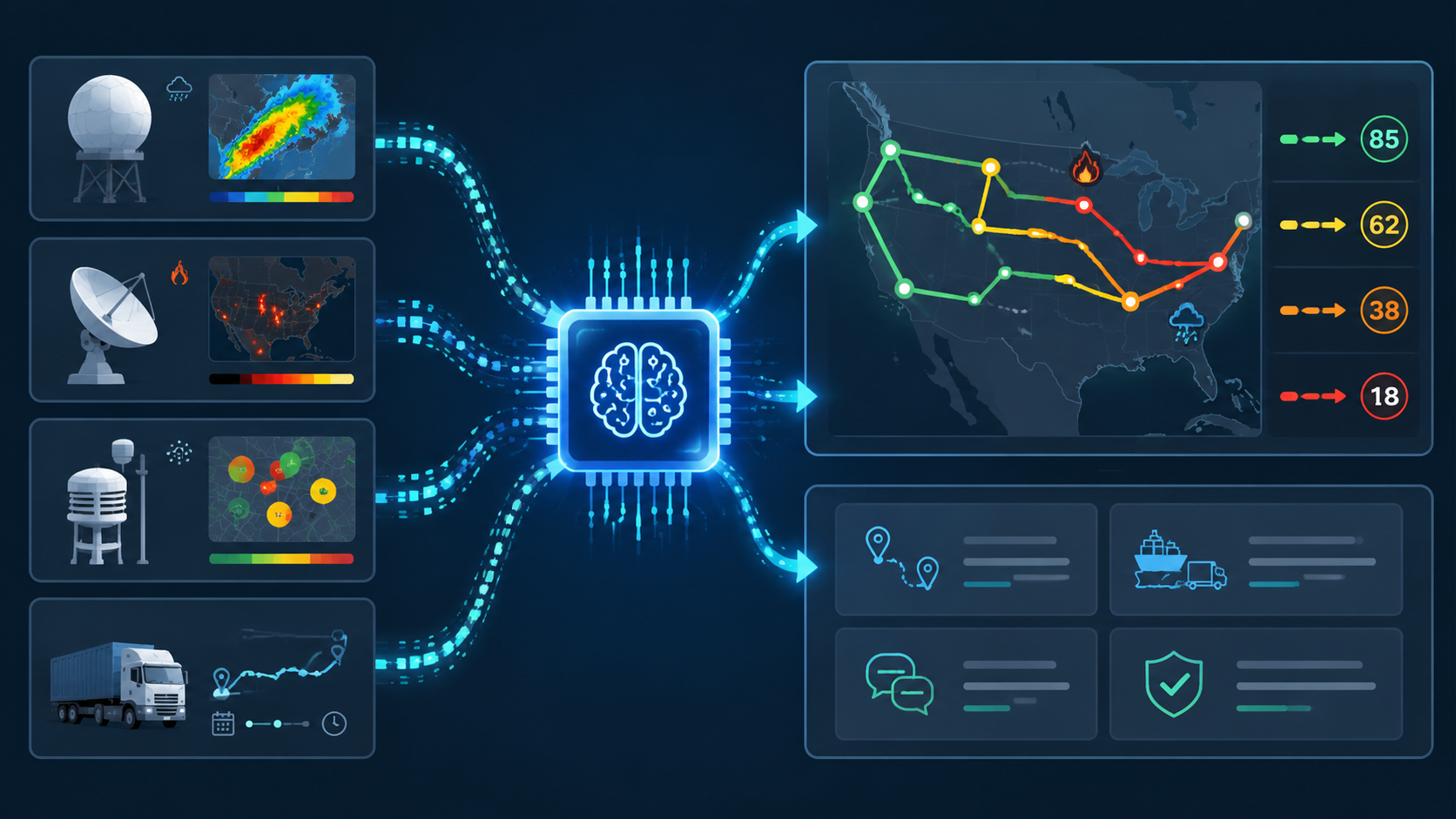
A fire map alone can tell a planner where the ignition and burn area are. A smoke-aware lane score should answer a different question: which loads are exposed to deteriorating operating conditions even though the origin, destination, and route may still be open?
| Signal | What It Helps A Logistics Team Decide |
|---|---|
| NOAA HRRR-Smoke forecast | Whether a corridor may face smoke-related visibility or air quality issues before dispatch |
| NASA FIRMS hotspot data | Whether active fire behavior is near enough to make the smoke forecast operationally relevant |
| Real-time AQI feeds | Whether conditions are worsening on the ground and need a faster control-tower response |
| Shipment and lane data | Which orders, carriers, customers, and appointments are exposed to the forecasted condition |
The shipment layer is what turns weather intelligence into supply chain action. Without it, the team has a smoke forecast. With it, the team can see that Monday's refrigerated loads into a certain metro, Tuesday's parcel linehaul, and an inbound production component all depend on the same corridor conditions.
From Forecast To Transportation Action
The workflow does not need to be dramatic. It needs to be early and specific. A smoke-risk score becomes useful when it changes work inside the transportation control tower before a load is late.
- Identify exposed lanes, not just exposed facilities.
- Rank live and planned shipments by service consequence.
- Decide whether to reroute, retime, mode-shift, or hold.
- Communicate early with carriers, sites, and customers.
- Keep the human planner in the approval loop when cost, service, and safety tradeoffs collide.
That first step is where many teams lose time. If wildfire smoke is tracked only as a regional alert, the response arrives as a broadcast: be aware, monitor conditions, expect disruption. If it is tied to lanes and shipments, the response can be narrower: these loads need earlier pickup, this corridor needs an alternate tender plan, this customer should get a revised appointment before the warehouse is waiting at the dock.
Mode shift is one of the clearer examples of what decision optionality looks like. Everstream cites a client example in which AI-supported smoke risk visibility helped shift shipments from ground to air freight on smoke-impacted lanes.[4] That should not be read as a general rule that air is always safer, cleaner, or available. Smoke can affect flight conditions too. The useful point is that earlier lane intelligence gives the team time to compare options before every alternative has become expensive or unavailable.
In practice, the decision may be less visible than a mode change. A planner may move a pickup earlier to beat a forecasted smoke window. A control-tower analyst may split volume across two carriers because one has better access to an alternate route. A customer service team may protect the highest-penalty appointment first and let a lower-risk replenishment load move later. Those are not grand AI moments. They are the kinds of small decisions that prevent a smoke event from becoming a network-wide scramble.
The Risk Score Has To Be Operational, Not Decorative
A useful smoke score should be explainable enough for dispatch and planning teams to act on it. If the score is high because AQI is deteriorating near the destination, the response may be different from a high score caused by forecasted smoke over the driving corridor. If the affected loads are low-priority stock transfers, holding may be sensible. If they are production-critical or appointment-sensitive, delay may be more expensive than rerouting.
The same applies to thresholds. A risk alert that fires only when disruption is obvious is too late. A risk alert that fires too broadly will be ignored after the first bad week. The threshold has to connect to actual operating choices: tender earlier, add transit time, change mode, avoid a corridor, protect a customer window, or accept the risk with eyes open.
Lower-Variance Routing Is A Governance Choice
The routing question is not simply whether AI finds a clever alternate path. It is whether the organization is willing to move away from the cheapest expected route when the risk-adjusted route is more reliable.
Everstream reports that a 3% shift from purely cost-efficient routing to lower-variance, risk-informed routing represents more than 70,000 shipments for leading companies.[4] That is a small percentage with a large operational footprint. It also makes the tradeoff visible. If procurement, transportation, finance, and customer service do not agree on when reliability is worth paying for, the AI recommendation will sit in a dashboard while planners continue to chase lowest cost until disruption forces a more expensive correction.
This is where governance matters more than model enthusiasm. A team can define which customers, SKUs, lanes, or appointment types justify a lower-variance route during smoke season. It can decide who approves premium freight before a formal closure. It can document when a planner is expected to act on a forecast rather than wait for proof of failure. Those rules protect the analyst who otherwise gets blamed for moving too early and blamed again for moving too late.
What The Evidence Does And Does Not Prove
The strongest evidence for the lane-risk workflow is vendor-sourced. Everstream provides both the June 2023 shipment disruption figures and the description of AI platforms combining NOAA HRRR-Smoke, NASA FIRMS, AQI, and shipment data.[1][4] That does not make the evidence useless. It does mean buyers should treat the mechanism as plausible and operationally relevant, while still asking for their own lane-level validation.
The June 2023 numbers should also stay in their lane. They show that one major wildfire smoke event coincided with severe shipment volume reductions and delivery delays in affected areas.[1] They should not be converted into a standing rule for all wildfire smoke events.
The labor and climate-cost research widens the seriousness of the issue without replacing logistics proof. Stanford's estimate of $125 billion in annual earnings losses covers the U.S. labor market broadly over 2007-2019, not only supply chain operations.[3] The same brief notes that wildfire smoke accounts for roughly 20% of PM2.5 emissions in the United States, which helps explain why smoke is not a marginal exposure problem.[3] But a logistics team still has to connect that exposure to its own routes, labor constraints, and service commitments.
There is also a difference between adoption and effectiveness. A platform may ingest the right data sources and generate a lane score. That does not prove the organization will act early, that carriers will have available capacity, or that customers will accept revised windows. The model can create decision time. It cannot guarantee that the business will use it well.
How To Use Smoke Forecasts Without Overtrusting Them
A practical smoke-risk process should start before wildfire season, not during the first bad air week. Transportation teams can mark lanes with repeated exposure, identify customers with narrow delivery tolerance, and agree on what level of forecast risk justifies a planning action. The goal is not to automate every reroute. It is to avoid debating the basic rules while smoke is already sitting over the corridor.
- Use smoke forecasts as an early decision input, not as a guaranteed disruption clock.
- Separate fire exposure from smoke exposure in lane reviews and exception reporting.
- Tie each alert to a named action: reroute, retime, mode shift, carrier escalation, or customer communication.
- Track whether early actions reduced missed appointments, detention, premium freight, and late customer notifications.
- Review false alarms and missed events after the season so thresholds improve instead of becoming background noise.
The last point is not administrative housekeeping. If planners do not see whether a risk-informed reroute avoided a delay, the next recommendation will look like another cost increase. If they do not see where the forecast overreached, they will stop trusting the alerts. Smoke-risk AI has to earn its place in the routing process through operating results, not through a convincing dashboard.
For networks exposed to wildfire seasons, smoke is becoming predictable enough to route around in many cases when forecast data is connected to live shipment decisions. The useful posture is neither panic nor blind automation. It is a disciplined control-tower process that treats smoke as a lane condition early enough for a human team to make a better transportation call.
References
- Climate Proofing Your Supply Chain, Everstream Analytics
- How AI can help combat climate-driven supply chain disruptions, SME/FreightWaves
- Wildfires reveal the large toll of air pollution on labor market outcomes, Stanford SIEPR
- Artificial Intelligence's Role in Supply Chain Risk Management, Everstream Analytics
Comments
Join the discussion with an anonymous comment.