
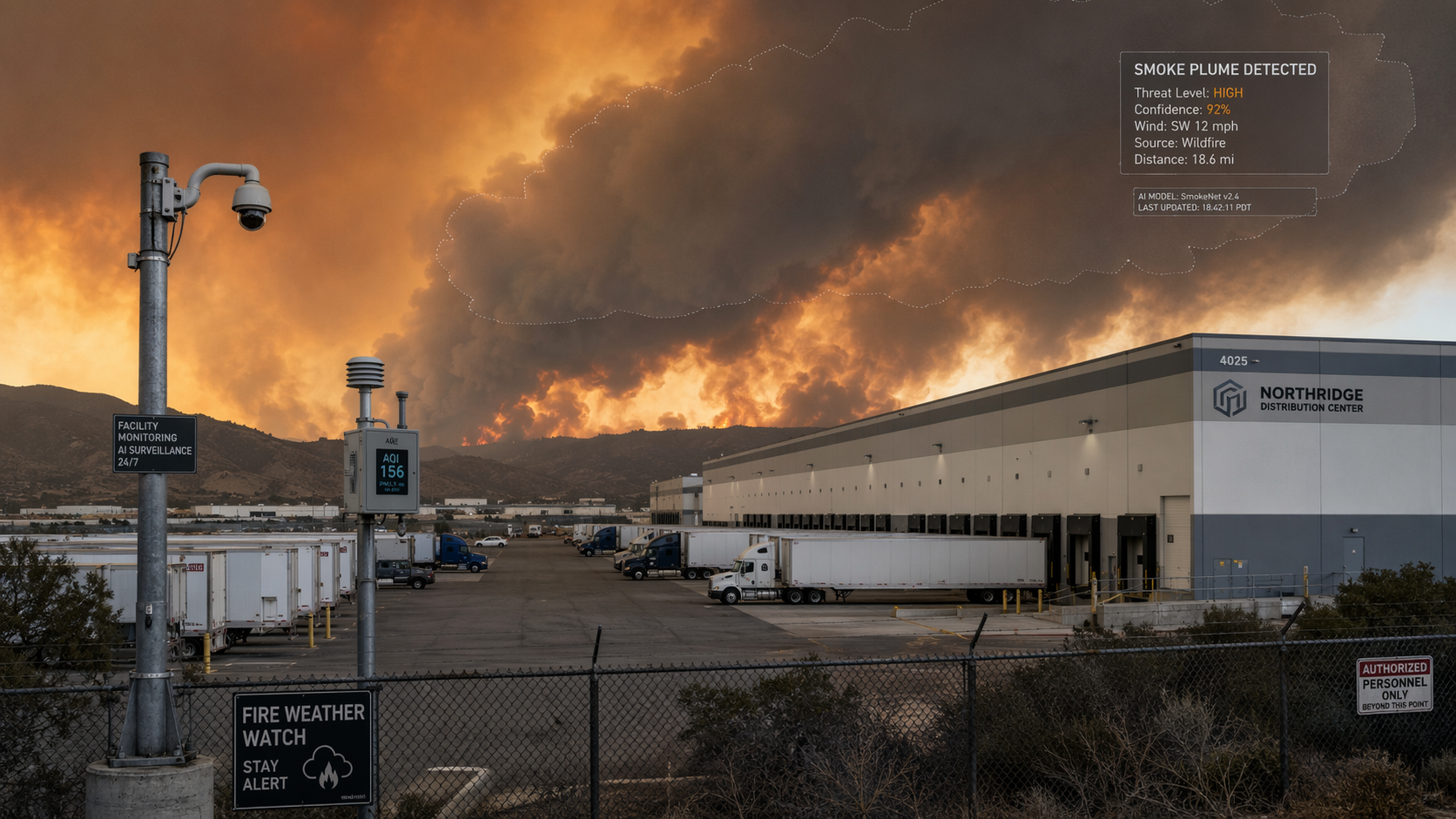
At a distribution center, wildfire smoke does not arrive as a clean line on a map. It drifts across the trailer yard, pools near dock doors, gets pulled toward makeup-air intakes, and shows up differently on opposite sides of the same building. The nearest public air monitor may be miles away. A supervisor walking the yard with a handheld meter may be too late for the first group of spotters, forklift operators, or dock workers who are already breathing the change.
That is the practical opening for AI worker-safety systems in supply chain facilities facing wildfire smoke: not a dashboard for its own sake, but a way to detect smoke earlier, verify the local air workers are actually breathing, and trigger a response before the shift turns into an after-action report. Vendor-published figures suggest the gap can be meaningful. viAct reports AI smoke detection up to 15 minutes earlier than conventional camera-based systems, 52% fewer false alarms, and automated BMS or SCADA responses within 45 seconds when integration is in place.[1] Chooch reports up to 60% fewer false alerts and 50% faster response for facility safety monitoring.[2] Those are vendor claims, not independent benchmarks, but they point to the right test: whether the system changes what happens during smoke, dust, fog, steam, welding sparks, and visual clutter on a bad shift.
The Facility-Level Failure Mode
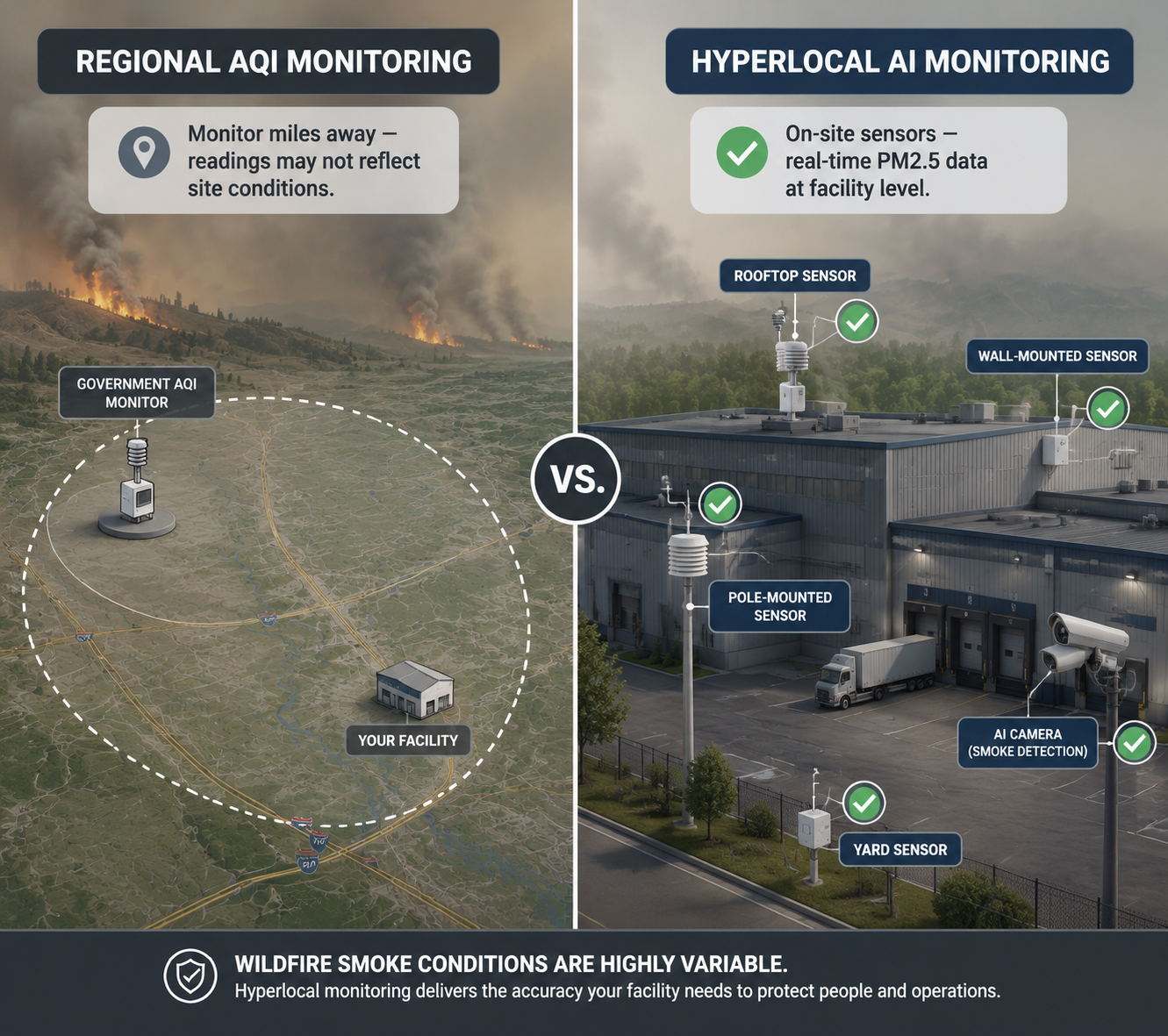
Regional AQI is useful, but it is blunt for a large warehouse campus. A monitor several miles away can miss what is happening beside a rail spur, near a truck queue, or along a wall where wind pushes smoke into dock openings. The same site can have outdoor yard workers, indoor packers, maintenance staff, and drivers moving through different exposure zones within the same hour.
Conventional visual checks have their own problem. Smoke can look like dust from traffic, fog in the morning, steam from equipment, or sparks from hot work. A standard camera may record the scene without classifying the hazard. A conventional fire alarm may wait for conditions that are too late or too localized for wildfire-smoke response. Manual spot checks help, but they are intermittent; someone must decide when to measure, where to stand, and how quickly to escalate.
The economic and safety stakes are not confined to inconvenience. Stanford SIEPR research estimated that wildfire smoke reduced U.S. annual labor earnings by $125 billion over 2007–2019, with disproportionate effects in counties with an above-median proportion of Black residents.[3] A Federal Reserve Bank of San Francisco brief reported that wildfire smoke exposure increases workplace injury claims by roughly 2.8% per additional smoke day, with heavy effects in sectors that include outdoor and warehouse workers.[4] For an EHS manager, that turns smoke from a weather event into a labor, injury, documentation, and continuity problem.
For a broader supply-chain view of wildfire disruption across routes, suppliers, carriers, and customers, see how AI predicts and mitigates wildfire supply chain disruptions. The worker-safety problem is narrower and more physical: what is happening at this gate, this dock, this intake, and this work zone right now.
How AI Smoke Detection Works When It Is More Than a Camera
The strongest use case combines three layers: computer vision, local air-quality sensors, and automated response logic. None is enough by itself. Together, they give a facility a better chance of seeing the plume, confirming the air-quality change, notifying the right people, and acting before the building continues to pull contaminated air through the wrong pathway.
| Layer | What It Watches | Why It Matters On-Site |
|---|---|---|
| AI computer vision | Smoke plume and flame signatures; visual differences from dust, fog, steam, and sparks | Can detect a developing hazard before a person reaches the yard or a conventional system escalates |
| Networked air sensors | Local PM2.5, PM10, CO, and VOC readings depending on the device | Verifies whether the air around workers and intakes is changing, not just whether smoke appears on a regional map |
| Alert escalation | Threshold breaches, location, duration, and severity | Moves the event from observation to action while preserving a record |
| BMS or SCADA integration | Ventilation, intake, suppression, and facility workflows where connected | Can shut down or adjust systems faster than manual coordination when the integration is properly designed |
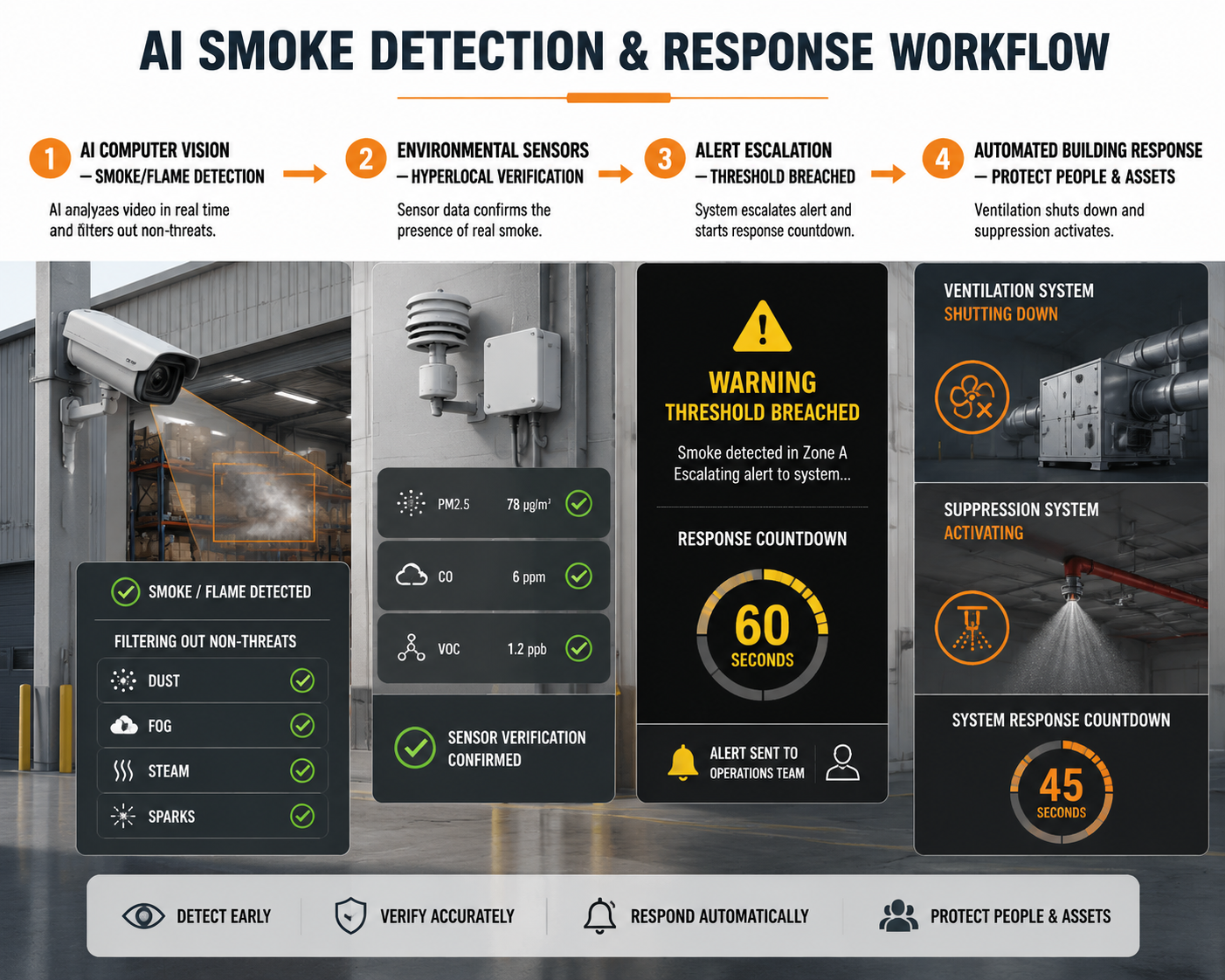
The camera layer is there to notice visible danger early. Models trained on smoke and flame signatures are meant to separate a real smoke plume from common nuisance triggers. That matters in a yard where dust follows tractors, steam vents near equipment, fog reduces contrast, and welding sparks may appear in a maintenance area. If the model treats every anomaly as fire or smoke, people learn to ignore it. If it filters too aggressively, the first useful warning disappears.
The sensor layer gives the visual alert a local air-quality check. Aethair describes continuous monitoring for PM2.5, PM10, CO, and VOCs for industrial outdoor workers in wildfire zones.[5] Aeroqual describes wildfire-smoke monitoring with automatic alerts within 60 seconds of a threshold breach and NIST-traceable calibration.[6] That type of local measurement is especially useful around dock doors, guard shacks, trailer yards, outdoor maintenance areas, and air intakes, where regional AQI may not describe the exposure workers are experiencing.
The response layer is where many safety technology projects either become real or stay decorative. If the system only adds a red icon to a screen that nobody watches during peak dispatch, it has not solved much. If the alert routes to operations and EHS, timestamps the location, shows the sensor trend, and triggers a defined ventilation or PPE workflow, then the site has something defensible. viAct reports that, when connected to BMS or SCADA, AI alerts can trigger ventilation shutdowns and suppression workflows within 45 seconds.[1] The important phrase is “when connected.” Without that integration, the 45-second claim does not belong in the operating plan.
What Earlier Detection Changes on a Bad Shift
Ten or 15 minutes is not much in a conference room. In a yard, it can be the difference between continuing normal trailer moves and holding outdoor work while supervisors check readings, distribute respirators, close dock doors, or change ventilation settings. Earlier detection is not valuable because it sounds impressive; it is valuable because the first response steps are slow when they depend on human observation alone.
A workable sequence is usually plain:
- A camera flags a developing smoke or flame signature in a defined zone.
- Nearby PM2.5, CO, or VOC sensors show whether local air conditions are moving past the site’s thresholds.
- The alert identifies location, source confidence, sensor readings, and time of threshold breach.
- Operations, EHS, security, or maintenance receive the escalation according to role.
- Connected systems adjust ventilation, close intakes, trigger suppression workflows, or move the event into the incident-management process.
That sequence also helps with nuisance alarms. A visual smoke-like event that does not coincide with a sensor change may need review, not a full facility response. A PM2.5 spike without a clear camera event may point to a local air-quality issue, a sensor placement problem, or smoke entering from a direction cameras do not cover. The value is not that the system never makes mistakes; it is that it gives the shift team more evidence before choosing the response.
False Alarms Are a Worker-Safety Issue
False alarms are often discussed as a convenience problem. In a distribution center, they are a trust problem. If every dust cloud from a yard truck generates a smoke warning, the next alert competes with production pressure, radio traffic, late loads, and the memory of the last five nuisance alarms.
That is why the vendor-reported reductions deserve attention, with the pencil mark left beside them. viAct reports 52% fewer false alarms for its AI fire, smoke, and wildfire detection system, while Chooch reports up to 60% fewer false alerts for facility safety monitoring.[1][2] Those figures should not be treated as universal results for every yard. They depend on camera angle, lighting, dust conditions, steam sources, weather, maintenance activities, model tuning, and how the site defines a false alarm.
The deployment question is therefore specific: can the system distinguish the site’s normal visual clutter from the abnormal event that requires action? A cross-dock with constant tractor movement is not the same as a refrigerated warehouse with visible vapor near doors. A facility with welding or repair work near the yard has a different nuisance profile from a parcel hub. A model that performs well in one scene can still need calibration before it is trusted in another.
Where Sensors Go Matters as Much as Which Sensor You Buy
Hyperlocal monitoring earns its name only when the sensor network reflects the geometry and airflow of the site. A single sensor at the front office may document the wrong reality for workers at the far dock line. A unit mounted too close to an exhaust source may overstate general exposure. A unit protected from the wind may miss the condition that workers face in the yard.
A practical placement plan should start with work zones and air pathways:
- Yard positions where spotters, hostlers, drivers, and security staff spend time.
- Dock doors and staging areas where outdoor air moves into indoor workspaces.
- HVAC and makeup-air intakes that can pull smoke into the building.
- Break areas, guard shacks, maintenance zones, and other occupied pockets outside the main warehouse floor.
- Upwind and downwind sides of large buildings, because the building itself changes airflow.
Calibration belongs in the same conversation. Aeroqual’s wildfire-smoke materials refer to NIST-traceable calibration and alerts within 60 seconds of a threshold breach.[6] That supports a stronger monitoring program than informal spot checks, but it still leaves operational work for the facility: maintaining devices, verifying readings, setting threshold logic, documenting calibration practices, and deciding what happens when one sensor disagrees with another.
Camera coverage has similar limits. A camera that sees a wide yard may not see around trailers, rooflines, stacked pallets, or temporary equipment. A camera aimed at the horizon may catch distant smoke but miss smoke pooling near an intake. A camera aimed too low may be excellent for a dock lane and poor for the plume above it. The coverage plan should be built from actual smoke-entry risks and worker locations, not from the easiest mounting points.
Compliance Needs Continuous Local Evidence
The regulatory pressure is practical. Cal/OSHA Section 5141.1 requires PM2.5 AQI monitoring when AQI is at or above 151, though employers should verify current enforcement status because the rule has been handled through emergency regulation extensions.[7] Oregon OSHA’s permanent wildfire-smoke rules became effective in July 2022, and AQI 201 triggers mandatory respirator use under those rules.[8] Washington L&I permanent rules became effective in January 2024 and require a written wildfire smoke response plan and training.[9]
For a warehouse or distribution center, continuous local readings can support the decisions regulators and workers will care about later: when the site identified the hazard, which work zones were affected, whether respiratory protection decisions matched measured conditions, whether ventilation changes were made, who received alerts, and what training or response plan governed the action. Manual spot-checking may still have a place, but it rarely produces the same time-stamped trail across multiple work zones.
This is also where AI smoke detection should be kept in its lane. A camera alert is not a compliance program. A sensor reading is not a respirator program. A dashboard is not worker training. The system becomes useful for compliance when it feeds the procedures EHS already has to defend: monitoring, escalation, PPE, ventilation, recordkeeping, and post-event review.
The Tradeoffs to Settle Before Procurement
The published materials support the broad technical direction, but they do not settle several buying and implementation questions. Cost, edge-versus-cloud processing, network resilience, detailed camera coverage planning, and long-term maintenance burden are not well covered in the available sources. Those gaps should not stop a pilot, but they should shape it.
A defensible pilot should answer questions that a demo video cannot:
- Which nuisance sources caused false alarms during normal operations?
- Which work zones had sensor readings that differed from the nearest public AQI monitor?
- How quickly did alerts reach the people who could act?
- Which BMS, SCADA, or facility-response steps happened automatically, and which still depended on manual approval?
- What records were created without extra work from supervisors?
- Who owns calibration, device maintenance, model tuning, and periodic review after installation?
Edge processing may be attractive where connectivity is unreliable or where the facility wants faster local decision-making. Cloud processing may simplify model updates and centralized oversight. The available sources do not provide enough evidence to declare one superior for wildfire-smoke worker safety, so the right question is operational: which architecture still detects, alerts, records, and triggers the response when the yard is smoky, the network is busy, and the shift lead is handling three other problems?
How to Judge Whether the System Is Working
The most useful scorecard is not the thickest analytics screen. It is whether the technology improves detection, trust, response, records, and fit.
| Test | What Good Looks Like |
|---|---|
| Earlier detection | The system identifies smoke or local air-quality deterioration before manual checks or conventional systems would have escalated. |
| Lower nuisance burden | Dust, fog, steam, sparks, and ordinary yard activity do not train workers to ignore alerts. |
| Actionable escalation | Alerts identify location, severity, sensor evidence, and the person or system expected to respond. |
| Building response | Ventilation, intake, suppression, or other workflows are connected where automation is safe and approved. |
| Audit trail | Readings, alerts, acknowledgments, and response actions are time-stamped and retrievable. |
| Site fit | Sensor placement, camera angles, calibration, and model tuning reflect the actual facility layout and airflow. |
That scorecard also keeps vendor claims in proportion. A reported 10–15 minute detection improvement, more than 50% fewer false alarms, 60-second threshold alerts, or 45-second automated response can be valuable. The facility still has to prove which of those numbers survive its own dust, weather, equipment, traffic, network, and response rules.
AI smoke detection and sensor networks can materially improve wildfire-smoke response in supply chain facilities. They do it best when cameras, PM2.5/CO/VOC sensors, alert escalation, BMS or SCADA workflows, and EHS records are designed as one operating system. Treated as a standalone alert tool, the technology is easy to overstate. Calibrated to the site and tied to real response procedures, it gives workers and managers a better chance of acting before smoke has already written the shift.
References
- Fire, Smoke & Wildfire Detection, viAct.
- Facility Safety Monitoring, Chooch.
- Wildfires Reveal Large Toll of Air Pollution on Labor Market Outcomes, Stanford SIEPR.
- Disruptions from Wildfire Smoke, Federal Reserve Bank of San Francisco, November 2022.
- Wildfires, Aethair.
- Wildfire Smoke Monitoring, Aeroqual.
- Cal/OSHA Wildfire Smoke Regulation, Aeroqual.
- Wildfire Smoke Rules, Oregon OSHA.
- Wildfire smoke, Washington State Department of Labor & Industries.
Comments
Join the discussion with an anonymous comment.