
Wildfire smoke is already a finance problem before it becomes a dramatic logistics story. Stanford SIEPR estimated that smoke exposure reduced U.S. earnings by about $125 billion per year, with the study covering 2007–2019; it also found labor-market costs exceeded mortality costs by 3–15 times.[1] That is not a 2026 trucking P&L model, and it should not be treated like one. But it is the right place to start because logistics is unusually exposed to the mechanics behind that number: people work fewer productive hours, freight nodes slow down, drivers face degraded conditions, and managers buy higher-cost substitutions when normal plans stop holding.
The case for AI for logistics risk management from wildfire smoke is therefore not that software can tame fire season. The case is narrower and more useful: smoke creates recurring delay, labor, throughput, mode, and customer-service costs, and logistics teams need more lead time before those costs move from manageable to expensive.
The Smoke Cost Stack Is Bigger Than a Delayed Truck
A wildfire that never touches a warehouse can still damage the freight plan. Smoke changes who can work safely, how quickly cargo can be handled, whether aircraft can move as scheduled, how confidently drivers can operate, and how many backup options remain available once every shipper in the same corridor starts calling carriers.
The January 2025 Los Angeles wildfire period shows the shape of the logistics bill. FreightAmigo reported average trucking delays of 3–5 days, smoke-related air freight restrictions, and 15–25% increases in logistics expenses during the disruption.[2] Those figures come from a logistics platform’s own analysis, not an independent post-event audit, so they should be read as directional evidence. Directional is still enough to matter when the exposure is a high-volume import gateway, not a remote spur road.
The same pattern appeared outside California. Xeneta reported that during the 2023 Canadian wildfires, smoke-reduced visibility caused shipments in affected areas to fall by as much as 75%, while prolonged smoke added up to two days of delivery delays.[3] That “up to” matters. It is not a claim that every affected market lost three-quarters of its shipment volume. It is a warning that smoke can collapse usable freight activity in the wrong place at the wrong time.
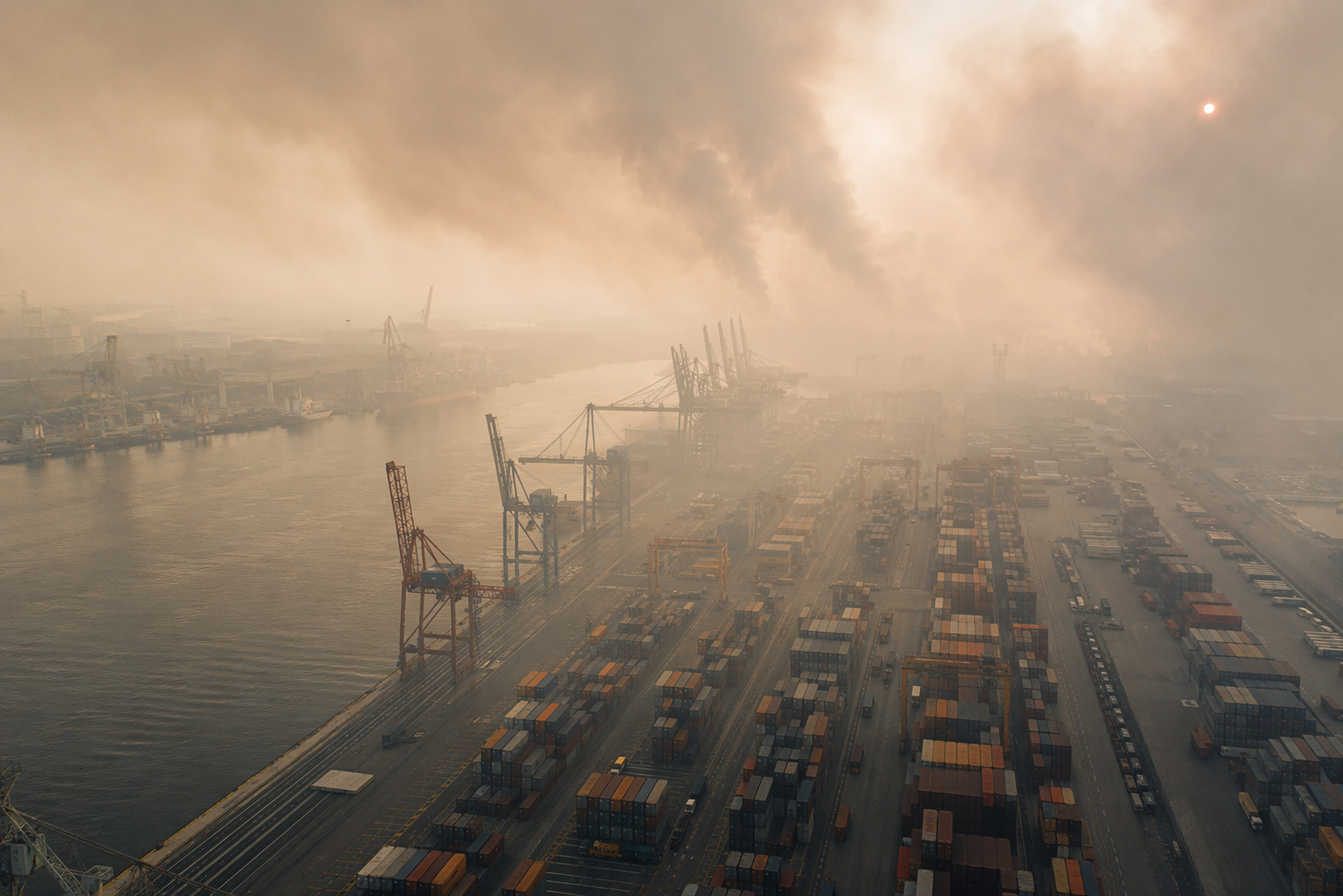
Ports make the cost stack less abstract. Profreight reported that the Ports of Los Angeles and Long Beach, which handle about 40% of U.S. imports, faced reduced visibility that slowed cargo handling, increased container dwell times, and worker shortages linked to poor air quality during the January 2025 wildfire disruption.[4] A port slowdown does not stay at the port. It becomes appointment churn, detention exposure, missed cross-dock windows, reworked drayage plans, and customer-service teams explaining why a shipment that technically arrived is still not moving.
| Cost layer | What smoke changes | Evidence boundary |
|---|---|---|
| Labor productivity | Fewer productive work hours and higher earnings losses from smoke exposure | Stanford SIEPR estimate covers 2007–2019, not a current logistics-only P&L |
| Truck lead time | Average delays of 3–5 days during the January 2025 LA wildfire disruption | FreightAmigo analysis; useful signal, not independently audited |
| Freight expense | Logistics expenses increased 15–25% during the same disruption | FreightAmigo analysis; not a universal benchmark |
| Shipment volume | Affected-area shipments fell by up to 75% during the 2023 Canadian wildfires | Xeneta reporting; “up to” limits the general claim |
| Port throughput | Reduced visibility, dwell-time increases, and worker shortages at LA/LB | Profreight reporting on a major import gateway |
This is why smoke deserves its own line in logistics risk management. A generic weather dashboard may tell a team that fire conditions are bad. A finance-ready smoke-risk view has to show which lanes, labor pools, ports, warehouses, carriers, and customer commitments are becoming expensive before the invoice trail proves it.
Where AI Changes the Operating Rhythm
The useful promise of AI here is not perfect prediction. It is earlier narrowing. Dispatch does not need a philosophical answer about climate volatility at 6 a.m.; it needs to know which loads are likely to miss pickup windows, which drivers may face unsafe or slow corridors, which port appointments are exposed, and which customers should hear from the company before they hear from the carrier.
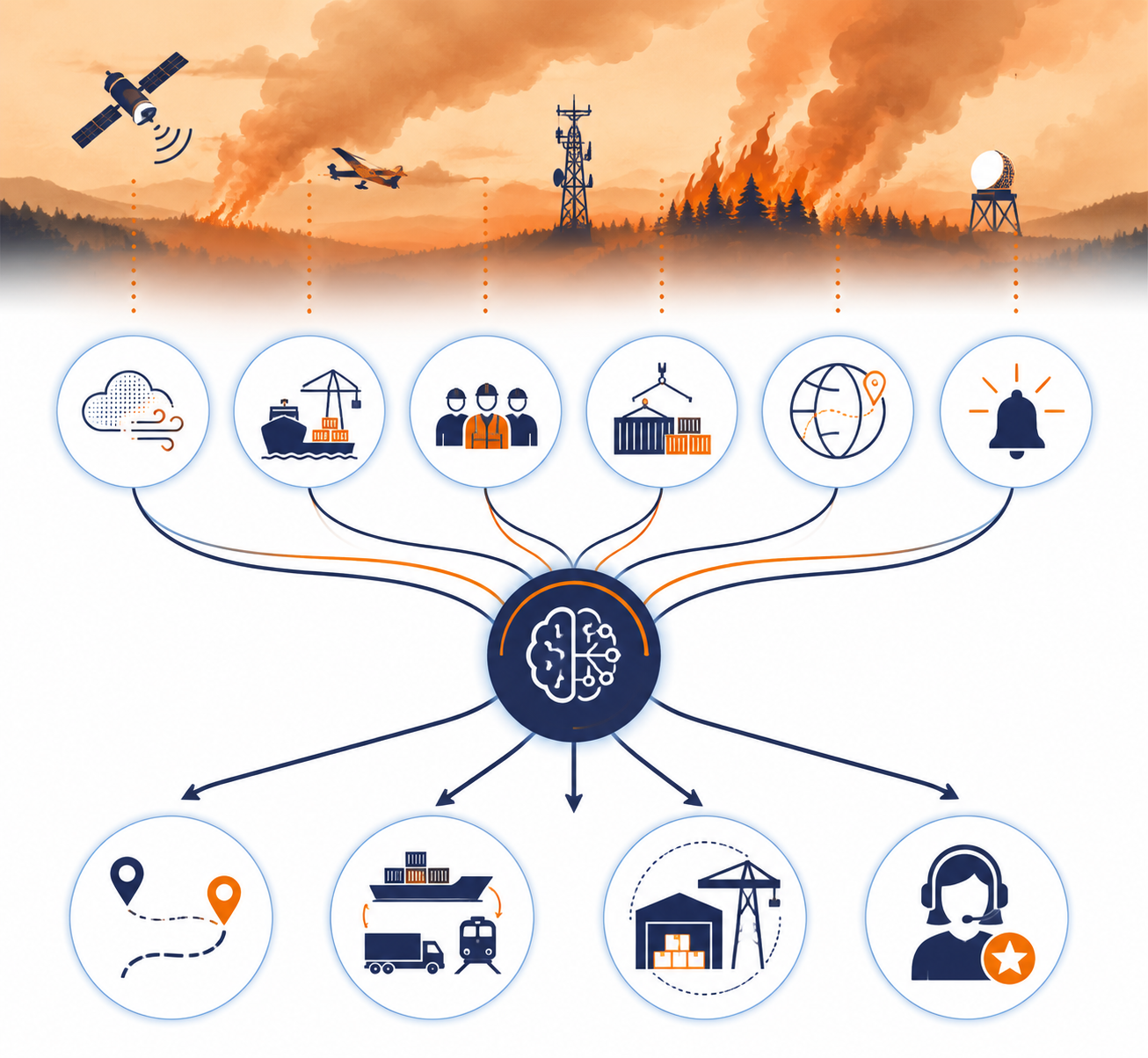
A smoke-risk intelligence platform earns attention when it connects signals that usually sit in separate workflows: air quality forecasts, wildfire perimeters, port visibility, worker availability, carrier capacity, shipment exposure, and promised delivery dates. The operational difference is timing. A two-day lead can be enough to pre-book alternate capacity, shift volume away from a vulnerable node, re-sequence appointments, or tell sales that a premium customer order needs a different service plan.
Everstream Analytics describes a platform model that maps supply networks, monitors risks, and alerts subscribers ahead of disruptive events; it also identifies extreme weather as a top-three supply chain risk for 2026.[5] Platforms such as Everstream, project44, and FourKites sit in the broader risk visibility and logistics intelligence category. Their value, for this specific use case, depends less on a polished risk score and more on whether smoke alerts can be turned into transportation and labor decisions before capacity reprices.
FreightAmigo’s wildfire examples illustrate the kind of decision window operators are buying, while still needing the usual caution around vendor-reported cases. The company described a California importer saving 48 hours through AI-assisted alternate routing during the Palisades Fire, an electronics firm diverting via Phoenix to avoid $200,000 in losses, and a food distributor using rail backups to maintain 95% on-time delivery.[2] Those are not audited benchmarks for every shipper. They are plausible examples of what changes when the team sees the exposure soon enough to act.
The Decisions Worth Automating Around
The practical workflow is not complicated, but it has to reach the people who spend money under pressure.
- Transportation identifies exposed lanes and determines whether to hold, reroute, advance, consolidate, or split shipments.
- Procurement checks alternate carrier capacity before spot markets absorb everyone else’s panic.
- Warehouse and port teams adjust labor plans, appointment sequencing, and yard priorities when smoke threatens safe or efficient work.
- Customer service ranks orders by contractual exposure, customer value, perishability, and recovery difficulty.
- Finance compares the cost of early substitutions with the likely cost of delay days, dwell time, chargebacks, premium freight, and lost service performance.
That last step is where many smoke disruptions are underpriced. If the organization only reviews wildfire cost after transportation has already bought emergency capacity, the analysis will usually treat the event as exceptional. After enough seasons, “exceptional” becomes a budget pattern with poor documentation.
For teams still framing wildfire disruption as a broader planning problem, AI wildfire supply chain disruption analysis can provide the wider operational context. Smoke, however, should not be buried inside the fire perimeter. It has its own cost channels and its own timing problem.
The ROI Case Is About Avoided Improvisation
A universal payback calculation would be false precision. A regional parcel network, an import-heavy retailer, a food distributor, and an industrial manufacturer will not have the same exposure, shipment criticality, carrier contracts, or labor constraints. The investment case still has a defensible structure: compare annual platform and integration cost with the organization’s avoidable smoke-driven losses across delay, premium freight, labor disruption, missed service commitments, and emergency management time.
The threshold does not have to be heroic. If one smoke event produces 3–5 days of trucking delay and a 15–25% logistics expense increase on affected freight, a platform only needs to prevent, shorten, or cheapen a portion of the response to become relevant to finance.[2] If an affected area can see shipment volume fall by up to 75%, the question is not whether the model predicts every plume correctly; it is whether the business can identify the exposed demand, capacity, and customer commitments early enough to avoid treating all shipments equally.[3]
For labor-intensive networks, the Stanford finding is especially hard to ignore. Smoke’s large earnings toll is evidence that air pollution affects work itself, not merely commute comfort or public health in the abstract.[1] Logistics leaders evaluating worker-safety exposure can pair the finance view here with AI worker-safety wildfire smoke planning, because labor availability and safety constraints often become transportation constraints a few hours later.
A useful internal ROI model should separate costs the platform can influence from costs it can only report. It can influence early carrier booking, alternate routing, customer prioritization, mode substitution, labor contingency planning, and appointment sequencing. It cannot eliminate smoke, guarantee port throughput, or create unlimited capacity in a regional disruption.
| Budget question | Finance-ready way to test it |
|---|---|
| How often are key lanes exposed? | Map historical smoke events against shipment lanes, DCs, ports, and customer concentrations. |
| What does one bad event cost? | Estimate delay days, premium freight, dwell, labor disruption, missed service credits, and management overtime. |
| Which costs are avoidable? | Classify each cost as preventable, reducible, transferable, or unavoidable. |
| Who acts on the alert? | Assign decisions to dispatch, procurement, site operations, customer service, and finance before the event. |
| What counts as success? | Track avoided premium freight, earlier rebooking, fewer missed appointments, fewer unplanned escalations, and protected priority shipments. |
Do Not Buy a Black Box and Call It Resilience
Smoke forecasting is a difficult modeling problem, and procurement teams should be skeptical of any pitch that makes “AI visibility” sound like a substitute for operational judgment. PreventionWeb summarized research indicating that combined machine-learning and chemical transport models can predict smoke-driven air quality degradation with more than 90% accuracy, while machine-learning-only approaches may be unreliable during extreme fire events outside their training distribution.[6]
That caveat should change the buying process. A logistics operator should ask what data the model uses, whether it combines physical atmospheric modeling with machine learning, how it handles outlier events, how alerts explain their confidence, and when a human escalation path overrides automation. The goal is not to reject AI. It is to avoid paying for a risk score that looks precise until the event that matters most is precisely the one the model has not learned well.
Market growth is supporting evidence, not a reason to sign a purchase order. Dataintelo valued the Wildfire Risk AI Platform market at $2.8 billion in 2025 and projected it to reach $9.4 billion by 2034, a 14.2% CAGR.[7] That signals institutional attention. It does not validate any one vendor’s platform, forecast accuracy, or logistics-specific ROI.
The better procurement test is operational. Can the platform show exposed lanes before dispatch is out of options? Can it connect smoke risk to port, warehouse, carrier, and customer data? Can it tell procurement which backup capacity matters first? Can it document decisions well enough that finance can compare the cost of early action with the cost of waiting?
The Finance Comparison That Matters
For logistics networks with meaningful exposure to wildfire-prone regions, the relevant comparison is not platform cost versus perfect prediction. It is platform cost versus repeated delay days, 15–25% expense spikes, shipment drops, port dwell, labor disruption, customer escalations, and emergency freight decisions made after the cheap options are gone.[2][3][4]
Smoke will still produce losses. The question for a supply chain CFO is how many of those losses remain unavoidable after the organization can see the exposed freight, labor, capacity, and customer commitments earlier. That is the practical investment case for AI-driven smoke risk intelligence: not certainty, but more usable hours before the invoice arrives.
References
- Wildfires Reveal Large Toll of Air Pollution on Labor Market Outcomes, Stanford SIEPR, Dec. 2022
- Navigating Supply Chain Disruptions: How FreightAmigo Helps Businesses Overcome Logistics Challenges Amid Los Angeles Wildfires, FreightAmigo, July 2025
- The Biggest Global Supply Chain Risks of 2025, Xeneta, March 2025
- Wildfires Disrupt Los Angeles Ports: A Freight Forwarding Nightmare, Profreight, Jan. 2025
- Climate Change Is Accelerating Supply Chain Disruption, Everstream Analytics, 2025–2026
- AI Can Help Forecast Air Quality, but Freak Events Like 2023’s Summer Wildfire Smoke Require Traditional Models, PreventionWeb
- Wildfire Risk AI Platform Market, Dataintelo
Comments
Join the discussion with an anonymous comment.