
For warehouse teams, AI-enabled wildfire smoke safety starts with an uncomfortable gap: the federal workplace dust limit most people remember is not the number that usually drives wildfire smoke decisions at the dock door. OSHA’s respirable nuisance dust permissible exposure limit is 5,000 µg/m³, while EPA’s tightened annual PM2.5 standard is 9 µg/m³, a roughly 550x difference that explains why relying on the federal dust limit alone can leave a warehouse program looking technically orderly and operationally thin.[1]
That does not mean every warehouse is legally required to buy AI air quality monitoring. It means the serious decision has moved closer to the facility: state wildfire smoke rules, building ventilation, open doors, yard work, dock activity, and the quality of the response record now matter more than a generic statement that the company is “OSHA compliant.”
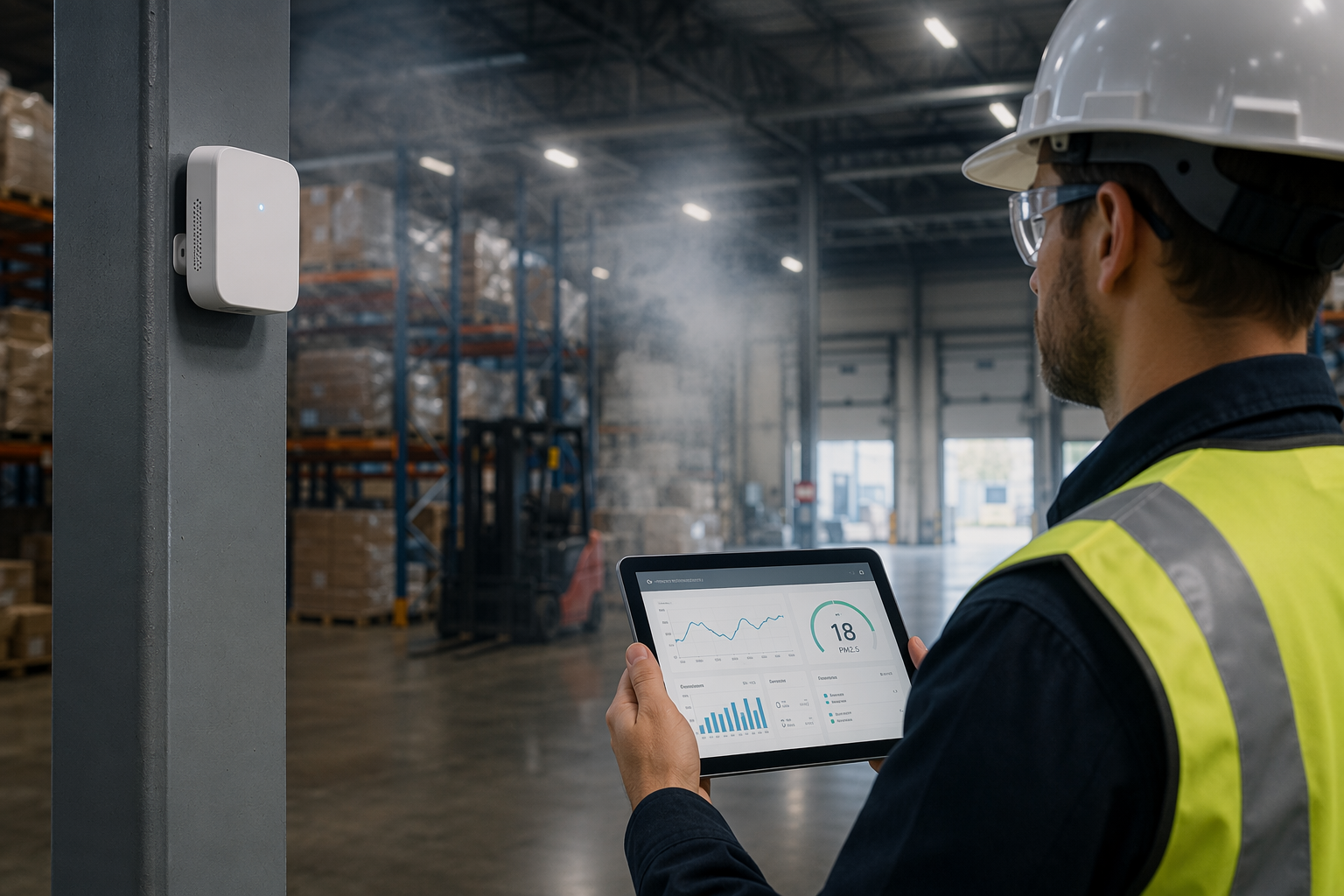
The Trigger Is PM2.5 Exposure, Not the Word “AI”
California’s wildfire smoke rule is the cleanest place to see the practical issue. Title 8, Section 5141.1 applies when employees may be exposed to wildfire smoke and the current AQI for PM2.5 is 151 or greater, with coverage extending to indoor workplaces where air is not filtered or where doors, windows, bays, or other openings are kept open.[2]
For a distribution center, that language matters. A warehouse with roll-up doors open for live loading is not the same exposure environment as a sealed, mechanically ventilated building. A mezzanine above a hazy dock is not the same as a filtered office. A yard hostler, a driver waiting at an open bay, and a picker deep in the rack may all be inside the same site boundary, but they are not necessarily breathing the same air.
Section 5141.1 also contains an important carve-out: enclosed buildings or structures with filtered mechanical ventilation are exempt when windows, doors, bays, and other openings are kept closed, except as needed to enter or exit.[2] That exception should not be treated as fine print. It changes whether continuous monitoring is a regulatory necessity, a prudent operational control, or a discretionary enhancement.
Washington and Oregon have also moved wildfire smoke into state-level worker protection territory, so multi-state operators should not treat California as an isolated compliance curiosity. The useful question is narrower than “Do we need AI?” It is: when AQI PM2.5 reaches the action range, can this facility identify exposed workers, verify indoor conditions by zone, trigger the required response, and document why work continued, changed, or stopped?
Where Continuous Monitoring Becomes Defensible
A supervisor can check a public AQI website during a smoke event. That may be enough for a small, sealed facility with stable mechanical ventilation and no exposed yard or dock work. It becomes much less convincing in a warehouse where the building breathes through doors, truck traffic, forklift movement, pressure changes, and shifting wind.
The defensible use case for AI-driven monitoring is not that the software is clever. It is that wireless sensors can continuously watch PM2.5, and often PM1, CO, and VOCs, across the places where exposure actually changes. Trend analysis then gives EHS and operations a time-stamped record: when the rise started, which zone was affected first, which alert fired, who acknowledged it, and what control was applied.
| Facility question | Why it matters for wildfire smoke |
|---|---|
| Are doors, docks, bays, or windows open during work? | Openings can remove the sealed-building argument and create zone-specific exposure. |
| Is mechanical ventilation filtered and operating as intended? | Filtered ventilation is central to the California enclosed-building exemption. |
| Do workers spend time in semi-enclosed or outdoor-adjacent areas? | Dock, yard, and driver interactions can remain covered even when office spaces are protected. |
| Can the site prove what happened at AQI PM2.5 151 or higher? | A written plan without time-stamped exposure and response data can be hard to defend after complaints. |
| Does anyone own the alert response? | Monitoring that nobody acts on becomes noise, not a control. |
This is also where AI-driven weather safety protocols for warehouses connect naturally with smoke programs. Heat, cold, and smoke are different hazards, but the operational pattern is similar: define the trigger, map the exposed zones, assign the response, and preserve the record.
A Warehouse Deployment Has to Follow the Air, Not the Org Chart
The common mistake is to place a single monitor where it is easy to mount, then let headquarters describe the building as “monitored.” That may satisfy a dashboard demo. It does not describe worker exposure in a warehouse with dock doors on one side, charging operations in another corner, vertical stratification near a mezzanine, and powered equipment moving through aisles.
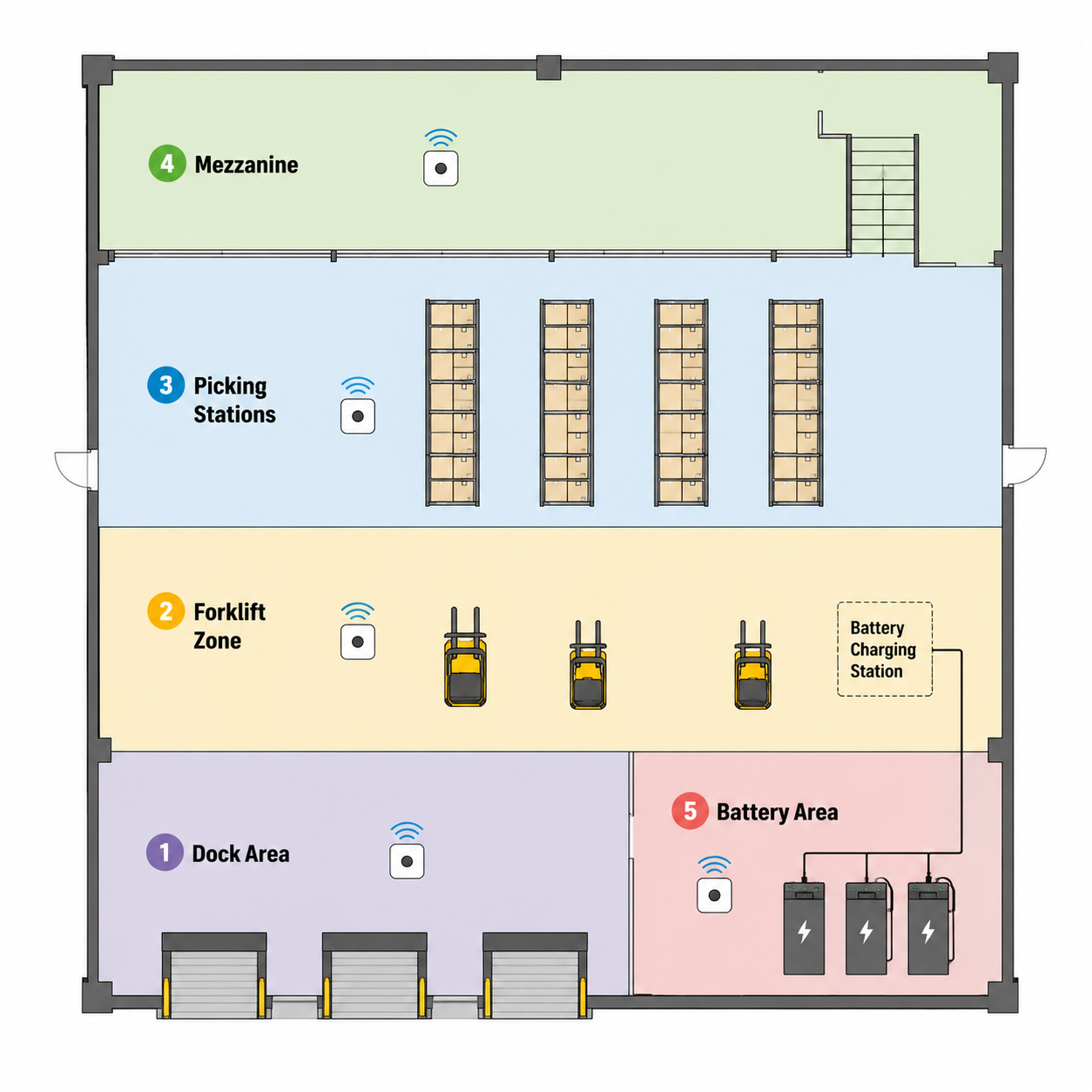
Published warehouse monitoring guidance from Envigilance identifies five critical placement areas: docks, forklift zones, picking stations, mezzanines, and battery areas. The same guidance says wireless systems can be deployed within 24 hours and puts comprehensive warehouse coverage at about $400–800 per month.[3]
Those five zones are a useful starting map, not a substitute for walking the floor. Docks need attention because doors stay open, trucks idle nearby, and smoke can be pulled inward by pressure differences. Forklift zones matter because workers are moving through changing air pockets instead of staying beside one fixed monitor. Picking stations deserve their own read because exposure time can be long even when concentrations are only moderately elevated. Mezzanines can behave differently from the floor. Battery areas already have ventilation concerns, so adding particulate and gas context may prevent one alarm stream from being mistaken for another.
The Minimum Practical Flow
- Confirm whether the site is covered under applicable state wildfire smoke rules, including any enclosed-building and filtered-ventilation exceptions.
- Map workers by exposure zone, not by department name.
- Place sensors where air enters, where people remain, and where equipment or elevation can change local conditions.
- Set alert thresholds that match the site’s written response plan.
- Assign ownership for each alert: supervisor acknowledgement, EHS review, HVAC action, respirator decision, shift adjustment, or stop-work escalation.
- Keep the record clean enough to explain the decision later.
HVAC integration is usually the point where a clean software drawing meets building reality. Some facilities can automate ventilation changes or filtration responses. Others need a manual step because controls are older, leases restrict modifications, or maintenance owns the building management system while EHS owns the exposure program. A good deployment acknowledges that friction instead of pretending every alert will flow neatly into automated correction.
What Should Happen at AQI PM2.5 151
AQI PM2.5 151 is not magic, but in California it is the point where the wildfire smoke rule becomes operational for covered exposures.[2] The site should already know which source it uses for outdoor AQI, which indoor zones it monitors directly, and which actions correspond to the threshold. Waiting until the number appears on a public map is how dock supervisors end up improvising while trailers keep arriving.
Cal/OSHA’s wildfire smoke worker protection materials frame PM2.5 exposure as the control point for wildfire smoke programs, and practical AQI guidance for employers similarly treats AQI categories as action cues rather than background weather information.[4][5]
Inside the warehouse, the response should be specific enough that operations can challenge it and still get a consistent answer. If the dock sensors rise first, the answer may be to close selected doors, rotate workers away from the affected bays, restrict nonessential open-door activity, or issue respiratory protection under the site’s program. If picking zones stay below the internal action level because filtration is holding, the site may decide those workers continue while dock work changes. That distinction is exactly why multi-zone monitoring is more useful than a single building-wide statement.
The record is part of the control. A defensible system should show the trigger, the zone, the alert, the response, and the duration. It should also show when conditions returned to normal. Without that, a safety manager is left reconstructing a smoke day from text messages, memory, and a regional AQI graph that may not match what workers experienced near the doors.
Costs Look Different Beside Penalties, Claims, and Lost Labor
The $400–800 per month benchmark for comprehensive warehouse monitoring is useful because it is small enough to compare against ordinary operational losses, not only against catastrophic outcomes.[3] A single serious complaint, inspection, workers’ compensation claim, or avoidable absenteeism pattern can consume more management time than a year of monitoring. That does not automatically prove the purchase; it sets the scale of the budget conversation.
The stronger financial argument is not “buy sensors to avoid fines.” It is “price the system against the decisions the facility already has to make.” If managers will slow dock work, issue masks, change ventilation, move people, or answer worker complaints during smoke events, then continuous monitoring gives those decisions a factual spine. If the facility is truly sealed, filtered, and stable, the same pricing exercise may show that periodic verification and a simpler response plan are enough.
For companies already using risk tools to watch weather-driven disruption, wildfire smoke worker exposure should not be buried under transportation delay analysis. A wildfire smoke monitoring platform comparison can help with broader vendor selection, but indoor warehouse exposure needs a different lens: sensor placement, threshold governance, supervisor response, and documentation.
Outcome Evidence Is Promising, With a Vendor-Reported Caveat
Envigilance reports 40–60% reductions in respiratory complaints within six months, a 23% absenteeism reduction in a 3PL case study, and 5:1 ROI across multi-site deployments.[3] Those figures are worth attention, but they should be handled as vendor-reported and directional, not as independently audited proof that every warehouse will see the same result.
The most believable part of those outcomes is the mechanism. If monitoring catches PM2.5 changes earlier, supervisors can close doors sooner, adjust work before complaints accumulate, and show workers that decisions are based on measured conditions rather than guesswork. Complaint reduction would be a plausible result of that chain. The exact percentage is the part that still needs site-specific validation.
A sensible pilot should therefore measure more than sensor uptime. Track alert frequency by zone, response time, HVAC or door actions, respirator issuance, worker complaints, absenteeism on smoke days, and the number of times operations challenged a slowdown. The last item sounds political, but it matters. A system that helps EHS explain a decision under pressure has value even before it produces a neat ROI slide.
When AI Monitoring Is the Practical Standard
AI air quality monitoring is becoming the practical standard for exposed warehouses in wildfire-prone states when three conditions are present: the state rule creates an AQI PM2.5 action framework, the building allows smoke pathways through doors or semi-enclosed work, and supervisors need zone-level evidence to make timely decisions. In that setting, manual AQI checks and a generic smoke policy are usually too blunt.
It is less urgent where the building is genuinely enclosed, filtered, and operated with doors and windows closed except for entry and exit. Those facilities still need to verify assumptions, because exemptions depend on real conditions, not design intent. A sealed building that props doors open during peak loading is no longer behaving like the building described in the exception.
The decision should land at facility level: assess coverage under state rules, verify whether the sealed-building carve-out actually applies, price multi-zone monitoring against claims and lost labor, and treat vendor ROI claims as useful signals rather than settled evidence. The goal is not to own an AI dashboard. It is to know, during a smoke event, which workers are exposed, what changed, what the site did, and why that decision was reasonable.
References
- PM2.5 Monitoring: Health & Regulatory Guide, Aethair.
- California Code of Regulations, Title 8, Section 5141.1, California Department of Industrial Relations.
- Warehouse Air Quality Monitoring, Envigilance.
- Worker Protection from Wildfire Smoke, Cal/OSHA.
- Wildfire smoke: How to use AQI for worker safety, Nationwide.
Comments
Join the discussion with an anonymous comment.