
The poultry supply chain usually does not break at the moment a virus enters a barn. It breaks in the hours and days between the first biological signal and the first trusted commercial decision. In the 2014 H5N2 outbreak, a five-day lag from detection to quarantine was associated with more than 48 million birds culled, a scale of loss that turned farm-level infection into a sourcing, processing, pricing, and confidence problem.[1]
That lag is the practical reason AI poultry disease surveillance matters for supply chain protection. The useful question is not whether artificial intelligence can produce an impressive alert on a dashboard. It is whether earlier, credible signals can move the industry from reacting after mortality is obvious to acting while containment is still narrow enough to protect supply.
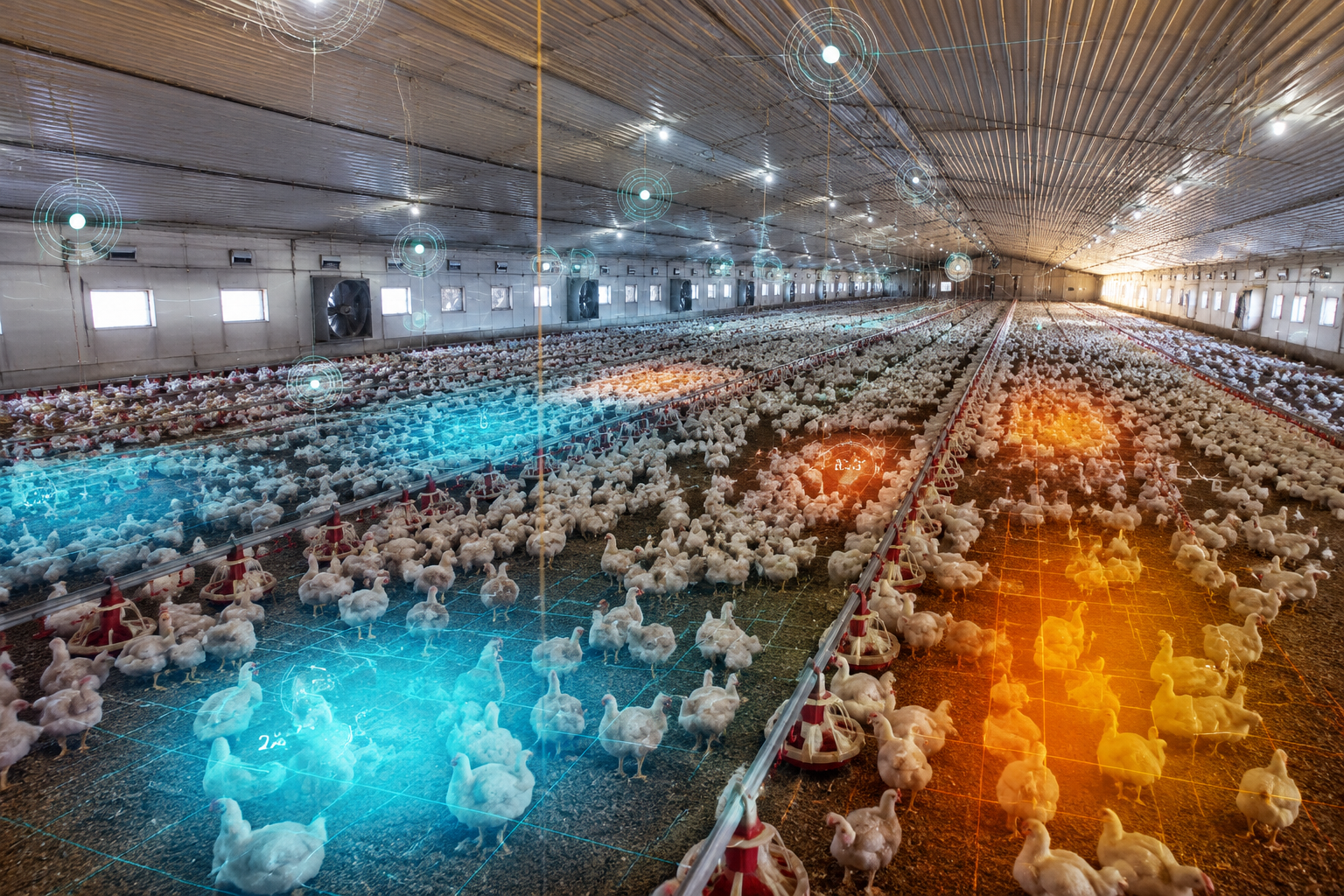
The Supply Chain Value Is In The Hours Before Certainty
Disease control teams want diagnostic confidence. Supply chain teams want time. Those are not the same demand, and outbreak planning often fails in the space between them. A processor may not need final laboratory certainty to start reviewing alternate sourcing, slowing flock movement, tightening visitor protocols, or separating suspect barns from normal production assumptions. But those actions only happen if the signal arrives early enough and carries enough trust to survive the handoff from farm staff to veterinary, live operations, planning, procurement, and customer-facing teams.
That is where the current AI evidence is most interesting. Thermography combined with machine learning has been reported as capable of detecting fever-linked temperature shifts 6 to 36 hours before death in poultry.[2] A wearable sensor described in a 2025 review weighed 5.2 grams, operated at 20-second intervals, had a two-week battery life, and detected H5N1 infection in chickens 6 to 36 hours before death.[1] Those windows are not long in a spreadsheet. In a barn, they can be the difference between isolating a house, holding a crew, redirecting movement, and discovering the problem after normal flows have already carried risk elsewhere.
The same logic applies downstream. In 2025, highly pathogenic avian influenza losses included more than 30 million laying hens across nine U.S. states, with Ohio accounting for 13.5 million of those birds.[3] CSIS reported that egg prices were up 60.4% year over year in March 2025 after 41.4 million birds were culled in December 2024 and January 2025.[4] Those numbers are retail symptoms of an upstream detection and containment problem. By the time shoppers see empty egg shelves or foodservice buyers get allocation notices, the useful early decision window has already closed.

What AI Surveillance Actually Watches
AI poultry disease surveillance is best understood as a set of signal sources feeding one operational decision: whether the flock, barn, farm, or surrounding perimeter is moving out of normal range quickly enough to justify action.
| Signal source | What it observes | Where it fits in outbreak response |
|---|---|---|
| Thermography | Temperature shifts linked to fever or stress | Early barn-level warning before visible mortality |
| Wearable sensors | Movement, body condition, or physiological patterns from individual birds | High-frequency monitoring when selected birds can act as sentinels |
| Audio analytics | Changes in flock sound patterns | Continuous house monitoring without handling birds |
| Computer vision | Activity, posture, clustering, gait, or abnormal flock behavior | Screening for deviations that farm teams may not catch quickly enough |
| Fecal image classification | Visual indicators of gut health issues | Health triage and flock monitoring, not necessarily influenza-specific confirmation |
| Wild bird detection | Incursions near farm buildings or high-risk areas | Targeted biosecurity before pathogen introduction |
The table matters because these systems do not all answer the same question. A thermal camera may flag fever-like change inside a house. A perimeter model may flag wild bird pressure near barns. A fecal image tool may support gut-health monitoring rather than directly diagnosing avian influenza. Treating all of them as interchangeable “AI disease detection” creates false confidence. Their value depends on where they sit in the response chain.
How Earlier Signals Change Containment
An early alert does not protect supply by itself. It protects supply when it changes the next action. A useful surveillance system should reduce the time between abnormal flock signal, human review, risk classification, movement control, and commercial adjustment.
The first benefit is a smaller intervention area. If a credible signal appears before mortality makes the problem obvious, live operations can isolate a barn or farm sooner, limit equipment movement, control people traffic, and avoid treating every nearby production unit as equally exposed. That does not guarantee fewer birds culled in every outbreak; disease strain, farm density, response rules, and confirmation timing still matter. But it gives containment teams a chance to act before the map expands.
The second benefit is less blind planning. Production planners do not need to wait for a public disruption to model affected lots, expected live supply, processing schedules, transportation changes, and customer commitments. Procurement teams can identify alternate supply earlier, when the market is not yet in the same scramble. Retail and foodservice buyers can decide whether to ration, substitute, promote differently, or communicate with customers before the shortage becomes visible.
The third benefit is cleaner escalation. A farm manager’s concern, a veterinarian’s review, a sensor alert, and a procurement hold should not be four disconnected events. AI surveillance is most valuable when it gives those teams a shared timestamp and a shared reason to act. Without that, the alert becomes another unowned notification competing with barn alarms, labor shortages, transport issues, and normal production noise.
Accuracy Claims Need To Be Sorted By Evidence Type
Some reported results are promising, but they should not be read as universal performance guarantees. Phytobiotics reported that its Chicken Checker tool identified gut health issues with about 90% probability, using roughly 47,000 farmer-collected images across about 150 flocks.[5] That is a meaningful scale for a vendor validation, and farmer-collected images are more useful than pristine lab-only data. It is still vendor-reported and focused on gut-health image classification, so it should not be treated as independent proof that AI can detect every high-consequence poultry disease in every housing system.
A separate night-vision wild bird detection effort reported deep learning models detecting incursions near farms with 95% accuracy.[6] For a supply chain operator, that kind of model belongs upstream of infection: it supports targeted biosecurity, not disease confirmation. It can help a farm intensify deterrence, sanitation, or access controls when exposure pressure rises. It does not replace flock health monitoring inside the house.
The most operationally powerful systems are likely to be multi-modal, combining thermal, visual, audio, behavioral, environmental, and perhaps diagnostic signals. A 2024 review described the broader shift from single-signal monitoring toward integrated decision intelligence, while also noting that many algorithms are still trained in controlled research environments.[7] That caveat is central. A model that works in a trial can weaken when lighting changes, litter conditions vary, stocking density shifts, cameras get dirty, connectivity drops, workers change routines, or a different disease strain produces a different early pattern.
The Hard Part Is The Handoff, Not The Alert
Outbreak response is a chain of custody for risk. The system detects something. Someone decides whether it is credible. Someone pays attention at the farm. Someone decides whether to test, isolate, clean, hold birds, delay movement, or notify a customer-facing team. Someone else decides whether the production plan still holds. If any handoff is vague, the model can be technically good and commercially weak.
This is why supply chain leaders should evaluate AI surveillance less like a gadget purchase and more like a control point. The operating questions are blunt:
- Who receives the first alert: farm staff, veterinary staff, live operations, procurement, or a central risk team?
- What threshold changes the farm’s behavior before diagnostic confirmation?
- Which actions are reversible if the alert proves false?
- Which actions are too costly to trigger without a second signal?
- How quickly does the alert reach production planning and customer allocation teams?
- What record shows when the signal arrived, who reviewed it, and what changed?
False positives are not a footnote in that workflow. On-farm teams bear the immediate cost of investigation, disruption, device maintenance, and remedial action. If a system cries wolf too often, farm managers learn to route around it. If it is too conservative, procurement still gets surprised. The acceptable error balance will differ between a high-density layer region, a broiler complex, breeder operations, and farms close to high wild-bird pressure.
What Current R&D Signals About The Next Layer
The research direction is moving beyond watching birds from the outside. UC Riverside announced a $1.8 million USDA-funded project in June 2026 to develop an AI and proteomics tool for highly pathogenic avian influenza detection.[8] That kind of work points toward surveillance systems that may combine flock behavior, environmental observation, and biological markers. For now, it should be treated as ongoing research rather than a commercially available answer to the next egg crisis.
Economic modeling from outside poultry also helps frame why earlier detection attracts supply chain attention, but it has to be used carefully. A Nature study published in January 2026 estimated that H5N1 impacts in U.S. dairy cattle could produce GDP losses of 0.06% to 0.91% and welfare decreases of $11.7 billion to $179.3 billion.[9] Those figures are not poultry outbreak estimates. They are a reminder that animal disease can propagate through production, prices, trade, and consumer welfare when response is slow or incomplete.
How To Evaluate AI Poultry Disease Surveillance For Supply Chain Protection
A credible evaluation starts with the supply chain decision the system is supposed to improve. If the goal is faster barn isolation, then the buyer needs evidence that the signal appears before normal observation and that staff can act on it. If the goal is regional biosecurity, perimeter detection may matter more. If the goal is procurement continuity, the key measure is not only detection accuracy but the number of hours gained before sourcing and allocation decisions become urgent.
The minimum diligence should cover farm fit, disease fit, and workflow fit. Farm fit means validating performance under the buyer’s housing system, lighting, litter, density, ventilation, connectivity, camera placement, bird age, and labor practices. Disease fit means understanding whether the model has been trained or validated on the relevant condition, or whether it is flagging general abnormality. Workflow fit means confirming that alerts trigger agreed actions and that those actions are acceptable to the people who must carry them out.
For integrators and processors, the strongest business case will usually come from a pilot that measures detection-to-response time, not just model accuracy. A useful pilot would compare when abnormality was first detected, when a human reviewed it, when farm action started, when movement controls changed, and when planning or procurement teams were notified. It would also record false alarms, missed signals, staff time, connectivity failures, maintenance burden, and whether the alert changed any decision that mattered.
The related question is how AI surveillance connects with other food supply chain controls. Disease alerts may eventually feed traceability, contract, insurance, and customer-notification workflows. For a broader look at how AI food supply chain systems can change legal exposure, see AI food traceability and lawsuit exposure.
The Narrow, Useful Conclusion
AI disease surveillance can protect the poultry supply chain when it compresses detection-to-response time and is embedded in a containment workflow that people trust. The strongest current evidence points to hours gained before death or visible outbreak escalation, and those hours have real operational value. They can support smaller quarantine decisions, earlier biosecurity action, cleaner production planning, and less frantic procurement.
The limits are just as practical. Reported accuracy figures come from specific studies, vendor validations, and research settings. They need validation across farm types, housing systems, disease strains, data quality conditions, and response protocols. A model that cannot survive commercial deployment will not protect supply, no matter how promising it looked in a paper or product launch.
For supply chain leaders, the right stance is neither to wait for perfect certainty nor to buy a black-box promise. The question is whether the system can give the organization enough trusted time to act before a barn incident becomes a market event.
References
- Artificial Intelligence for the Detection and Control of Infectious Diseases in Poultry, PMC, 2025
- AI for early poultry disease detection, Feedstuffs, March 2026
- HPAI causes loss of over 30 million laying hens in the US in 2025, Avinews
- How Is Bird Flu Impacting Agriculture and Food Security in the United States?, CSIS
- Chicken Checker AI Tool Launched at Poultry Science Association Meeting, Phytobiotics, December 2024
- Artificial Intelligence Helps Protect From Avian Influenza, Land Grant Impacts
- Artificial Intelligence in Poultry Production: Applications, Challenges, and Opportunities, PMC, 2024
- Preventing the next egg crisis with smarter avian flu detection, UCR News, June 2026
- The economic impacts of H5N1 influenza in US dairy cattle, Nature, January 2026
Comments
Join the discussion with an anonymous comment.