

The uncomfortable part of the use of AI in supply chain is no longer whether the technology can produce an impressive answer. It often can. The harder question is whether that answer survives contact with the planning calendar, the procurement approval path, the transportation management system, the warehouse supervisor’s exception queue, and the people who will be blamed if the recommendation is wrong.
That is where many programs stall. In PwC’s 2026 Digital Trends in Operations Survey, 89% of surveyed operations leaders said their technology investments had not fully delivered the expected results, while 87% said poor data quality had hampered digital initiatives; the same survey identified integration complexity as the top barrier, cited by 59% of respondents.[1] Those figures are not AI-only measures, and the survey covers 767 US-based operations leaders at organizations with at least $100 million in revenue, so they should not be stretched into a universal claim about every supply chain. They still describe the operating environment into which many AI programs are being dropped: digital investment is high, but the organizational plumbing is not ready.

The model is rarely the whole project
A pilot can be built around a narrow data extract, a sympathetic user group, and enough manual cleanup to make the demo work. Production has less patience. It asks whether item masters are governed, whether supplier names match across systems, whether exceptions are routed to someone with authority, whether ERP changes break the model feed, and whether planners understand when to override the recommendation.
This is why treating AI capability as the main constraint leads programs in the wrong direction. The constraint is increasingly readiness: data readiness, integration readiness, decision-process readiness, and workforce readiness. The companies that look more mature are not simply buying more advanced tools. They are making the surrounding work visible, funded, and owned.
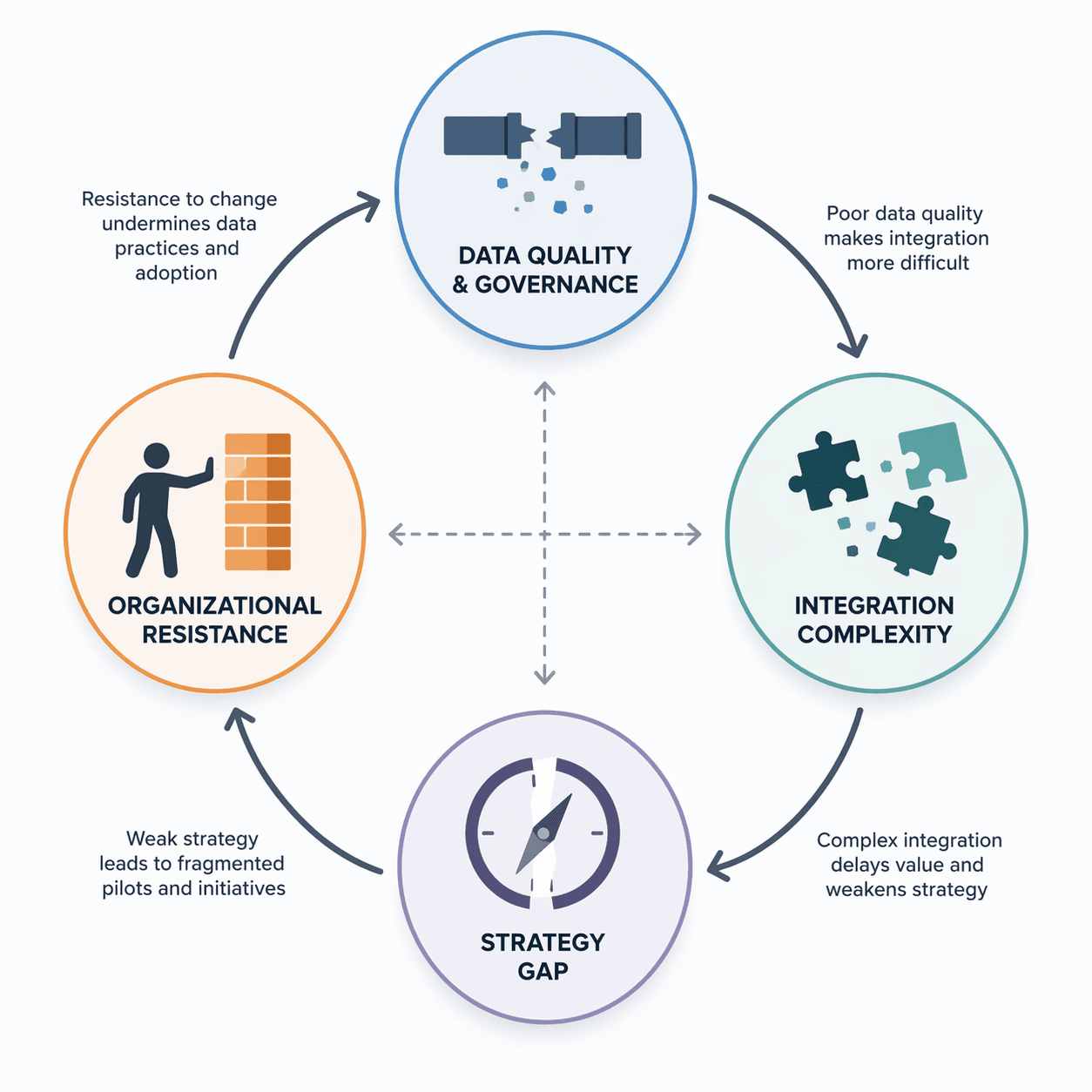
| Barrier | What it looks like in daily operations | Why it blocks scale |
|---|---|---|
| Data quality and governance | Duplicate supplier records, inconsistent item attributes, late inventory updates, unclear master data ownership | Users have a defensible reason not to trust AI recommendations |
| Integration complexity | Planning, ERP, WMS, TMS, procurement, and visibility tools operate through brittle or partial connections | AI stays useful inside one workflow but fails when decisions cross systems |
| Strategy gap | Pilots are approved without a clear decision model, governance path, or operating change | The organization funds experiments but does not change how work is done |
| Organizational resistance | Users receive dashboards without training, role clarity, or confidence in escalation rules | Adoption becomes optional, uneven, and easy to route around |
Bad data does more than reduce model accuracy
Poor data quality is often discussed as if it were a technical nuisance: clean the fields, normalize the units, remove the duplicates, and continue. In supply chain, it is more structural than that. Data quality determines whether a recommendation can be traced, explained, challenged, and acted on before a shipment is late or a production schedule is frozen.
If the demand signal is clean but the inventory position is delayed, the model can recommend replenishment that looks logical in isolation and wrong on the warehouse floor. If supplier performance history is inconsistent across procurement and quality systems, a sourcing recommendation can appear to optimize cost while hiding delivery risk. If item substitutions are maintained in spreadsheets outside the core planning system, the AI may be blamed for missing relationships the enterprise never made machine-readable.
The 87% figure from PwC matters because it turns data quality from an IT complaint into an operations constraint.[1] It is not just that dirty data weakens outputs. Weak governance makes integration harder, weak integration produces partial context, partial context generates recommendations users distrust, and user distrust quietly turns adoption into theater.
The practical test is not whether the project team can clean enough data for a pilot. The test is whether the company has decided who owns the fields that matter after go-live. A supply chain AI program needs named owners for product, supplier, customer, location, inventory, lead-time, and order-status data. It also needs issue paths that are faster than the planning cycle. If a planner identifies a broken lead time on Tuesday and the correction lands after the next planning run, the model may be technically improved while the business has already learned to ignore it.
This is where many roadmaps under-budget the work. They fund the platform, the model, and the pilot team, then treat master data stewardship as cleanup. In a supply chain environment, governance is part of the AI product. Without it, each recommendation arrives carrying the reputation of the weakest source system behind it.
Integration complexity turns good pilots into stranded tools
Supply chain decisions rarely stay inside one application. A forecast affects purchasing. Purchasing affects inbound logistics. Inbound delays affect production sequencing, warehouse labor, customer allocation, and working capital. An AI tool that improves one decision point but cannot pass context into the next system becomes another screen someone has to reconcile.
PwC’s finding that 59% of respondents cite integration complexity as the top reason technology investments have not delivered is therefore more than a systems statistic.[1] It explains a familiar failure pattern: a visibility tool works for a lane, a planning model works for a business unit, a procurement assistant works for a category, but the enterprise cannot turn those local wins into an operating rhythm because the handoffs are fragile.
Vendor-published survey data should be read with care, especially when respondents may be more technology-forward than the broader market. With that caveat, Tradeverifyd’s 2026 supply chain statistics point in the same direction: 67% of respondents reported stalled ROI from visibility tools because of fragmented legacy systems.[2] The useful takeaway is not the exact percentage as a universal benchmark. It is that visibility does not automatically equal operational control when the underlying architecture is fragmented.
Before scaling a pilot, the integration review should be blunt. Which systems create the signals? Which systems consume the recommendation? Which fields are authoritative? How often are they refreshed? Which exceptions require a human approval? What happens when the AI recommendation conflicts with an ERP rule, a customer allocation policy, or a transportation constraint?
Those questions can feel slower than model development, but they prevent the expensive version of success: an accurate tool that creates work for everyone around it. For teams trying to move from pilot to production in procurement, a phased implementation path can help keep process redesign and systems integration in the same plan rather than splitting them into separate workstreams. See AI in Procurement Implementation: A Phased Roadmap from Pilot to Production Scale for a more detailed scaling sequence.
The strategy gap shows up after the pilot is applauded
The most revealing AI strategy question is not whether a company has approved use cases. It is whether the company has decided how AI changes decisions, roles, governance, and operating cadence. Without that, use cases multiply faster than the organization’s ability to absorb them.
Gartner reported in June 2025 that only 23% of supply chain organizations had a formal AI strategy, even among organizations already deploying AI.[3] PwC’s 2026 survey adds a related operating measure: only 27% of respondents said AI strategy was fully embedded across business units.[1] Together, those findings explain why so many programs feel busy but disconnected. The enterprise is funding AI activity without always deciding what kind of management system AI is supposed to become.
A formal strategy does not need to become a binder that delays every experiment. It does need to answer several practical questions before pilots become procurement events:
- Which decisions will AI support, automate, or leave untouched?
- Who is accountable when a recommendation is accepted, overridden, or ignored?
- Which data domains must be governed before scale?
- Which systems must exchange information in production, not just during the pilot?
- Which performance metrics will distinguish model accuracy from business value?
- How will users be trained, supported, and measured as workflows change?
The absence of these answers creates a predictable handoff problem. Leadership celebrates the pilot. The project team moves to the next priority. The planner, category manager, data steward, or IT integration lead inherits a tool that is technically live but operationally unfinished.
Readers who want the maturity benchmark behind this gap can go deeper in the Gartner 2025 supply chain AI deployment maturity analysis, or compare root causes in Why AI in Supply Chain Fails — and What the 23% With a Formal Strategy Do Differently.
ROI pressure can kill the work just before it compounds
Executives are not wrong to ask for returns. The problem is asking for production-level returns while funding only pilot-level readiness. Deloitte’s 2025 analysis described an AI ROI paradox: 85% of organizations increased AI investment, but only 6% saw ROI in under a year, while most satisfactory returns emerged over a two- to four-year period.[4]
That timing matters in supply chain because the early months are often consumed by non-glamorous work: reconciling data definitions, stabilizing integrations, training users, adjusting approval paths, and learning which recommendations should be automated versus reviewed. If the business expects the economics of a mature operating model before those foundations are in place, the program can be judged a failure before it has had a fair test.
Patience does not mean tolerance for vague transformation talk. It means staging value. A first release may reduce manual analysis in one planning process. A later release may connect the recommendation to procurement action. A subsequent release may add exception routing, feedback loops, and governance metrics. Each stage should make the next one cheaper, safer, or more trusted. If it does not, the roadmap is probably expanding activity rather than building capability.
Organizational resistance is usually evidence, not attitude
When users work around an AI tool, the easy explanation is resistance. Sometimes that is true. More often, the behavior is evidence that the implementation left too many unanswered questions. A planner who ignores a recommendation because the inventory feed is late is not anti-AI. A buyer who keeps a spreadsheet because the tool cannot explain supplier constraints is not nostalgic. A warehouse manager who refuses an optimization suggestion that breaks labor reality is doing the job.
Adoption improves when people know what the system is for, how it reached a recommendation, when they are expected to override it, and who will review exceptions. Training is part of that, but training alone is not enough if the workflow still punishes users for trusting the tool. The operating model has to change with the software.
Role redesign is often where the real discomfort appears. If AI takes over part of expediting, forecasting, supplier screening, or exception triage, the human role should become clearer, not fuzzier. Does the planner move toward scenario review? Does the buyer focus on supplier risk and negotiation? Does the logistics team manage exceptions rather than chase status updates? If the answer is not defined, users will protect the old workflow because it is the only one with known accountability.
The people-side work should be designed before go-live, not added after adoption disappoints. For a deeper playbook on that part of the rollout, see the people-side AI procurement transformation change management guide.
Other risks matter, but they do not replace the readiness problem
Security, regulatory exposure, and scaling risk are real. ARC Advisory Group’s discussion of AI in supply chain frames the challenge across categories that include data, integration, strategy, skills, security, regulatory concerns, and scaling.[5] Those categories are useful because they prevent an overly narrow diagnosis. A company handling sensitive supplier, customer, or cross-border trade data cannot treat AI governance as a productivity exercise only.
Still, for many stalled supply chain deployments, the first failure is closer to the floor: the data is not trusted, the systems are not connected, the strategy is not embedded, and the users are not carried into the new workflow. Security and regulatory reviews should be built into the program, but they do not excuse skipping the operating basics.
What the minority does differently
PwC identifies a small leader cohort — 4% of surveyed operations leaders — that is further ahead in turning digital investment into results.[1] The important lesson is not that every company should copy the same tooling choices. Industry, scale, and system landscape matter. A mid-market consumer goods company does not face the same integration estate as a global automotive manufacturer, and a highly regulated life sciences supply chain will carry different validation burdens than a regional distributor.
The transferable pattern is more basic. Stronger organizations make readiness visible before the pilot begins. They identify the data domains that will determine trust. They map the systems that must exchange signals. They decide how recommendations will enter daily work. They assign ownership for overrides, feedback, and model monitoring. They budget change management as part of the AI investment rather than as an adoption campaign after the contract is signed.
They also scale incrementally without confusing incremental with timid. A narrow first release can be ambitious if it proves a repeatable pattern: governed data, stable integration, a changed workflow, trained users, and a measurable business outcome. A broad rollout without those ingredients is only scale on a slide.
The practical standard is simple to state and difficult to fake: before a pilot is approved, the organization should be able to name the data owner, the integration owner, the business process owner, and the adoption owner. If any of those names are missing, the program is not ready to scale. It may still be ready to explore, but exploration should not be sold as transformation.
References
- Digital Trends in Operations Survey, PwC, 2026.
- Supply Chain Statistics, Tradeverifyd, 2026.
- Gartner Survey Shows Just 23% of Supply Chain Organizations Have a Formal AI Strategy, Gartner, June 2025.
- AI ROI: The Paradox of Rising Investment and Elusive Returns, Deloitte, 2025.
- Challenges and Risks of AI in Supply Chain: Architecting the Future of Logistics, ARC Advisory Group.
Comments
Join the discussion with an anonymous comment.