
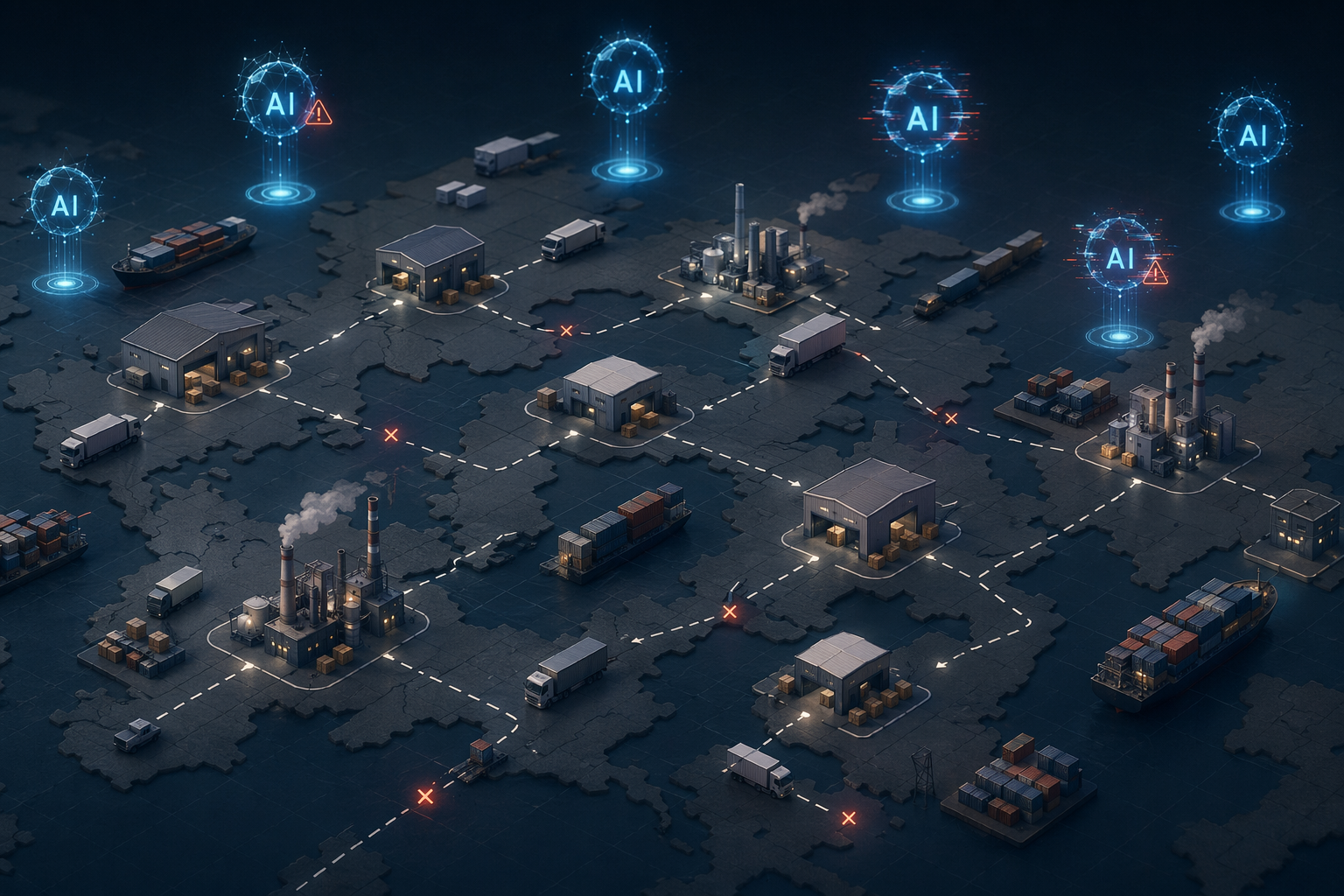
The awkward question in 2026 is no longer whether the role of AI in supply chain management is strategically important. Most executives have already answered that with budget. The harder question is why so many AI pilots still end with a polished demo, a slide on potential savings, and no clear change to planning accuracy, inventory turns, freight cost, supplier response time, or exception workload.
The broad enterprise signal is uncomfortable: MIT Sloan’s 2025 State of AI in Business study, covering 52 organizations and more than 300 AI initiatives, found that 95% of enterprise GenAI pilots delivered no measurable ROI despite an estimated $30 billion to $40 billion in cumulative investment.[1] That is not a supply-chain-specific failure rate, and “no measurable ROI” is not always the same as “worthless.” Some pilots produce learning, expose data problems, or build internal capability before the financial case is visible. Still, it is a useful warning for supply chain leaders because supply chain AI has even less tolerance for theater. A model that cannot survive bad item masters, split shipment logic, planner overrides, supplier minimums, and a brittle TMS integration is not an operating capability.
The pressure to spend is rising anyway. The AI in supply chain market was estimated at $9.94 billion in 2025 and projected to reach $236.42 billion by 2035, while 85% of supply chain executives planned to increase AI spending in 2026.[2][3] The adoption picture behind that spending is much thinner: only 12% of companies reported AI fully integrated into supply chain processes, while 43% remained at pilot stage and 36% reported limited adoption.[3]
That gap between investment intent and operational integration is where most of the real work sits. Gartner’s supply chain AI roadmap reported that only 23% of supply chain organizations had a formal AI strategy, and only 29% had built the capabilities needed for future readiness.[4] In steering-committee language, that means the ambition is funded before the operating model is ready to absorb it.
The failure pattern is usually visible before the pilot starts
Supply chain AI does not usually fail because the algorithm is too weak to recognize a pattern. It fails because the pattern is trapped inside processes and systems that were never designed to make the model usable. The same demand-sensing or autonomous-planning demo that looks compelling in a sandbox becomes much less convincing when it has to reconcile customer hierarchy changes, late purchase-order updates, carrier tender rejections, regional ATP rules, and a planner who knows the system’s promised ship date is fiction every third Thursday.
Four causes show up repeatedly: poor data quality, integration complexity, weak change management, and the absence of a governing AI strategy. They are not independent. Bad data raises the manual exception load. Poor integration pushes users back into spreadsheets. Weak adoption creates shadow processes. No formal strategy allows every function to solve the same problem differently.

Bad data does not become good data because a model is expensive
Data quality is the least glamorous explanation for AI failure and the most common one to underestimate. An industry estimate cited by TraxTech says 70% of AI projects fail because of data quality issues and that poor data quality costs organizations $12.9 million annually.[5] The methodology behind that 70% figure is not transparent enough to treat it as a precise benchmark. It is better read as a widely cited warning: AI projects are disproportionately vulnerable to the data problems companies have tolerated for years.
Supply chain data is especially unforgiving because it is both transactional and contextual. A forecast model may need historical shipments, lost sales, promotions, substitutions, customer-level demand signals, item transitions, supplier constraints, lead-time variability, and inventory positions. A transportation model may need lane history, accessorial charges, appointment compliance, dwell time, carrier capacity, tender acceptance, and service failures. Those fields often live in different systems, follow different definitions, and degrade at different speeds.
Procurement shows the same problem in a more concentrated form. Gartner reported in 2025 that 74% of procurement leaders said their data was not AI-ready.[4] That matters because procurement AI use cases often depend on supplier hierarchies, contract metadata, spend taxonomies, item classifications, risk signals, and payment terms that are messy even in organizations with mature sourcing teams. If supplier records are duplicated, contract clauses are buried in PDFs, and category codes are applied inconsistently, the AI tool inherits the confusion.
This is why a pilot can look successful in a controlled sample and then collapse when expanded. The pilot team may clean the data manually, exclude hard cases, or rely on a business analyst who knows which fields cannot be trusted. Production removes that protection. The model begins consuming live operational data, and the hidden labor becomes visible: exception queues grow, planners override recommendations, IT is asked for urgent data fixes, and the sponsor wonders why the projected ROI moved backward.
The practical test is not whether the organization has enough data. Most large supply chains have too much of it. The test is whether the data is governed, current, mapped to business meaning, and reliable enough for someone to let it influence a replenishment decision, a carrier award, a supplier risk escalation, or a production-plan change without recreating the analysis by hand.
For organizations already stuck here, the next conversation is not about a better model. It is about data ownership, master-data accountability, integration design, and the minimum viable data foundation for the use case. ChainSignal’s procurement data readiness roadmap is useful precisely because it treats AI readiness as operating work, not as a data-cleansing side quest. How to Get Procurement Data AI-Ready: A 4-Phase Roadmap.
The Frankenstack problem: AI pilots attached to systems that cannot use them
Integration is where supply chain AI stops being a technology procurement and becomes a systems architecture problem. Gartner has warned about “Frankenstack” environments: disconnected AI tools bolted onto legacy supply chain platforms rather than embedded into the workflows that actually run planning, warehousing, transport, procurement, and fulfillment.[4]
The phrase is useful because it captures the common failure mode. One team pilots an AI forecast layer. Another tests supplier-risk summarization. Logistics runs a carrier-performance model. Procurement experiments with contract intelligence. Each one may be defensible on its own. Together, they create a portfolio of narrow tools that do not share data definitions, do not feed the same workflow, and do not clarify who is accountable when recommendations conflict.
The adoption data makes that fragmentation visible. In the 2026 Supply Chain Brain/Innovecs survey, only 12% of companies said AI was fully integrated into supply chain processes. The much larger share was still in the middle: 43% at pilot stage and 36% with limited adoption.[3] That does not mean these organizations learned nothing. It does mean many have not crossed the line from “AI can produce an answer” to “AI changes the way work is executed.”
That line is harder to cross in supply chain than in many corporate functions. A recommendation in a sales deck can remain advisory. A recommendation in supply chain has to land somewhere: into an ERP planning run, a WMS task, a TMS tendering flow, an S&OP review, a procurement event, a supplier development action, or an exception-management queue. If the AI output sits beside the system of record, the user must translate it, copy it, challenge it, or ignore it. The promised productivity improvement quietly becomes another screen.
The integration question should be asked before the demo, not after it. Which system consumes the recommendation? Which workflow changes? Which human approval remains? Which exception is escalated? Which transaction is written back? Which KPI is expected to move next quarter? If those answers are vague, the pilot is not yet testing operating value. It is testing analytical possibility.
That distinction is why many planning pilots stall between proof of concept and production. The model may be competent, but the surrounding architecture is not ready. ChainSignal’s analysis of why AI supply chain planning pilots stall goes deeper into that transition from prototype to operating workflow. Why Most AI Supply Chain Planning Pilots Stall — and the Methodology That Scales Them.
Adoption fails when the tool changes work but the organization does not
Change management is often treated as the soft part of AI implementation. In supply chain, it is operational risk management. If planners, buyers, dispatchers, warehouse supervisors, category managers, and supplier managers do not trust the recommendation, understand the escalation path, or know when they are allowed to override it, the AI system becomes optional. Optional systems have a short life in busy operations.
The shadow AI signal shows how fast the workforce is moving ahead of formal operating models. MIT’s 2025 research found that 90% of employees used personal AI tools at work, while only 40% of firms had official subscriptions.[1] That statistic does not tell us how much of the usage is risky. Some of it may be harmless productivity support. But when personal AI tools begin touching supplier analysis, customer commitments, contract interpretation, inventory decisions, or exception prioritization, the governance gap becomes real.
Shadow AI is not only a compliance issue. It is a symptom of unmet demand. People are trying to reduce manual work, summarize messy inputs, compare options, and move faster than current systems allow. If the formal AI program cannot meet that need inside approved workflows, employees will improvise. The organization then gets the worst version of AI adoption: high usage, low visibility, uneven quality, and unclear accountability.
Good change management starts earlier than training. It defines which decisions AI may influence, which remain human-owned, how exceptions are handled, how recommendations are explained, how performance is reviewed, and how users can challenge bad outputs without being labeled resistant. A planner who has to defend service levels to sales will not simply accept a black-box inventory recommendation because the transformation office likes the dashboard.
Capability building also has to reach beyond the AI project team. If procurement does not understand model limitations, if logistics does not trust data lineage, if IT cannot support integration patterns, and if finance cannot separate timing lag from underperformance, the program will be judged through incompatible assumptions. ChainSignal’s change-management playbook for AI procurement transformation is relevant here because it treats adoption as a cross-functional capability rather than a communications campaign. The People Side of AI Procurement Transformation.
The strategy gap is the reason the other three problems keep repeating
Data, integration, and adoption failures are often described as implementation problems. That is true, but incomplete. They persist because no one has made a small number of strategic decisions that should govern the whole portfolio: which supply chain decisions AI will improve first, what data foundation is required, how tools connect to core systems, what governance model applies, how benefits will be measured, and who owns the operating change after the pilot team leaves.
That is why the 23% formal-strategy figure matters. Gartner’s finding that only 23% of supply chain organizations had a formal AI strategy is not just a planning statistic; it explains why AI investments so often arrive as disconnected experiments.[4] A demand-planning pilot, procurement copilot, warehouse-optimization tool, and logistics analytics model may all be funded under the same AI narrative while pulling the organization in four different architectural directions.
The absence of strategy also makes ROI measurement sloppy. One pilot is judged on cost reduction, another on adoption, another on productivity anecdotes, another on executive excitement. Some benefits are real but delayed. Deloitte has noted that AI investments may require a two- to four-year ROI timeline, which means premature measurement can make a foundational program look worse than it is.[6] But the opposite mistake is just as common: using long-horizon transformation language to avoid specifying which operating metric should move and when.
A useful AI strategy does not need to be theatrical. It needs to be enforceable. It should prevent the organization from buying five tools that solve adjacent problems with incompatible data models. It should force tradeoffs between attractive use cases and readiness. It should decide where AI is advisory, where it is semi-autonomous, and where the company is not yet prepared to let it act.
For leaders trying to benchmark this gap, ChainSignal’s analysis of the Gartner AI strategy paradox and its maturity benchmark decoding are better companions than another use-case catalog. The Gartner AI Strategy Paradox and Gartner's 2025 Supply Chain AI Maturity Data Decoded both extend the diagnosis.
What the 23% do differently
The organizations with a formal AI strategy are not automatically successful. A strategy document can be just as performative as a pilot demo. The difference is that the better organizations treat strategy as a way to force operational readiness before scaling, not as a cover page for experimentation.
Gartner’s 2026 CSCO guidance points to four practical moves: grow the AI knowledge base across the organization, study what peer organizations are doing, assess readiness honestly, and embed AI in enterprise strategy rather than treating it as a supply-chain-only initiative.[7] None of those are exciting on a conference stage. All of them reduce the odds that a supply chain AI program becomes a scattered collection of tools looking for a workflow.
| What weaker programs do | What more mature programs do |
|---|---|
| Start with a vendor demo or executive-sponsored pilot | Start with the operating decision, data requirement, integration path, and accountable owner |
| Clean data manually for the pilot sample | Define the data foundation needed for production and assign ownership before scale |
| Keep AI outside the core planning, ERP, TMS, WMS, or procurement workflow | Design how recommendations are consumed, approved, written back, and measured |
| Train users after the tool is selected | Build AI literacy, exception rules, override rights, and governance into the operating model |
| Measure success through adoption anecdotes or generic ROI claims | Connect each use case to specific operating metrics and realistic benefit timing |
The upside is real enough to justify the effort, but it should be read carefully. Accenture’s research found that companies with AI-mature supply chains were 23% more profitable than peers.[8] That is directional evidence from proprietary consulting research, not proof that having an AI strategy alone causes a 23% profitability lift. More mature companies may also have stronger data foundations, better process discipline, higher technology budgets, and more capable operating teams. The finding still matters because those are exactly the conditions that allow AI to scale.
Other performance estimates point to similar potential. McKinsey-linked figures cited in secondary references suggest AI-enabled distribution can reduce logistics costs by 5% to 20% and inventory by 20% to 30%.[9] Capgemini’s 2025 research found AI adoption associated with a 23% reduction in fulfillment costs and forecast accuracy improvements up to 85%.[10] These numbers should not be pasted into a business case without context. They are not guarantees. They are evidence of what becomes possible when the use case is connected to the operating system of the supply chain.
That is the useful way to think about autonomous planning, demand sensing, AI-enabled distribution, procurement copilots, and warehouse optimization. The question is not whether the use case is impressive. Many are. The question is what must be true inside the organization before the use case can survive production: trusted data, connected systems, clear decision rights, trained users, governance, and a benefit model that finance and operations both accept.
A 2026 investment test that is harder to evade
Supply chain leaders do not need another abstract debate about whether AI belongs in supply chain management. It already does. It belongs in demand planning, inventory optimization, supplier intelligence, logistics execution, exception management, and network decision support. But belonging is not the same as scaling.
The better 2026 investment test is more specific:
- If the project fails, will it fail because the data was not reliable enough for production?
- Will it fail because the AI output never enters the TMS, WMS, ERP, planning platform, procurement workflow, or exception process where work is actually done?
- Will it fail because users were asked to trust recommendations without clear decision rights, explanation, escalation, or override rules?
- Will it fail because every function is running its own AI experiment without a shared architecture, governance model, or benefit standard?
Those questions are uncomfortable because they move accountability away from the vendor and back to the operating environment. They also make the investment case more credible. A company that can name its failure mode can start fixing it. A company that cannot will keep celebrating pilots while the real supply chain continues to run on manual workarounds.
For teams ready to move from diagnosis to execution, ChainSignal’s phased procurement AI implementation roadmap can help translate the same readiness logic into a rollout path, and its case-study collection is useful for seeing what scaled deployment looks like when the operational pieces are in place. AI in Procurement Implementation and 13 Real-World AI Deployments in Supply Chain.
AI supply chain projects usually fail for predictable organizational and technical reasons, not because the technology is inherently useless. The companies with a formal strategy are advantaged because they treat AI as an operating-system change rather than a pilot portfolio. Before approving the next AI investment, the sharper question is not whether AI has a role in supply chain management. It is whether the organization has built the conditions under which AI can survive contact with real supply chain operations.
References
- State of AI in Business, MIT Sloan Management Review, 2025.
- AI in Supply Chain Market, Precedence Research.
- Supply Chain AI Adoption Survey, Supply Chain Brain/Innovecs, 2026.
- CSCO Roadmap: Building a Supply Chain AI Foundation, Gartner, 2025.
- 70% of AI projects fail due to data quality issues; $12.9M annual cost of poor data quality, TraxTech.
- AI ROI timeline for AI investments, Deloitte, 2025.
- Supply Chain Symposium autonomous supply chain framework, Gartner, May 2026.
- AI: Built to Scale, Accenture, 2024.
- AI-enabled distribution logistics and inventory improvement figures, McKinsey, 2024.
- AI adoption fulfillment cost and forecast accuracy research, Capgemini, 2025.
Comments
Join the discussion with an anonymous comment.