
What AI Adds to Multi-Echelon Inventory Optimization
For definitional grounding on what MEIO is and how echelons interact, see the MEIO glossary entry. This article is scoped to deployment evidence, vendor fit, and the organizational conditions that determine whether AI-powered MEIO delivers on its documented potential.
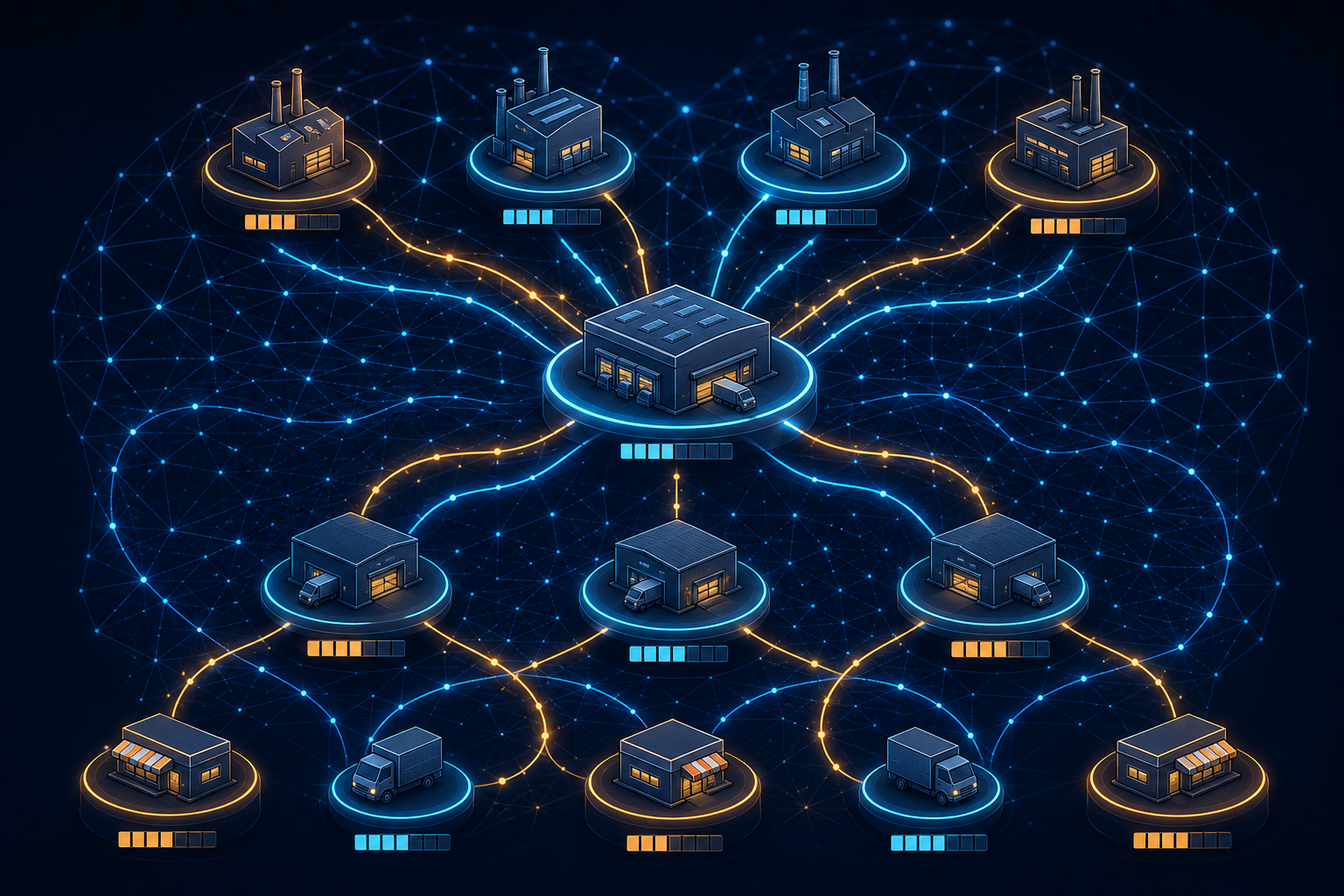
Classical statistical MEIO methods — service-level equations, lot-sizing heuristics, periodic reorder-point calculations — set safety stock parameters once and recalibrate them infrequently. AI-enabled MEIO replaces that static posture with continuous recalibration: probabilistic demand models update as new sales, promotion, and lead-time signals arrive; stochastic risk models jointly optimize safety and cycle stock across all network tiers simultaneously; and machine learning algorithms surface the inventory positioning decisions that minimize total working capital while holding service levels at target. The shift is from a set of locally managed buffers to a single network-wide policy that self-adjusts.
When Multi-Echelon Optimization Is Warranted: Network Complexity Thresholds
MEIO adds model complexity that only pays off when the network itself is complex enough to generate the cascading inefficiencies that single-echelon optimization cannot resolve. The minimum threshold is a network with three or more echelons where replenishment decisions at one tier materially affect inventory outcomes at adjacent tiers — combined with meaningful demand variability and lead-time variability at multiple points in the chain.
Single-echelon models fail in these environments because each node optimizes its own safety stock independently. A regional DC sets its buffer based on its own demand signal; the central DC sets its buffer based on aggregated replenishment requests from regional nodes. Neither model accounts for the statistical interdependence between tiers. The result is safety stock duplication — every echelon carries its own buffer against the same upstream uncertainty — and service failures when local decisions cascade in ways no single-node model anticipated.
- Three or more echelons with interdependent replenishment (e.g., supplier → central DC → regional DC → store or dealer)
- High demand variability at the point of consumption that propagates upstream (promotional spikes, seasonal swings, new product introductions)
- High lead-time variability at one or more upstream tiers that cannot be absorbed by simple safety stock rules
- Significant inventory investment where even a 15–20% reduction in total stock represents material working capital impact
- Service-level commitments that vary by echelon or customer segment and cannot be managed with a uniform policy
Where AI-Powered MEIO Delivers Measurable Value by Industry
Deployment evidence concentrates in three verticals where network complexity, service-level pressure, and inventory cost converge.
| Industry | Network Configuration | Primary MEIO Value Driver | Differentiating Requirement |
|---|---|---|---|
| Pharma & Life Sciences | Manufacturer → wholesaler → hospital/pharmacy chain | Staged inventory across licensed distribution tiers; shelf-life constraints on biologics and temperature-sensitive products | Freshness-aware and expiry-date-sensitive optimization; regulatory compliance on inventory positioning |
| CPG & Retail | Plant → central DC → regional DC → store | Dynamic safety stock rebalancing during promotions, seasonal peaks, and new product launches; fresh produce replenishment | Real-time demand sensing integration; freshness constraints for perishables; promotional event modeling |
| Automotive, Industrial & Spare Parts | Manufacturer → regional distribution center → dealer/service location | Pooling high-value component safety stock upstream rather than duplicating at every dealer or plant; critical parts fill-rate targets | Slow-mover and sparse-history handling; fill-rate SLAs within defined time windows (e.g., 24-hour parts availability) |
In pharma and life sciences, the challenge is not just variability — it is that inventory must be positioned across a regulated, multi-tier distribution chain where each tier has distinct service-level obligations and shelf-life constraints. AI models that cannot account for expiry dates and aging risk will systematically overstock early-expiry products at downstream nodes while creating shortages of longer-dated stock upstream.
In CPG and retail, the highest-value MEIO applications are promotional and seasonal rebalancing — situations where demand signals change faster than static safety stock rules can respond. AI demand forecasting in CPG and retail provides the upstream demand signal that MEIO converts into network-wide inventory positioning decisions. The Walmart AI inventory deployment is a large-scale reference case for how AI-driven inventory management scales across a multi-tier retail network.
In automotive and industrial spare parts, the defining problem is that duplicating safety stock at every dealer or service location is prohibitively expensive for high-value, low-velocity components. MEIO allows critical parts to be pooled upstream at regional distribution centers, with AI-driven replenishment policies that maintain fill-rate commitments without requiring each downstream location to carry its own full buffer.
Documented Deployment Outcomes and ROI Benchmarks
The figures below are drawn from vendor-published sources, third-party analyst estimates, and direct customer statements. Each is labeled by source type. None should be treated as guaranteed results — deployment context, network complexity, and data quality all affect realized outcomes.
| Company / Context | Outcome | Source Type | Vendor / Platform |
|---|---|---|---|
| Procter & Gamble | $1.5B saved in a single year from MEIO adoption across ~30% of business units | Vendor-reported (ICRON, citing ResearchGate) | MEIO methodology (not platform-specific) |
| Caterpillar | 98% of customer parts orders filled within 24 hours across global service parts network spanning manufacturing, regional DCs, and dealer locations | Vendor-reported (ICRON, citing cat.com) | MEIO methodology (not platform-specific) |
| ICA Sweden (1,300 stores) | 32% reduction in safety stock inventory; 6.69 percentage-point improvement in forecast accuracy | Direct customer statement (Andreas Persson, Head of Replenishment, ICA Sweden) | RELEX Solutions |
| Unnamed global food & beverage company | 7% reduction in inventory holdings; 3–5% improvement in OTIF | Vendor-reported (o9 Solutions, client unnamed) | o9 Solutions |
| Carrier (Asia-Pacific HVAC operations) | Improved inventory visibility, optimized service levels, and adaptive real-time planning across diverse regional demand patterns | Vendor-reported (ketteQ, percentage unquantified) | ketteQ |
| Range benchmark — inventory reduction | 15–30% inventory reduction while maintaining or improving service levels | Vendor-reported range (ToolsGroup, ICRON) | Multiple platforms |
| Range benchmark — service levels | 98%+ service levels sustained even with demand fluctuations | Vendor-reported (ToolsGroup) | Multiple platforms |
Not only has our collaboration produced tangible results, such as the 32% decrease in safety stock inventory, but working with RELEX has been easy and innovative. — Andreas Persson, Head of Replenishment, ICA Sweden
AI and ML Techniques Applied in Production MEIO Deployments
The techniques below are described in the context of specific vendor implementations or documented deployment contexts — not as standalone algorithmic concepts. For deeper definitional treatment, the MEIO glossary entry covers the technical foundations.
- Probabilistic demand modeling: Rather than generating a single demand forecast and deriving safety stock from it, ToolsGroup's approach models the full distribution of possible demand outcomes. Safety stock is set against a specified percentile of that distribution, not against a point estimate — producing more accurate buffers that reflect real-world uncertainty across echelons.
- Stochastic risk modeling for safety and cycle stock: o9 Solutions applies stochastic modeling to capture simultaneous variability in demand and supply when calculating both safety stock and cycle stock. The result is inventory policies that account for correlated risk across tiers — not just independent variability at each node — producing more resilient network-wide positions.
- ML-driven safety stock recalibration with bootstrapping: ketteQ uses bootstrapping techniques specifically for slow-moving items and new products with sparse sales history — a common failure point for classical statistical models. By resampling from limited historical data, the model generates plausible demand distributions even when transaction history is thin, enabling dynamic safety stock recalibration for long-tail SKUs.
- Scenario simulation and what-if planning: The EY–Blue Yonder MEIO implementation generates and evaluates hundreds of end-to-end scenario plans, including a delta analysis comparing current inventory policy to MEIO targets. o9 and e2open also surface what-if simulation capabilities, allowing planners to stress-test network-wide inventory policies against supply disruption or demand shock scenarios before committing to a policy change.
- Real-time demand sensing and dynamic rebalancing: RELEX processes real-time sales, seasonal variation, and promotional impact signals to dynamically adjust safety stock calculations per location — eliminating the lag between a demand shift and a safety stock policy update. For a discussion of how demand sensing differs from demand forecasting as an input signal, see demand sensing vs. demand forecasting.
- Shelf-life and freshness-aware optimization: o9 integrates shelf-life, freshness, and aging risk directly into inventory optimization and order confirmation logic. This is a differentiating capability for food and beverage, life sciences, and consumer products — categories where obsolescence from poor inventory positioning directly reduces margin, not just service levels.
Representative Vendors and Functional Differentiators
The vendor landscape for AI-powered MEIO splits into two categories: purpose-built MEIO and inventory optimization platforms, and MEIO as a module within broader Integrated Business Planning (IBP) or Supply Chain Planning (SCP) suites. The distinction matters for implementation scope, integration complexity, and how MEIO fits into the organization's existing planning architecture. For readers evaluating broader IBP platform context, the Kinaxis Maestro vs. SAP IBP vs. o9 Solutions comparison covers implementation profile and deployment cost tradeoffs across major IBP platforms.
All vendor capabilities below are vendor-reported or platform-described unless otherwise noted. Independent validation is indicated where available.
| Vendor | Platform Type | Key MEIO Differentiator | Documented Deployment Evidence | Profile |
|---|---|---|---|---|
| Blue Yonder (EY Alliance) | IBP/SCP suite with MEIO module | Delta analysis from current inventory policy to MEIO targets; risk pooling combined with EY segmentation practices; hundreds of end-to-end scenario plans evaluated per run | Vendor-reported (EY/Blue Yonder alliance page) | Full vendor profile |
| o9 Solutions | IBP/SCP suite with MEIO module | Shelf-life and freshness constraints integrated into inventory optimization; stochastic risk modeling for safety and cycle stock; end-to-end visibility including in-transit and Tier 1/2 supplier inventory; postponement logic | Unnamed global F&B: 7% inventory reduction, 3–5% OTIF improvement (vendor-reported) | Full vendor profile |
| RELEX Solutions | Purpose-built retail/grocery planning with MEIO | AI/ML-driven safety stock with dynamic per-location adjustment; freshness and perishability modeling; real-time seasonal and promotional responsiveness | ICA Sweden: 32% safety stock reduction, 6.69pp forecast accuracy improvement (direct customer statement) | — |
| ToolsGroup | Purpose-built inventory optimization / MEIO | Probabilistic forecasting modeling full range of demand outcomes; automated policy optimization; self-learning model that improves as new data arrives | 15–30% inventory reduction range; 98%+ service levels (vendor-reported aggregate) | — |
| GAINSystems | Purpose-built MEIO / inventory optimization | P3 phased methodology for rollout; decoupling point optimization to identify where inventory should be held; ML combined with heuristics for variability handling | Vendor-reported methodology (no named client outcomes in available sources) | — |
| e2open | Integrated network-wide supply chain planning | Real-time network-wide rebalancing; agentic assistant capabilities for risk event analysis (emerging/directional); multi-tier supplier visibility | Vendor-reported capability descriptions; no quantified case outcomes in available sources | — |
| ketteQ | Purpose-built probabilistic inventory optimization | Bootstrapping for slow-movers and new products with sparse history; probabilistic AI safety stock across multi-echelon networks | Carrier Asia-Pacific: improved inventory visibility and optimized service levels (vendor-reported, percentage unquantified); Parts Town case study (vendor-reported) | — |
| Manhattan Associates | Unified supply chain planning suite with MEIO | MEIO within a broader unified planning suite combining warehouse management, order management, and supply chain planning; hybrid statistical and AI forecasting | Vendor-reported capability descriptions; no quantified MEIO-specific outcomes in available sources | — |
Key Implementation Risks and Failure Modes
The following failure modes are documented across vendor implementation experience and practitioner sources. They represent the conditions vendors rarely surface prominently in sales conversations.
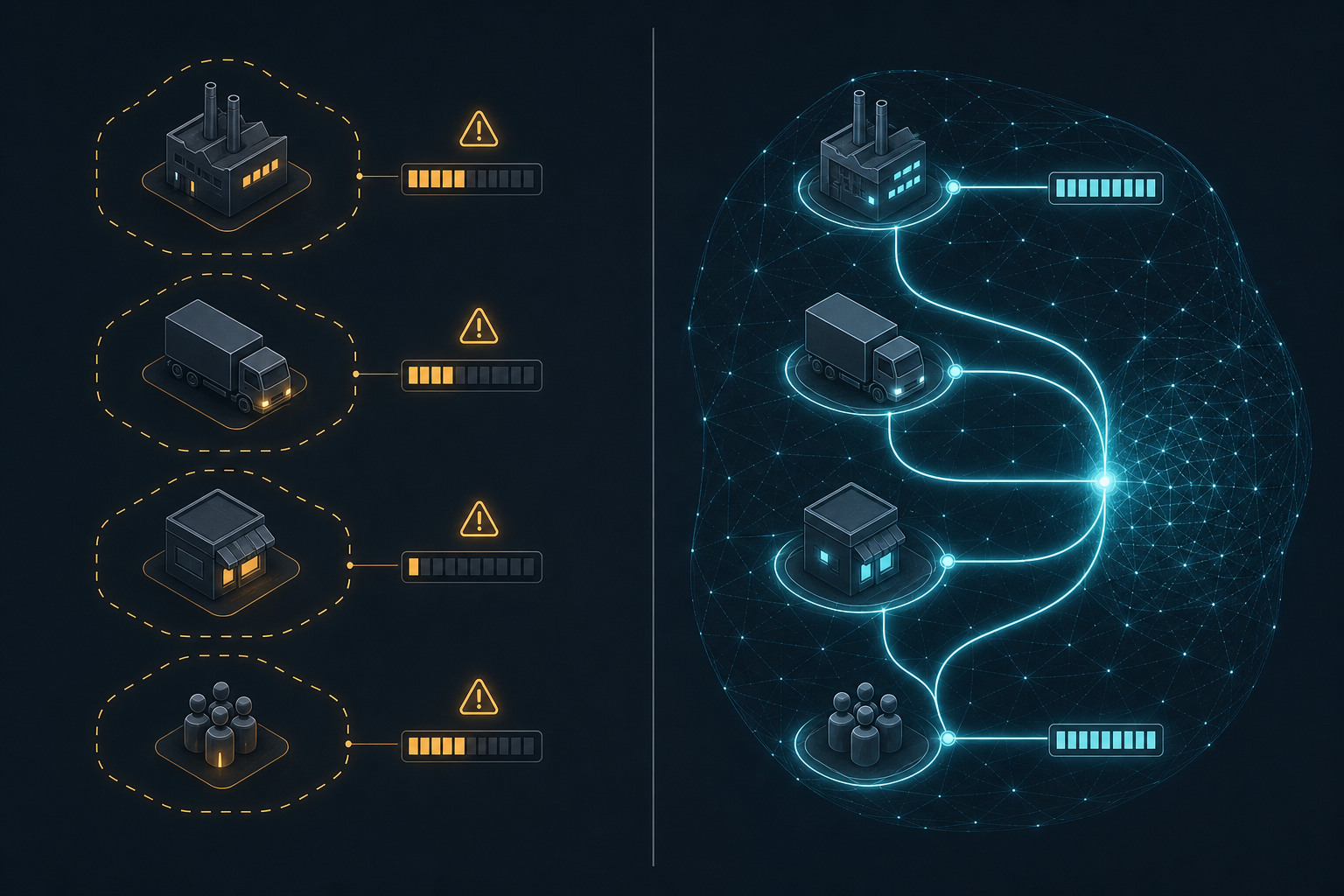
- Siloed ERP and WMS data: Fragmented data across systems is the most frequently cited failure cause. Both ICRON and o9 identify disconnected demand, supply, and inventory data as the primary barrier to MEIO functioning as designed. An AI model optimizing across echelons is only as good as the data flowing from each echelon — if WMS inventory positions are not visible to the planning system in near-real-time, the model is optimizing against stale inputs.
- Misaligned KPIs across echelons: When each echelon is measured on its own inventory turns, fill rate, or cost metrics independently, local optimization overrides network-wide policy. Regional DC managers who are penalized for stockouts will maintain higher buffers than the MEIO model recommends. Without KPI alignment that rewards network-level outcomes, the model's recommendations are routinely overridden.
- Overcomplicating models before data and governance are mature: ToolsGroup explicitly names this as a common failure path. Organizations that attempt to configure a full multi-echelon probabilistic model across their entire network before establishing clean data pipelines and governance processes typically produce a system that planners distrust and override manually — defeating the purpose of the investment.
- Insufficient change management and planner training: MEIO shifts inventory decisions from planner judgment to model-driven policy. Planners who do not understand the model's logic — or who lack confidence in its recommendations — will intervene manually, creating a hybrid that combines the cost of the AI system with the inconsistency of manual override. ToolsGroup and broader MHI/Deloitte adoption data both identify skills gaps and change management failures as a top barrier to AI supply chain deployment.
- Legacy system integration incompatibility: Many mid-to-large enterprises operate ERP instances and WMS platforms that were not designed to expose real-time inventory position data via API. Integration projects to connect these systems to an MEIO platform frequently extend timelines and absorb budget that was allocated to model configuration and training. This is especially acute in organizations with heterogeneous ERP landscapes across business units or geographies.
Data and Organizational Readiness Checklist Before Committing to MEIO
The following conditions determine whether an MEIO deployment is likely to succeed or stall. This is not a vendor-selection checklist — it is a self-assessment of organizational prerequisites. Organizations that cannot check the majority of these boxes should address readiness gaps before committing to a full MEIO platform deployment.
| Readiness Condition | Why It Matters | Common Gap Signal |
|---|---|---|
| Clean, integrated demand and sales data from ERP and POS/order management | MEIO models require accurate demand signals at each echelon; garbage-in produces confidently wrong inventory policies | Demand data lives in multiple disconnected systems with no single source of truth |
| Reliable lead-time data by supplier, lane, and product category | Lead-time variability is a primary input to safety stock calculation; missing or inaccurate lead times produce systematically wrong buffers | Lead times are manually maintained in spreadsheets or sourced from nominal contract terms rather than actuals |
| Current inventory position visibility across all echelons in near-real-time | MEIO requires knowing what is on hand and in-transit at every node to optimize across tiers; batch-updated snapshots introduce lag that degrades model performance | WMS data is available only as daily batch exports; in-transit inventory is not tracked |
| Defined, measurable service-level targets per echelon and customer segment | The model must know what it is optimizing toward; undefined or inconsistently applied service-level targets produce unstable policy recommendations | Service level is discussed qualitatively but not expressed as a specific fill-rate percentage per node or segment |
| Cross-functional KPI alignment that rewards network-level outcomes | Local KPIs override network-wide model recommendations unless incentives are aligned | Each DC or business unit is measured on its own inventory turns or fill rate independently of network performance |
| A scoped pilot product line or business unit for initial deployment | Full-network MEIO deployments that attempt to cover all SKUs and all nodes simultaneously have a poor track record; phased rollout allows model validation before scaling | Leadership expects a full-network deployment within the first six months |
| Planner training and change management plan in place before go-live | Planners who distrust the model will override it; overrides undermine ROI and create a hybrid that combines AI cost with manual inconsistency | No structured training program; planners have not been involved in model design or validation |
Adoption Maturity and Deployment Outlook
AI-powered MEIO sits at a Growing maturity level. Enterprise deployment is documented across pharma, CPG, retail, and industrial distribution, with a growing body of source-attributed outcome data. The deployment evidence is not theoretical — P&G, Caterpillar, ICA Sweden, and Carrier represent organizations at scale that have moved MEIO from pilot to production. But the evidence base also shows that most of the documented outcomes come from large enterprises with the data infrastructure and organizational capacity to support a multi-echelon model.
According to the MHI/Deloitte 2025 Annual Industry Report (as cited in WarpDriven's MEIO trend analysis), 28% of supply chain organizations are actively deploying AI today, with planned adoption expected to reach 82% by 2029. Investment intent is strong: 55% of supply chain leaders are increasing technology investment, with 60% planning to spend over $1 million. These figures reflect broad AI adoption intent across supply chain functions — not MEIO specifically — but they indicate the organizational and budget context in which MEIO decisions are being made.
Mid-market adoption remains constrained by data infrastructure gaps rather than by model availability. Most purpose-built MEIO platforms are technically accessible to mid-market organizations, but the prerequisite of clean, integrated, real-time inventory data across three or more echelons is a higher bar than many mid-market IT environments currently meet. The practical barrier is data readiness, not software cost.
Comments
Join the discussion with an anonymous comment.