

Why the Global Rollout Is the New Chapter
Most coverage of Walmart's AI inventory program focuses on its US origins: the Element platform, Self-Healing Inventory's domestic launch, and the Black Friday stress tests that validated the system at scale. That story is well-documented and largely complete.
The analytically distinct — and less examined — question is what happened next: how Walmart moved a proven US AI toolkit across borders into structurally different markets, and whether the architecture held. That is the subject of this case record.
For supply chain leaders at multinational organizations, the US-to-international transfer decision is the harder problem. Building AI inventory capability in a single home market is a bounded engineering challenge. Replicating it across markets with different logistics infrastructure, consumer behavior, regulatory environments, and data maturity is a different category of problem — one where most programs stall at the pilot stage.
Walmart's 2025 international rollout provides the supply chain industry's most detailed documented case of this specific challenge. The evidence is imperfect and the financial disclosures are partial, but the deployment pattern is real, the architectural decisions are traceable, and the organizational model is extractable. This article documents what is verifiable and is explicit about what is not.
Walmart International's Scale and the Globalize-vs-Localize Decision
Walmart International operates across more than 20 countries, with significant retail and fulfillment footprints in Mexico (Walmex), Canada, Chile, China, South Africa, and Central America, among others. The operational complexity is not uniform: store formats, fulfillment models, cold chain requirements, and supplier ecosystems vary substantially across these markets.
The core strategic decision Walmart made — and the one most relevant to other multinationals — was to export a proven AI toolkit rather than commission market-by-market builds. The alternative approach, where each regional operation procures or builds its own inventory AI capability, is common in large multinationals and produces predictable outcomes: inconsistent data schemas, incompatible models, and an inability to share learnings across markets.
The globalize-first approach requires a different precondition: a sufficiently mature and modular home-market system that can be parameterized for new environments without being rebuilt. By 2025, Walmart's US deployment had reached that threshold.
| Dimension | Globalize (Walmart's approach) | Localize-per-market (common alternative) |
|---|---|---|
| AI model development | Shared core logic, tunable regional parameters | Separate model builds per market |
| Data schema | Standardized across markets before deployment | Market-specific schemas, integration debt accumulates |
| Deployment cycle | Weeks to configure and deploy proven components | Quarters to build, test, and validate from scratch |
| Cross-market learning | Model improvements propagate across all markets | Siloed; improvements do not transfer |
| Organizational overhead | Central AI team manages shared codebase | Distributed teams, duplicated capability investment |
The AI Toolkit Being Deployed Internationally
Walmart moved a modular set of AI capabilities across borders, not a single monolithic system. Each component addresses a distinct operational problem and can be deployed independently or in combination.
- Self-Healing Inventory: Detects stock imbalances across the network — overstock in one location, stockout risk in another — and autonomously reroutes inventory overnight without requiring manual intervention. The system acts on its own recommendations within defined parameters, with human override available.
- Enterprise Inventory: A unified inventory visibility layer that consolidates stock position data across stores, distribution centers, and fulfillment nodes into a single operational picture. Serves as the data foundation that other AI tools draw on.
- Predictive WMS and TMS: Warehouse management and transportation management systems augmented with predictive models for inbound flow, slot allocation, and outbound routing. In produce logistics contexts, these models incorporate perishability windows and time-of-day routing constraints.
- Agentic AI natural-language query tools: Associates can query inventory status, shortage causes, and recommended actions in plain language and receive structured responses within seconds. The agentic layer translates natural-language questions into queries against the Enterprise Inventory data layer and surfaces actionable outputs — without requiring the associate to navigate complex dashboards or understand the underlying model.
- Trend-to-Product GenAI: A generative AI tool that identifies emerging consumer trends from external signals and translates them into product sourcing and inventory positioning recommendations. Deployed in markets where Walmart's private-label and general merchandise assortment is managed centrally.
The modularity of this toolkit is operationally significant. A market that has completed data standardization can deploy Enterprise Inventory first, establish the visibility layer, and then layer Self-Healing Inventory on top. A market with established inventory data but limited associate digital literacy can prioritize the agentic natural-language tools as a change management bridge. The components are sequenceable, not all-or-nothing.
Market-Specific Deployment Evidence
Walmart's corporate communications and secondary trade reporting document three international deployment cases with varying levels of quantitative detail. The financial outcome figure is available only for Mexico. The Costa Rica and Canada cases describe operational deployments without disclosed financial metrics.
| Market | AI Component Deployed | Documented Outcome | Source Type | Financial Figure Available? |
|---|---|---|---|---|
| Mexico (Walmex) | Self-Healing Inventory — overnight stock rebalancing across the store network | More than $55M in savings attributed to autonomous inventory rerouting | Walmart corporate press release, July 2025 | Yes — with scope caveats |
| Costa Rica | Predictive TMS — predawn routing for perishable produce deliveries | Produce routed to stores before opening based on predictive demand and perishability models | Walmart corporate press release, July 2025 | No financial figure disclosed |
| Canada | Predictive WMS — pre-assembled fulfillment orders staged before shift start | Fulfillment orders assembled in advance of associate arrival, reducing pick time and improving throughput | Walmart corporate press release, July 2025 | No financial figure disclosed |
The Costa Rica and Canada deployments are significant as deployment evidence even without financial disclosure. They demonstrate that the same underlying AI components — predictive routing and predictive warehouse staging — were configured and operational in markets with different logistics environments and store formats. That is the portability proof, separate from the financial proof.
The Costa Rica produce routing case is particularly instructive. Perishable logistics is one of the highest-complexity inventory optimization problems: demand windows are short, spoilage costs are direct, and routing decisions interact with both traffic patterns and store receiving schedules. The fact that Walmart's predictive TMS was operating in this context in a Central American market — not a high-data-density US metropolitan area — speaks to the robustness of the underlying model architecture.
The Architectural Decisions That Enabled Replication
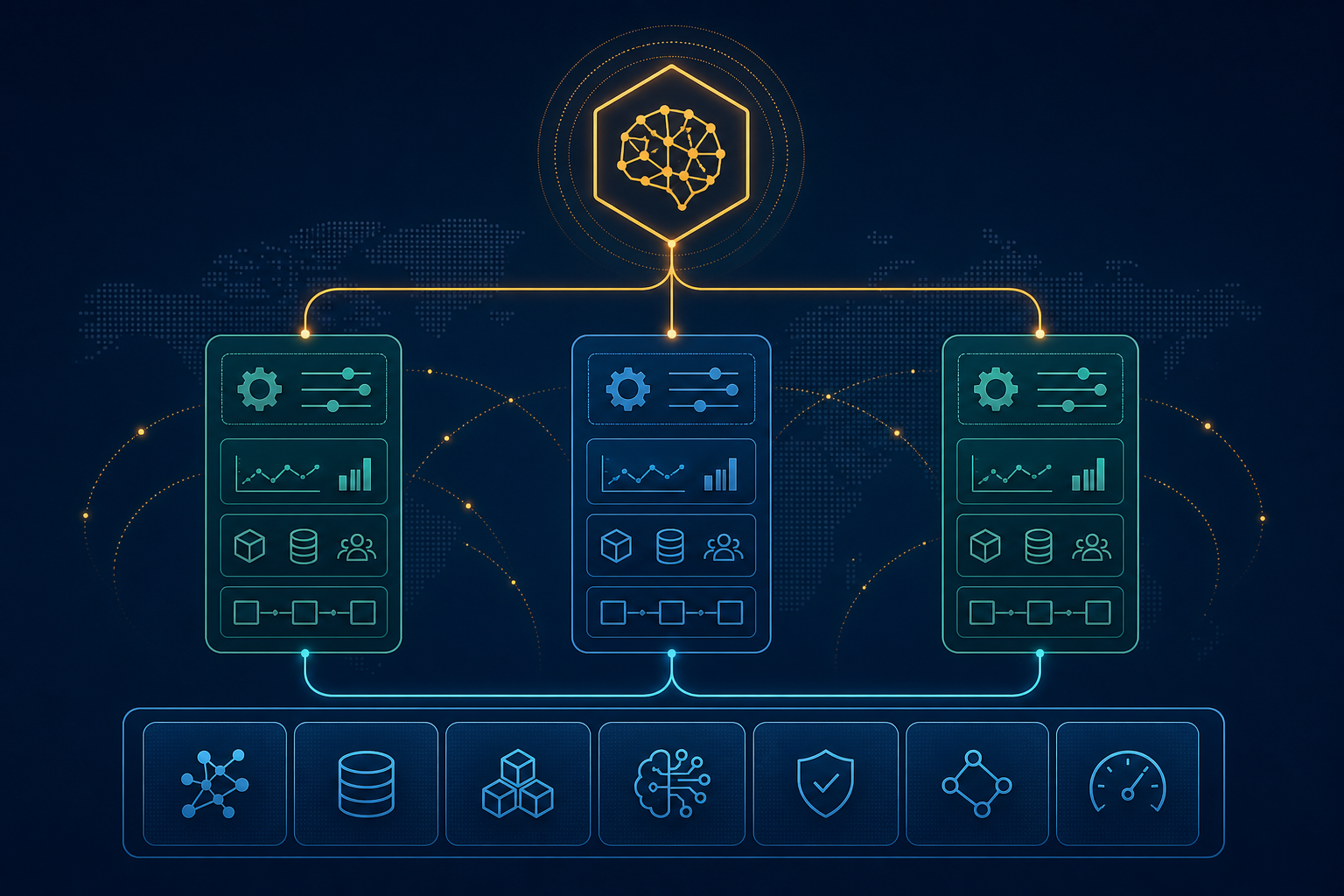
The architectural principle that made cross-border replication viable is what Walmart's technology leadership has described as a "standardized but configurable" design philosophy. The core AI logic — demand signal processing, stock imbalance detection, routing optimization — is shared across markets. What varies by market are the parameters: regional logistics network topology, store format constraints, consumer demand patterns, and local supplier lead times.
This distinction matters because it determines the deployment effort required to enter a new market. In a fully localized architecture, entering a new market means rebuilding the model from the data layer up. In a standardized-but-configurable architecture, it means configuring regional parameters against an already-validated core. The difference in calendar time is measured in weeks versus quarters.
- Shared core AI logic: The demand forecasting, imbalance detection, and routing optimization algorithms are maintained in a single codebase. Improvements validated in one market propagate to all markets through the shared layer.
- Tunable regional parameters: Market-specific variables — store cluster definitions, supplier lead time distributions, cold chain constraints, local demand seasonality — are configured at the deployment layer without modifying the core model.
- Reusable component libraries: Rather than building market-specific integrations from scratch, Walmart's teams deployed pre-built connectors and data pipeline components from the US deployment. The integration work shifted from construction to configuration.
- Data standardization as a prerequisite: Cross-border model reuse required that inventory, transaction, and supplier data from international markets be mapped to a common schema. This data standardization work was a prerequisite to deployment — and in some markets, it was the longest phase of the project.
- Unified tech stack as the enabling layer: The estimated 60% tech stack unification across Walmart International created the data infrastructure that allowed AI agents to share state across borders — enabling cross-market inventory coordination that would be impossible in a fragmented-stack environment.
A parallel signal of architectural maturity: in March 2024, Walmart began commercializing its Route Optimization capability as a SaaS offering through Walmart Commerce Technologies, making it available to external retailers. A company does not externalize a technology capability until it is confident the underlying architecture is stable and defensible. The SaaS commercialization decision is indirect evidence that Walmart's AI inventory stack had crossed the threshold from experimental to production-grade.
Organizational Enablers: Change Management and the Associate Empowerment Model
The technical architecture is only part of the international rollout story. Walmart's deployment succeeded in part because it addressed a predictable failure mode in AI inventory programs: the gap between model output and human action.
In markets where associates are unfamiliar with AI-generated recommendations, the risk is that the model produces accurate outputs that no one acts on — because the interface requires training that hasn't happened, or because the recommendation is presented in a format that doesn't translate to a clear action. Walmart's agentic natural-language query tools directly address this failure mode.
By allowing associates to ask questions in plain language — "Why is aisle 7 short on cooking oil?" or "Which stores have excess stock of this SKU?" — and receive structured, actionable responses within seconds, the agentic layer removes the training barrier that typically slows AI adoption in new markets. An associate in Costa Rica and an associate in Canada are interacting with the same underlying system through an interface that requires no model-specific knowledge to use.
- Natural-language interfaces reduced the training requirement for associates in new markets, compressing the change management timeline that typically accompanies AI tool rollouts.
- AI-generated recommendations were structured as actionable outputs — specific rerouting suggestions, specific restocking priorities — rather than abstract scores or signals that require human interpretation.
- Human override remained available at each decision point. Walmart's model is AI-recommended, human-confirmed for decisions above defined thresholds, and autonomous within defined parameters for routine rebalancing decisions.
- Accountability for AI-generated inventory decisions was assigned at the operational level — store managers and fulfillment leads retained responsibility for outcomes, with the AI system positioned as a decision-support tool rather than an autonomous authority.
Constraints and Honest Limitations
The Walmart international rollout is a useful reference case, but it comes with constraints that limit direct replicability for most organizations. Supply chain leaders evaluating this case for internal business cases should be explicit about these gaps.
- Data volume requirements: Walmart's AI models were trained on transaction data from thousands of stores across multiple years. The statistical confidence that makes the models reliable at Walmart's scale requires data volumes that most retailers — even large ones — do not possess. Models trained on thinner data will have wider prediction intervals and higher error rates.
- Proprietary MLOps infrastructure: Walmart operates a proprietary machine learning infrastructure that handles model training, versioning, deployment, and monitoring at a scale that is not commercially available as a packaged product. Organizations without equivalent internal engineering capability will need to rely on vendor platforms that approximate — but do not replicate — this infrastructure.
- Multi-billion dollar investment threshold: The AI capability Walmart deployed internationally was built over multiple years with investment levels that are not accessible to most organizations. The international rollout compressed deployment cycles, but the underlying capability required years of prior investment to reach the maturity that made replication viable.
- Data standardization lead time: Even for Walmart, data standardization across international markets was a prerequisite that required resolution before model reuse was possible. For organizations with more fragmented international data environments, this phase may take longer than the model deployment itself.
- Partial financial disclosure: The $55M savings figure is the only quantified financial outcome in the public record. Market-specific ROI for Canada and Costa Rica has not been disclosed. Organizations using this case to build internal business cases should not extrapolate the Mexico figure to other markets without independent modeling.
Benchmarking Takeaways for Multinational Supply Chain Leaders
The Walmart case generates a specific set of evaluation criteria that are useful for supply chain leaders assessing their own international AI inventory programs — or evaluating vendors who claim cross-border portability.
| Evaluation Dimension | What the Walmart Case Implies | Questions to Ask Your AI Vendor |
|---|---|---|
| Modular architecture | Components should be deployable independently and sequenced by market readiness | Can we deploy inventory visibility before autonomous rebalancing? What is the dependency chain? |
| Core vs. configurable separation | Core AI logic should be market-agnostic; regional parameters should be configurable without model rebuilds | What changes between markets — the model, the parameters, or both? Who owns that configuration? |
| Data standardization requirements | Cross-border model reuse requires a common data schema; this is a prerequisite, not a byproduct | What data schema do you require? What is the typical effort to standardize our international data to that schema? |
| Deployment cycle evidence | Weeks-not-quarters deployment cycles require reusable components and pre-built integrations | What was the actual deployment cycle for your most recent international market entry? What drove the timeline? |
| Human-in-the-loop design | Autonomous decisions should have defined thresholds and human override at escalation points | At what decision thresholds does the system require human confirmation? How are those thresholds set? |
| Cross-market learning | Improvements validated in one market should propagate to all markets through the shared model layer | When you improve the model in one market, how do those improvements reach other markets? What is the release cycle? |
| Financial outcome attribution | Vendor-reported outcomes should specify market, time period, and scope — not aggregate figures without attribution | Can you provide market-specific outcome data with defined scope and time period, not aggregate figures? |
Two organizational prerequisites emerge clearly from the Walmart case that are independent of technology vendor selection.
First, a unified international data layer is not optional. Walmart's ability to deploy the same AI components across Mexico, Costa Rica, and Canada depended on having resolved the data standardization problem before attempting model reuse. Organizations that attempt cross-border AI deployment before this prerequisite is met will encounter the data standardization work as an unplanned delay mid-deployment — which is more disruptive and more expensive than addressing it as a planned prerequisite.
Second, the change management model matters as much as the technology architecture. The agentic natural-language interface was not an afterthought — it was a deliberate design choice that addressed the adoption barrier in markets where associates have limited familiarity with AI-generated recommendations. Organizations evaluating AI inventory platforms should assess the associate-facing interface with the same rigor as the underlying model, particularly for international deployments where training capacity is constrained.
Comments
Join the discussion with an anonymous comment.