
In renewable energy supply chain optimization, the harder question is not whether AI can be used somewhere. It can. The harder question is where a renewable energy operator, manufacturer, or utility should put the first serious investment when every function has a plausible pitch: demand forecasting, predictive maintenance, logistics, procurement intelligence, storage management, and grid integration.
Executive attention is understandable. Precedence Research valued the global AI in renewable energy market at USD 20.63 billion in 2025 and projected it to reach USD 158.76 billion by 2034, a 25.65% CAGR.[1] That market curve explains why the topic is in more board decks. It does not prove that a specific supply chain team is ready to automate replenishment, change maintenance intervals, or trust a planning engine with constrained component availability.
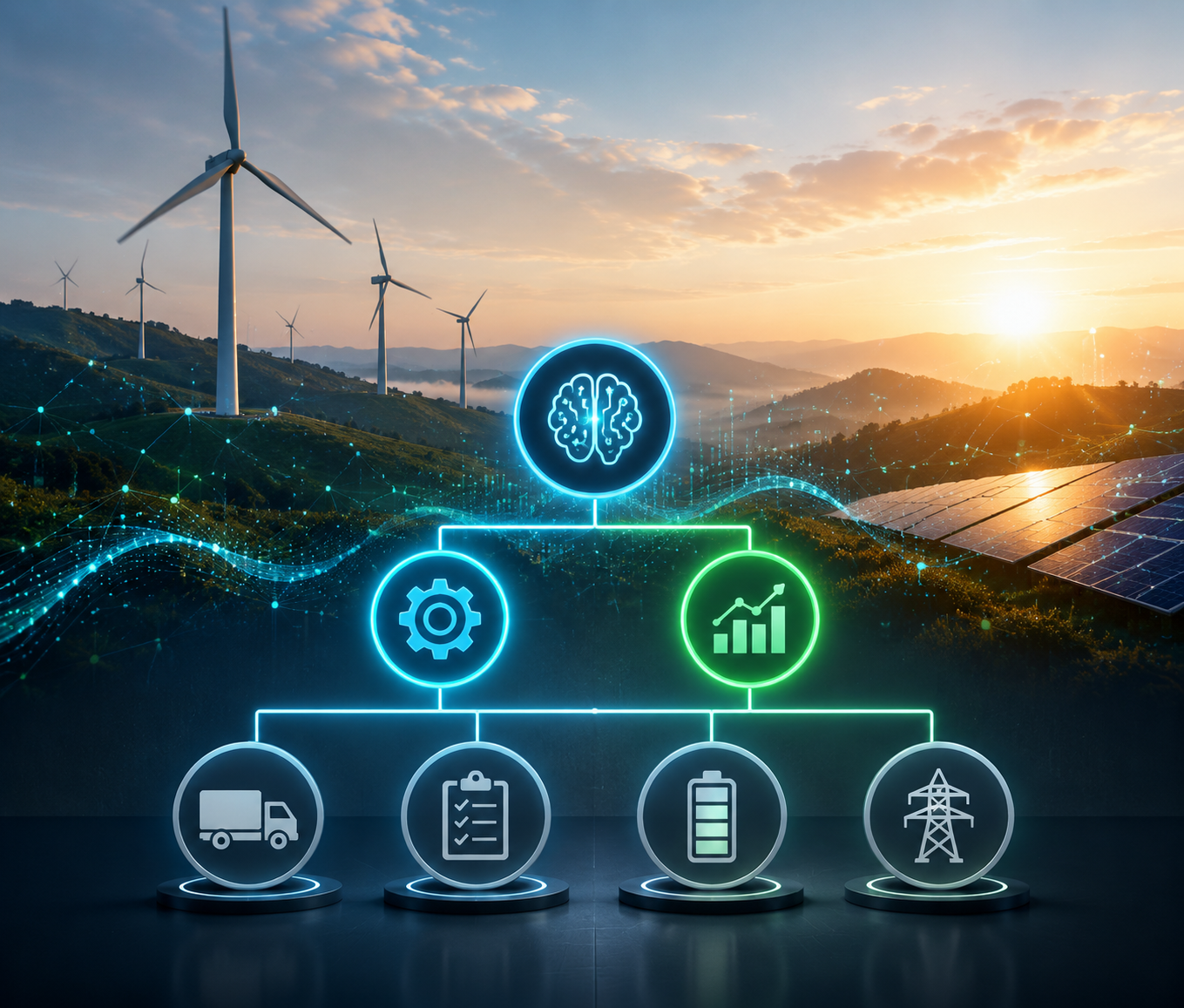
A useful catalog has to separate adoption potential from operating evidence. The strongest cases are the ones that connect identifiable inputs to a decision someone already has to make: which asset needs attention, which forecast should drive procurement, which shipment must be expedited, or which supplier risk is large enough to change the plan.
Start With The Use Cases That Touch Real Operating Plans
The Avathon and Ørsted deployment is a useful place to begin because it does not describe AI as a detached analytics layer. Avathon says its Autonomy Platform operates across 5.5 GW of Ørsted’s onshore and offshore wind, solar, and storage assets in the United States, consolidating SCADA, ERP, weather, and financial data into a single AI-driven operating plan.[2]
Those data categories matter. SCADA data tells a different story from ERP data. Weather forecasts move production assumptions. Financial data changes the cost of a decision. Maintenance and asset teams live with the consequences when those signals sit in separate tools and the operating plan is rebuilt by hand. A deployment that names the data streams and asset classes is more credible than a general claim that AI can “optimize renewables.”
It is still vendor-described evidence, not an independent benchmark. But as a proof point for readiness, it clears a higher bar than many AI claims in energy supply chains: named customer, named asset base, real operating environment, and multiple operational data systems being brought into one planning layer.
Predictive Maintenance Has The Clearest Line From Signal To Action
Predictive maintenance deserves first-tier attention because the operating problem is concrete. Wind turbines, solar assets, hydro turbines, inverters, storage systems, and balance-of-plant equipment already produce signals. The supply chain consequence is also concrete: if failure is detected too late, the team pays through downtime, emergency labor, expedited parts, and schedule disruption.
Futurice describes the shift from reactive to proactive maintenance as using sensor data from wind turbines, solar panels, and hydro turbines to reduce unplanned downtime and extend asset life.[3] The useful part of that framing is not the algorithm label. It is the change in work sequence: inspect fewer healthy assets, intervene earlier on deteriorating assets, and place parts before the maintenance window turns into an outage response.
For a supply chain leader, the maintenance model is only as valuable as the decisions it can trigger. A useful alert does not merely say an asset is abnormal. It should help the organization decide whether to reserve a component, move a technician visit, change the spares position, or defer work because the confidence level is too weak. That is where predictive maintenance becomes supply chain optimization rather than asset analytics.
The readiness conditions are also visible. The organization needs reliable sensor streams, asset hierarchy discipline, work-order history, parts consumption data, and a maintenance process willing to act on probability rather than waiting for failure. Where those inputs are scattered or incomplete, the first investment may be data alignment and work-order hygiene, not a model rollout.
What Makes This Use Case Easier To Defend
- The failure mode is operationally visible: downtime, missed generation, field labor, parts shortages, or maintenance backlog.
- The AI input is identifiable: sensor data, operating history, asset condition, weather exposure, and maintenance records.
- The decision path already exists: inspect, schedule, reserve parts, expedite, repair, or defer.
- The value can be measured against familiar baselines: unplanned downtime, emergency purchase orders, spares availability, and maintenance schedule adherence.
That combination is why predictive maintenance usually belongs near the top of the investment sequence. It does not require the company to redesign every planning process before value appears. It requires disciplined integration between asset health, maintenance execution, and materials planning.
Demand Forecasting Is Strong When It Changes Procurement And Inventory Decisions
Demand forecasting is the other first-tier use case because the cost of a poor forecast is absorbed across the entire renewable energy supply chain. Manufacturers carry inventory they do not need, miss parts they do need, rework production plans, and pay for premium freight when demand and supply assumptions diverge.
GEP says AI-driven forecasting has achieved up to 98% accuracy using SVM, ANN, and KNN models trained on weather, historical consumption, and real-time sensor data, citing multiple studies.[4] The phrase “up to” needs to stay in the sentence. It does not mean every renewable energy supply chain will reach that accuracy, and it does not say forecast accuracy alone produces savings. It does show why forecasting is a credible candidate when the data environment and decision process are mature enough.
The stronger business case comes when forecast improvement is tied to a downstream action: fewer emergency orders, better supplier commitments, more stable production schedules, or lower working capital without damaging service. A more accurate forecast that no planner trusts, or that procurement cannot translate into supplier releases, remains an analytics achievement rather than an operating improvement.
This is where renewable energy differs from cleaner textbook examples. Weather, interconnection timing, project delays, policy-driven demand changes, long-lead components, and supplier constraints can all move at once. AI can help connect those signals, but it cannot remove the need to define which forecast is being optimized: customer demand, generation output, spare parts consumption, production capacity, or logistics demand. Those are related, not interchangeable.
Planning And Procurement: The Spreadsheet Replacement Case Is More Important Than The AI Label
The o9 Solutions case study is valuable because it describes a familiar operating constraint: a global renewable energy manufacturer replacing siloed spreadsheets with o9’s AI-powered “Digital Brain” digital twin. The case reports improved forecast accuracy and reduced expedited logistics costs.[5]
That combination is more convincing than a generic procurement-intelligence pitch. The problem was not that planners lacked another dashboard. The problem was that planning assumptions lived in separate spreadsheets, which made it harder to align demand, supply, inventory, and logistics decisions. A digital twin has a practical role when it becomes the shared operating representation of constraints instead of another layer of commentary.
In renewable energy manufacturing, this matters because small timing errors can cascade. A nacelle component, inverter, transformer, battery module, or specialized part may not have a convenient substitute. If the forecast changes after supplier commitments are set, planners either accept delay, consume buffer inventory, or pay to move material faster. Reducing expedited logistics cost is therefore not a side benefit. It is a sign that the planning process is becoming less brittle.
The case is still vendor-published, and the available public evidence does not provide enough detail to generalize the size of the benefit. Its main value is the workflow evidence: replacing disconnected planning files with an AI-supported digital twin can be a supply chain transformation project, not just a forecasting model project.
Where Procurement Intelligence Fits
Procurement intelligence sits adjacent to demand forecasting and planning. It can help teams compare supplier risk, spot pricing movement, evaluate constrained components, and model alternate sourcing. The evidence base available here is thinner than for predictive maintenance and demand forecasting, so it should not be sold as equally proven across all renewable supply chains.
It is still worth monitoring because the pain is real. Renewable projects often depend on long-lead, capital-intensive, and geographically concentrated supply. A procurement model that identifies risk earlier can protect schedules, but only if the team has authority to change suppliers, split awards, adjust inventory policy, or pay for resilience. For disruption-heavy categories, related scenario-modeling practices in AI disruption planning are a useful comparison point because the same distinction applies: detecting risk is not the same as having an executable response.
Logistics Optimization Has Useful Benchmarks, But Attribution Needs Care
Logistics optimization is a credible use case when it targets specific frictions: premium freight, poor route planning, delayed project cargo, low container or trailer utilization, and weak visibility into parts movement. The available metrics are encouraging, but they should be handled carefully.
TraxTech reports that energy companies using AI in supply chains have seen 15% lower logistics costs, 35% reduced inventory, and 65% improved service levels, citing industry data.[6] Those figures are useful as a vendor-attributed benchmark, not as a universal renewable energy average. They do not tell a supply chain director whether the same gains will appear in offshore wind spares, solar module inbound logistics, battery manufacturing, or field-service parts.
The right way to use these metrics is as a prompt for baseline design. If the organization cannot currently measure logistics cost by lane, expedite rate by category, inventory turns by criticality, service level by asset class, and the root cause of late deliveries, then a quoted ROI percentage will be difficult to defend. AI may still be useful, but the first deliverable is measurement discipline.
Logistics AI becomes more investment-ready when it is connected to an operating trigger. A storm forecast may change route risk. A turbine failure may move a spare part from planned replenishment into emergency shipment. A project delay may free capacity that another site can use. These are not abstract optimizations; they are choices about what moves, when, and at what cost. Teams already working on weather-driven logistics can draw from adjacent practices such as AI hurricane disruption planning and flood-risk modeling for supply chains, while still validating whether the renewable-specific data is good enough to act on.
Storage Management And Grid Integration Are Strategically Important, But Less Proven As Supply Chain Priorities
Energy storage management and grid integration are often grouped with supply chain optimization because they affect asset utilization, dispatch decisions, maintenance timing, and infrastructure planning. They belong in the catalog. They should not automatically outrank predictive maintenance or demand forecasting in a 2026 supply chain investment sequence.
The Avathon-Ørsted deployment is relevant here because it includes storage assets alongside wind and solar in an AI-driven operating plan across 5.5 GW.[2] That shows cross-asset orchestration is not merely theoretical. It does not, by itself, provide a separate ROI case for storage optimization or grid integration as standalone supply chain initiatives.
For many supply chain teams, the near-term role of storage and grid intelligence is indirect. Better asset and generation planning can change maintenance windows, spares positioning, service crew allocation, and project timing. But the evidence available here is not granular enough to claim that AI-driven grid integration should be a first-wave supply chain investment for most organizations.
| Use case | Evidence strength in the available material | Best first question for investment sequencing |
|---|---|---|
| Predictive maintenance | Strongest operational fit; supported by named cross-asset deployment context and maintenance mechanism evidence | Can asset signals trigger maintenance and parts decisions before downtime occurs? |
| Demand forecasting | Strong; supported by forecasting accuracy evidence and clear downstream planning impact | Will forecast changes alter procurement, production, inventory, or logistics decisions? |
| Planning and procurement digital twin | Moderate to strong; supported by a vendor case tied to spreadsheet replacement, forecast accuracy, and expedited logistics cost reduction | Can the digital twin replace disconnected planning files and become the shared constraint model? |
| Logistics optimization | Moderate; supported by vendor-attributed benchmark metrics but requires local baseline validation | Which logistics cost or service failure is measurable enough to improve? |
| Procurement intelligence | Emerging; strategically relevant but less directly documented in the materials | Does the team have authority to act on supplier-risk signals? |
| Storage management and grid integration | Emerging for supply chain prioritization; strategically important but less granular in supply chain ROI evidence | Will improved asset orchestration change a supply chain decision, or only improve operational visibility? |
The Wider Supply Chain Evidence Supports Caution, Not Delay
There is also broader academic evidence that AI and renewable energy supply chain vulnerability are connected. A ScienceDirect study examined AI’s impact on renewable energy supply chain vulnerability using panel data from 61 countries over 2000–2019.[7] That scope gives the topic credibility beyond vendor material, but the time window matters. It predates the post-pandemic supply chain reset, the recent AI investment surge, and major changes in renewable energy industrial policy.
The study is best used as background support for the idea that AI can affect renewable energy supply chain resilience. It should not be used to claim that a 2026 deployment in a wind, solar, storage, or manufacturing environment will produce a specific cost reduction. That distinction matters in a business-case review, where the CFO will eventually ask whether the evidence describes the company’s decision, the vendor’s customer base, or a historical macro panel.
A Defensible First-Investment Hierarchy
The first investment should go where four conditions overlap: the operating problem is already expensive, the data inputs can be named, the decision owner is clear, and the outcome can be measured without inventing a new accounting language. On the evidence available, predictive maintenance and demand forecasting meet that standard most often.
Planning and procurement digital twins come next when the organization is visibly constrained by spreadsheet reconciliation, planning latency, and expedite costs. The o9 case is persuasive because it describes that exact movement from siloed spreadsheets toward a shared digital planning representation.[5] It is not a reason to buy a digital twin everywhere; it is a reason to investigate one where spreadsheet fragmentation is already causing measurable misses.
Logistics optimization belongs in the next tier when the organization has enough shipment, inventory, and service-level data to establish a baseline. TraxTech’s reported 15% logistics cost reduction, 35% inventory reduction, and 65% service-level improvement can help frame the upside, but the local business case should stand on current expedite spend, late-delivery causes, and inventory-service tradeoffs.[6]
Procurement intelligence, storage management, and grid integration should be watched closely and piloted selectively where the operating decision is already defined. They are not weak ideas. They are thinner-evidence supply chain investment candidates in the evidence reviewed here. A monitored opportunity is not the same as a rollout priority.
That hierarchy keeps the AI conversation close to the work renewable energy teams actually have to perform: keeping assets available, plans synchronized, suppliers aligned, and exceptions from becoming emergencies. The strongest business cases will not be the ones with the broadest AI ambition. They will be the ones that remove the next avoidable outage, expedite, planning miss, or reconciliation cycle.
References
- Artificial Intelligence in Renewable Energy Market, Precedence Research, October 2025.
- Renewables Solutions, Avathon.
- Energy supply chain, Futurice, 2024.
- Artificial intelligence: Accelerating the clean energy transition, GEP, 2024.
- Renewable Energy, o9 Solutions, 2026.
- AI-Powered Supply Chain Transformation: Energy Sector Shows the Way Forward, TraxTech.
- ScienceDirect article S0140988324000653, ScienceDirect.
Comments
Join the discussion with an anonymous comment.