
An AI chatbot for enterprise supply chain is no longer just a nicer search box bolted onto an ERP screen. In the better deployments, it sits between planners, buyers, logistics teams, warehouse supervisors, and the systems they already use, then turns a messy operational question into a recommended action, a routed exception, or a short list of decisions that still need a human owner.
That distinction matters in 2026 because board-level interest is running ahead of operating readiness. One industry roundup cites ABI Research’s finding that 94% of supply chain companies plan to deploy AI for decision support within two years, while Gartner is cited for the much smaller figure that only 23% have a formal AI strategy. The same roundup cites Precedence Research’s estimate that the AI in supply chain market was $9.94 billion in 2025 and could reach $236 billion by 2035 at a 37.3% CAGR, but market size does not tell a planner whether tomorrow’s allocation recommendation is safe to approve.[1]
BCG’s 2026 discussion of AI agents reports that 44% of companies have deployed AI in supply chain management, though the public article does not publish enough survey-methodology detail to treat that number as a universal benchmark.[2] RELEX’s 2026 supply chain AI research points in the same direction from a governance angle: 54% of supply chain leaders prefer hybrid augmentation over full autonomy, and fewer than 10% trust AI for fully autonomous critical decisions.[3] The useful conclusion is narrower than either the hype or the backlash: chatbots and agents are becoming business-case material where they remove friction from human-led workflows, but most enterprises are not ready to hand over decision rights.

First, separate chatbot, copilot, agent, and agentic AI
Vendors often use these words loosely. For a supply chain investment decision, the boundary should be operational rather than linguistic.
| Term | What it usually means in supply chain | Decision-right implication |
|---|---|---|
| AI chatbot | A conversational interface that answers questions, retrieves records, summarizes data, and may trigger simple workflows. | Low decision rights; mainly search, explanation, and task initiation. |
| Copilot | A role-aware assistant that recommends actions to a planner, buyer, customer service agent, or supervisor. | Human approves, edits, or rejects recommendations. |
| AI agent | A system that can pursue a goal across multiple tools, such as checking inventory, supplier status, transportation capacity, and policy constraints. | May execute bounded steps, but escalation rules and audit trails matter. |
| Agentic AI | A multi-step autonomous or semi-autonomous workflow that plans, acts, monitors outcomes, and adjusts its next action. | Requires explicit governance over autonomy, exceptions, and accountability. |
IBM frames AI agents as systems that use tools, data, and reasoning to complete goals, while emphasizing transparent decision logic and governance rather than invisible automation.[4] BCG and RELEX use similar distinctions when they separate decision support, human-in-the-loop execution, and more autonomous workflows.[2][3] In practice, the same vendor demo may include all four levels. The buying team needs to ask which part is live, which part is licensed, which part is roadmap, and which part can actually write back into ERP, WMS, TMS, procurement, or planning systems.
The eight places chatbots are already earning attention
The strongest enterprise cases do not start with a generic “ask me anything” assistant. They start with one recurring operational problem: a forecast no one understands, a supplier negotiation too small for sourcing to handle manually, a delayed shipment buried in a portal, an order blocked by allocation rules, or an exception that has bounced between teams for two days.
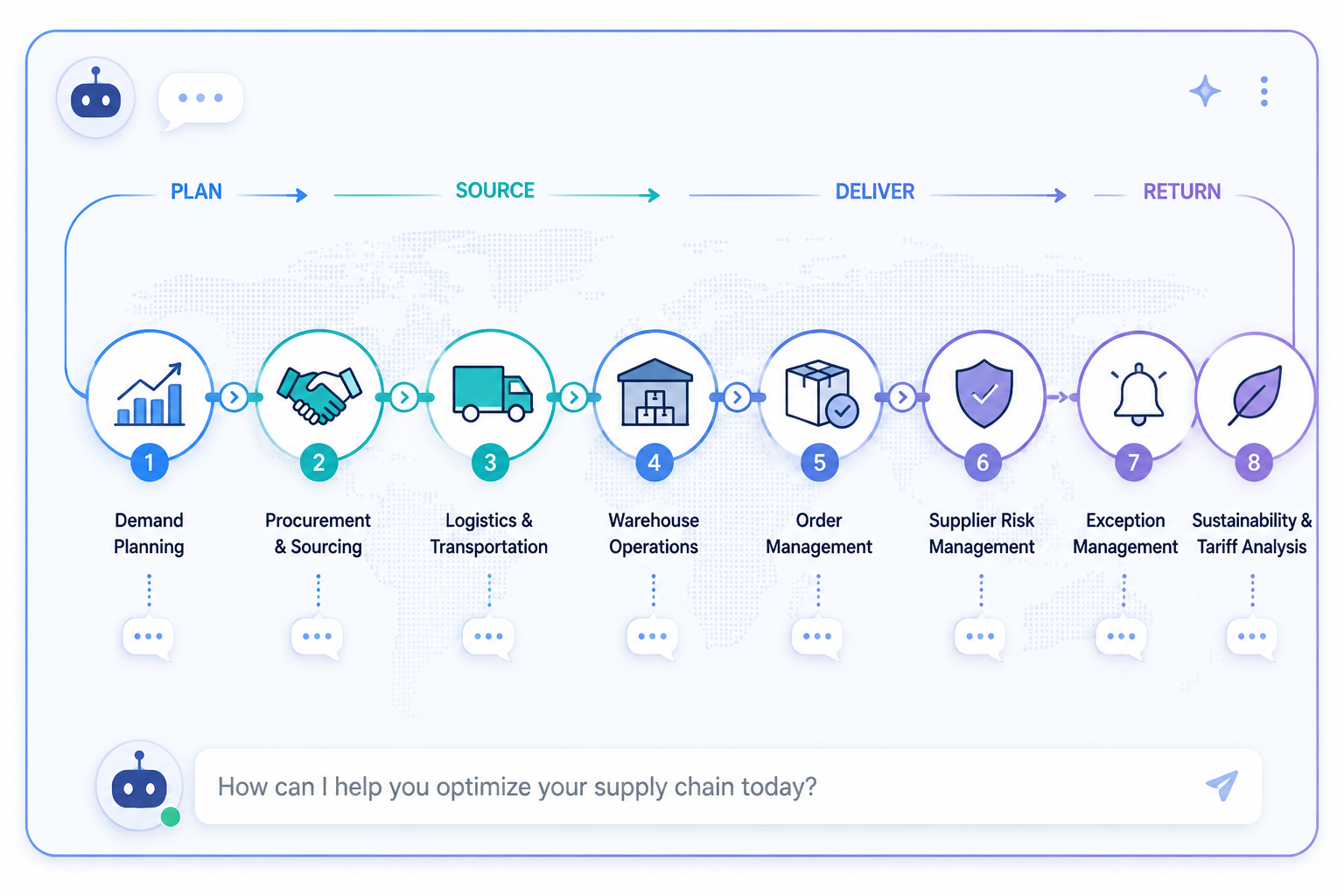
| Use case | Where the chatbot helps | Evidence strength |
|---|---|---|
| Demand planning and forecasting | Explains forecast drivers, flags outliers, compares scenarios, and helps planners understand recommended changes. | Strong for AI forecasting overall; chatbot-specific ROI is harder to isolate. |
| Procurement and sourcing | Runs guided intake, supplier Q&A, negotiation support, spend analysis, and in bounded cases autonomous tail-spend negotiation. | Strongest concrete case evidence, especially Walmart/Pactum, with provenance caveats. |
| Logistics and shipment tracking | Answers “where is it,” identifies delay risk, and reduces status-chasing across carriers and customer teams. | Credible pattern; much evidence is vendor or solution-led. |
| Warehouse operations | Helps supervisors query labor, slotting, replenishment, and exception queues without digging through WMS screens. | Vendor capability evidence is growing; deployment scope varies. |
| Order management and fulfillment | Supports available-to-promise checks, order status, backorder explanation, and service-agent triage. | Operationally plausible; mostly product and implementation evidence. |
| Supplier risk monitoring | Summarizes supplier signals and escalates risk changes from financial, geopolitical, compliance, and ESG inputs. | Useful if data feeds are reliable; risk scoring must remain explainable. |
| Exception handling and root-cause analysis | Connects alerts to likely causes, owners, and next actions across planning, logistics, procurement, and fulfillment. | One of the strongest workflow-orchestration opportunities. |
| Sustainability and tariff scenario analysis | Lets teams ask scenario questions about cost, emissions, sourcing alternatives, and tariff exposure. | Promising but often vendor-led and dependent on data model maturity. |
1. Demand planning and forecasting: make recommendations usable
Demand planning is usually presented as a forecasting problem. On the floor, it is also an explanation problem. A planner may receive a forecast that reflects seasonality, promotions, channel shifts, weather signals, sell-through, and inventory constraints, but the workday still starts with a practical question: “Why did this SKU-location forecast move, and should I override it?”
A supply chain chatbot can reduce the time between recommendation and action by translating model output into planner language. It can surface the demand drivers behind a forecast change, compare the current recommendation with last cycle’s plan, show which customers or channels are contributing to the variance, and draft an exception note for the planning meeting. That is not the same as proving the chatbot caused the forecast improvement; it is the interface layer that helps people use the forecast instead of ignoring it.
The broader AI forecasting case is meaningful. Gartner is cited as forecasting that 70% of large organizations will adopt AI-driven forecasting by 2030, and McKinsey is cited for the claim that AI-driven demand forecasting can reduce inventory by 20–30%.[1] Those figures support investment in AI-enabled planning, not a blank check for a conversational layer. The chatbot earns its place when it increases forecast adoption, reduces planner investigation time, or improves exception review discipline.
2. Procurement and sourcing: the clearest operational case
Procurement is where the business case becomes more concrete because the workflow has obvious friction. Buyers cannot personally negotiate every low-value or tail-spend supplier agreement. Suppliers wait for answers. Finance wants terms discipline. Legal wants guardrails. Category managers want leverage, but not another inbox.
The Walmart/Pactum case is the one worth studying, with care. An AI to ROI case study published in April 2026 reports that Walmart used Pactum’s autonomous procurement agent to negotiate with more than 2,000 suppliers simultaneously, achieving 3% average savings, extending payment terms by 35 days, reaching a 68–72% supplier agreement rate, and reporting 83% supplier satisfaction.[5] The numbers are operationally plausible because the use case is bounded: structured negotiation, defined commercial levers, approved guardrails, and supplier opt-in. They should still be verified against the primary HBR, CIO Dive, Pactum, and Thunderbird materials before being treated as independently validated performance benchmarks.
This is where conversational AI can do more than answer policy questions. It can guide intake, classify requests, draft RFx documents, summarize supplier responses, compare negotiated concessions, and escalate only the cases that exceed policy, risk, or value thresholds. In tail-spend settings, the chatbot or agent can keep the conversation moving when a human buyer would otherwise never get to the file.
The surrounding procurement evidence also supports targeted investment. Open Sky Group’s roundup cites McKinsey for AI-enabled procurement spend analysis delivering 5–15% procurement spend reduction.[1] Coupa cites Hackett Group research that AI cuts resources devoted to transactional procurement activities by 30%.[6] Those numbers point to spend analytics and process automation broadly, not chatbot ROI alone. The procurement chatbot business case should therefore separate three buckets: savings from negotiated outcomes, labor capacity released from transactional work, and compliance gains from routing more spend through approved workflows.
For teams moving from pilot to production, procurement is also where decision rights need to be written down early. What can the bot offer? Which payment-term changes require human approval? Which suppliers are excluded? What happens when the supplier asks for a non-standard clause? A deeper look at procurement deployment patterns belongs in AI procurement pilot-to-production patterns, because the hard part is rarely the demo conversation. It is the operating model around it.
3. Logistics and shipment tracking: fewer status chases, faster escalation
Logistics chatbots usually start with shipment visibility because the pain is familiar. Customer service asks transportation for an ETA. Transportation checks the TMS, a carrier portal, an email thread, and maybe a warehouse departure scan. By the time the answer comes back, the customer has already asked again.
Conversational logistics tools can pull shipment status, appointment times, proof-of-delivery information, delay explanations, and carrier contact history into one response. Telnyx describes conversational AI for logistics around shipment updates, carrier communication, and customer-facing tracking experiences, including UPS and FedEx-style tracking examples.[7] TheNoah.ai similarly describes chatbot use cases for communication and tracking across supply chain participants.[8]
The measurable gain is not that someone can ask “Where is order 481?” in natural language. The gain comes when the system recognizes that the late shipment affects a priority customer, checks whether inventory exists at another node, alerts the correct transportation planner, and gives customer service a consistent explanation. That is where a chatbot starts to behave like a workflow layer rather than a tracking widget.
4. Warehouse operations: supervisors need exception answers, not dashboards
Warehouse supervisors already have dashboards. The problem is that a dashboard does not always explain which constraint matters first. A useful warehouse chatbot lets a supervisor ask why wave release is slipping, which pick zones are short on labor, which replenishments are blocking priority orders, or whether a dock appointment delay will affect outbound cut-off.
Oracle’s AI for SCM materials describe more than 80 warehouse and logistics AI agents, along with procurement-related agents such as Sourcing Command Center and Contract Advisor.[9] That is a serious signal that major SCM suites are packaging agent capabilities inside operational workflows. It is not, by itself, proof that every customer can switch on all of those agents in every region, release, or license tier.
Warehouse use cases should be evaluated against the WMS reality: data latency, task interleaving, labor standards, inventory accuracy, device availability, and supervisor trust. If the assistant cannot see current work queues or write approved actions back into the execution system, it may still help with Q&A and training, but it will not materially change throughput or service levels. Buyers comparing suite roadmaps may also want a broader Blue Yonder, Manhattan Active, and Oracle SCM comparison before treating agent counts as equivalent capability.
5. Order management and fulfillment: explain the promise before it breaks
Order management is where supply chain, sales, finance, and customer service collide. A conversational assistant can help answer questions that are simple to ask and painful to resolve: Can we promise this date? Why is this order on hold? Which line is short? Can we split ship? Which customer gets the constrained inventory?
Druid AI’s 2026 discussion of must-have conversational AI features for supply chain includes order management and fulfillment use cases, including support for process automation and role-specific interactions.[10] SAP also presents Joule capabilities for supply chain planning, including an Exception Management Agent and Inventory Investment Allocation Agent, which shows how planning and fulfillment conversations are starting to merge around constrained supply decisions.[11]
The accountability question is sharper here than in simple status tracking. If the assistant recommends reallocating scarce inventory from one customer to another, someone must own the commercial rule, the service impact, and the audit trail. The chatbot can explain the rule and prepare the action; the enterprise still needs a policy for who approves exceptions to that rule.
6. Supplier risk monitoring: summarization is useful, scoring needs scrutiny
Supplier risk chatbots are appealing because risk signals are scattered. Financial deterioration, geopolitical exposure, sanctions changes, ESG controversy, late deliveries, quality escapes, and capacity warnings rarely arrive in one neat record. A conversational layer can summarize the current risk picture for a supplier and tell a category manager what changed since the last review.
Oracle, Coupa, and Zycus all describe AI-enabled procurement or supply chain capabilities that touch sourcing, supplier intelligence, procure-to-pay automation, and agentic procurement workflows.[6][9][12] These are credible application patterns, especially for monitoring and triage. The weak point is not the conversation; it is whether the underlying risk feeds are complete, current, licensed for this use, and explainable enough for a buyer to challenge the output.
A good supplier-risk chatbot should therefore show source attribution, confidence, and the reason for escalation. “Supplier risk increased” is not enough. The user needs to know whether the increase came from a late shipment trend, a financial filing, a country-risk change, a quality incident, or a missing certification. Without that trail, the assistant creates a new review burden instead of reducing one.
7. Exception handling and root-cause analysis: where the interface becomes orchestration
Exception handling is the use case that often separates useful supply chain chatbots from attractive demos. Most companies do not lack alerts. They lack clean ownership, root-cause context, and a short path from alert to action.
BCG reports that agentic AI at a global consumer packaged goods company reduced administration costs by 40–60%.[2] The public example should be treated as a directional case rather than a universal cost-reduction promise, but it points to the right type of work: administration that sits around the decision, including gathering context, checking policies, preparing responses, routing approvals, and updating systems.
In a supply chain control-tower environment, an exception assistant can connect symptoms that would otherwise be reviewed separately: a supplier delay, a missed inbound appointment, a production schedule change, a constrained finished-good allocation, and a customer order at risk. Instead of asking five teams for status, the manager gets a proposed cause chain, the affected orders, recommended actions, and the person who must approve each action. For readers building that operating model, control tower AI use cases with proven ROI is the more natural companion topic.
This is also where integration work becomes unavoidable. A chatbot that only reads alert text can summarize the problem. A chatbot that can query ERP orders, WMS inventory, TMS milestones, supplier commitments, and planning constraints can help resolve it. The difference shows up in cycle time, not in the polish of the chat window.
8. Sustainability and tariff scenario analysis: useful questions, difficult data
Sustainability and tariff analysis are good fits for conversational interfaces because the business questions are naturally scenario-based. What happens if we shift sourcing from one country to another? Which lanes increase emissions? Which suppliers expose this product family to new tariff assumptions? What is the cost-service-emissions trade-off if we change the network?
RELEX describes agentic AI capabilities for supply chain optimization and scenario modeling, while Oracle presents SCM AI agents that include sustainability-oriented analysis.[3][9] These use cases should be scoped carefully. A chatbot can make scenario exploration easier, but the answer is only as good as the product classification, bill-of-materials, supplier-origin, lane, emissions-factor, and tariff data behind it.
This is not a reason to avoid the use case. It is a reason to start with decision support. Let the assistant assemble assumptions, compare scenarios, identify missing data, and prepare a recommendation packet. Do not let it silently convert uncertain master data into confident sourcing decisions.
What to measure before approving the business case
The most useful AI chatbot metrics are tied to a named workflow. If the goal is procurement, measure negotiated savings, cycle time, supplier response rate, policy compliance, and buyer capacity. If the goal is exception handling, measure time from alert to owner assignment, time from owner assignment to approved action, number of manual handoffs, and avoided service failures. If the goal is planning, measure forecast-adoption behavior and override quality, not just model accuracy.
- Decision changed: the assistant must affect a forecast, buy, allocation, shipment, order, supplier review, or scenario recommendation.
- Human owner named: every recommendation needs an approver, escalation path, or automated-action boundary.
- Source visible: users should see which system, document, supplier record, or external signal supports the answer.
- System connected: the workflow should specify whether the chatbot only reads data, drafts actions, or writes back to enterprise systems.
- Benefit traceable: savings, time reduction, inventory impact, service improvement, or risk mitigation should be measured against a baseline.
Deloitte is cited in the Open Sky Group roundup for the view that AI ROI in supply chain typically takes two to four years to materialize.[1] That timeline is uncomfortable but realistic. Supply chain chatbots touch master data, workflow design, integration, user trust, and governance. The pilot may look fast; the production operating model usually is not.
The governance line: augmentation first
The near-term deployment stance should be conservative in decision rights and ambitious in workflow relief. Let chatbots retrieve, explain, compare, summarize, draft, route, and recommend. Let agents execute bounded steps where policies are explicit and rollback is possible. Keep humans in the loop for supplier commitments, customer-impacting allocations, material forecast overrides, high-value sourcing decisions, and risk judgments that require commercial accountability.
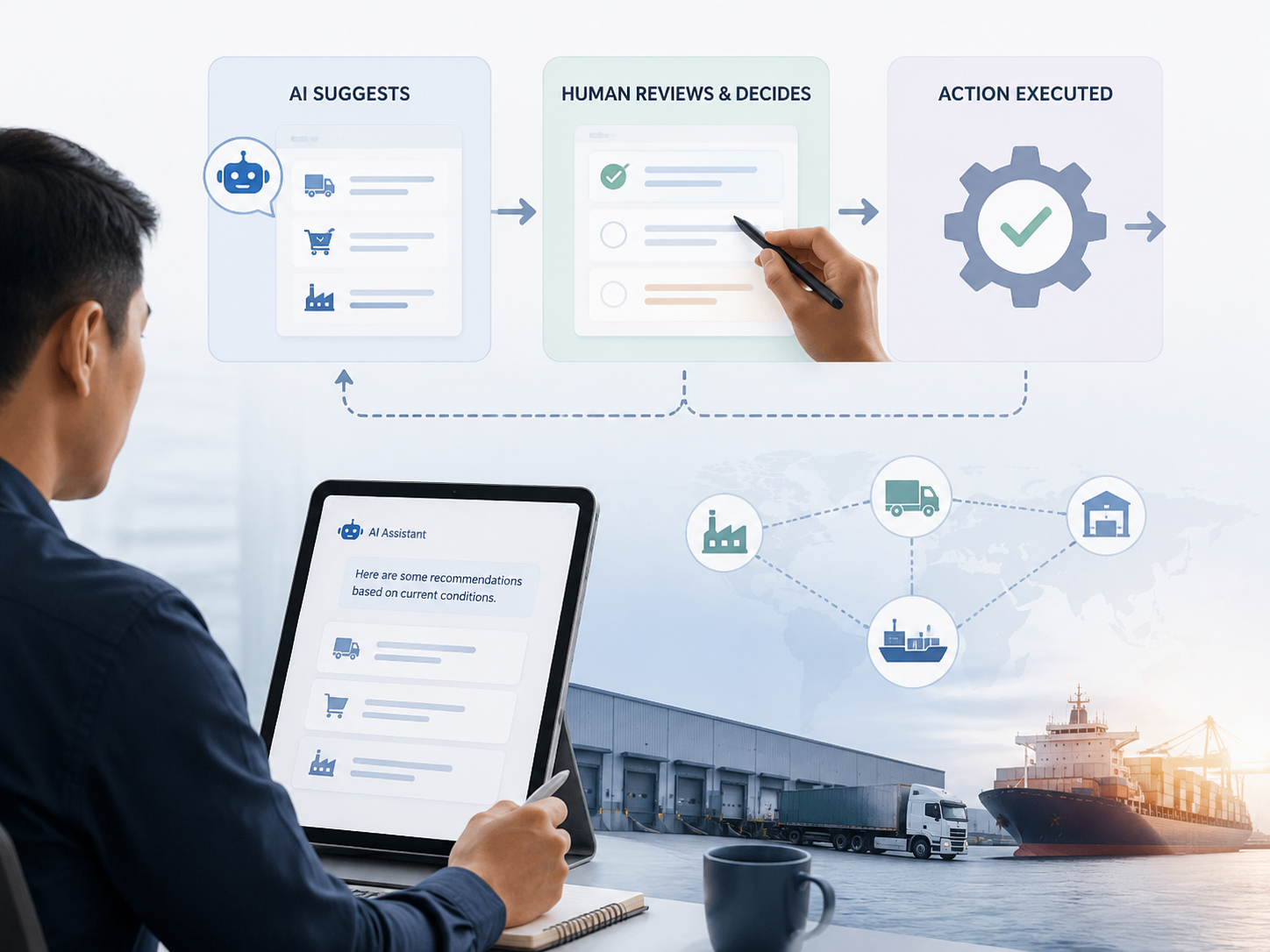
Integration should be treated as part of the product, not a later technical task. ERP, WMS, TMS, procurement, planning, supplier-management, and data-lake connections determine whether the assistant can resolve work or only describe it. A practical starting point is an ERP integration plan for AI supply chain tools before vendor selection reaches final scoring.
This is also why many pilots stall. A team proves that a chatbot can answer useful questions, then discovers that production requires identity controls, source attribution, data-quality remediation, approval design, change management, and exception ownership. The failure mode is predictable enough that AI agent pilot failure in supply chain deserves attention before the first proof of concept is scoped.
Enterprise supply chain chatbots are ready for serious funding where they augment high-friction workflows: procurement negotiation support, exception handling, forecast explanation, shipment-status triage, warehouse supervision, order resolution, supplier-risk monitoring, and scenario analysis. They are not ready to be treated as autonomous supply chain managers. The practical path is human-in-the-loop deployment, verified source attribution, explicit decision rights, integration planning, and ROI expectations measured over two to four years rather than one impressive demo.
References
- Supply Chain AI Statistics: 18+ Statistics You Should Know for 2026 — Open Sky Group
- How AI Agents Are Transforming Supply Chains — BCG, 2026
- Supply chain AI in 2026: The numbers behind the hype — RELEX Solutions
- AI Agents in Supply Chain — IBM
- AI to ROI Case Study: Walmart's Autonomous Procurement Agent — AI to ROI / Pactum, 2026
- AI in Supply Chain Management — Coupa
- Conversational AI for logistics — Telnyx
- 6 Ways AI-Powered Chatbots Transform Supply Chain — TheNoah.ai
- Oracle AI for SCM — Oracle
- Conversational AI for Supply Chain: 6 Must-Have Features — Druid AI
- AI Assistant for Supply Chain Planning — SAP Joule
- AI in Supply Chain & Procurement: A Practical Guide 2026 — Zycus
Comments
Join the discussion with an anonymous comment.