
The dangerous part of fresh-produce contamination is not finding it; it is finding it before the lot leaves control. Once suspect product is blended, repacked, or shipped, QA is no longer screening a lot; it is explaining a recall. Oregon State University's deep-learning model matters because it detected live bacterial microcolonies on produce within 3 hours and filtered out food debris that would otherwise create false classifications, while FoodReady reports that AI-native traceability cut mock recall time from 4-8 hours to 10-30 minutes and reduced data errors by 85-95%. [1][2]
The economic pressure sits behind that clock. FoodReady also cites the WHO's estimate of 600 million annual foodborne illness cases and industry studies that place average direct recall cost at about $10 million, which is why a faster hold matters even when the model is only a screen, not a verdict. [2]
That is the real test for AI in produce contamination traceability: can it change the moment QA acts? A model that only improves classification on a dashboard does not help much; a model that gets a lot on hold before it mixes with clean inventory does.
What the screening tools are actually doing
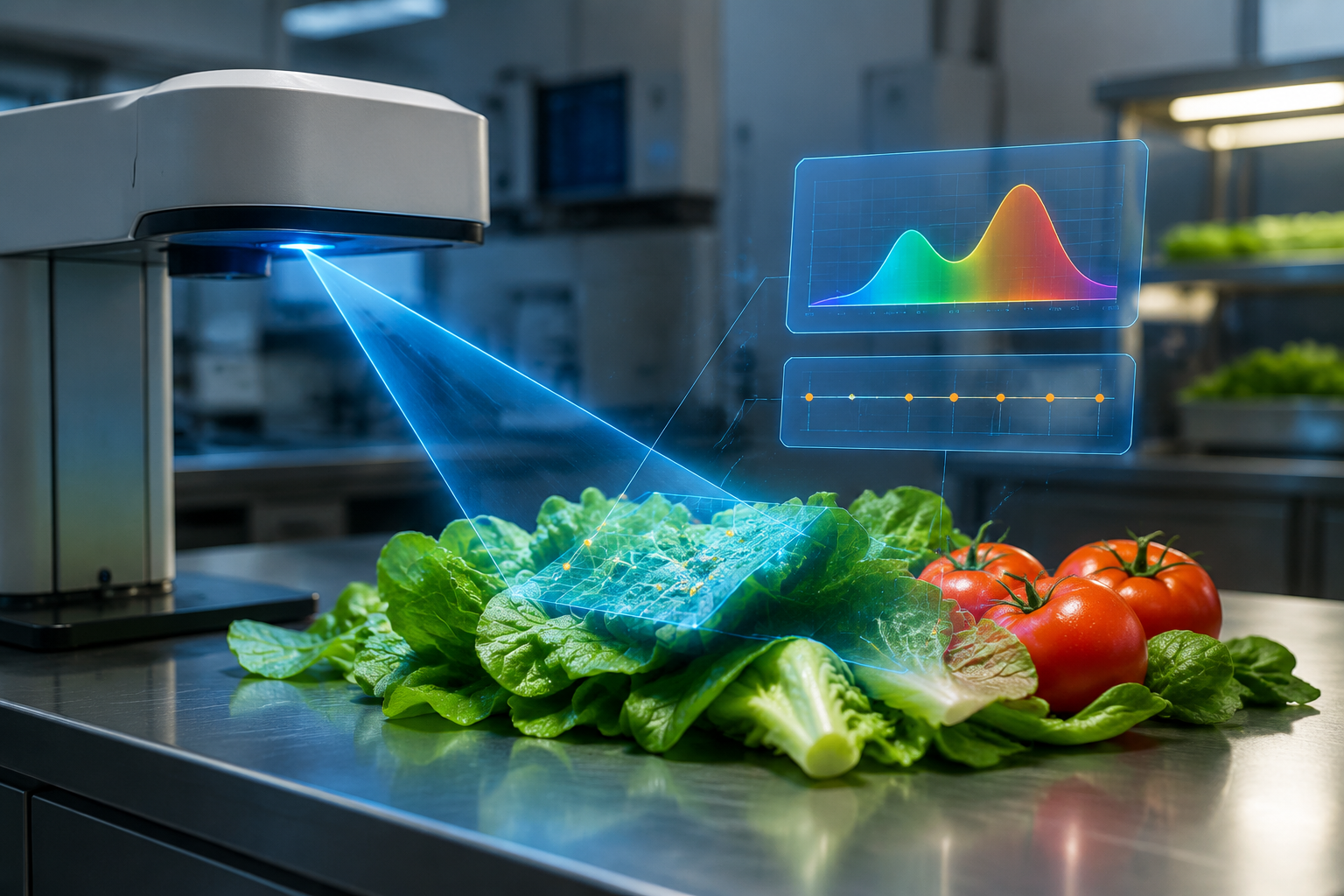
The studies that matter here are not all doing the same job, but they point in the same operational direction: spectral fingerprints become model input, and model output becomes a screening decision.
| Method | What it screened | Reported result | Operational read |
|---|---|---|---|
| Deep-learning imaging [1] | Live bacterial microcolonies on produce | 96% accuracy, within 3 hours; debris filtered out | Useful for early holds before contamination is obvious |
| Transformer + SERS spectroscopy [3] | Pesticide residues on spinach | 98.4% accuracy | Shows a spectral screen can classify residue risk quickly |
| Smartphone-embedded colorimetric sensing [4] | Spoilage detection in fish | 99.6% accuracy; 0.1-second processing time | Shows how fast a field screen can be, though not on produce |
That mix matters because each signal plays a different role. SERS and hyperspectral methods turn a surface or residue pattern into something a model can sort. Transformers help with residue classification when the signal is noisy. CNNs are useful when the spectral pattern needs spatial or local feature extraction. Smartphone colorimetry is less about laboratory elegance and more about getting a usable answer at the edge of the process, where a line supervisor or QA tech can act without waiting on a bench. The point is not that one architecture wins every contest; the point is that the screening window gets short enough to justify a preventive hold.
How the signal becomes a hold
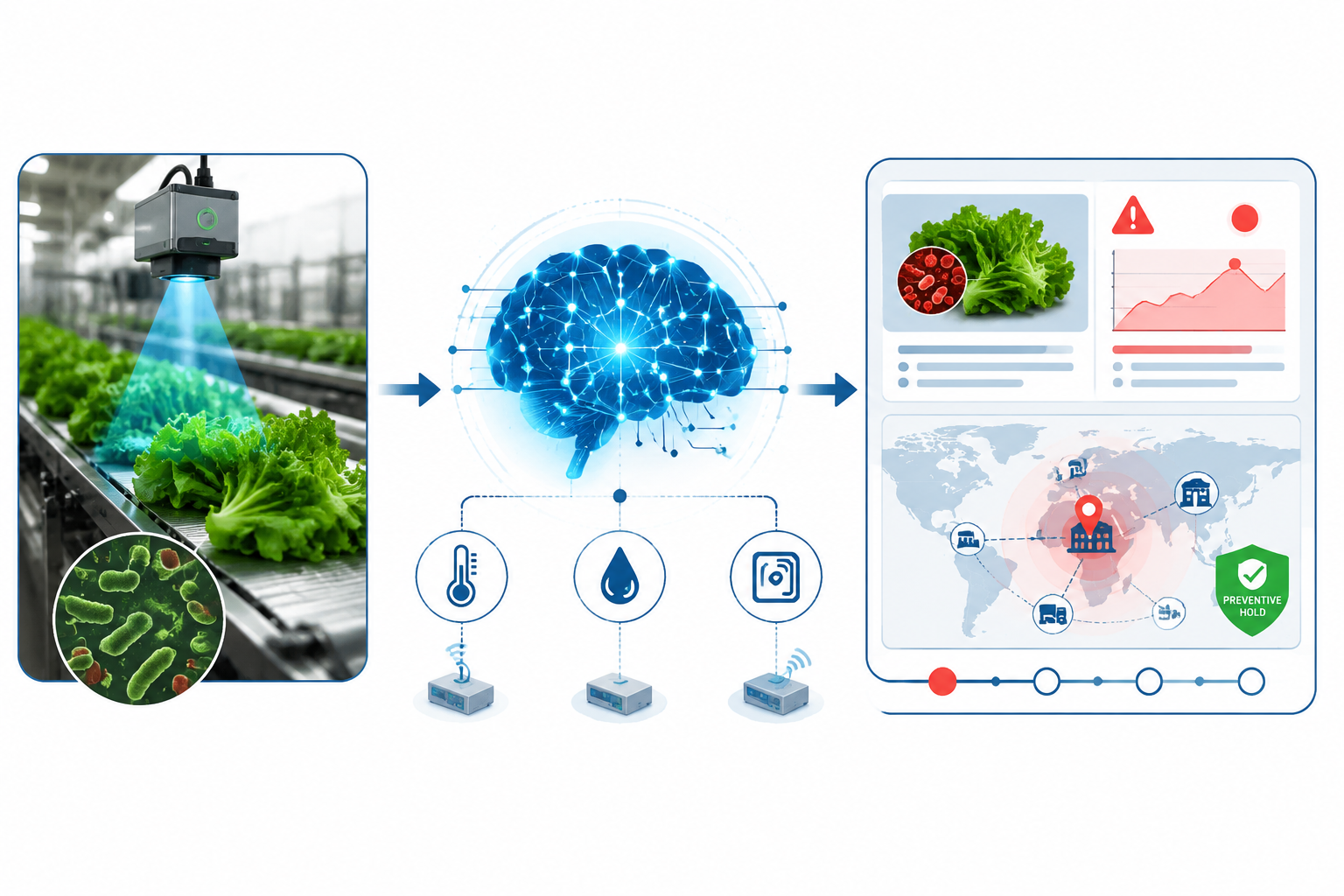
A useful deployment is never just one sensor. Temperature and humidity tell you whether the cold chain drifted; spectral scanners tell you whether the surface signature changed; RFID lot tracking tells you where the lot has already been; the traceability platform ties those signals to cases, pallets, and receiving records. That is why cold-chain control and traceability should be wired together, not treated as separate projects.
- Temperature and humidity history show whether the lot moved through a storage or transit excursion.
- Spectral scans provide the biological or chemical fingerprint that the model can rank.
- RFID and lot genealogy show which cases, pallets, and touching points are already inside the blast radius.
- The traceability layer turns a risk flag into a preventive hold and a narrower search.
That is the same logic behind FSMA 204 traceability workflows: the difference is that predictive detection moves the first decision earlier, before the suspect lot becomes a customer issue.
Where the evidence stops
The limits are plain. The strongest numbers here come from controlled studies, mostly on spinach, fruit, or fish, so they prove that the method can work in narrow categories and lab conditions, not that every conveyor line will see the same performance. [1][3][4] The OSU result is especially relevant because it handled real food debris, but it is still a study result, not a promise of commercial throughput. [1]
So the useful role is screening and prioritization. These models are strong enough to tell QA where to place the preventive hold first and which lots deserve confirmatory testing, but they do not replace lab verification or regulatory judgment.
References
- New AI model improves accuracy in food contamination detection - Oregon State University, 2026
- Transforming Food Safety With AI-Native Traceability Across Hundreds of Facilities - FoodReady
- Transformer-based machine learning and SERS spectroscopy for pesticide residue classification on spinach - Journal of Hazardous Materials, 2024
- Smartphone-embedded machine learning colorimetric system for on-site spoilage detection - Talanta, 2024
Comments
Join the discussion with an anonymous comment.