
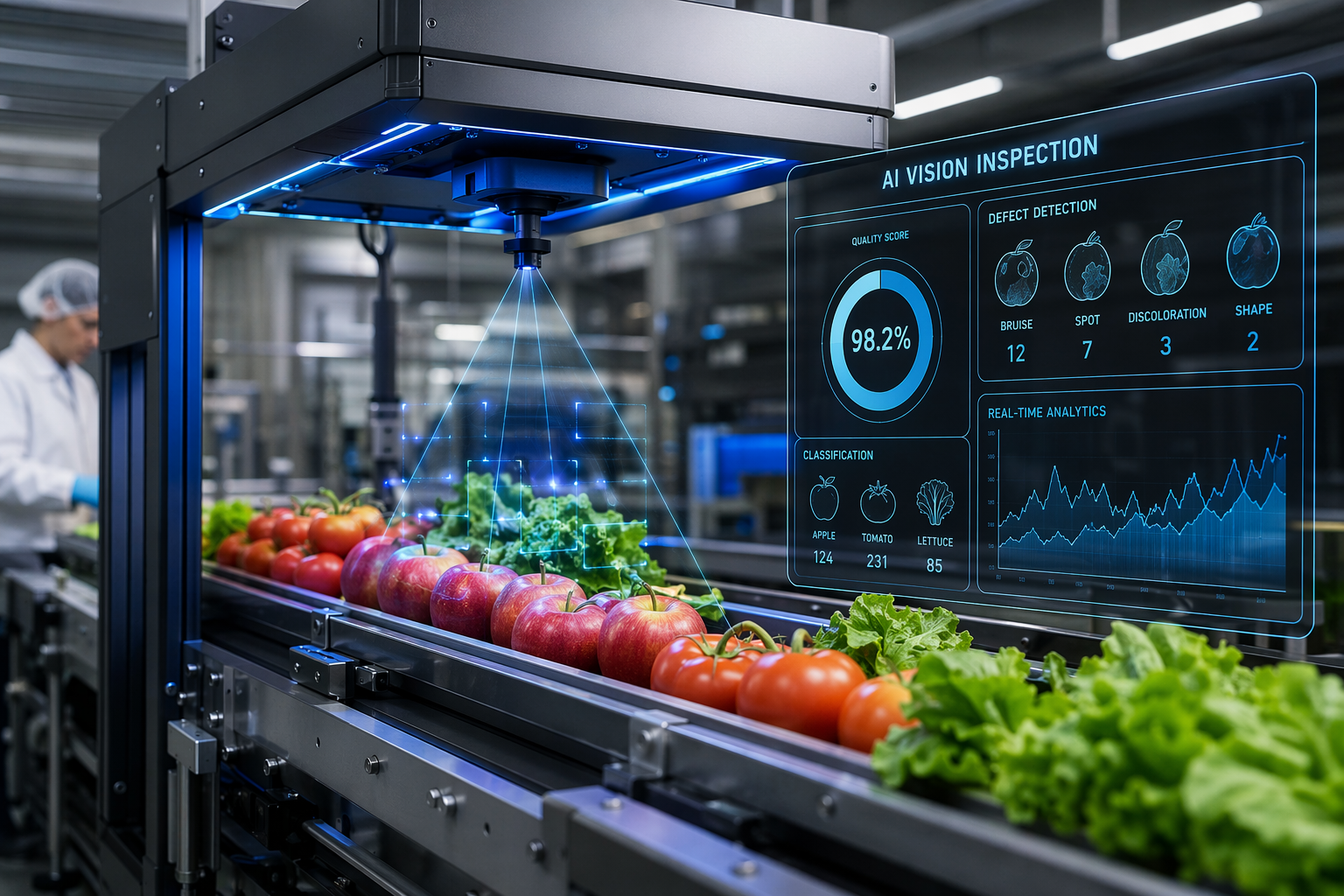
On a produce line, inspection is not an abstract data problem. Product arrives wet, irregular, bruised in ways that look different by variety and season, and sometimes riding the belt in clumps instead of neat single-file rows. The operator at the reject station has seconds to decide whether a dark spot is decay, soil, shadow, insect damage, or just the normal uneven color of a piece of fruit. For teams evaluating AI for produce supply chain food safety, the real question is whether computer vision can make that call at belt speed without turning safe, saleable product into waste.
That is where the evidence has become harder to ignore. IONI reports that PepsiCo AI computer vision deployments on snack-food processing lines achieved more than 95% defect detection accuracy at full line speed, while Nestlé systems for wrapper integrity and fill-level inspection reduced manual checks by 80% and identified defects in real time.[1] Those are useful business signals, but they are also second-hand reported figures, and snack-food or packaged-goods inspection is not the same as loose, high-moisture produce. The stronger conclusion is narrower: AI vision has crossed into production-relevant inspection, and fresh produce buyers should now test it seriously against their own defects, lighting, presentation, and reject rules.
The old inspection problem was never just eyesight
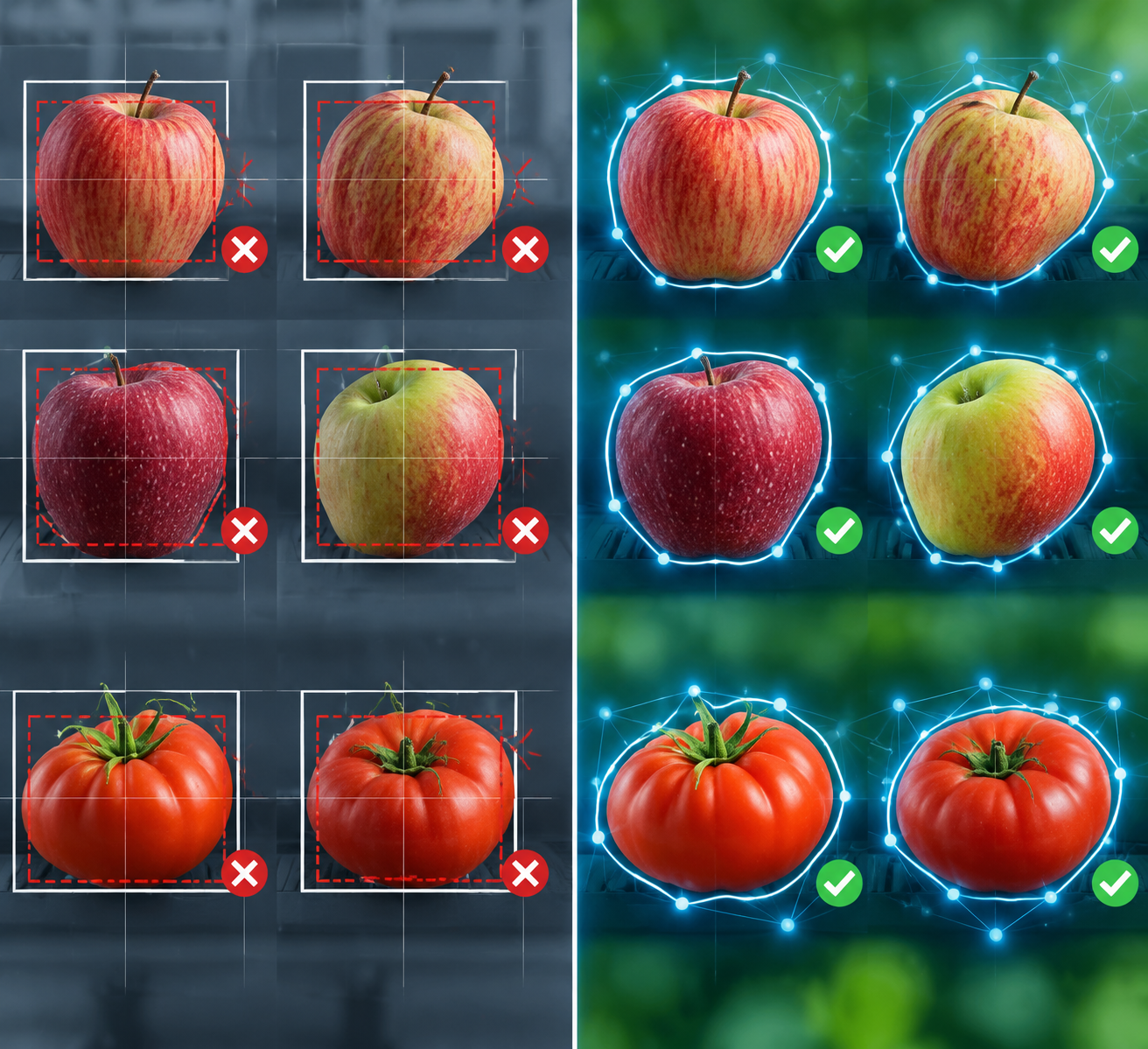
Traditional machine vision worked best when the product was predictable. A camera could check whether a package seal crossed a fixed boundary, whether a label sat inside a box, or whether an object matched a tight color range. Produce does not behave that politely. Apples rotate. Tomatoes vary by cultivar and ripeness. Leafy greens fold over themselves. Moisture changes reflectance. Field soil and harmless scarring can look enough like defects to confuse a rigid rule.
Robovision describes the central limitation clearly: rule-based vision systems struggle with the natural variability in shape, color, and texture that defines food products, while deep learning systems can adapt to those visual differences by learning from examples rather than relying only on fixed thresholds.[2] That distinction matters on a produce line because the cost of brittleness shows up in both directions. Missed defects create safety and quality risk. Over-rejection fills totes with good product, increases rework, and makes the system unpopular with the people who have to run it.
Human inspection is still valuable, especially when judgment depends on context. But hours of looking at irregular product moving quickly under plant lighting is a fatigue problem. Even good inspectors become inconsistent late in a shift or when product presentation deteriorates. The strongest use case for AI vision is not replacing judgment everywhere; it is making the high-volume, repetitive first call more consistent, then routing uncertain or high-risk cases to people who can act on them.
What counts as production-ready evidence
A useful accuracy number has to answer more than “did the model work in a lab?” It should say what product was inspected, how fast images were processed, which defects counted, how product was presented to the camera, and what happened to false positives. The available research is not equally strong across all produce categories, but it does show why the technology deserves budget-level attention in 2026.
| Evidence | What it supports | What it does not prove |
|---|---|---|
| PepsiCo reported 95%+ defect detection at full line speed | AI vision can perform at production tempo in food manufacturing | It does not directly prove the same performance on delicate fresh produce |
| Walnut sorting at 96.1% accuracy and 60 ms/image | Deep learning classification can be fast enough for high-throughput sorting | Results may change with different commodities, defects, and belt presentation |
| Hyperspectral and X-ray AI work reaching 99.4% segmentation accuracy | Advanced imaging can detect some defects or contaminants beyond ordinary visual inspection | Segmentation accuracy is not the same as end-to-end plant performance |
| Nestlé reported 80% reduction in manual checks | Vision systems can reduce inspection labor in bounded packaged-goods tasks | It should not be used alone to forecast produce-line labor savings |
The walnut result is especially relevant because it ties accuracy to speed. A 2025 Foods review described walnut sorting with 96.1% accuracy at 60 milliseconds per image, a processing time that belongs in a production conversation rather than a slow bench test.[3] Walnuts are not berries or leafy greens, and the article is a review rather than a single fresh-cut produce deployment report. Still, it answers one of the first questions operations leaders ask: can the model keep up?
The same review also points to why ordinary RGB cameras may not be enough for some safety and quality targets. It reports AI combined with X-ray and hyperspectral imaging for subsurface defects and contaminants invisible to the human eye, including a cited hyperspectral segmentation result of 99.4% accuracy.[3] That is not a blanket promise that every hidden defect can be caught on every line. It does show that the inspection toolbox has expanded beyond what a tired inspector or a color camera can see.
Trade and professional coverage now reflects the same movement from experiment to implementation. IFT Food Technology Magazine’s 2026 coverage describes AI reshaping food safety across multiple applications, including produce-sector deployments, while The Packer’s 2025 produce-focused perspective separates practical uses from hype.[4][5] That split is the right one. The technology is no longer speculative, but the buyer still has to prove the application.
Why deep learning changes the reject decision
The practical breakthrough is that deep learning can learn the difference between acceptable variation and unacceptable defect from many examples. A rule-based system might be told that a dark region over a certain size should be rejected. A deep learning model can be trained on many images where dark regions mean different things: stem-end shadow, harmless russeting, rot, embedded debris, insect damage, bruising, or soil. The model is not reasoning like a QA manager, but it can learn visual patterns that fixed rules handle poorly.
That matters because produce inspection is full of borderline calls. If the threshold is too loose, defects pass. If it is too aggressive, the reject stream gets expensive. The best systems do not remove that trade-off; they make it adjustable and measurable. A FSQA director should be able to review sample rejects, see which defect class triggered the decision, compare false rejects against false accepts, and tune the operating threshold for the risk profile of the product.
For safety-critical contaminants, the threshold may need to favor sensitivity even if waste increases. For cosmetic defects on a lower-grade pack, the same plant may choose a different setting. A system that only advertises one accuracy number without showing threshold behavior is not giving operations enough information to run the line.
The deployment conditions that make or break accuracy
Most failed vision projects do not fail because the idea is wrong. They fail because the plant reality was treated as an afterthought. Training data, lighting, belt speed, presentation, camera angle, and retraining discipline all decide whether a model that looked strong in a demo still performs during a wet, high-volume run.
Training data has to look like the product you actually run
Representative data is not a box to check once. A produce model needs examples across varieties, suppliers, growing regions, maturity levels, seasonal appearance changes, packaging formats, moisture levels, and normal defect ranges. If a berry model is trained mostly on clean, dry, evenly spaced fruit, it has not learned the Monday morning run where product arrives wetter, softer, and more clustered than the sales demo showed.
The labeling process also deserves more respect than it usually gets. Someone has to decide what counts as decay versus pressure bruising, foreign material versus field debris, minor cosmetic damage versus rejectable defect. If the labels are inconsistent, the model learns inconsistency. FSQA should own the defect definitions, not just receive a model score from engineering or a vendor.
Lighting and presentation are food safety controls, not cosmetic details
A camera sees what the line lets it see. Overlapping leaves hide surfaces. Rolling fruit exposes some sides and not others. Glare from moisture can wash out color differences. Shadows from guards, uneven belt surfaces, or poorly placed fixtures can create false defects. These are not minor installation issues; they are inspection conditions.
Before shortlisting a vendor, operations should ask how the system handles singulation, product rotation, belt loading, vibration, water, sanitation cycles, and lighting drift. A camera enclosure that works on a dry snack line may need different protection, cleaning access, and mounting on a wet produce line. The best technical proposal is the one that has already thought about the floor drain.
Line speed must be validated with rejects, not just images
Processing an image quickly is only part of the timing chain. The system has to capture the product, classify it, trigger the reject mechanism, and remove the right item at the right point on the belt. If the reject actuator is late, if the belt tracking is loose, or if product clumps together, a good model can still create bad outcomes.
A line trial should therefore measure end-to-end performance: detected defects, missed defects, false rejects, reject accuracy, rework burden, sanitation interruption, and operator intervention. Accuracy that only lives in an image folder is not the same as accuracy after product has hit the reject chute.
Model drift is a maintenance task
Produce changes. Suppliers change. Varieties change. Weather changes the product before it ever reaches the plant. Packaging and lighting changes can alter what the camera sees. A model that performed well during commissioning can drift as the product mix moves away from the data it learned from.
That means the operating plan should include retained images, periodic review of misses and false rejects, retraining triggers, version control, and sign-off rules for model updates. If a vendor cannot explain how model updates are tested before release, the plant is accepting a new kind of uncontrolled process change.
Where ROI actually comes from
The business case for AI vision is strongest when it is built from the line outward. Labor savings matter, and the Nestlé figure reported by IONI shows why executives pay attention to inspection automation.[1] But in fresh produce, labor is only one part of the calculation. A good model can reduce rework, stabilize grading, cut avoidable waste from false rejects, increase documentation, and catch defects earlier before value has been added downstream.
The avoided-cost side is harder to present cleanly but may be more important. A missed contaminant or severe defect that ships can trigger customer complaints, chargebacks, intensified inspection, lost confidence, or recall exposure. AI vision does not eliminate those risks. It can add a consistent detection layer at a point where manual inspection is most vulnerable to speed and fatigue.
The cost side should include more than cameras and software. Plants should budget for installation engineering, lighting, enclosures, reject hardware, data labeling, validation runs, operator training, sanitation access, IT integration, cybersecurity review, storage for retained images, and ongoing model maintenance. A proposal that looks cheap because it ignores those items is not cheaper; it is incomplete.
| ROI input | What to measure during validation |
|---|---|
| Defect detection | Miss rate by defect class, not only overall accuracy |
| False rejects | Weight or cases of good product rejected under normal operating thresholds |
| Labor impact | Manual checks reduced, rework added, and supervision still required |
| Throughput | Line speed maintained during normal belt loading and peak conditions |
| Maintenance | Time required for cleaning, calibration, review, labeling, and retraining |
| Traceability | Image retention, event logs, audit access, and linkage to lot records |
What buyers should verify before a pilot becomes a purchase
A vendor demo can show that the model recognizes obvious defects. A purchase decision needs to show that the system can run under plant conditions and that the organization can maintain it after the vendor team leaves. The pilot should be designed around the product’s real failure modes, not around the easiest images to classify.
- Define the defect classes before testing: foreign material, decay, discoloration, bruising, size, shape, stem defects, packaging defects, or other line-specific targets.
- Run validation across normal product variation, including different suppliers, varieties, maturity levels, moisture conditions, and belt loading patterns.
- Measure false accepts and false rejects separately; an attractive overall accuracy number can hide an unacceptable miss rate for the defect that matters most.
- Test the complete reject event, including timing, actuator accuracy, product spacing, and rework flow.
- Require a model maintenance plan that covers retained images, relabeling, retraining, approval, rollback, and performance monitoring.
- Clarify who owns the data, who can access images, and how inspection records connect to lot-level food safety documentation.
The pass/fail question is not whether AI can inspect produce. It can, for bounded tasks, when the line is set up for it. The better question is whether the proposed system has seen enough of your product, at your speed, under your lighting, with your reject standard, to be trusted as part of the control program.
Where computer vision fits in the produce safety stack
AI vision is strongest at intake, sorting, trimming, grading, packaging, and other points where the product or package can be presented consistently enough for inspection. It is not a substitute for supplier controls, sanitation, environmental monitoring, preventive maintenance, or finished-product release procedures. It is another inspection layer, and it should be judged by whether it improves the decisions already required on the line.
It also complements, rather than replaces, distribution-side food safety work. Inspection catches visible or image-detectable problems before product ships; temperature and handling controls protect product after it leaves the facility. For the distribution side of the same risk picture, see AI-driven food safety optimization for the cold chain.
In 2026, AI computer vision is mature enough for serious produce inspection upgrades, especially where the task is bounded: known defect classes, defined contaminants, controlled presentation, and measurable reject outcomes. The buying decision should not rest on a single accuracy claim. It should rest on line-specific validation, representative data, controlled imaging conditions, threshold behavior, and a maintenance plan that keeps the model honest as the product changes.
References
- How AI Is Transforming Food Safety in 2026, IONI.
- Visual Food Inspection: How AI is Transforming Food Manufacturing, Robovision, February 2025.
- AI-Powered Innovations in Food Safety from Farm to Fork, PMC / Foods Journal, June 2025.
- How AI Is Reshaping Food Safety, IFT Food Technology Magazine, June 2026.
- AI in Produce: Practical Uses, Pitfalls and What's Next, The Packer, October 2025.
Comments
Join the discussion with an anonymous comment.