
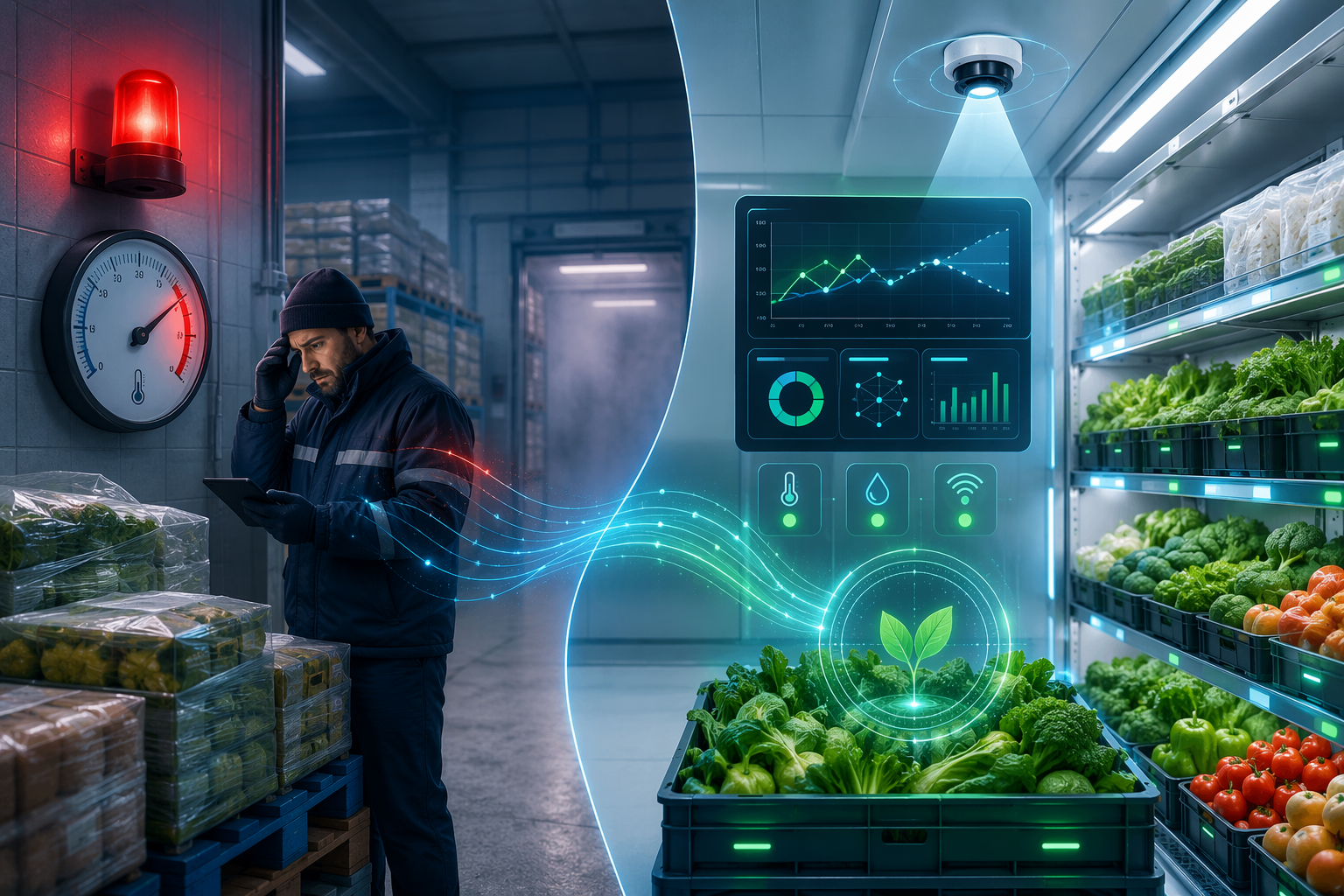
A cold chain alarm rarely arrives at the beginning of a food safety problem. It arrives after a threshold has already been crossed, when the QA manager has to decide whether product can be released, the logistics lead has to explain dwell time, and a store team may be staring at produce that still looks saleable but has lost days of usable life. The better question is no longer simply whether the trailer, case, or room became too warm. It is how long the product was exposed, what that did to remaining shelf life, what action could still prevent waste or safety risk, and whether the record is clean enough for an audit.
That is where AI food safety supply chain optimization becomes useful: not as another dashboard, but as a way to turn cold chain signals into earlier decisions. The most credible systems connect temperature, location, equipment behavior, product age, demand, and traceability into one operating view. They do not remove human judgment. They give quality, logistics, merchandising, and compliance teams a better decision trail before the product is already in question.
From Alarms To Shelf-Life-Aware Control
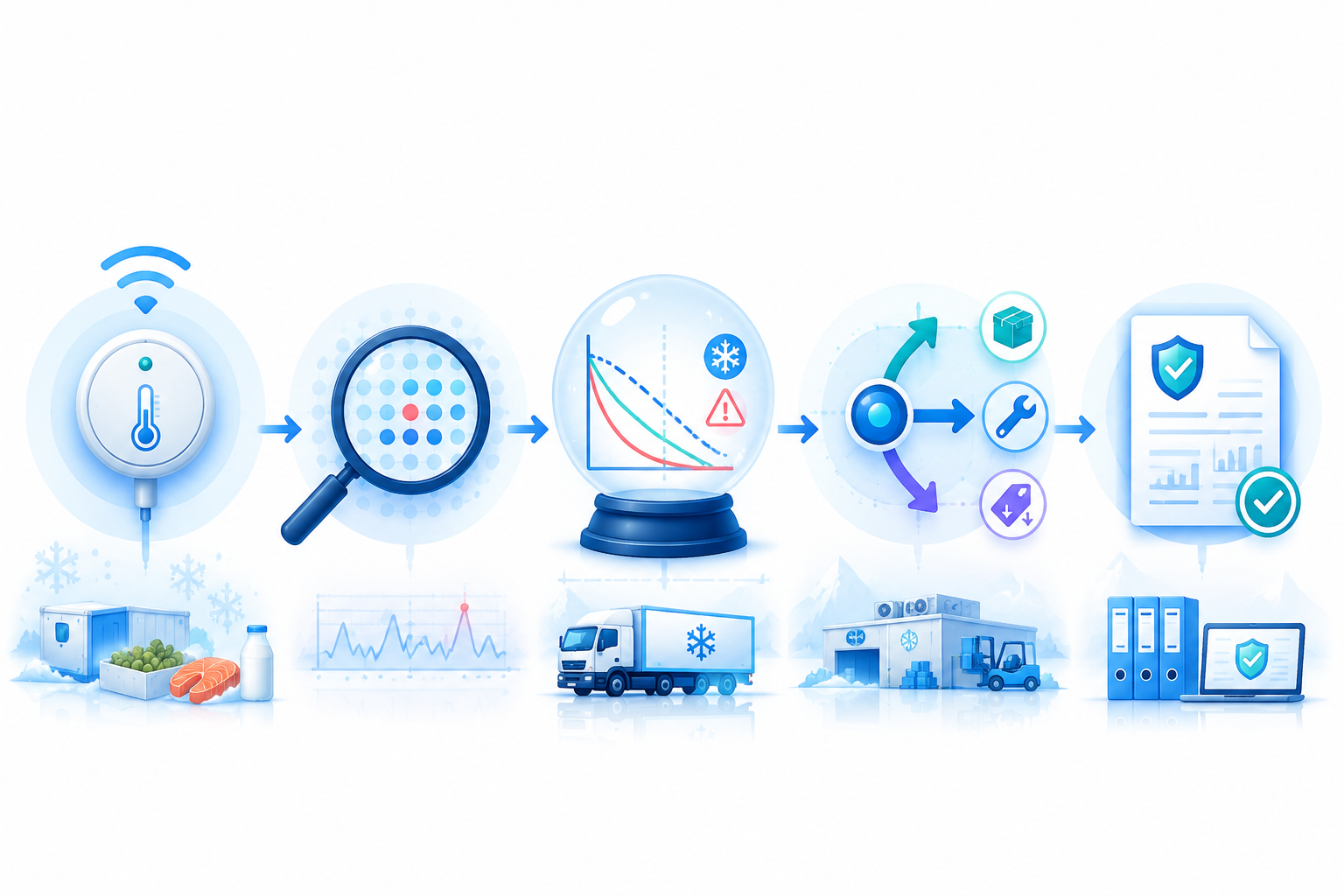
IFT’s 2026 food safety AI framework is useful because it follows the work rather than the software category. It describes five functions: sense, detect, predict, decide, and prove. In a cold chain setting, that sequence means gathering condition data, finding abnormal patterns, forecasting spoilage or equipment risk, choosing an intervention, and preserving evidence that shows what happened and why.[1]
The distinction matters. A temperature sensor can show that a case hit a limit. A shelf-life-aware system should help estimate how much usable life remains, whether a different allocation would protect margin and safety, whether a refrigeration asset needs service, and which records will support release, hold, markdown, donation, disposal, or recall decisions. The value is not the alert itself. It is the earlier, defensible action that follows.
| AI function | Cold chain question | Operational consequence |
|---|---|---|
| Sense | What happened to the product, equipment, and route? | Condition, location, and handling data become available before the review meeting. |
| Detect | Which pattern is abnormal enough to investigate? | Teams can separate routine variation from emerging risk. |
| Predict | What is likely to happen next to shelf life, spoilage, or equipment performance? | Intervention can happen before the excursion becomes a disposition problem. |
| Decide | Who should change allocation, replenishment, maintenance, or markdown timing? | The prediction turns into a workflow, not just a chart. |
| Prove | Can the organization show what happened and why it acted? | Traceability and audit records become part of the operating process. |
The Waste Reduction Claim Needs A Workflow Behind It
Waste reduction numbers are attractive, and in this category they can be substantial. The supported range in the available evidence runs from about 15% to about 49%, but those figures do not carry the same weight. The stronger public evidence comes from the Pacific Coast Food Waste Commitment pilot, where Shelf Engine and Afresh demand-planning AI produced a 14.8% average waste reduction per store. ReFED also estimated that if the entire U.S. grocery sector adopted AI-enhanced demand planning, it could prevent 907,372 tons of food waste annually and generate more than $2 billion in potential financial benefits.[2]
That pilot matters because it ties AI to a specific operating change: better demand planning for perishables. Overstock is not just an inventory problem in fresh food. It becomes a shelf-life problem, a labor problem, a markdown problem, and eventually a shrink problem. When ordering aligns more closely with actual demand, fewer cases arrive already on a path toward discounting or disposal.
The larger 49% figure should be handled more carefully. TraxTech describes an unnamed major online grocery retailer that achieved an approximately 49% reduction in food waste using AI-powered shelf-life and demand modeling.[3] That is directionally useful, especially because the mechanism is plausible: combine remaining shelf-life signals with demand forecasts, then route or prioritize product before it ages out. But the case is vendor-reported and unnamed in the cited material, so it should not be treated like an independently audited benchmark for every grocer, distributor, or food manufacturer.
Where Shelf-Life Intelligence Changes The Day
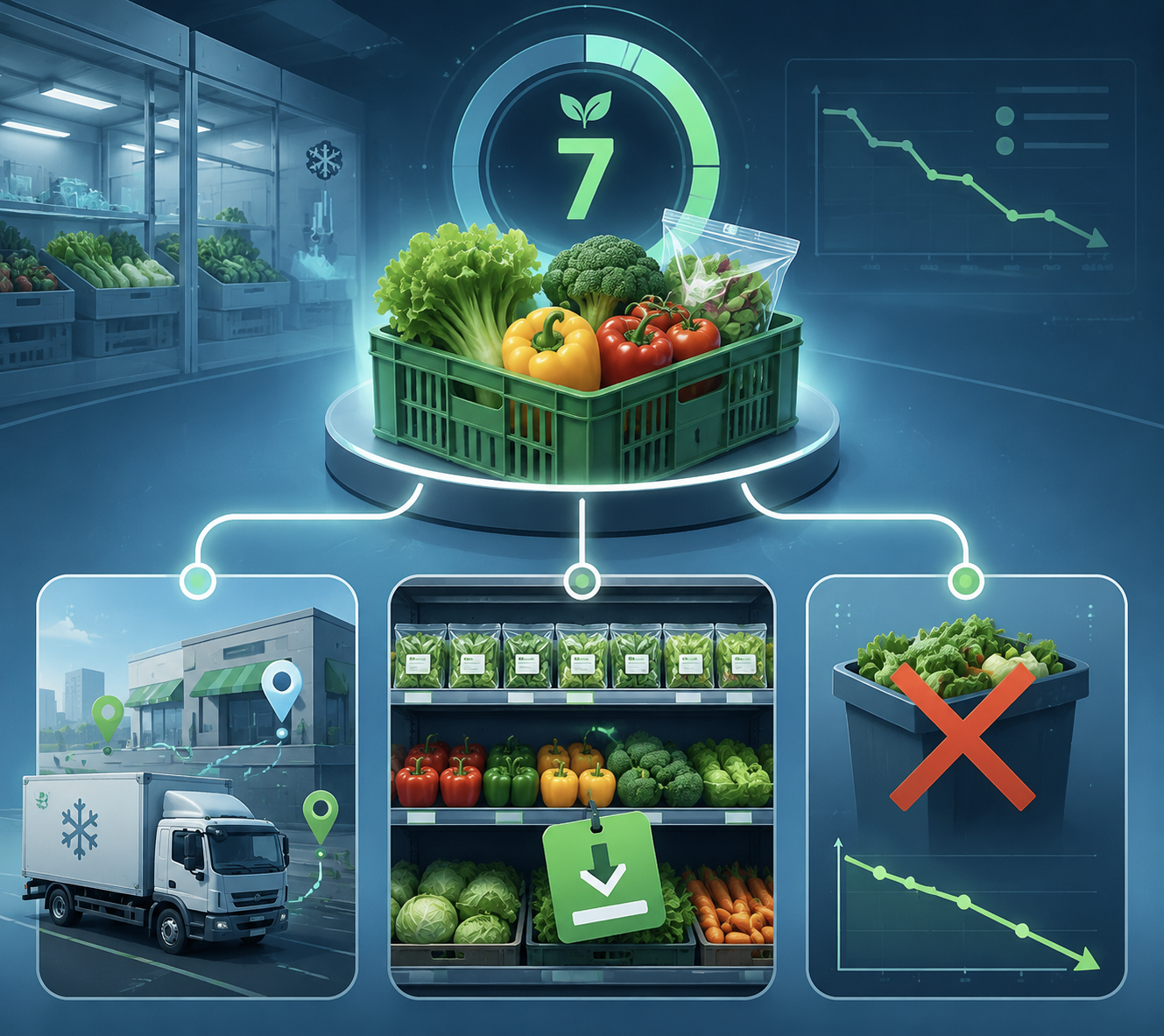
Shelf-life modeling becomes operational when it changes who receives product, when replenishment happens, and how quickly a store or DC acts. A pallet with shorter remaining life may still be safe and saleable, but it is a poor candidate for a slow-turning location. A store with stronger near-term demand can absorb it with less markdown risk. A DC that sees a cluster of lots losing life faster than expected can adjust pick priority instead of discovering the issue after store complaints or shrink reports.
The same logic changes markdown timing. Traditional markdowns often react to visible age, fixed calendar rules, or store discretion. AI does not make the decision automatically credible; the credibility comes from whether it can estimate remaining life from product history, current demand, and handling conditions. A timely markdown may protect revenue and move product while it is still acceptable. A late markdown simply documents the decline.
Replenishment also becomes less blunt. If demand planning sees that a category is likely to slow, the system can reduce inbound volume before the extra inventory becomes waste. If a weather event, promotion, or local demand pattern changes expected turns, the system can alter the order before the shelf is overfilled. The operational gain is not that AI “knows” the future; it is that it can compare more signals quickly enough for a buyer, planner, or store team to still act.
Equipment Risk Is A Food Safety Problem, Not Just A Maintenance Ticket
Cold chain failures often look like maintenance issues until product is implicated. A compressor, door, sensor, trailer unit, or reefer container that drifts from normal behavior can create a food safety review long before anyone calls it a failure. Predictive maintenance is therefore part of food safety optimization when it prevents the excursion instead of merely responding to it.
The ThroughPut example is useful because it connects AI-predicted refrigeration maintenance to avoided food safety incidents caused by equipment failure. In the cited case, a global food manufacturer saw about $0.5 million per week in productivity gains and a 5% output increase from AI-predicted refrigeration equipment maintenance.[4] Those figures should be read as one case, not a universal promise. Still, the mechanism is the right one: detect abnormal refrigeration behavior early enough for maintenance to intervene before product disposition becomes the only remaining control.
This is also why condition intelligence matters beyond stores and warehouses. Smart reefer deployments at sea, including Hapag-Lloyd’s, show the same cold chain direction: combine connected equipment data with analytics so that condition risk is visible while cargo is still moving. The cited reference does not provide quantified outcome data for that deployment, so it should be treated as evidence of application rather than evidence of a specific waste or safety reduction.
The best maintenance signal is not just “unit failed.” It is a pattern: longer recovery time after door openings, unusual cycling, temperature drift under load, repeated sensor disagreement, or lane-specific dwell that pushes equipment harder than expected. A model that catches those patterns can create a work order, adjust routing, protect high-risk product, or trigger a QA review while there are still good options.
Compliance Records Should Be Produced While The Work Happens
The “prove” function in IFT’s framework is easy to undervalue until an auditor, customer, regulator, or recall team asks for the record.[1] Cold chain AI should not leave compliance owners reconstructing events from sensor exports, emails, carrier notes, spreadsheets, and warehouse timestamps. If the model informs a release, hold, allocation, markdown, maintenance, or disposal decision, the reason for that action should be tied to the product, lot, location, time window, and responsible workflow.
That matters for FSMA 204 readiness and GFSI audit expectations because traceability evidence is only useful if it is specific, retrievable, and credible. Predictive shelf-life data can strengthen the record when it shows not only where a product moved, but what conditions it experienced and what decision followed. For a deeper look at the recall and traceability side of that problem, ChainSignal’s AI traceability and FSMA 204 produce recall use case connects the operational record to regulatory response.
There is one regulatory uncertainty to keep visible: the FSMA 204 compliance date extension to July 2028 is proposed, not final. Teams should verify the current regulatory status before implementation planning. The practical point does not change much for operators, because traceability data, cold chain condition records, and decision history take time to standardize across suppliers, carriers, DCs, stores, and systems.
ROI Benchmarks Help, But They Do Not Replace Food-Specific Evidence
Broader supply chain AI benchmarks can help frame the business case, as long as they are not mistaken for cold chain food safety results. McKinsey figures cited in the available Open Sky Group compilation point to 20–30% inventory reduction and 5–20% logistics cost reduction in AI-enabled distribution operations.[4] Those are useful ranges for executive context. They are not a guarantee that a dairy, meat, seafood, produce, or prepared-food network will see the same outcome from cold chain AI.
Food-specific value depends on whether prediction reaches the right workflow. If a model forecasts spoilage but ordering rules do not change, waste may not fall. If equipment risk is visible but maintenance scheduling remains reactive, the alert simply arrives earlier. If traceability data is collected but cannot be connected to lot, route, and disposition decisions, compliance still becomes a reconstruction exercise.
The strongest ROI cases usually have a narrower operational target: reduce over-ordering in a fresh category, lower shrink from short-life product, prevent a known refrigeration failure mode, improve allocation from DC to store, or reduce manual effort in audit preparation. That is less glamorous than “AI transformation,” but it is closer to how cold chain improvements survive budget scrutiny.
What Gets In The Way
The barriers are not abstract. Legacy sensors may report at the wrong frequency, lack calibration discipline, or sit outside the systems where quality and logistics teams actually work. Data integration can be expensive because the useful picture crosses WMS, TMS, ERP, demand planning, maintenance, supplier, carrier, and store systems. A model that cannot see product age, route history, current demand, and equipment condition will make narrower predictions, and that limitation should be visible to users.
Implementation cost also includes people. QA teams need to understand when a model is advisory and when it should trigger a formal hold or review. Planners need to trust the shelf-life signal enough to change allocations. Maintenance teams need work orders that fit their existing priorities. Store teams need markdown or rotation guidance that is practical during a busy shift. Compliance owners need records that are standardized, not a new pile of exception reports.
There is also a governance question. Predictions about spoilage, safety risk, and remaining shelf life can affect release decisions, supplier conversations, claims, customer service, and regulatory posture. Operators should know what the model sees, how exceptions are escalated, who can override recommendations, and what evidence is retained when an override happens.
The Practical Test For Cold Chain AI
A credible cold chain AI program can answer four plain questions. What does the model see? What does it predict? Who acts on the prediction? What record remains afterward? If those answers are vague, the system is probably still closer to monitoring than optimization.
The best-supported food waste evidence points to AI demand planning and shelf-life modeling reducing waste by about 15% in a transparent multi-store pilot and up to about 49% in a vendor-reported unnamed online grocery case.[2][3] The strongest operational safety evidence here points to predictive refrigeration maintenance preventing equipment-related food safety incidents in a single manufacturer case.[4] The compliance value comes when those same signals create a defensible decision trail aligned with the sense, detect, predict, decide, and prove workflow described by IFT.[1]
AI is most credible in cold chain food safety when it converts monitoring into earlier decisions and defensible evidence. The strongest results will come where shelf-life, demand, equipment, and compliance data are treated as one operating system rather than separate dashboards.
References
- How AI Is Reshaping Food Safety, IFT Food Technology Magazine, June 2026.
- Three Ways AI is Driving Reductions in Food Loss and Waste, ReFED, October 2024.
- AI May Slash Food Waste 49%, Trax Technologies.
- Supply Chain AI Statistics, Open Sky Group.
Comments
Join the discussion with an anonymous comment.