
AI for maritime logistics disruption recovery becomes useful at the point where most recovery time is lost: after the first warning and before a defensible operating decision. A port delay, labor action, weather system, canal restriction, or berth congestion alert may arrive quickly. The harder work is identifying which containers are exposed, which customer promises are now at risk, which inventory buffers can absorb the delay, and whether rerouting will reduce cost or simply move the exception somewhere else.
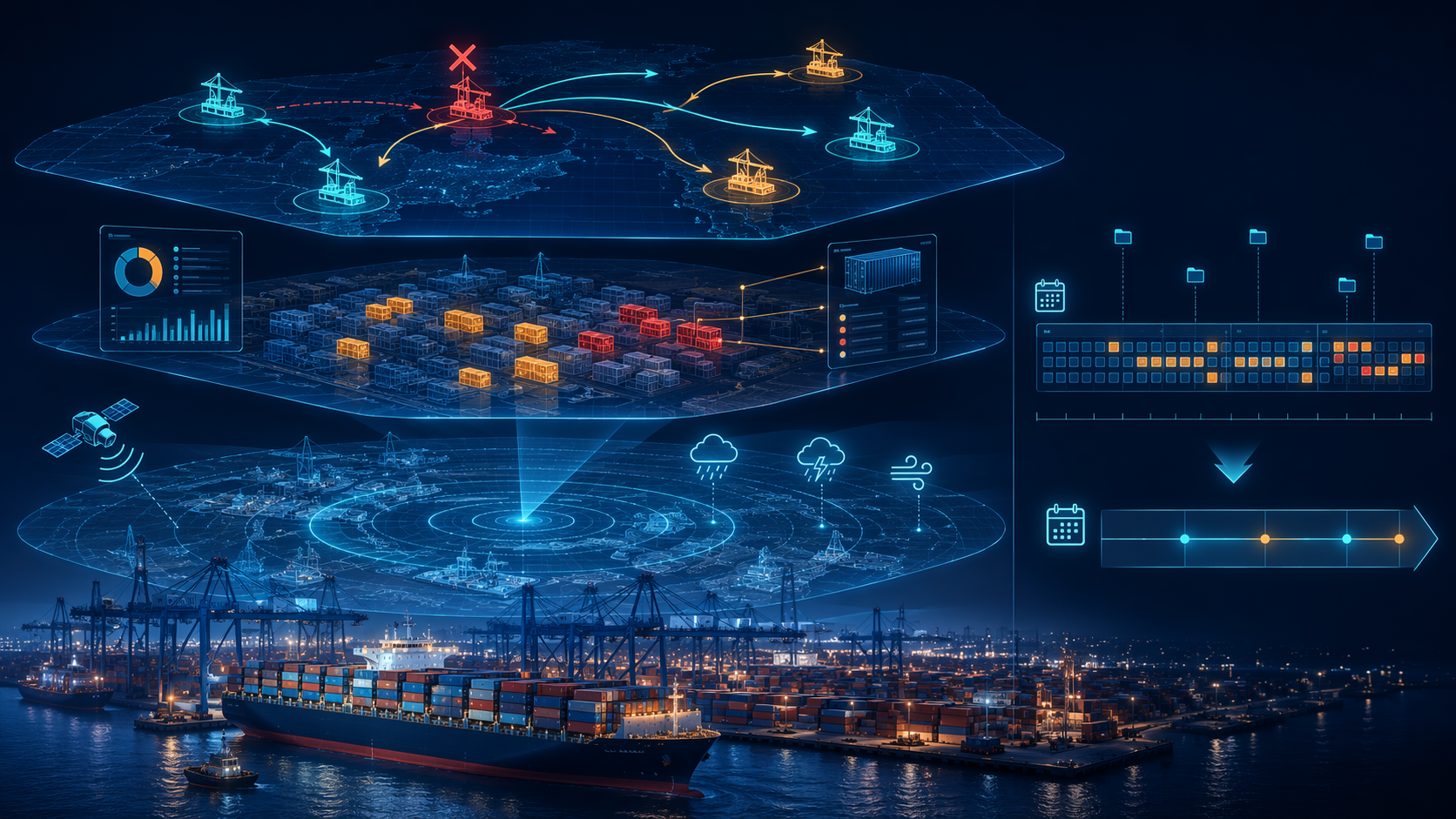
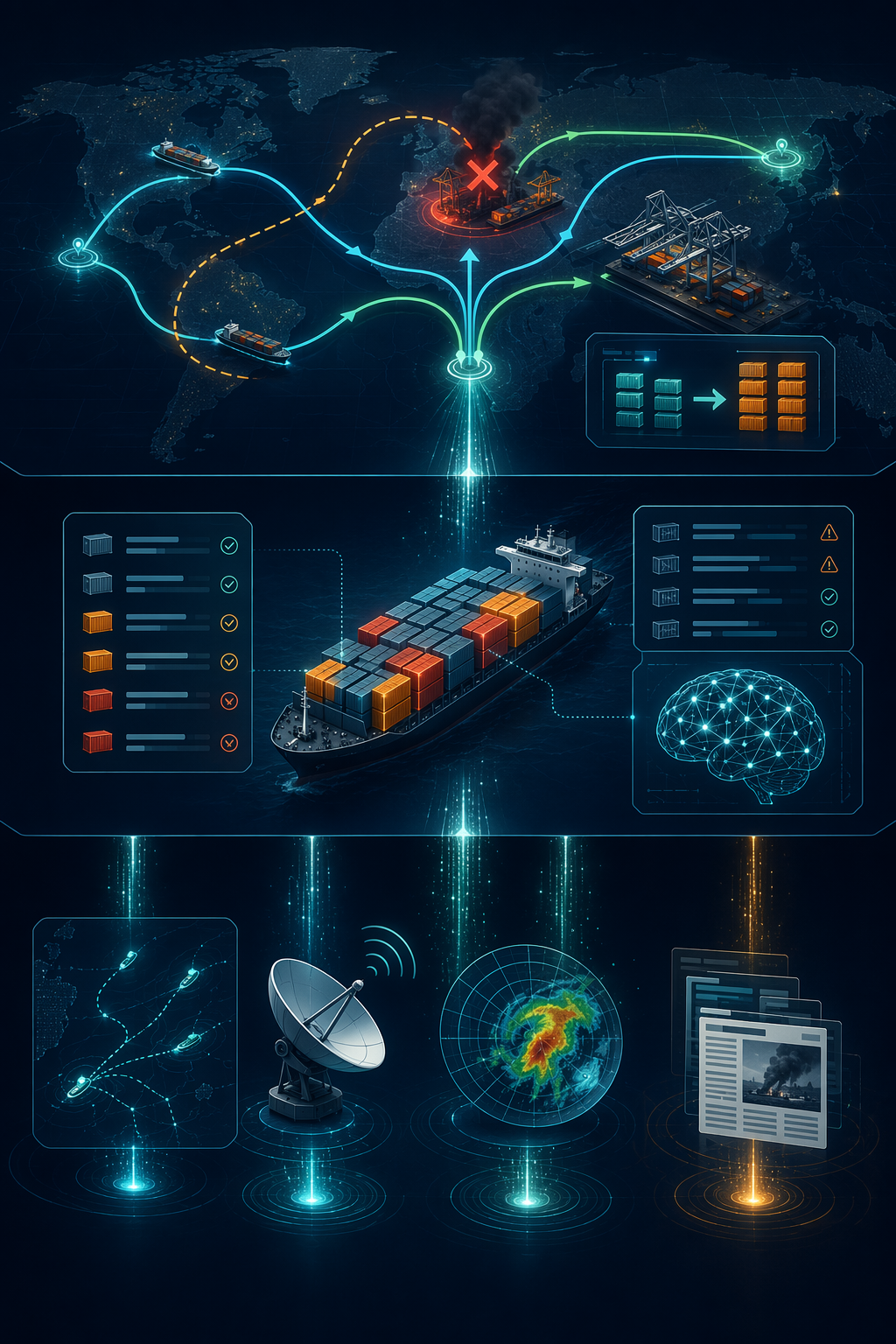
The strongest deployments do not treat AI as a smarter map. They stack three capabilities: predictive detection, automated impact assessment, and recovery optimization. Detection says something is changing. Impact assessment connects that change to shipments, lanes, inventory, and cost exposure. Optimization proposes the next move: reroute, switch terminal or berth strategy, rebalance inventory, expedite selectively, or wait with a clearer reason.
That distinction matters in Q3 2026 because maritime disruption is no longer a rare planning exception. FreightWaves, citing the 2026 State of Logistics Report, reported U.S. business logistics costs of $2.4 trillion in 2025, equal to 7.8% of GDP, and noted McKinsey’s finding that maritime disruptions now occur every 3.7 years on average. The same report placed the maritime AI market at $4.3 billion in 2024 with a 40.6% CAGR, but the recovery use case is still narrower than that market headline suggests: there is no independent benchmark that isolates “AI for disruption recovery” as its own mature category.[1]
The Three Layers That Shorten Recovery Time
A useful recovery workflow can be read as a handoff chain. The first layer watches for signals across the maritime environment. The second layer translates those signals into operational exposure. The third layer decides what can still be changed before the exception becomes a customer failure, demurrage charge, production shortage, or unplanned expedite.
| Capability layer | What it does | What changes operationally |
|---|---|---|
| Predictive detection | Monitors vessel, port, weather, regulatory, news, and market signals for disruption indicators | Teams see a likely exception earlier than carrier milestone updates alone would show |
| Automated impact assessment | Maps the disruption to shipments, lanes, purchase orders, inventory, customers, and cost exposure | Operators stop building manual exception spreadsheets and start from a ranked exposure list |
| Recovery optimization | Recommends and can trigger rerouting, berth or terminal changes, carrier-network actions, and inventory moves | Decision time shifts from days of coordination to a shorter review-and-execute cycle |
Detection alone creates alerts. Impact assessment alone creates a better spreadsheet. Optimization without trusted shipment and inventory data creates recommendations that operations teams will not execute. The recovery gain comes from the layers working together.
Detection: wider signal coverage, not just earlier alarms
The detection layer pulls from sources that traditional track-and-trace systems usually treat as external context: AIS vessel positions, satellite inputs, weather feeds, port conditions, news, regulatory text, and economic indicators. The practical question is not whether the model can label an event as a disruption. It is whether it can surface a lane, port, terminal, or vessel pattern early enough for planners to still have options.
PSA BDP and A*STAR’s Institute of High Performance Computing are working on an LLM-based model that combines AIS data with news and regulatory text to detect and evaluate maritime disruption impacts. That is a useful signal of where the category is moving: toward systems that read both the physical movement of vessels and the unstructured language around port restrictions, regulatory changes, and emerging events.[2]
For adjacent maritime AI maturity, Maersk describes AI use in predictive maintenance, with available materials citing a 30% reduction in vessel downtime and more than $300 million in annual savings. That supports the broader point that maritime operators are applying AI to operational reliability, but it should not be treated as proof of disruption recovery ROI. The savings figure is not directly confirmed as a primary-source number in the available Maersk page, and predictive maintenance is not the same workflow as recovering cargo from a port or lane disruption.[3]
Impact assessment: the layer that turns visibility into work
Impact assessment is where the recovery promise becomes operational. A disruption signal has to be joined to shipment records, carrier bookings, container milestones, purchase orders, inventory positions, customer allocations, service commitments, and cost rules. Without that join, a team may know that a port is congested while still needing two days to find out which orders are trapped behind the congestion.
The best version of this layer answers questions in minutes that used to move through email chains: which containers are on vessels likely to miss the planned berth; which SKUs are already below buffer in the destination region; which orders can tolerate the delay; which shipments are moving into detention or demurrage exposure; which customers need a revised promise; and which expediting candidates are worth pricing before capacity disappears.
Project44’s Disruption Management Agent claims 75% faster identification of disruption impact on in-transit inventory and 40% savings on disruption-related costs. Those are vendor-claimed figures, and no independent audit was found in the provided materials. Even with that caveat, the metric is pointed at the right operational bottleneck: the time between detecting a disruption and knowing which inventory is exposed.[4]
FourKites describes a GenAI solution that lets shippers assess disruption impact through natural-language queries and automate responses across carrier networks. The natural-language interface is not the real breakthrough by itself; the value depends on whether the query is backed by enough shipment, carrier, and exception data to produce an answer that a planner can act on without rebuilding the analysis manually.[5]
Recovery optimization: recommendations must be executable
Recovery optimization is the decision layer. It compares feasible alternatives rather than simply listing affected freight. In ocean operations, those alternatives may include rerouting through another port, switching terminals within the same port complex, changing transshipment plans, reprioritizing carrier allocations, adjusting inland moves, pulling substitute inventory from another node, or reserving expedited freight only for orders whose margin or service commitment justifies it.
This is where coarse visibility breaks down. Portcast gives a terminal-level example at Le Havre: one terminal showed 85–90% yard utilization while another had clear capacity. At a port-level view, the location could look broadly congested. At a terminal-level view, there may still be a recovery path if the cargo, carrier, berth plan, and downstream inland move can be changed in time.[6]
Blue Yonder describes AI agents cutting recovery time from major disruptions “from weeks to days and hours” through automated multi-enterprise rerouting. That phrase is credible only when the decision layer can reach across trading partners and execution systems. If the recommendation still has to be copied into spreadsheets, emailed to carriers, checked against inventory in another system, and approved in a separate workflow, the model may be fast while the recovery remains slow.[7]
What the Documented Outcomes Actually Prove
The strongest evidence in the available material comes from metrics tied to everyday maritime execution rather than broad claims about autonomy. Siemens reported that Portcast helped Siemens reduce manual shipment tracking updates by 80%, lower detention and demurrage charges by 15%, and reduce expedited freight costs by 5%. Those figures are still supplier-published, not independently audited, but they map directly to known recovery pain: manual milestone chasing, avoidable delay charges, and emergency transportation spend.[8]
The 80% reduction in manual tracking updates matters because it removes work from the period when teams are usually least able to absorb it. During a disruption, operators are not only looking for container status; they are also answering sales, production, procurement, finance, and customer service. If AI reduces routine update work, the team can spend more time on exception triage and less time proving that the exception exists.
The 15% detention and demurrage reduction is a more concrete recovery-cost signal. It suggests that earlier awareness and better exception handling changed behavior before charges accumulated. The 5% reduction in expedited freight is smaller, but it is still operationally meaningful because expedite spend often reflects late recognition: by the time the team confirms the real exposure, the cheapest recovery options are gone.[8]
Project44’s claimed 40% savings on disruption-related costs points to the upper end of the available cost-reduction range, but it should be handled as a vendor claim rather than a category benchmark. Read beside the Siemens-Portcast figures, the more defensible conclusion is bounded: documented early deployments show material reductions in manual work and selected disruption-related cost lines, while the broad 15–40% cost-saving range depends on source type, baseline process maturity, and whether the deployment includes impact assessment and execution authority rather than visibility alone.[4][8]
Where Enterprises See the Business Case First
The easiest business case is not a once-in-a-decade black swan event. It is recurring disruption exposure across complex lanes: chronic port congestion, seasonal weather risk, shifting terminal capacity, blank sailings, schedule unreliability, labor uncertainty, and customer commitments that leave little room for late discovery.
A mid-to-large retailer may care most about protecting promotional inventory and avoiding late allocation changes across stores. A manufacturer may care more about inbound parts that can stop a production line. A 3PL may need to identify which customers are exposed, propose alternatives, and document why one shipment was expedited while another was not. The AI capability is similar, but the recovery decision is different because the cost of being wrong lands in different places.
Pattern-based vendor selection should follow that operating reality. If the largest gap is early event detection, a platform needs strong maritime signal coverage. If the pain is exception triage, the priority is shipment, order, and inventory mapping. If the enterprise already sees exceptions quickly but loses time in carrier coordination and inventory decisions, the recovery-optimization layer matters most. A single-point AI feature can be useful, but it will not cut recovery from weeks to days unless it plugs into the rest of the workflow.
This is also where related disruption programs can share infrastructure. Teams already evaluating AI hurricane supply chain risk planning or AI pirate hijacking prevention can reuse parts of the same data architecture: event signals, exposure mapping, escalation rules, and execution workflows. These are not the same use case, but they reinforce the same operating lesson: prediction only pays when it is connected to response.
Implementation Boundaries That Decide Whether Recovery Speeds Up
The main barrier is usually not model ambition. It is data and workflow integration. A recovery system needs reliable shipment milestones, booking data, container identifiers, carrier updates, port and terminal data, purchase-order links, inventory positions, service commitments, and cost rules. If those inputs are incomplete or late, the AI layer may produce confident recommendations that operators still have to verify by hand.
- Data quality: vessel and container events must be matched accurately to orders, inventory, and customer commitments.
- Granularity: port-level visibility is often too coarse when terminal, berth, yard, and inland capacity differ.
- Execution rights: recommendations need a path into transportation management, carrier communication, inventory planning, and approval workflows.
- Exception governance: operators need to know which recommendations can be automated and which require human review.
- Edge-case coverage: models perform best on recurring disruption patterns and are weaker when a novel event falls outside available training examples.
Black swan performance deserves particular restraint. AI can widen signal coverage and accelerate scenario analysis, but no source in the available material proves reliable prediction of novel global shocks. The stronger claim is narrower and more useful: when disruptions resemble patterns that the system can recognize and map to live freight, AI can reduce the time between warning, exposure analysis, and response.
There is also an adoption gap that does not disappear because the model is good. If transportation, inventory, customer service, and finance teams do not agree on who can approve a reroute, who pays for an expedite, or when to notify customers, recovery will still slow down at the handoff. For a broader view of logistics AI adoption and value realization, see the logistics AI adoption gap.
The Bounded Answer
AI can shorten maritime disruption recovery from weeks to days when the enterprise deploys it as a layered recovery workflow: predictive detection, automated impact assessment, and recovery optimization. The available evidence supports measurable gains in manual tracking reduction, detention and demurrage reduction, expedited-freight reduction, faster disruption-impact identification, and vendor-claimed disruption-cost savings.[4][8]
The cost case is strongest when expressed as a bounded early-deployment range rather than a universal promise: documented materials show specific cost-line reductions such as 15% lower detention and demurrage and vendor-claimed savings up to 40% on disruption-related costs.[4][8] That is enough to justify serious evaluation for enterprises with recurring ocean disruption exposure. It is not enough to claim autonomous resilience against every maritime shock.
The practical test is simple: can the system detect the disruption, identify affected freight and inventory, rank the cost and service exposure, and move an executable recovery option to the people with authority before the team loses days to manual reconciliation? If yes, AI is no longer dashboard decoration. It is part of the recovery mechanism.
References
- 2026 State of Logistics Report: volatility new normal, FreightWaves
- PSA BDP and A*STAR IHPC partner to advance maritime resilience with AI innovation, PSA BDP
- Artificial Intelligence in Logistics, Maersk
- AI Disruption Navigator, Project44
- FourKites Announces Breakthrough Generative AI Solution to Help Companies Respond to Supply Chain Disruptions, FourKites
- Impacted by port congestion and shipment rerouting? Here’s how AI can help, Portcast
- AI agents are poised to revolutionize logistics networks, Blue Yonder, 2025
- When sea freight gets smarter, Siemens, 2025-09-05
Comments
Join the discussion with an anonymous comment.