
The uncomfortable moment in airline disruption management is not when the storm appears on radar. It is the hours after the warning arrives, when the airline knows the operation is bending but has not yet converted that knowledge into a new crew plan, aircraft rotation, gate plan, passenger reaccommodation sequence, and cargo recovery path.
That gap is where ai for airline disruption management matters. The useful version is not another alert layer telling controllers what they already suspect. It is a set of models, optimizers, and workflow tools that help an airline move from early risk detection to executable recovery while there is still time to keep the network from unraveling.

The economic pressure is large enough to justify the attention, even if the headline numbers need careful handling. INFORM Software cites a Wipro estimate that airline disruptions cost the industry about $60 billion annually, equal to roughly 8% of airline revenue.[1] In the United States, OAG and U.S. Department of Transportation data indicate that nearly 60% of delays are industry-related rather than weather-caused, including airline operations, air traffic control, and crew scheduling factors.[2] That distinction matters: AI cannot move a thunderstorm, but it can help an airline respond earlier to the aircraft, crew, gate, and passenger constraints that decide whether a weather event stays local or becomes a network failure.
Regulation adds another clock. OAG and AeroTime reported that nearly 220,000 delayed or canceled EU flights in 2024 represented about €6.5 billion in potential EU261 compensation exposure.[3] The point is not that every eligible disruption can be avoided. It is that slow recovery turns operational friction into passenger compensation, missed connections, crew mispositioning, cargo exceptions, and public-service workload all at once.
Southwest’s late-2022 operational collapse remains the warning case because it showed what happens when disruption recovery depends on brittle systems under network stress. DataIntelo’s market report cites an $825 million cost for the meltdown, including a $140 million U.S. Department of Transportation penalty.[4] No single AI system would have magically solved that event. But it is hard to look at that failure and still treat crew recovery, passenger reaccommodation, and operational communication as back-office conveniences.
The useful unit of analysis is the recovery workflow
Airline disruption management is often described as prediction, because prediction is easy to demonstrate. A dashboard shows a likely ground delay, a station risk score changes color, or a model flags a rotation that will not survive the afternoon. That is helpful, but it is not yet recovery.
Recovery starts when the airline decides what to do with scarce resources. Which aircraft should be swapped? Which crew can legally continue? Which passengers should be protected first? Which cargo bookings lose their connection if a widebody leaves without a feeder? Which station teams need the decision before passengers start queuing at the wrong counter?
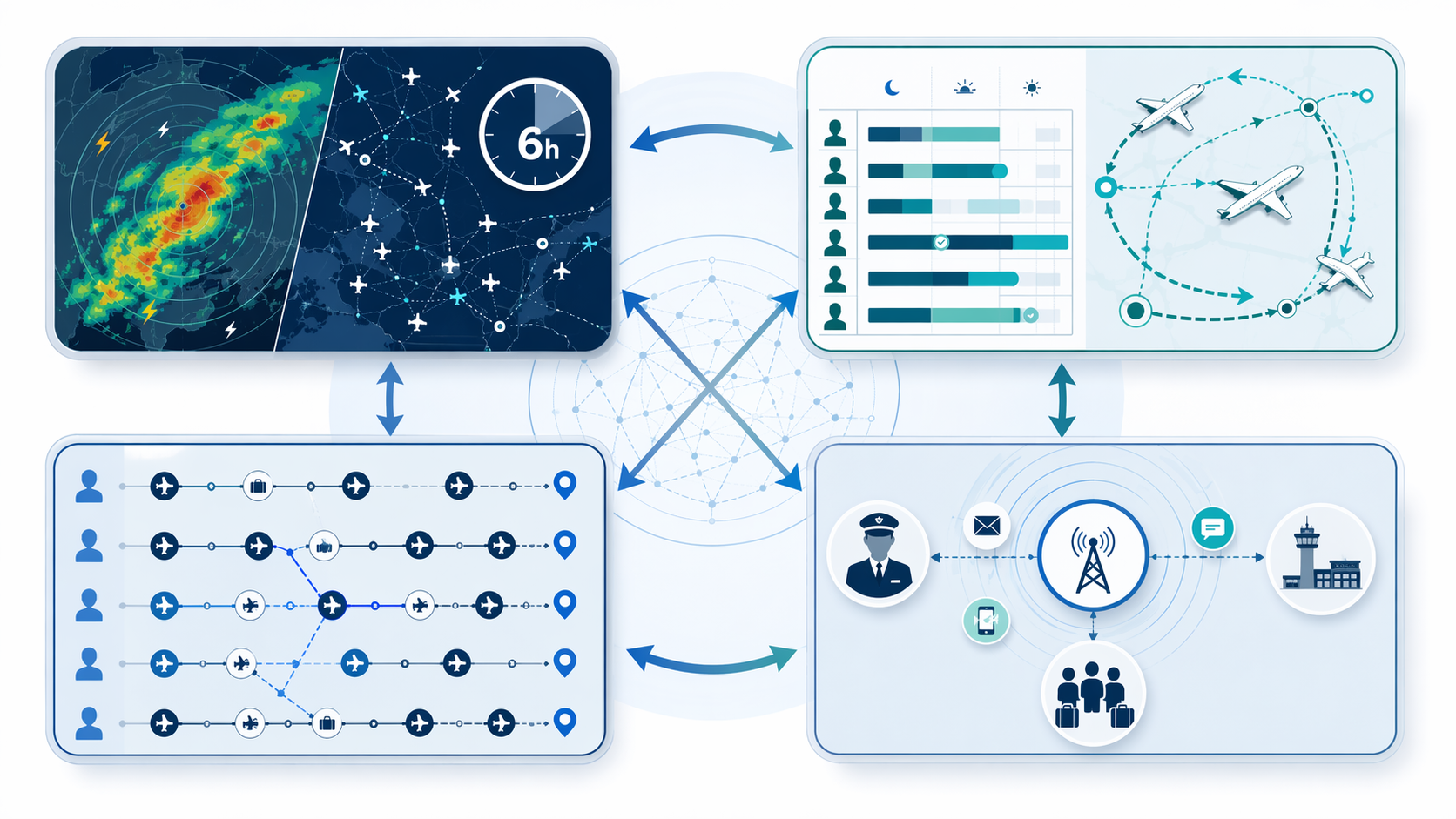
The practical lifecycle has four connected workflows:
- Disruption prediction: ingesting weather, air traffic management, aircraft tracking, maintenance, airport, and crew data to identify risk before the published schedule breaks.
- Crew and aircraft recovery: rebuilding legal crew pairings and feasible aircraft rotations under time pressure.
- Passenger reaccommodation: protecting itineraries, prioritizing missed connections, and processing large volumes of rebooking decisions.
- Stakeholder communication: pushing consistent decisions to passengers, crews, stations, contact centers, cargo teams, and logistics partners.
The workflows are separated here only so the dependencies are visible. In a live operation, they collide. A crew legality problem can force an aircraft swap. An aircraft swap can change the cargo capacity available on a lane. A gate reassignment can shorten taxi time for one departure bank while creating tow conflicts somewhere else. Good AI does not make those trade-offs disappear; it exposes them sooner and helps humans compare feasible options faster.
Prediction buys time, but only if the airline can spend it
DataIntelo reports that AI disruption systems can identify risks up to six hours in advance by ingesting real-time weather, air traffic management network data, aircraft tracking, and crew scheduling inputs.[4] That time window is valuable because it can move decisions from the passenger-facing crisis window into the operations-control window.
Six hours is enough time to evaluate a preemptive aircraft swap, protect a reserve crew, hold or release a connection, retime a turn, or warn a cargo planner that a shipment may miss its onward movement. It is also enough time to do nothing useful if the prediction is trapped in a dashboard that the recovery team cannot act on.
The data inputs are not exotic in isolation. Airlines already monitor weather, aircraft positions, crew schedules, air traffic flow programs, and airport constraints. The operational difficulty is making those signals comparable in time. A weather risk at 1500 local, a crew duty limit at 1835, a minimum connection time at a hub, and a cargo cold-chain cutoff are different clocks. AI earns its place when it lines up those clocks early enough for the airline to choose among options.
This is also where supply chain readers should pay attention. A passenger airline disruption is often an upstream logistics signal. A ground stop, rotation break, or late inbound aircraft can change belly capacity before a freight forwarder receives a clean status update. ChainSignal has covered this angle in articles on airport ground-stop prediction and the cargo planning gap in airline disruption AI; the same principle applies here. The earlier the airline’s operational signal becomes trusted, the earlier downstream planners can protect temperature-sensitive, high-value, or time-definite cargo.
Crew and aircraft recovery is where proactive disruption management either becomes real or fails
Prediction is the clean part of the story. Crew and aircraft recovery is the messy part, because every option has legality, labor, qualification, aircraft, maintenance, airport, and passenger consequences. A controller cannot simply choose the mathematically neatest recovery plan if the cockpit crew times out, the aircraft cannot operate the next sector, or a maintenance requirement gets stranded away from the right base.
This is why the most useful AI systems for IROPS combine predictive models with optimization. The model may flag the disruption risk. The optimizer then evaluates feasible recovery actions: reassigning crews, swapping aircraft, canceling or delaying selected flights, protecting high-impact connections, and preserving tomorrow morning’s schedule where possible. The goal is not to remove network controllers from the loop. It is to stop them from manually searching through options that a machine can rank in seconds.
| Constraint | Why it matters in recovery |
|---|---|
| Crew legality | A late inbound can become a cancellation if the crew exceeds duty-time limits before the next departure. |
| Aircraft rotation | A swap that saves one flight can strand the wrong aircraft type at a later station. |
| Maintenance positioning | Recovery plans must preserve required checks and access to parts, technicians, or maintenance bases. |
| Hub bank structure | A delay may be tolerable on a point-to-point leg but destructive if it breaks a large connection bank. |
| Cargo commitment | A passenger recovery plan can still fail logistics customers if belly capacity or connection timing disappears. |
The measurable claims are promising but should not be treated as automatic ROI. DataIntelo reports that AI-powered disruption management can reduce recovery times by 30% to 45%, and that IBM Watson-based aviation analytics cut crew reassignment processing time by more than 60% in pilot deployments.[4] The same report cites IBS iFlight as saving $3 million annually for one carrier group.[4] Those are useful signals of what better decision automation can achieve, but the outcomes depend on the airline’s rules, data quality, union agreements, recovery authority, and integration depth.
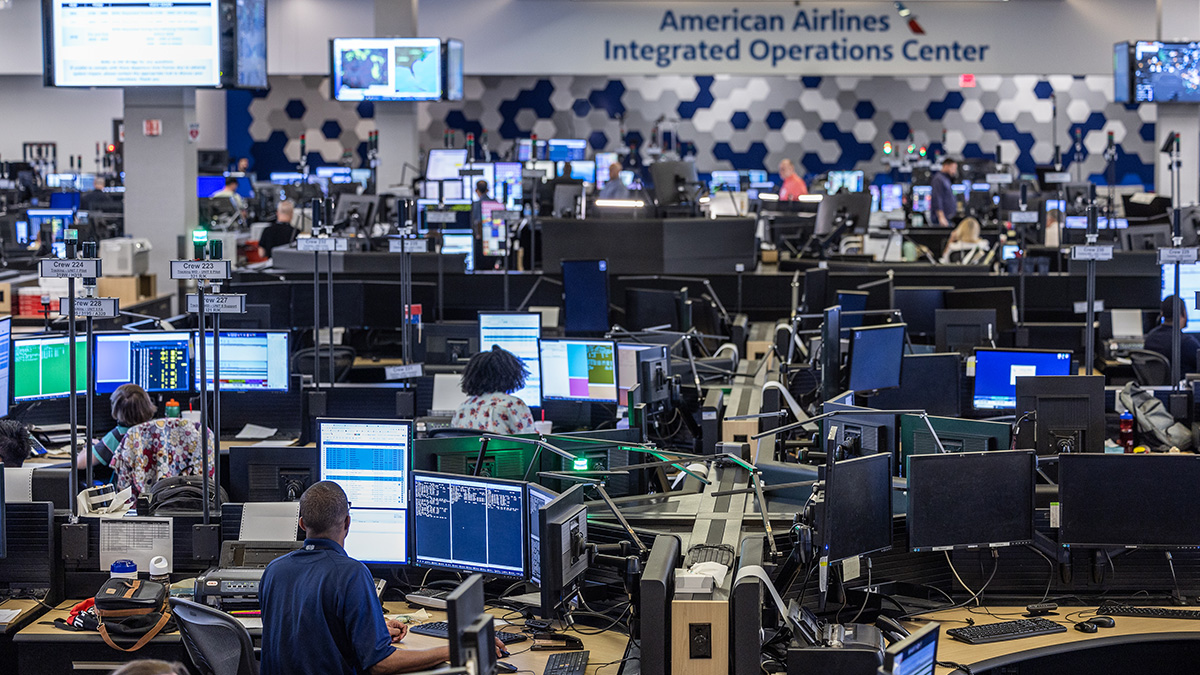
The American Airlines gate-assignment case at Dallas Fort Worth shows the quieter version of AI value. In a Microsoft and OAG report, American’s AI-powered gate assignment reduced taxi time by more than one minute per flight, saving about 10 hours of taxi time per day and 870,000 gallons of jet fuel annually.[5] A minute per flight sounds unimpressive until it is multiplied across a hub operation and translated into aircraft availability, fuel burn, emissions, gate pressure, and passenger connections.
That case is not a full IROPS recovery system, and it should not be oversold as one. Its importance is narrower and more useful: it proves that operational micro-decisions can become material at network scale when the system sees across flights rather than optimizing each movement in isolation.
The legacy-system problem is not cosmetic
Airline recovery workflows still depend on older crew, operations, maintenance, departure-control, customer-service, and airport systems that were not built around real-time AI orchestration. A model can recommend a crew reassignment, but if the crew-management system cannot accept the change quickly, if the legality engine calculates a different answer, or if the station receives the update late, the recommendation becomes another exception for humans to reconcile.
That is why integration matters more than model novelty. The hard requirement is a closed operational loop: detect the risk, generate feasible options, approve the recovery plan, write the decision into systems of record, and distribute the resulting changes to the people and partners who must act. If any handoff is manual, unclear, or delayed, the AI system may still be useful, but it is not yet proactive disruption management.
Passenger reaccommodation is volume work with network consequences
Passenger reaccommodation is the workflow most travelers recognize: missed connections, new itineraries, hotel eligibility, refund rules, and notifications. Operationally, it is also a prioritization problem. The system has to decide who can still make a connection, who needs protection on another carrier, which itineraries should be held together, and which rebooking option creates the least downstream damage.
AI rebooking engines can process tens of thousands of simultaneous multi-leg and multi-airline reaccommodation decisions in seconds, according to DataIntelo.[4] That speed matters when a hub bank breaks. Manual queues cannot keep pace with a disruption that affects multiple inbound banks, outbound connections, and interline options at the same time.
The passenger workflow should still be treated as connected to crew and aircraft recovery, not as a separate customer-service island. Rebooking a traveler onto a flight that is itself dependent on a fragile aircraft swap can create a second failure. Protecting a high-value passenger connection may be commercially sensible, but it can also consume scarce seats that would have resolved a larger group misconnect. ChainSignal’s dedicated article on AI-powered airline rebooking during disruptions goes deeper on this workflow; within the broader IROPS lifecycle, the important point is that reaccommodation decisions need the same operational truth as the control center.
Communication turns recovery decisions into coordinated action
A recovery plan that stays inside the operations center is not a recovery plan for very long. Crews need assignment updates. Gate agents need boarding and misconnect guidance. Contact centers need consistent eligibility rules. Passengers need a credible next step before they form a line. Cargo teams and logistics partners need to know whether capacity, departure time, or connection integrity has changed.
AI-supported communication is often reduced to chatbots, but the more important function is synchronization. The message to a passenger should match the aircraft plan. The instruction to a station should match the crew plan. The cargo exception should match the actual recovery decision, not a stale estimated time of departure. When communication systems are fed by the same recovery engine, the airline reduces the gap between what it knows internally and what customers and partners are being told.
AWS describes United Airlines and TCS Aviana using machine learning for anomaly detection, with the system handling 400 events per second.[6] That example is not a full disruption-recovery proof point, but it is a useful indication of the scale at which airline operational systems must process event streams. In disruption management, the value is not just noticing an anomaly; it is deciding which anomalies require action and routing that action to the right team before the operating window closes.
The market is commercializing, but maturity is uneven
The technology category is no longer theoretical. DataIntelo valued the airline disruption management market at $4.8 billion in 2025 and projected it to reach $11.2 billion by 2034, a 9.8% compound annual growth rate.[4] The same report says cloud-based solutions account for 57% of new contracts in 2026.[4] Those figures show demand, not guaranteed effectiveness, but they explain why disruption management has moved from a niche operations topic into airline technology strategy.
The product landscape is also broadening. Sabre positions Mosaic as a modular airline retailing and operations platform that includes disruption-management capabilities.[7] Coforge launched FlightFlex.AI as an AI-led disruption-management product, according to coverage in The Economic Times.[8] These references matter less as vendor endorsements than as evidence that airlines are being offered disruption recovery as an integrated commercial category rather than a set of custom control-center tools.
Agentic AI is entering the discussion as well. Tech Mahindra describes agentic architectures for airline disruption workflows, including detection, planning, and response orchestration.[9] The concept is attractive because disruption management is full of multi-step tasks that cross systems. Still, the evidence base is not yet the same as for decision support and optimization. Air India’s AI.g customer-service assistant, cited in the OAG and Microsoft report, is a signal of AI adoption in airline service, not proof that autonomous operational IROPS recovery is mature.[5]
There is a similar caution around broad AI-performance claims. PYMNTS reported a BCG projection that AI-first carriers could have a 5-to-6-percentage-point operating-margin advantage by 2030.[10] That is plausible as a strategic direction, especially for airlines that use AI across pricing, maintenance, customer service, operations, and disruption recovery. But disruption management leaders should not treat that margin spread as the business case for a single IROPS deployment.
What has to be true before AI improves IROPS recovery
The minimum conditions are operational, not decorative. An airline needs trusted data pipelines, clear workflow ownership, system integration, and governance over what AI can recommend or execute. Without those foundations, a better prediction model can simply produce better-looking exceptions.
- Trusted data: aircraft status, crew legality, passenger itineraries, airport constraints, and cargo commitments must be current enough for recovery decisions.
- Workflow boundaries: the airline must define which decisions AI can automate, which require human approval, and which should only be advisory.
- Systems of record: approved recovery actions must write back into crew, aircraft, passenger, station, and communication systems.
- Human handoffs: controllers, crew schedulers, station managers, and customer teams need to see why a recommendation is feasible.
- Post-event learning: the airline should compare recommended actions with actual outcomes so the recovery logic improves over time.
The OAG and Microsoft report cites Gartner’s view that 60% of AI projects fail to deliver expected business value.[5] Because that figure is cited indirectly, it should be handled as a caution rather than a law of nature. The practical lesson is still sound: airline AI projects fail when they are scoped as technology installations instead of operating-model changes.
For supply chain and logistics teams, the test is whether airline disruption intelligence becomes usable outside the passenger network. If cargo planners only learn about a broken connection after the passenger recovery plan is finalized, the AI has not closed the planning gap. If the system can expose likely capacity loss, station congestion, or missed cold-chain windows earlier, airline disruption management becomes a logistics resilience tool as well as an airline operations tool.
AI can make airline disruption management proactive when it is embedded into recovery workflows and trusted data pipelines. The advantage belongs to carriers that connect prediction with execution across crew, aircraft, passengers, stations, and downstream logistics. Buying another alerting layer is easier. It is also the part of the problem airlines have the least excuse to stop at.
References
- A Proactive Approach to Managing Disruptions in Aviation with AI, INFORM Software.
- OAG and U.S. Department of Transportation delay data, OAG / U.S. Department of Transportation.
- EU261 compensation exposure for disrupted EU flights in 2024, OAG / AeroTime.
- Airline Disruption Management Market Research Report 2034, DataIntelo.
- AI and Trusted Data: Building Resilient Airline Operations, OAG / Microsoft.
- How machine learning is transforming airline operations, AWS Blog.
- Sabre Mosaic disruption management product page, Sabre.
- Coforge launches FlightFlex.AI, The Economic Times.
- Future-Proofing Airline Disruptions with Agentic AI, Tech Mahindra.
- As Storm Grounds Flights, Airlines Turn to AI to Handle Disruptions Better, PYMNTS.
Comments
Join the discussion with an anonymous comment.