

The useful question around examples of AI in logistics is no longer whether the tools can optimize a route, recommend a pick path, or improve a forecast. In narrow conditions, they can. The harder question is why so many logistics companies can show AI activity while so few can show AI value in the operating statement.
That gap is now too large to treat as normal technology adoption noise. In BCG’s 2026 survey of more than 180 logistics experts, 94% of logistics service providers said they planned to invest in AI, yet only 13% reported measurable financial value from AI embedded in core operations. BCG also found that the leading barriers were not mainly technology cost, but unclear ROI and gaps in internal capability.[1]

That sounds familiar to anyone who has watched a pilot move from a controlled demo into a transportation desk or warehouse floor. The demo uses clean shipment records, stable assumptions, and a friendly workflow. The operation uses late tenders, missing accessorials, customer-specific routing rules, old WMS logic, partial EDI feeds, dispatcher overrides, and supervisors who have to keep freight moving while the model is still learning what “normal” means.
The 13% are not winning because they bought a more magical model. They are usually more disciplined about where AI is allowed to start. They pick constrained workflows, tie the project to a KPI finance already recognizes, build or clean the data path before scaling, and expect payback quickly enough that the operating team cannot hide behind a transformation narrative.
Investment intent is no longer a useful signal
A few years ago, a logistics provider announcing AI investment might have signaled real operating ambition. In 2026, it mostly signals that the company has joined the queue. The better distinction is between companies that have AI in procurement, AI in presentations, or AI in isolated dashboards, and companies that have AI changing a cost line, service metric, or labor plan.
The difference matters because visible AI work can absorb a surprising amount of organizational oxygen. A route optimization pilot can involve transportation planning, IT, data engineering, carrier management, customer service, and finance before a single lane plan changes. A warehouse picking model can look promising in a test zone while still being blocked by slotting rules, labor standards, device adoption, and supervisor trust. A demand-sensing tool can produce a better-looking forecast without changing replenishment decisions or inventory exposure.
This is the point often missed in executive AI scorecards. Adoption is not deployment. Deployment is not scaled use. Scaled use is not ROI. Each step removes a different kind of risk, and most logistics AI programs do not fail at the same point for the same reason.
For a broader view of the adoption gap, The Logistics AI Paradox: 94% Intent, 23% Strategy frames the same market problem from the strategy side. The operating question here is narrower: what separates AI work that survives contact with dispatchers, warehouse supervisors, and finance from work that remains a pilot?
The failure pattern usually starts before the model
The industry figure that 88% of AI proofs-of-concept never reach production is often used as a doom statistic. It is more useful as a diagnostic. In logistics, pilots usually die because the project underestimated the work around the model: data readiness, legacy integration, operating ownership, change management, and measurement design.
Legacy integration alone can change the economics. Thinking Inc.’s 2026 logistics AI ROI guide estimates that integrating AI with existing TMS and WMS environments can consume 30% to 40% of total project cost. The same guide places workforce training and change management at 15% to 20% of project cost.[2]
Those numbers explain why a pilot that looks cheap in a vendor proposal becomes expensive in the building. The model license is visible. The buried cost is the mapping of shipment statuses, stop events, appointment logic, SKU attributes, location hierarchies, carrier codes, exception reasons, and labor transactions into something the AI can use without poisoning the recommendation.
Poor data quality is not an abstract data-team complaint. It changes the operational decision. A route model trained on incomplete empty-mile records may recommend a plan that looks efficient but ignores backhaul realities. A picking model using stale location data may send associates through a mathematically elegant but physically broken path. A demand model fed by unclean promotion, substitution, or allocation history may reduce forecast error in a dashboard while still leaving planners exposed to the same inventory decisions.
The change-management shortfall is just as practical. Dispatchers will not follow a lane recommendation they cannot explain to a customer. Warehouse supervisors will not risk the shift plan on a pick sequence that does not match congestion, equipment availability, or replenishment timing. Finance will not credit savings that disappear into volume mix, customer changes, or labor absorption. If those people are brought in only after the pilot is declared successful, the pilot has not really tested the deployment.
What the 13% tend to do before they scale
The deployments that earn their way out of pilot status usually start smaller than the strategy deck wants. They do not begin with “AI transformation.” They begin with a lane group, a picking process, a forecast segment, or a repetitive exception workflow where the baseline is known and the consequence of a better decision can be measured.

The pattern has three parts. First, the use case is narrow enough that the operating team can name the decision being improved. Second, the required data is shared and governed before the project is judged. Third, the ROI metric is selected before deployment, not reconstructed afterward.
| Use case | What the model changes | KPI that should be visible | What must be true before scaling |
|---|---|---|---|
| Route optimization | Load matching, sequencing, backhaul selection, or lane planning | Empty miles, cost per mile, on-time performance, planner touches | Shipment, appointment, carrier, rate, and execution data are reliable enough to compare planned versus actual results |
| AI-directed picking | Pick path, task interleaving, batching, or labor assignment | Lines per hour, travel time, touches, error rate, overtime, dock cutoffs | Location, inventory, order, slotting, equipment, and labor data match physical reality on the floor |
| Demand sensing | Short-term forecast adjustment and replenishment signal quality | Forecast error, stockouts, inventory turns, expedite cost, service level | Historical demand, promotions, substitutions, lead times, and inventory policies are clean enough to explain variance |
This is why route optimization often appears early in credible AI programs. The decision is frequent, the baseline is visible, and the KPI can be measured without asking the whole enterprise to change at once. Thinking Inc. describes route optimization deployments with 2-to-4-month payback windows and directional three-year ROI benchmarks of 800% to 1,200% for fleets of more than 500 vehicles.[2]
Those figures should not be treated as a universal promise. Fleet size, network density, lane volatility, data quality, and dispatch adoption decide whether the economics hold. A private fleet with repeatable routes and reliable telematics is not the same problem as a brokered transportation network with fragmented carrier data. The benchmark is useful because it shows why the use case can repay quickly when the operating inputs are in place, not because every fleet should expect the same return.
AI-directed picking has a similar profile when the warehouse process is bounded. The best applications do not ask the system to reinvent warehouse management on day one. They improve a specific motion problem: reducing travel, batching compatible work, sequencing tasks around congestion, or aligning pick paths with cutoffs. Thinking Inc. cites directional three-year ROI benchmarks of 250% to 400% for AI-directed picking.[2]
Again, the operating caveat matters. A model cannot compensate for broken inventory accuracy, bad slotting discipline, or supervisors who are measured on a conflicting labor standard. If the WMS says the item is in a forward pick location but replenishment is late, the AI did not create the problem. It just becomes the new face of the problem for the associate holding the scanner.
Demand sensing is usually less forgiving. It can produce significant value, but the path to ROI is often more dependent on cross-functional behavior. A better forecast only matters if replenishment rules, inventory targets, supplier lead-time assumptions, and planner overrides change with it. That makes demand sensing a strong candidate when the organization already has disciplined planning data, and a poor first AI project when forecast history is full of unexplained overrides and exception codes.
The expensive mistake: measuring ROI after the pilot
Many logistics AI projects measure model performance first and business performance later. That order is backwards. A model can improve prediction accuracy and still fail to reduce cost. It can reduce manual planning time and still fail to create P&L benefit if the saved hours are not redeployed, overtime is unchanged, or service failures move somewhere else in the network.
This is where finance should be involved earlier than most teams prefer. Before the pilot starts, the team needs a baseline, a control or comparison method, a benefit owner, and a rule for separating AI impact from volume, mix, rate changes, and seasonality. Without that, the project ends with a familiar argument: operations believes the tool helped, finance cannot verify the savings, and IT is left supporting another system with an unclear mandate.
Deloitte’s broader AI adoption data, cited by Open Sky Group, points to the same patience problem at the enterprise level: 85% of executives planned to increase AI spending in 2026, but only 6% reported ROI in under a year.[3] That does not mean every logistics AI use case needs a multi-year wait. It means leadership should separate quick-payback operating use cases from enterprise programs whose returns depend on wider process and data maturity.
A route optimization deployment on a defined fleet can be held to a much shorter payback window than an enterprise-wide demand-planning transformation. A picking workflow in one facility can be measured faster than a network-wide inventory optimization program. The mistake is putting all of them into the same AI budget category and then asking for one generic ROI story.
For a CFO-level treatment of this measurement problem, see Supply Chain AI ROI in 2026: Why Productivity Gains Don't Reach the P&L. The short version for logistics operators is simple: if the benefit cannot be tied to a cost line, service metric, working-capital change, or labor decision before the pilot begins, the project is not ready for an ROI claim.
Company examples are useful, but only if handled carefully
The logistics market has plenty of impressive AI case studies: empty-mile reduction, automated warehouse throughput, faster proposal generation, predictive exception handling, and agentic workflow ambitions. They are worth reading, but not as transferable benchmarks. Many of the largest numbers come from vendor materials or company-published case studies, not independently audited operating results.
The right lesson from those examples is narrower and more useful. When Uber Freight discusses machine-learning improvements to routing or matching, the lesson is not that every broker will reach the same empty-mile result. It is that a repeatable decision with a measurable baseline gives AI a place to earn trust. When large retailers or 3PLs describe warehouse automation gains, the lesson is not that every facility can copy the percentage. It is that the model worked inside a process where task data, physical flow, and labor execution could be connected.
DHL-style systematic rollout stories are more interesting than single-point demos because they imply some of the less glamorous work happened first: data management, process ownership, integration sequencing, and operating governance. FedEx-style agentic workflow targets are worth watching, but they should not distract a logistics buyer from the nearer question: which decisions can safely be delegated or recommended today, with a measurable control in place?
Readers comparing case studies can use Where AI in Supply Chain Actually Delivers ROI: Evidence from 20+ Real Deployments as a companion benchmark set. The discipline is to treat each example as evidence that a class of problem can be improved, not as a forecast for your own network.
A practical sorting framework for logistics AI opportunities
The most useful AI portfolio review for a logistics provider is not a ranking of tools. It is a sorting exercise. Each proposed use case should land in one of three buckets: fund now, fix data first, or do not pilot yet.
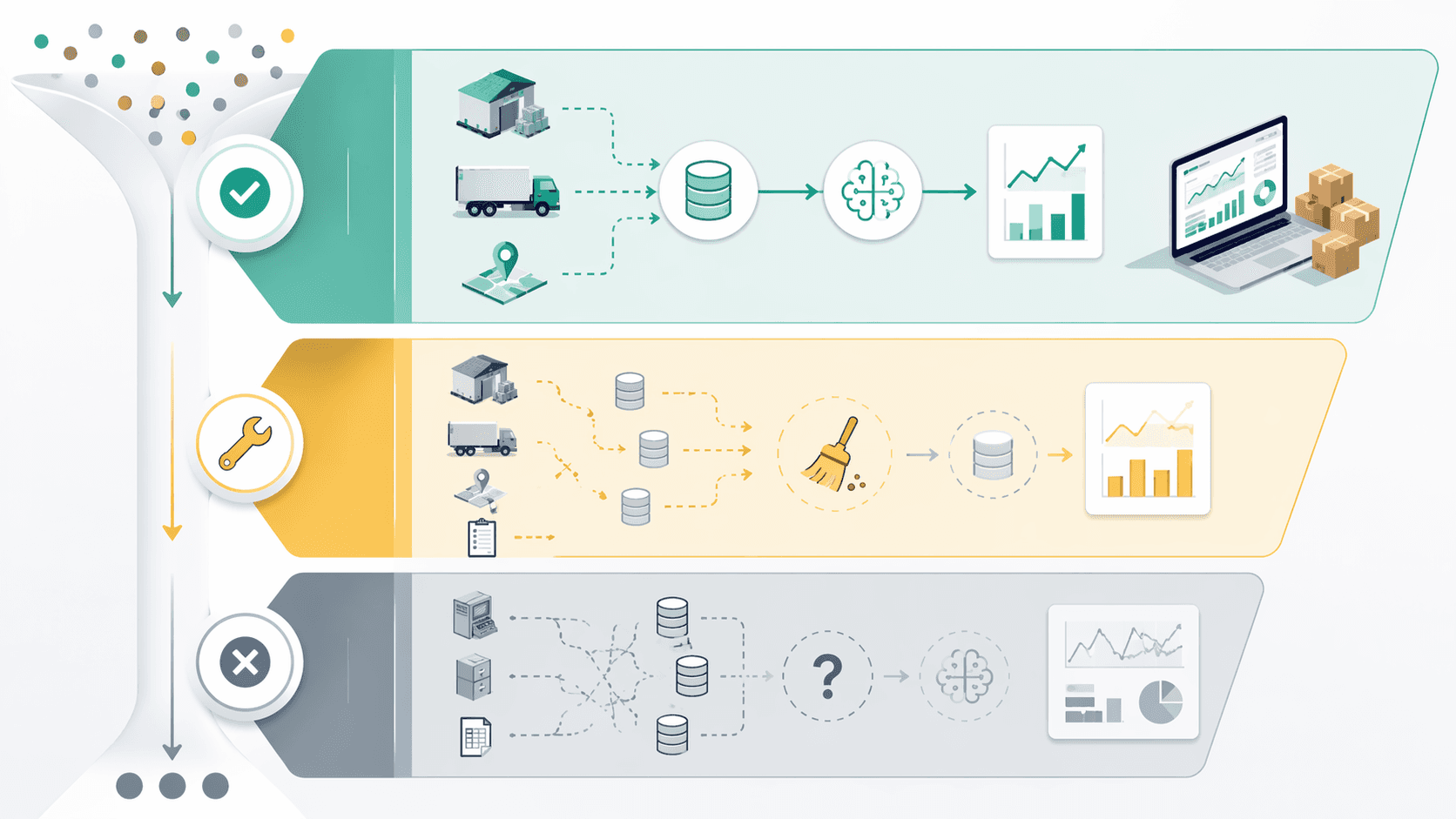
Fund now
Fund the use case when the operating decision is specific, the data path is good enough to test, the integration requirement is understood, and the KPI can be measured within a short payback window. Route optimization for a defined fleet segment, AI-directed picking in a stable zone, or exception triage for a high-volume workflow can fit here.
- The baseline is known before the pilot starts.
- The operating owner can explain what decision will change.
- Finance agrees how savings or service improvement will be verified.
- IT has sized the integration work instead of treating it as a later phase.
- Supervisors, planners, or dispatchers have a role in testing and adoption.
Fix data first
Put the use case here when the business problem is real but the data cannot yet support reliable recommendations. This is common in demand sensing, inventory optimization, and multi-node transportation planning. The correct first investment may be master-data cleanup, event standardization, API work, telemetry coverage, or exception-code discipline.
This bucket is not a rejection. It is a way to prevent a model from becoming a very expensive audit of data problems everyone already suspected. If the project cannot explain why prior shipments were late, why locations differ across systems, or why forecast overrides happened, AI will surface the confusion faster than it resolves it.
Teams building the warehouse version of this business case may find How to Build a Business Case for AI in Warehouse Management useful before they ask for deployment funding.
Do not pilot yet
Do not pilot the use case when the scope is broad, the decision owner is unclear, the data lives in disconnected legacy systems, and the ROI claim depends on benefits no one is prepared to measure. These projects often sound strategic because they touch the whole network. That is also why they are poor first moves.
A proposal to “use AI to optimize the supply chain” is not ready. A proposal to reduce empty miles on a specific regional fleet, improve pick productivity in a defined facility process, or reduce forecast error for a measurable product segment might be. The difference is not ambition. It is whether the operating system around the model can absorb the recommendation and prove the result.
That is the practical lesson from the 13%. Logistics providers should not start by asking which AI tool is most advanced. They should ask which operational problem has clean enough data, a measurable KPI, an integration path, and a payback window short enough to survive internal scrutiny.
References
- AI Is Already Moving the Logistics Industry Forward, BCG, 2026
- Logistics AI ROI, Thinking Inc., 2026
- Supply Chain AI Statistics, Open Sky Group
Comments
Join the discussion with an anonymous comment.