
The 2026 Atlantic hurricane season looks, on paper, like the kind of forecast that can make a planning meeting relax too early. NOAA’s outlook calls for 8–14 named storms and assigns a 55% probability to a below-normal season, with the usual caution that the outlook will be updated in early August while the season is still underway.[1] For supply chain teams, that storm-count frame is useful, but it is no longer enough to decide how much inventory to move, which suppliers to escalate, or when to pay for routing optionality.
The harder problem is severity arriving faster than operating committees are built to approve. In 2025, four of five Atlantic hurricanes reached Category 4 or higher, and the season produced the second-highest number of Category 5 hurricanes on record, behind only 2005.[2] Rapid intensification rates increased by about 29% between 1971–1990 and 2001–2020, which is exactly the kind of shift that turns a watch-list item into a procurement, logistics, or inventory decision before the usual evidence feels complete.[3]

That is where AI earns attention in Atlantic hurricane season supply chain risk: not as a better-looking storm dashboard, and not as a replacement for the planner who has to sign off on an expensive move. The useful test is whether it compresses the distance between weak signal and accountable action. Can it help a team position inventory before landfall, surface hidden supplier exposure before procurement is boxed in, or reroute freight before every shipper is trying to buy the same capacity?
A conventional hurricane playbook still matters. But when Gulf Coast port closures can last 24–72 hours, recovery can take 5–10 days, and backlog normalization after a Category 3 or stronger direct hit can stretch 2–4 weeks, the cost of waiting is not limited to the day the storm crosses the coast.[4] The backlog is the business event.
Where AI Actually Enters Hurricane Planning
The practical use case is narrower than “AI for resilience.” It sits in three decision areas where timing, visibility, and allocation choices are genuinely different from a reactive response.
| Workflow | Decision AI Can Move Earlier | Evidence Strength |
|---|---|---|
| Demand sensing and inventory positioning | What to pre-position, where, and before which demand spike | Strongest concrete case, but vendor-published and single-instance |
| Multi-tier supplier risk mapping | Which hidden facilities, materials, or tiers need escalation before the storm | Large exposure data and documented use case, but not hurricane-specific performance proof |
| Real-time logistics visibility and rerouting | Which shipments, ports, lanes, and carriers need intervention as conditions change | Operationally credible, with vendor examples; performance depends on network coverage and execution |
The distinction matters. AI that only adds another alert to a hurricane room is easy to buy and hard to defend after the fact. AI that changes a purchase order, allocation rule, supplier escalation, or routing decision has a clearer burden of proof.
Demand Sensing Turns a Storm Signal Into an Inventory Bet
The most persuasive hurricane-season AI use case starts before the warehouse is in the cone. Demand sensing can combine weather signals, regional exposure, product history, and local demand patterns to tell a planner which items are likely to move, where they should be staged, and how early the organization has to commit capacity. That is not a trivial forecast. It becomes a capital allocation decision made while the storm track is still uncertain.
ClimateAi’s Hurricane Ian case is useful because the action is specific. A building materials company used AI-driven demand forecasting to pre-position hurricane-response inventory that complied with Florida building codes, and ClimateAi reports that the company captured $15 million in incremental sales as a result.[3] The important detail is not the dollar figure by itself; it is the sequence. The company moved the right kind of inventory into the right market before demand fully materialized.
That is what a good use case looks like. The AI did not “predict a hurricane” in some abstract sense. It translated the threat into a merchandising and supply decision: inventory placement ahead of a foreseeable, storm-driven demand spike. A conventional process might still identify the same products after landfall, but by then trucking, warehouse labor, supplier capacity, and customer demand are all being contested at once.
The caveat belongs right next to the case, not in small print. The $15 million result is a single vendor-published case study, so it should be treated as an existence proof rather than a benchmark. It shows that AI-assisted pre-positioning can matter under favorable conditions; it does not prove that every building materials, retail, healthcare, or industrial distributor will capture a comparable outcome.
Still, the operational pattern travels. A distributor can ask whether storm-adjusted demand forecasts would change branch-level stocking. A manufacturer can ask whether constrained components should move inland before a Gulf Coast disruption. A retailer can ask whether essential goods should be staged closer to exposed markets or held back to avoid stranded stock. None of those decisions are free. That is why the AI output has to be tied to an approval process: who reviews the forecast, who releases inventory, who pays for the transfer, and who owns the explanation if the storm turns.
Vendor-linked industry figures suggest AI can reduce supply chain errors by 20–50% and detect 85% of major disruptions an average of seven days ahead, but those numbers should be read as directional evidence, not a performance guarantee.[3] For hurricane planning, the more useful evaluation question is simpler: did the forecast create enough lead time to act before the rest of the market reacted?
Supplier Risk Mapping Has to Reach Past the Obvious Coastline
The first-tier supplier list usually finds the obvious hurricane exposure: the plant near the coast, the distributor inside the projected impact zone, the port-dependent lane everyone already knows is fragile. The missed risk is often one tier down, or two. A component maker, packaging supplier, raw material processor, maintenance provider, or regional logistics node can be outside the usual procurement dashboard and still stop production.
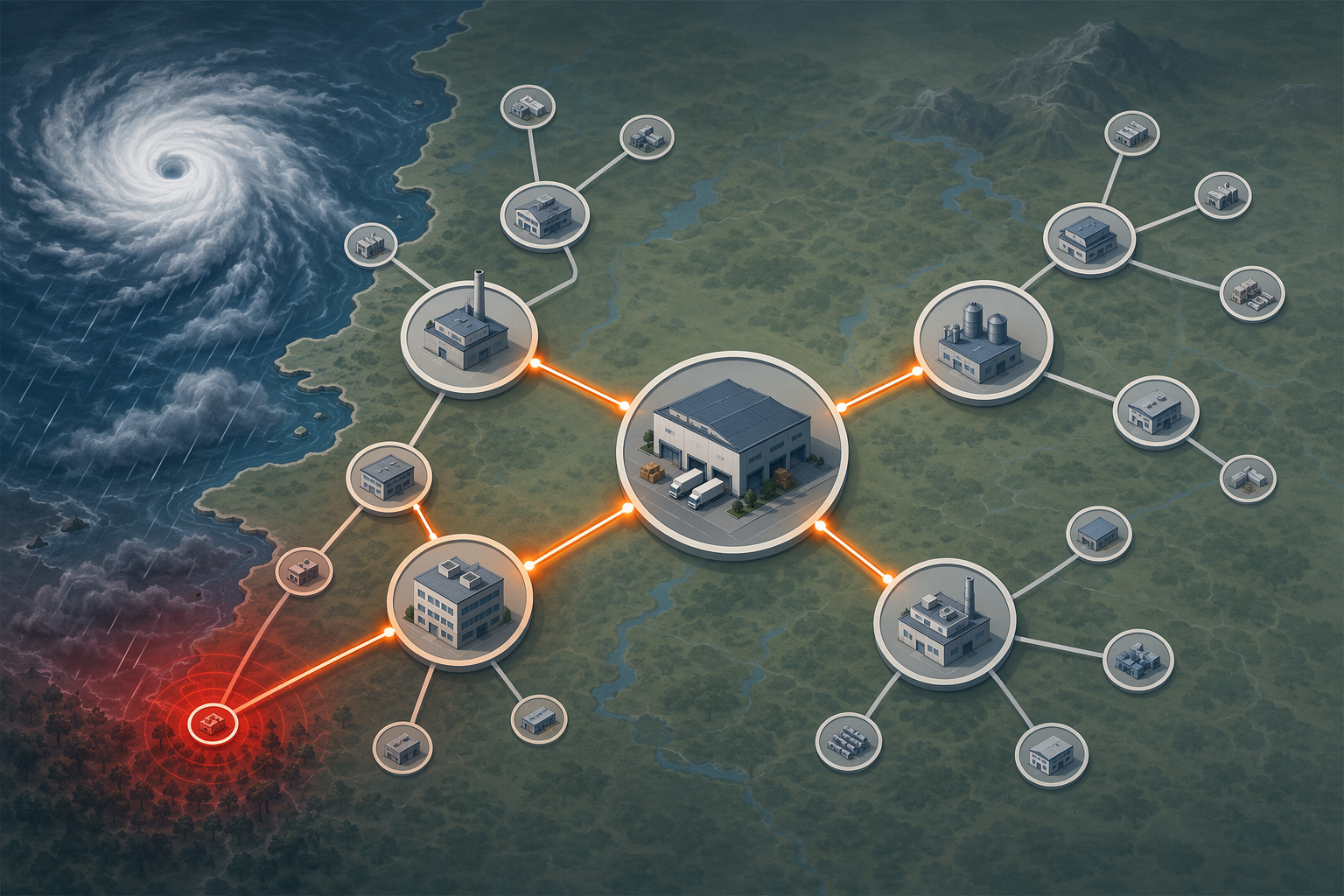
Interos reports that 94.5 million businesses were at risk from extreme weather in 2025, a 48% year-over-year increase, and places that exposure against $182 billion in total U.S. climate disaster costs in 2024.[5] Those are large numbers, and large numbers can become decorative if they do not change the work. Their value is in forcing a better map: which suppliers, sub-suppliers, facilities, and logistics dependencies sit in the path of the storm, and which of them support revenue, safety, regulated service levels, or scarce materials?
This is where AI-enabled risk intelligence can do something spreadsheets rarely maintain well. It can connect supplier entities, locations, ownership links, weather exposure, and operational dependencies into a continuously updated view. The output should not be a generic red score. It should be a ranked queue for procurement and risk teams: verify this facility, contact this supplier, check alternate sources for this item, review inventory cover for this SKU family, and decide whether an executive escalation is warranted.
Interos cites Cooper University Health Care as a reference point for supply chain risk monitoring in this context.[5] The healthcare angle is a useful reminder that hurricane exposure is not only a retail or construction-materials problem. For hospitals and other critical operators, the dependency map has to account for suppliers that affect continuity of care, not just direct spend. A low-dollar item can become high consequence when it is hard to substitute under regional disruption.
The procurement discipline is to keep the exposure map connected to decisions. A multi-tier view should tell the team which supplier relationships need pre-season validation, which alternates need qualification before the storm, and which contracts should include surge, substitution, or shipment-flexibility language. If the map only makes the risk look larger, it has not yet done its job.
Real-Time Logistics AI Is Most Useful When It Triggers a Playbook
Once a storm is close enough to affect ports, road networks, warehouse labor, and carrier behavior, the planning problem shifts from “what could happen?” to “which shipments need a decision now?” This is the brisker, messier part of the use case. Real-time visibility tools can detect exceptions, identify at-risk loads, and help teams see where freight is likely to be delayed or stranded.
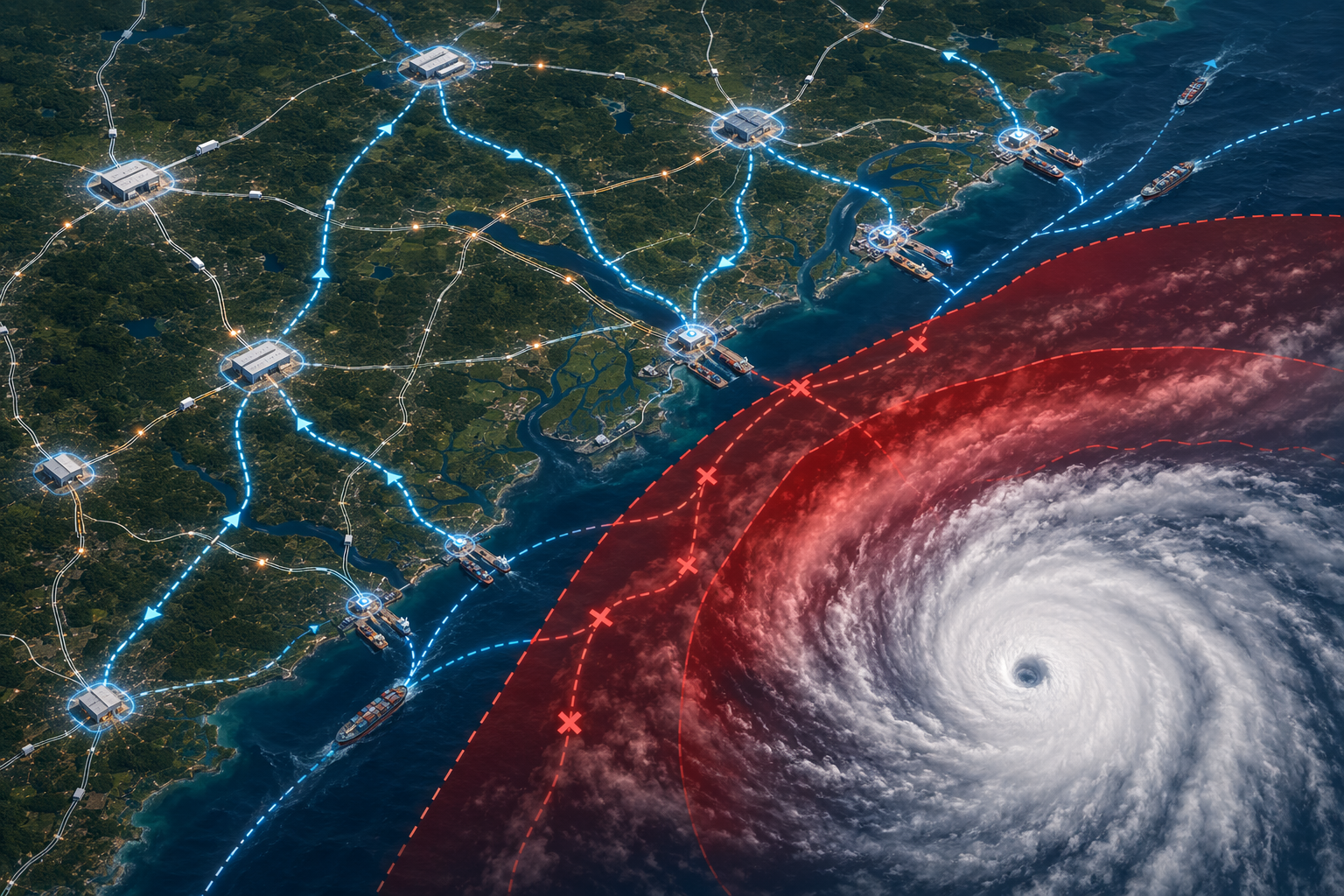
FourKites describes hurricane-season practices around real-time shipment visibility and AI-enabled detection, including the use of Fin AI to help identify and manage disruption signals across transportation networks.[6] C.H. Robinson’s hurricane readiness playbook points to the other half of the equation: response capacity, carrier coordination, alternate routing, facility status, and customer communication when conditions change.[7]
The distinction matters because detection is not execution. A model may flag a load headed toward a vulnerable port or a lane likely to deteriorate, but someone still has to decide whether to hold, divert, expedite, consolidate, or rebook. The best logistics AI use cases are therefore tied to operating rules: which customers get priority, which products cannot wait, which facilities can receive rerouted freight, and how much premium cost is acceptable before approval rises.
This is also where timing compounds. If a port closure lasts 24–72 hours and recovery takes several more days, rerouting after the closure notice may only move the company from one queue into another.[4] The advantage comes when a logistics team sees enough probability, exposure, and capacity pressure to make a controlled change while options still exist.
What to Treat as Evidence, and What to Treat as Sales Material
The evidence base is uneven, which is normal for a use case that sits between weather science, commercial planning, procurement risk, and transportation execution. The ClimateAi Hurricane Ian result is the clearest documented business action, but it is vendor-published and single-instance.[3] Interos provides useful scale and a logic for multi-tier exposure mapping, but the exposure totals do not by themselves prove avoided loss.[5] FourKites and C.H. Robinson are credible operational references for visibility and response, but the outcome depends on data coverage, carrier participation, and whether the customer has authority to act.[6][7]
That does not make the use case weak. It means buyers should evaluate it through decision evidence rather than platform vocabulary. During vendor shortlisting, the most revealing questions are not about how many models sit behind the screen. They are about the decision path.
- For inventory: which forecast signal changes stock placement, replenishment timing, or allocation rules before the storm?
- For suppliers: which tier-two or tier-three dependency would the team miss without automated mapping?
- For logistics: which shipment, port, lane, or carrier decision is triggered earlier than the normal exception process?
- For governance: who approves the action when the storm risk is credible but not certain?
- For measurement: what would count as success besides a dashboard showing that a storm existed?
The human-in-the-loop point is not a polite caveat. It is the control mechanism that makes the use case investable. AI can narrow the detection-to-action window, but the business still needs accountable people to weigh false alarms, customer commitments, regulatory obligations, working capital, and premium freight. A forecast that no one is authorized to act on is just another meeting invite.
A Practical Judgment for 2026
The below-normal 2026 forecast should not be ignored, but it should not be allowed to settle the risk conversation either.[1] Storm count is a planning input. Severity, intensification speed, port recovery, supplier concentration, and logistics capacity determine whether the business can still move.
AI is worth evaluating for Atlantic hurricane season supply chain risk when it is attached to specific pre-season inventory positioning, multi-tier supplier exposure mapping, and live rerouting workflows. Its real value is not that it knows the future. It is that it can give planners a cleaner first move before everyone else is calling the same carriers, ports, suppliers, and internal approvers.
References
- NOAA predicts below-normal 2026 Atlantic hurricane season, NOAA
- Atlantic hurricane season outlook 2026, Allianz Commercial
- Three Ways AI Can Help Companies De-Risk Supply Chains During Hurricane Season, ClimateAi
- Atlantic Hurricane Season 2026: Shipping Impact Guide, iContainers
- Protecting Your Supply Chain from Extreme Weather, Interos
- Tips for Keeping Your Supply Chain Running During Hurricane Season, FourKites
- C.H. Robinson playbook for hurricane readiness, C.H. Robinson
Comments
Join the discussion with an anonymous comment.