
The AI Sales Forecasting Software Market: Marketing vs. Real-World ML Adoption
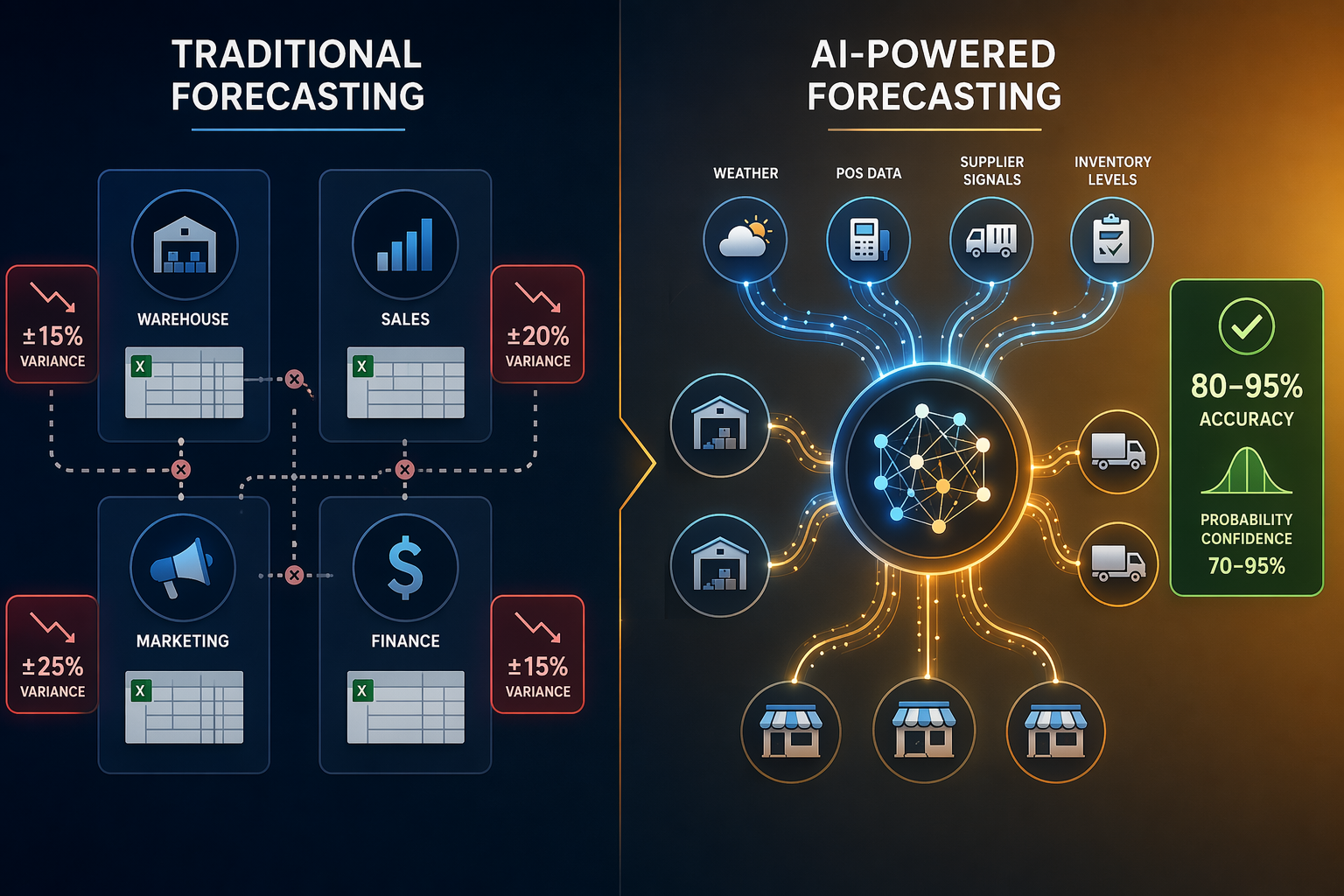
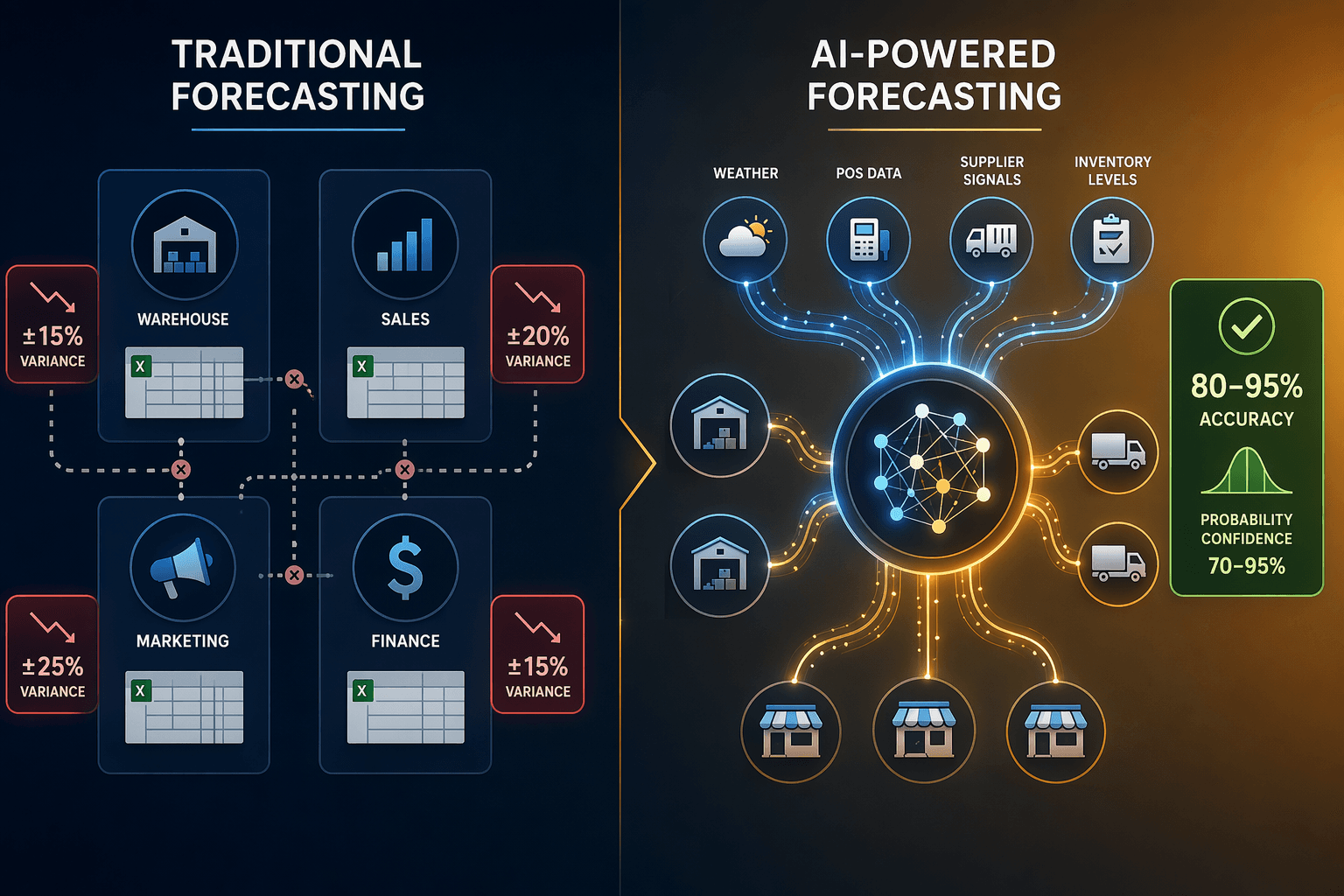
The market for AI sales forecasting software in supply chain is bifurcated. On one side sit the legacy suite vendors — Blue Yonder, SAP IBP, Kinaxis — whose marketing materials prominently feature AI capabilities but whose real-world adoption of machine learning at scale remains thin. On the other side are AI-native platforms — o9 Solutions, ToolsGroup, Flowlity, and relational modeling platforms like Kumo — that have built their architectures around probabilistic forecasting, demand sensing, and cross-product relational modeling from the ground up.
This gap between AI marketing and actual ML deployment is not a minor nuance. It is the single most important distinction a supply chain buyer must navigate when evaluating tools for demand forecasting. A vendor that has bolted a neural network onto a 20-year-old time-series engine is not delivering the same capability as a platform whose core data model is designed to capture substitution effects, causal drivers, and probabilistic ranges.
Our previous three-vendor architecture comparison examined Blue Yonder, Kinaxis, and o9 Solutions through the lens of AI architecture. This guide expands the analysis to seven vendors — adding SAP IBP, RELEX, ToolsGroup, and Flowlity — and introduces a critical evaluation framework that separates genuine ML capability from feature-check-box marketing.
7 Criteria for Evaluating AI Sales Forecasting Software
Supply chain organizations evaluating AI forecasting platforms need a structured framework that cuts through vendor claims. The following seven criteria are designed to surface the differences between AI-native and AI-enhanced architectures — a distinction explored in depth in our guide to identifying genuinely AI-first supply chain companies.
- Cross-product modeling capability. Can the platform capture substitution effects — where demand shifts when a product stocks out? According to Kumo.ai, standard time-series models miss 25-30% of demand signal precisely because they cannot model these cross-product relationships.
- Demand sensing. Does the tool incorporate near-real-time signals (POS data, weather, promotions, social sentiment) into short-term forecasts, or does it rely solely on historical shipment data?
- Implementation time and IT resource requirements. Some platforms require 6-12 month deployments with dedicated data engineering teams. Others are designed for faster time-to-value with lighter integration footprints.
- User satisfaction. G2 ratings provide a proxy for real-world user experience, but they must be read critically — a high score from a small sample may not indicate enterprise readiness.
- Total cost of ownership (TCO). Beyond license fees, factor in data quality remediation, integration consulting, and ongoing model maintenance.
- Model Context Protocol (MCP) and openness. As of April 2026, Flowlity is one of the only vendors with a production MCP server (Flowlity Co-planner), while SAP announced platform-level MCP support for HANA Cloud starting Q1 2026. Openness to data exchange and model portability is becoming a strategic differentiator.
- Forecast granularity. Can the platform produce SKU-location-day-level forecasts with probabilistic ranges, or does it aggregate to monthly product-family-level predictions?
Vendor Profiles: Capability Assessments with Source-Attributed Data
Each profile below draws on publicly available capability data, G2 user satisfaction ratings (as of mid-2025, sourced via third-party vendor comparison pages), and published benchmark results. Ratings should be verified directly on G2 before making procurement decisions.
Blue Yonder
Blue Yonder holds a G2 rating of 4.1/5. The platform markets AI capabilities across its Luminate Planning suite, but user reviews rarely mention AI features delivering measurable value. Many customers continue to use traditional time-series forecasting methods within the platform. Blue Yonder's strength remains its deep ERP integration ecosystem and installed base in large enterprises, but its AI adoption depth lags behind AI-native competitors.
o9 Solutions
o9 Solutions (G2: 4.2/5) offers broad AI capability spanning demand forecasting, supply planning, and inventory optimization. Its Digital Brain platform supports probabilistic modeling and scenario analysis. However, deployments typically require 6-12 months and dedicated IT resources. The platform's flexibility comes with complexity — organizations without strong internal data engineering teams often struggle to realize the full capability set.
Kinaxis RapidResponse
Kinaxis (G2: 4.0/5) is known for its concurrent planning architecture and in-memory calculation engine. The platform supports what-if scenario modeling and has added ML-based forecasting capabilities through its Kinaxis AI offerings. However, user satisfaction scores are the lowest among the vendors profiled here, and the platform's AI features are less deeply integrated than those of AI-native competitors. Kinaxis remains a strong choice for organizations that prioritize scenario modeling over ML-driven forecast accuracy.
SAP Integrated Business Planning (IBP)
SAP IBP (G2: 4.3/5) benefits from deep integration with SAP S/4HANA and a massive installed base. Its AI capabilities include demand sensing and ML-based forecasting through SAP IBP for Demand. However, as a module within the broader SAP ecosystem, IBP inherits the complexity and long implementation timelines of SAP deployments. The platform's MCP support for HANA Cloud, announced for Q1 2026, signals a move toward greater openness, but production adoption remains early.
RELEX
RELEX is a strong player in retail and CPG demand forecasting, with a focus on AI-driven promotion planning and inventory optimization. The platform's unified data model covers demand, supply, and space planning. RELEX has a growing presence in North America and Europe, particularly among grocery and consumer goods retailers. Independent capability assessments for RELEX are limited in publicly available comparison data, making direct vendor engagement and proof-of-concept testing essential.
ToolsGroup
ToolsGroup (G2: ~4.7/5) is an AI-native platform specializing in probabilistic demand forecasting and inventory optimization. Its SO99+ engine uses machine learning to generate probabilistic demand distributions rather than point forecasts. The platform has a strong track record in industrial manufacturing, automotive, and CPG. User satisfaction scores are among the highest in the category, though the vendor's smaller market presence means fewer peer references for enterprise buyers.
Flowlity
Flowlity (G2: 4.9/5) applies AI across demand forecasting, new product launch forecasting, demand sensing, promotion forecasting, and autonomous supply planning. As of April 2026, Flowlity is one of the only vendors with a production MCP server (Flowlity Co-planner), enabling real-time data exchange with other planning systems. The platform is designed for faster time-to-value than legacy suite alternatives, with a focus on mid-market and enterprise organizations that want AI-native capability without multi-year implementation cycles.
Kumo (Relational AI)
Kumo takes a fundamentally different approach to demand forecasting. Instead of treating each SKU as an independent time series, Kumo's relational AI models the entire product graph — capturing cross-product substitution, cannibalization, and complementarity effects. On the SAP SALT enterprise benchmark, KumoRFM scored 89% accuracy versus 75% for PhD data scientists using XGBoost and 63% for LLM+AutoML, with zero feature engineering. This benchmark result, while impressive, comes from a single vendor-published study and should be validated independently.
Side-by-Side Comparison: Accuracy Benchmarks and Key Differentiators
The following table consolidates available accuracy benchmarks, user satisfaction scores, implementation timelines, and key differentiators across the seven vendors. Data is drawn from published sources and vendor-reported benchmarks — see the callout below for important caveats.
| Vendor | G2 Rating | AI Depth | Implementation Timeline | Key Differentiator |
|---|---|---|---|---|
| Blue Yonder | 4.1/5 | Moderate (limited real-world ML adoption) | 6-12 months | Deep ERP integration; large installed base |
| o9 Solutions | 4.2/5 | High (probabilistic, scenario modeling) | 6-12 months | Broad capability; requires dedicated IT resources |
| Kinaxis | 4.0/5 | Moderate (concurrent planning, ML add-ons) | 4-9 months | Scenario modeling strength; lowest user satisfaction |
| SAP IBP | 4.3/5 | Moderate (demand sensing, ML modules) | 9-18 months | SAP ecosystem integration; MCP support announced |
| RELEX | Not available | High (retail/CPG focus) | 4-8 months | Unified demand-supply-space planning |
| ToolsGroup | ~4.7/5 | High (probabilistic, inventory optimization) | 3-6 months | Probabilistic demand distributions; strong industrial base |
| Flowlity | 4.9/5 | High (demand sensing, autonomous planning) | 2-4 months | Production MCP server; fastest time-to-value |
| Kumo | Not available | Very high (relational AI, graph-based) | 2-4 months | 89% accuracy on SAP SALT benchmark; zero feature engineering |
For broader context on accuracy benchmarks: McKinsey & Company research indicates that AI-powered forecasting for supply chain management can reduce errors by 20% to 50% and reduce product unavailability by up to 65%. This figure, widely cited across the industry, originates from a single 2021 McKinsey report and should be treated as directional rather than guaranteed. Industry-specific benchmarks from ThroughPut.AI show that Food & Beverage median forecast error is approximately 25%, with upper quartile at 20% (per Gartner data), while Durable Consumer Products forecast error rates can reach 50%. Only 35% of businesses report confidence in their inventory forecast accuracy.
Selection Decision Matrix: Matching Vendors to Company Size and Complexity
No single vendor is optimal for every organization. The right choice depends on company size, supply chain complexity, industry vertical, and internal technical capability. The matrix below maps vendors to common buyer profiles.
| Company Profile | Recommended Vendors | Rationale |
|---|---|---|
| Large enterprise with complex multi-echelon supply chain | o9 Solutions, SAP IBP, Blue Yonder | Deep integration with existing ERP; broad capability for global operations; longer implementation timelines acceptable |
| Mid-market manufacturer or distributor | ToolsGroup, Flowlity, RELEX | Faster time-to-value; AI-native architecture; lower IT resource requirements |
| Retail or CPG company with high SKU count and promotions | RELEX, Flowlity, Kumo | Cross-product substitution modeling; promotion forecasting; demand sensing |
| Organization with limited data engineering resources | Flowlity, ToolsGroup | Shorter implementation cycles; less dependency on custom data pipelines |
| Company prioritizing scenario modeling over ML accuracy | Kinaxis | Concurrent planning and what-if analysis strength; acceptable for organizations with stable demand patterns |
| Data-science-mature organization seeking cutting-edge accuracy | Kumo, o9 Solutions | Relational AI or probabilistic modeling; requires internal ML expertise to maximize value |
For a deeper technical understanding of how AI forecasting differs from traditional statistical methods, see our side-by-side technical primer on traditional vs. AI-based forecasting.
Implementation Timeline and Hidden Cost Drivers
Implementation timelines vary dramatically across the vendor landscape. AI-native platforms like Flowlity and ToolsGroup can be deployed in 2-4 months for core demand forecasting use cases. At the other end of the spectrum, o9 Solutions and SAP IBP deployments typically require 6-18 months, with significant time allocated to data integration, model configuration, and organizational change management.
Beyond license fees, buyers should budget for several hidden cost drivers:
- Data quality remediation. Poor data quality costs organizations an average of $12.9 million annually, with supply chain operations experiencing disproportionate impact. Most AI forecasting projects require significant upfront investment in data cleaning, normalization, and historical correction before models can be trained.
- Integration complexity. Connecting AI forecasting platforms to existing ERP, WMS, and POS systems often requires custom middleware or API development. 29% of firms cite data silos and incompatible IT infrastructure as a major barrier to deploying analytics tools.
- Change management and organizational resistance. Shifting from deterministic point forecasts to probabilistic ranges requires planners and executives to interpret uncertainty — a skill that existing teams may not have developed.
- Model maintenance and drift monitoring. AI models degrade over time as demand patterns shift. Ongoing model retraining, performance monitoring, and governance add operational costs that are often underestimated during vendor selection.
For readers evaluating Flowlity or Lokad as AI-native alternatives, our Flowlity vs. Lokad comparison provides additional depth on the trade-offs between these two platforms.
Comments
Join the discussion with an anonymous comment.