
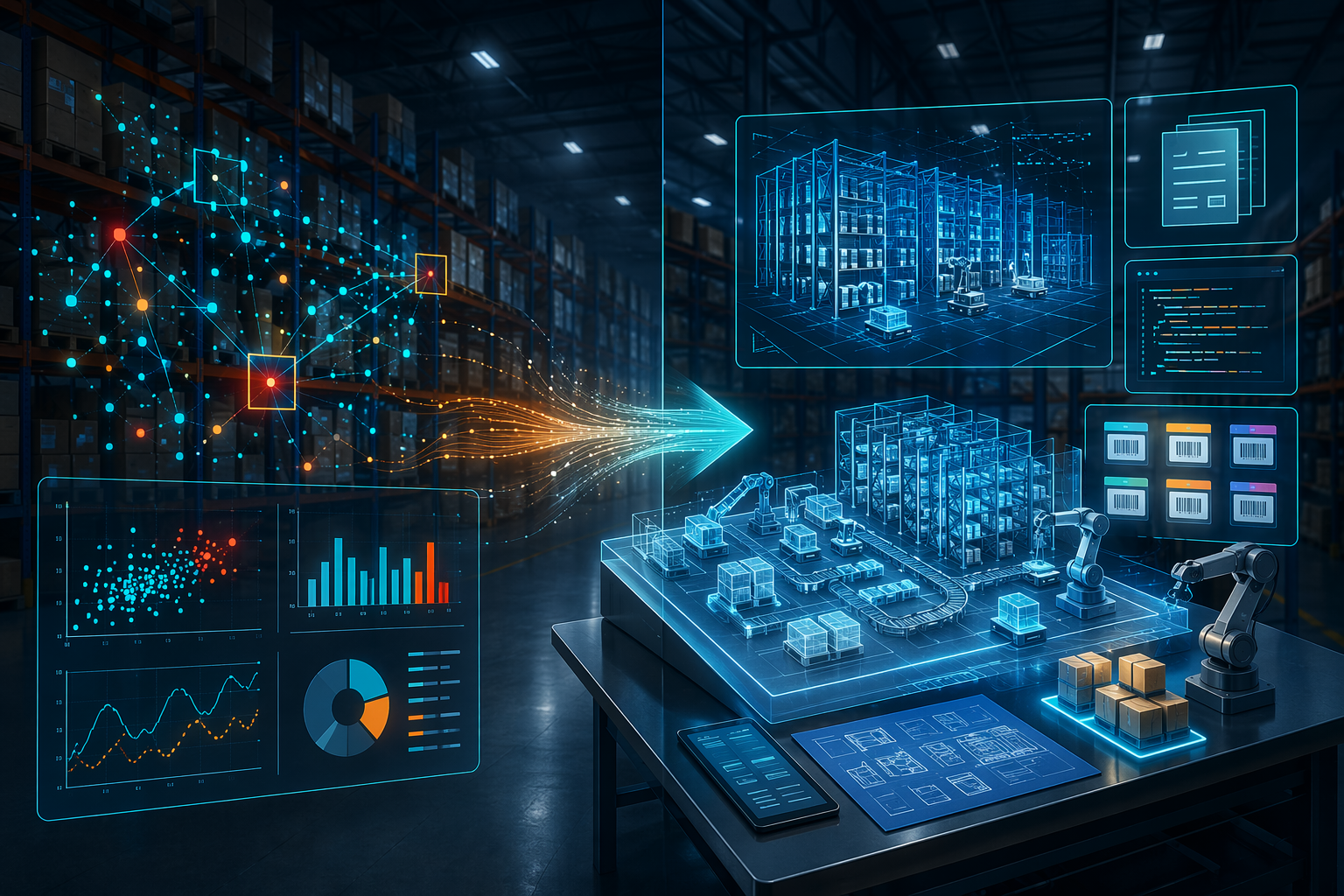
The most useful line in the current debate over AI in warehouse management is not a vendor promise about autonomy. It is Dr. Matthias Winkenbach’s distinction in the MIT-Mecalux warehouse AI study: “Traditional machine learning is great at predicting problems, but generative AI actually helps you engineer the solution.” In the same study of more than 2,000 warehouse leaders across 21 countries, generative AI ranked as the most valuable AI method in warehouses, ahead of predictive analytics and computer vision.[1]
That finding lands differently if you have watched warehouse teams live with the outputs of earlier AI programs. A prediction that labor demand will spike next Thursday is useful. A vision model that flags a mispick is useful. But neither one writes the revised work instruction, proposes the new label format, produces the automation script, or gives a supervisor a usable answer when the shift is already moving.
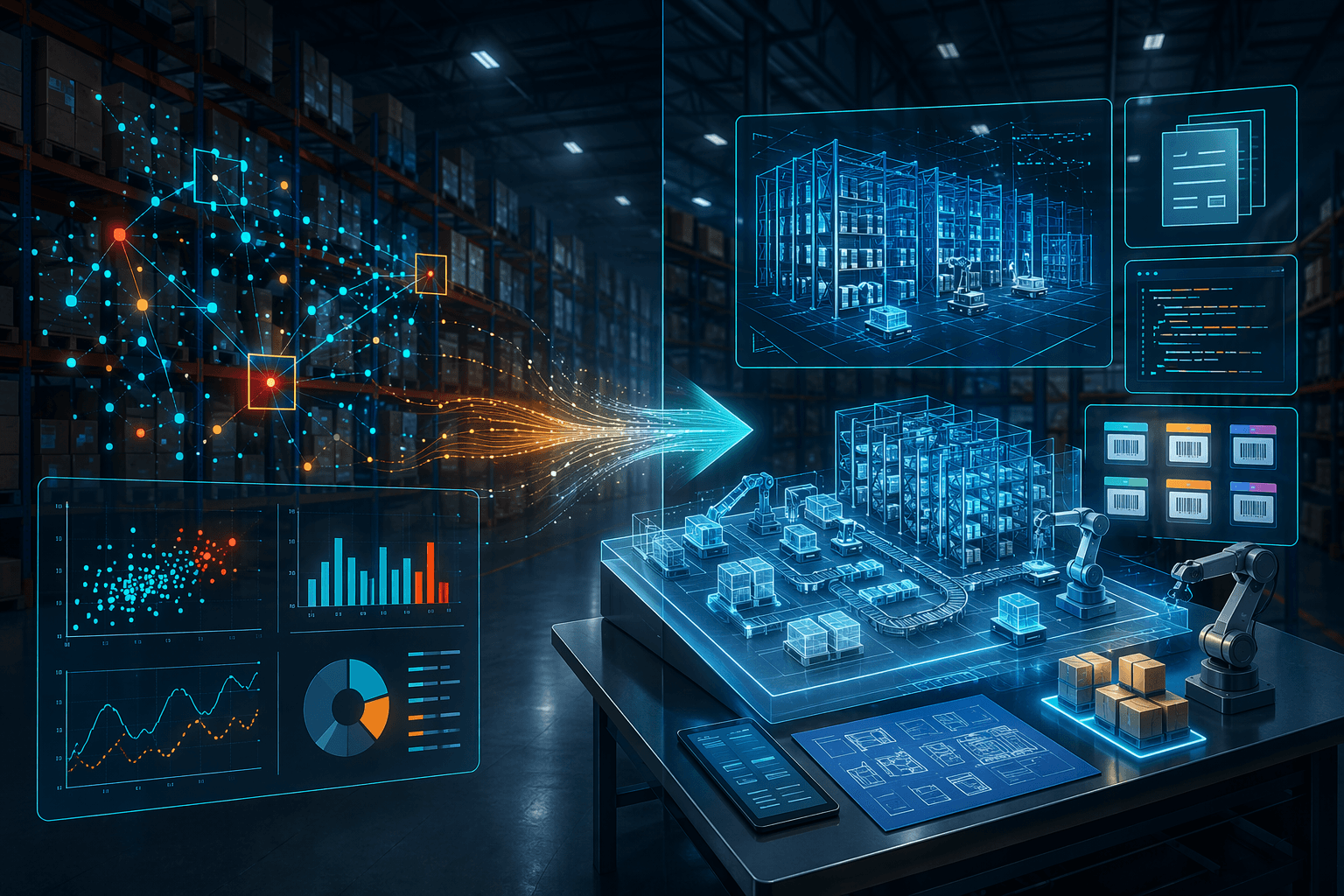
That is the practical reason generative AI has pulled ahead in perceived value. It does not merely make an old warehouse analytics chart more conversational. At its best, it moves into the awkward middle layer of warehouse work: the procedures, configurations, explanations, scripts, exception notes, layouts, and operating knowledge that usually sit between a good insight and a changed operation.
Why the ranking matters, and why it needs a careful reading
The MIT-Mecalux result deserves attention because it cuts against the reflex to make predictive accuracy the main scorecard for warehouse AI. The study also reports that 60% of warehouses already operate at advanced AI maturity levels, and that more than 90% use some form of AI or advanced automation.[1] Those numbers show how broadly the term “AI” is now being used in warehouse operations.
They should not be read as proof that most warehouses are running deeply integrated generative AI across daily execution. Mecalux is a warehouse automation vendor, so the study is not a neutral academic census in the strictest sense. MIT Intelligent Logistics Systems Lab participation gives the work weight, and secondary logistics coverage has treated the study’s direction as notable, but the definitions around “advanced AI maturity” appear broad enough to include advanced automation and earlier AI methods as well as newer GenAI deployments.[1][2][3]
That caveat does not weaken the main point. It sharpens it. If the warehouse sector already has years of exposure to optimization engines, forecasting models, machine vision, slotting logic, and rule-based automation, then GenAI ranking first is not simply a novelty effect. It suggests leaders are valuing a different class of work.
Traditional ML finds the condition; GenAI helps produce the change
Traditional machine learning is strongest when the task can be framed as detection, classification, prediction, or optimization against a known objective. In a warehouse, that can mean forecasting order volume, predicting congestion, detecting damage, identifying pick anomalies, recommending slotting changes, or estimating equipment maintenance risk.
Those are not small achievements. They are the basis of many credible warehouse AI business cases. But they still leave a large amount of work on the floor. Someone has to translate the insight into the changed process. Someone has to explain it to supervisors, modify SOPs, update training material, generate labels, alter integration logic, review system behavior, and keep the change from becoming another unsupported local workaround.
Generative AI becomes valuable where the output is not only a score, alert, or recommendation, but a draft artifact: a procedure, script, label set, layout variation, operator prompt, exception explanation, or natural-language answer drawn from warehouse data. That does not make GenAI magically correct. It means the automation target has shifted from recognizing the state of the operation to helping construct the next version of the operation.
| Warehouse problem | Typical traditional ML contribution | Where GenAI adds a different kind of value |
|---|---|---|
| Unexpected pick errors | Detects error patterns or predicts higher-risk orders | Drafts revised work instructions, exception explanations, and training prompts |
| Label and documentation maintenance | Flags inconsistency or correlates changes with performance | Generates updated label formats, SOP drafts, and localized procedural text |
| Automation system changes | Optimizes parameters or predicts bottlenecks | Helps generate and explain code or configuration logic for review |
| Layout and process-flow redesign | Models throughput, congestion, or travel-time impacts | Produces design alternatives and process narratives for simulation and review |
| Daily operational questions | Feeds dashboards and alerts | Turns warehouse data into conversational answers for supervisors and managers |
The work GenAI can take off the warehouse team’s plate
The highest-value GenAI use cases in warehouse operations are not the ones that pretend the building no longer needs operators, engineers, or supervisors. They are the ones that remove the manual glue work that has always slowed down warehouse transformation.
Documentation, labels, and operating instructions
Warehouse documentation is where good operational changes often go to die. A process engineer updates the flow. A supervisor explains the workaround verbally. Labels get revised in one zone and not another. Training material trails the actual process by weeks. By the time the system is “live,” the documents that operators rely on may already be stale.
The MIT-Mecalux materials identify automated documentation and labeling as tangible GenAI applications in warehousing.[1] The important word is not “automated” in the sense of unsupervised publishing. The useful version is supervised generation: draft the SOP from the new process design, convert it into shift-level instructions, produce label text in the right format, and give the operations owner something to approve rather than something to create from a blank page.
This is a different value proposition from predictive analytics. A model may identify that a picking zone has a recurring exception pattern. GenAI can help turn the fix into the artifacts people must actually use: revised procedure text, operator guidance, exception-handling language, checklist updates, and label variations. The human review remains essential, especially where safety, compliance, or customer-specific labeling is involved. But the tedious first draft moves from someone’s late afternoon to the system’s queue.
Code generation for automation systems
The warehouse automation stack is full of small, consequential pieces of logic: interface mappings, control scripts, exception rules, data transformations, test cases, and configuration snippets. These are not glamorous, but they are exactly where small errors wake up IT and operations before the first shift is fully staffed.
KNAPP describes GenAI applications in warehouse logistics that include support for code generation in automation contexts.[4] That should be treated as vendor-described capability, not an independent benchmark. Still, the use case is directionally credible because it fits where GenAI is already useful in software work: generating drafts, explaining code, translating intent into structured logic, and helping engineers review alternatives faster.
The safety rail is obvious. Generated code should not move straight into conveyor controls, robotics orchestration, WMS integrations, or PLC-adjacent workflows without engineering review, test environments, version control, rollback paths, and change approval. But dismissing the use case because it needs review misses the operational value. Warehouse engineers spend too much time turning process intent into technical scaffolding. GenAI can reduce that translation load, especially when the target is a draft integration, a test harness, a configuration explanation, or a repeatable script pattern.
Layout design and process-flow work
Layout work is another place where the distinction between prediction and solution engineering matters. A conventional model can tell a team that travel distance is high, congestion is likely in a zone, or a process is underperforming against a target. That is useful, but it does not by itself produce a practical redesign.
The warehouse GenAI use cases highlighted in the MIT-Mecalux research include layout design and process-flow optimization, with digital twin environments providing a way to test alternatives before physical changes are made.[1] The GenAI contribution is strongest when it helps generate candidate layouts, describe process implications, produce simulation-ready scenarios, or convert design choices into the downstream materials needed for execution.
This does not remove industrial engineering judgment. A warehouse layout is constrained by racking, dock doors, fire code, labor standards, automation footprints, inventory profiles, replenishment behavior, and customer commitments. GenAI does not know those constraints unless the system is connected to reliable data and the team gives it guardrails. But it can widen the set of alternatives a team can examine before committing scarce engineering time to detailed modeling.
Knowledge capture and operator guidance
Every warehouse has a second operating system made of local knowledge: how a customer’s cartons usually arrive, which putaway exception needs escalation, which replenishment rule behaves badly during a promotion, which aisle looks fine on a dashboard but slows down after lunch. Some of it lives in the WMS. Much of it lives in supervisors’ heads.
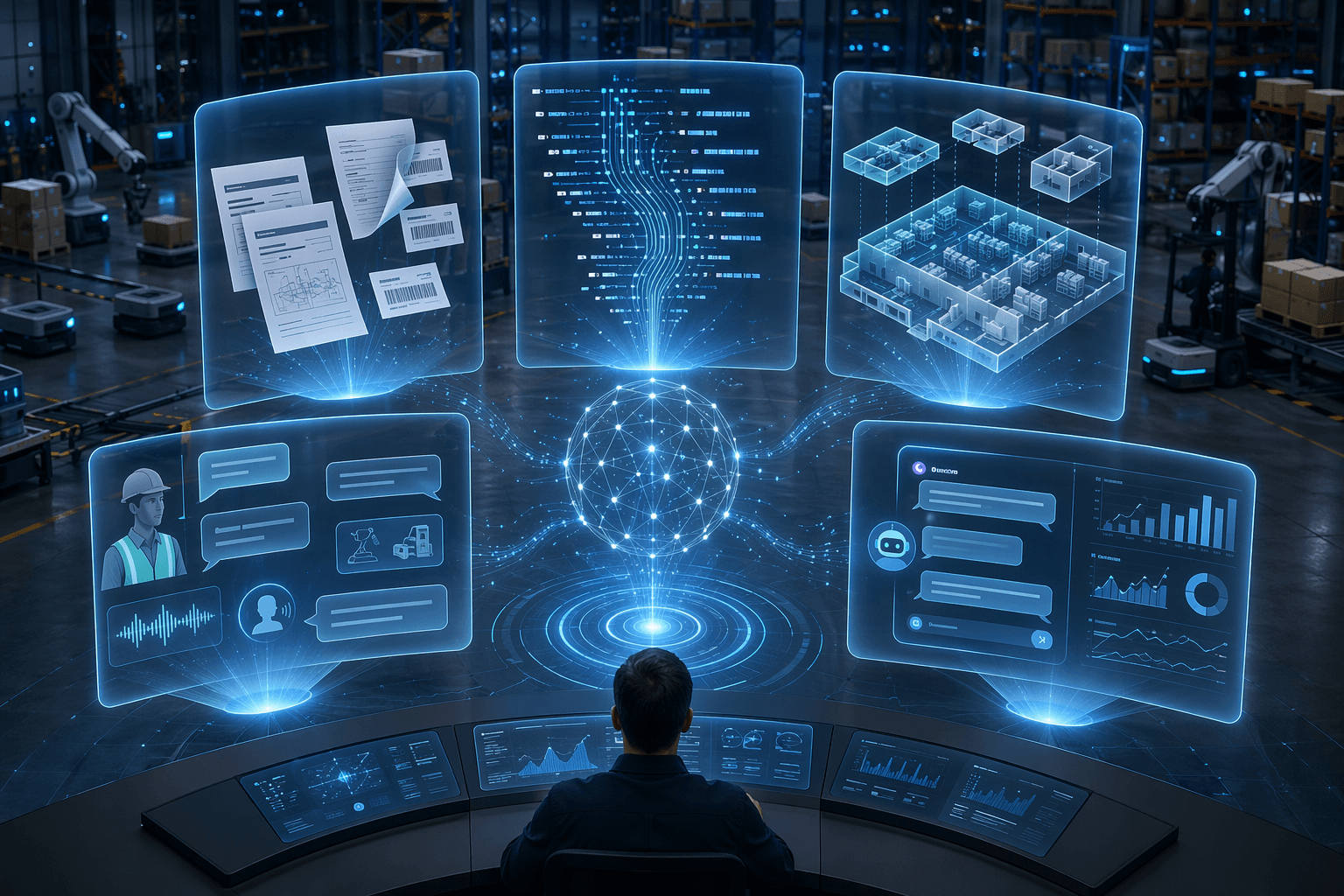
GenAI is well suited to turning that scattered knowledge into guidance because it can synthesize text, procedures, prior tickets, manuals, exception histories, and system records into a usable answer. Coram AI, for example, describes AI agents applied to warehouse safety compliance, including support for monitoring and operational guidance; that is vendor content, so it should be read as an example of where products are moving rather than proof of general performance.[5]
The better implementation target is not a chatbot that confidently improvises policy. It is a guided assistant that retrieves approved procedures, cites the underlying source, asks for missing context, and routes uncertain cases to the right owner. In that form, GenAI helps reduce the repeated questions that consume supervisors’ time while keeping accountability where it belongs.
Conversational access to warehouse data
Dashboards are useful until the actual question does not match the dashboard tab. A warehouse manager may need to know which SKUs drove yesterday’s late waves, whether a carrier issue is isolated to one door, or why a replenishment queue grew while labor hours looked normal. In many facilities, getting that answer still means exporting data, asking an analyst, or waiting for someone who knows the reporting schema.
Synkrato describes Trinity AI as a conversational agent for natural-language queries of warehouse data.[6] Again, this is a vendor example rather than independent proof of outcome. The category matters because it changes who can interrogate the operation. If a supervisor can ask a governed system for an explanation of an exception, and the answer is tied back to WMS, labor, inventory, or automation data, the warehouse gains more than a prettier dashboard.
The hard part is not the chat window. It is making sure the system understands the data model, respects permissions, distinguishes actual transactions from planned activity, and does not turn incomplete data into a confident narrative. A natural-language answer is only helpful if the warehouse can trust what it is grounded in.
Adoption momentum is real, but it is not the same as warehouse readiness
The MIT-Mecalux study reports that 87% of organizations expect to increase AI budgets and that more than 92% are implementing or planning new AI projects, with GenAI positioned as the next frontier.[1] Those numbers explain why warehouse technology shortlists now include GenAI by default. They do not prove that every warehouse has the data, architecture, or governance to use it well.
A broader procurement signal points in the same direction, but should stay in its lane: AI at Wharton and The Hackett Group reported in 2025 that 94% of procurement executives use GenAI tools at least weekly, up 44 percentage points year over year.[7] That is procurement, not warehouse operations. It shows that supply chain-adjacent leaders are getting comfortable with GenAI work patterns; it does not tell us how many warehouses can safely connect GenAI to execution data.
This distinction matters during vendor selection. A polished GenAI demo can make a warehouse look conversational in ten minutes. A production system has to survive item master errors, duplicate location naming, inconsistent reason codes, missing timestamps, customer-specific exceptions, role-based access rules, and the ordinary mess of systems that were implemented in different budget cycles.
The gating factors are not glamorous
The most practical constraint on GenAI in warehouse management is still data discipline. LIDD has emphasized data quality as a gating factor for AI in supply chain and warehousing contexts, while Oracle points to the need for cloud-based platforms and connected data foundations for AI-enabled operations.[8][9] The MIT-Mecalux materials make the same point in warehouse terms: GenAI depends on consistent master and transaction data, API-centric architectures, and cloud enablement.[1]
For warehouse leaders, that translates into a short list of unglamorous questions before any serious GenAI rollout:
- Do item, location, customer, carrier, and unit-of-measure records mean the same thing across the systems GenAI will query?
- Are transaction timestamps, exception codes, labor events, and inventory movements reliable enough to support operational answers?
- Can the WMS, WES, TMS, labor system, automation layer, and reporting environment expose data through governed interfaces rather than brittle manual exports?
- Is there a review workflow for generated procedures, labels, scripts, layouts, and operator guidance?
- Can the system show what source material or data it used, especially when the answer affects safety, compliance, inventory accuracy, or customer commitments?
These are not side issues. They decide whether GenAI removes work or creates a new class of cleanup work. A warehouse with poor master data will not become intelligent because a language model sits on top of it. It will become more fluent at exposing the consequences of poor master data.
Autonomy is coming into view, but it is not the current baseline
The forward edge is AI agents making or resolving more logistics decisions without direct human intervention. Gartner projects that 15% of daily logistics decisions will be made autonomously by AI agents by 2028, and that 60% of supply chain disruptions will be resolved without human intervention by 2031.[10]
Those projections are worth watching, but they are not a license to talk as if autonomous warehouse operations have already arrived. In 2026, the more defensible claim is narrower and more useful: GenAI is expanding the set of warehouse tasks that can be partially automated, especially where the work involves language, design alternatives, code drafts, process knowledge, and human-readable explanations.
That is still a meaningful shift. Traditional ML helped warehouses see problems earlier and optimize within known structures. Generative AI helps create the materials needed to change those structures: the document, the label, the script, the layout option, the supervisor answer, the operator instruction. It is the most valuable AI method in warehouse management in 2026 because it reaches the workbench, not just the dashboard.
References
- MIT-Mecalux AI in Warehousing Study, Mecalux
- MIT-Mecalux study coverage, Supply Chain Management Review
- MIT-Mecalux study coverage, DC Velocity
- Generative AI in warehouse logistics, KNAPP
- AI agents for warehouse safety compliance, Coram AI
- Trinity AI conversational agent, Synkrato
- Procurement GenAI adoption research, AI at Wharton / The Hackett Group, 2025
- Supply chain AI and data quality analysis, LIDD
- AI-enabled supply chain and cloud platform guidance, Oracle
- AI agent autonomy projections for logistics and supply chain, Gartner
Comments
Join the discussion with an anonymous comment.