
The hard part of a food recall is often not the contaminated lot itself. It is the fog that follows: which adjacent lots touched the same line, which supplier shipment was blended into which batch, which distributor received the product, which customer has it now, and whether the next decision can be defended after the fact.
That fog has a measurable shape. Mergen AI’s analysis of 1,576 FDA food recalls from 2025 estimates a 23-to-31-day range between the contamination event and recall initiation, inferred from date patterns in the recall data rather than presented as an official mean with confidence intervals.[1] For anyone evaluating AI for food supply chain recall management, that is the right place to start. Not with a dashboard demo. Not with a promise that AI will “transform” food safety. With the weeks during which product keeps moving while the organization is still assembling the facts.
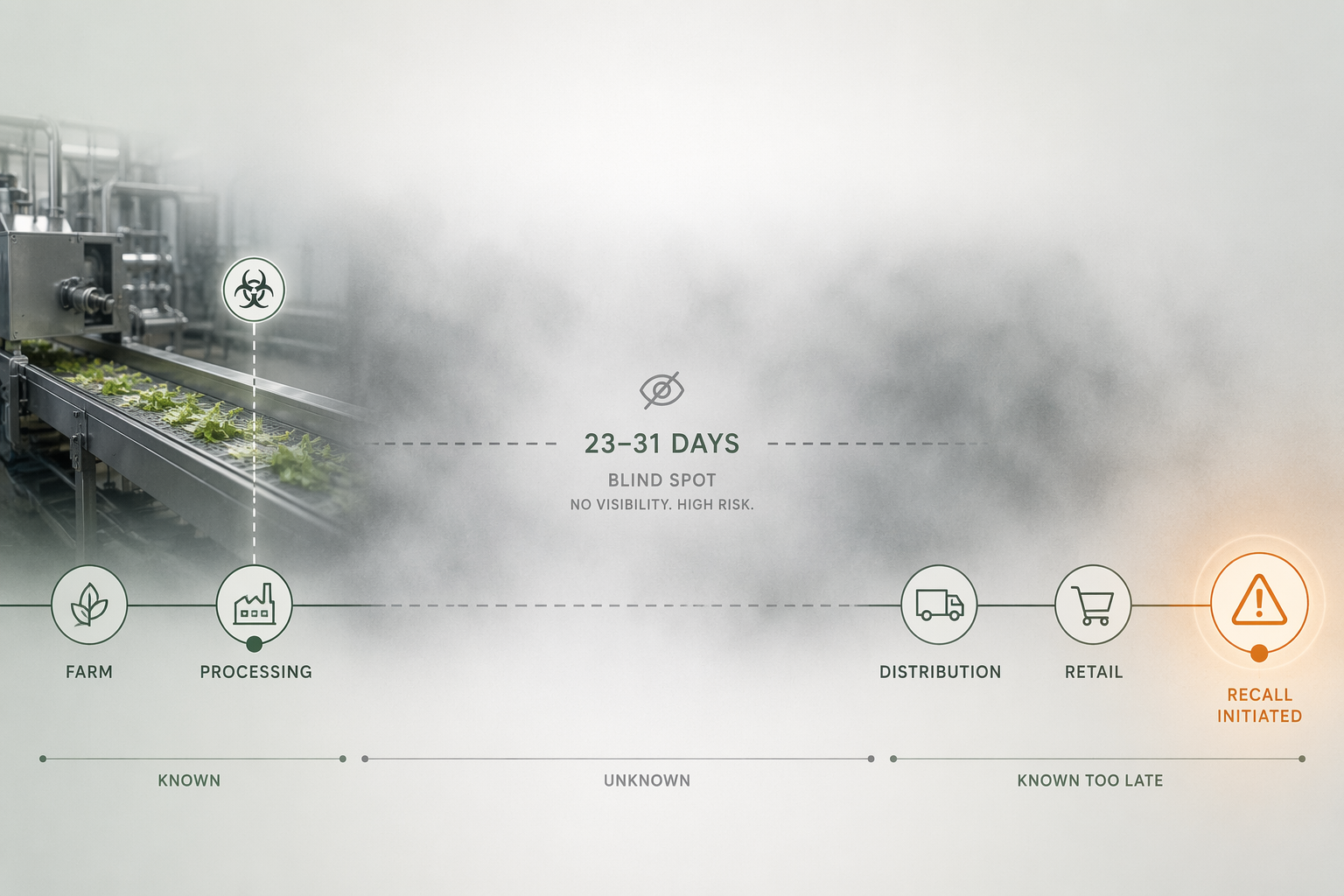
The latency matters because recall management is a narrowing exercise. Each hour of uncertainty leaves more inventory in circulation, more downstream customers to notify, more records to reconcile, and more room for contradictory evidence. A recall coordinator does not need an elegant prediction if it cannot be translated into a dated lot, a site, a shipment path, and an action.
The Blind Spot Is Built Into the Data
Most food companies do not lack data. They lack recall-ready data. Supplier quality records sit in one system. Certificates of analysis arrive as PDFs. Environmental monitoring results live with QA. Production lots and work orders live in ERP or MES. Temperature logs may sit with a carrier or a warehouse provider. Customer shipments are often clean at the order level but less clean at the ingredient-lot level.
When an adverse signal appears, the first question is rarely “what does the model think?” It is more basic: can the company connect the signal to a lot-level history quickly enough to act before the implicated product has spread further? If the answer requires phone calls, spreadsheet joins, supplier emails, handwritten sanitation records, and a few people who happen to remember what happened on third shift, the recall clock is already running faster than the investigation.
The Bedner Growers cucumber cascade is the kind of case that turns an abstract latency problem into an operating problem. Mergen AI’s analysis describes a single supplier failure triggering 258 downstream recalls because manufacturers lacked real-time visibility into supplier quality status.[1] That number is not just a count of public notices. It is a picture of the network work created when an upstream uncertainty cannot be constrained early.
Inside a recall room, that kind of cascade changes the nature of the decision. The team is no longer asking only whether one finished-good lot is suspect. It is asking which co-manufacturers used the same ingredient, whether any lots were reworked, which distribution centers cross-docked product before the hold went in, and whether customer notification can wait for cleaner evidence. The cost is not merely waste. It is time spent proving what should have been knowable.
Where AI Actually Compresses Recall Time
The useful AI pattern in recall management is not a single model making a dramatic yes-or-no call. It is a chain of systems that shortens the route from signal to lot-level action: sensing an abnormal condition, detecting the relevant event in operating data, predicting the affected scope, supporting the recall decision, and proving the chain of custody. The Institute of Food Technologists frames this as sense, detect, predict, decide, and prove.[2]
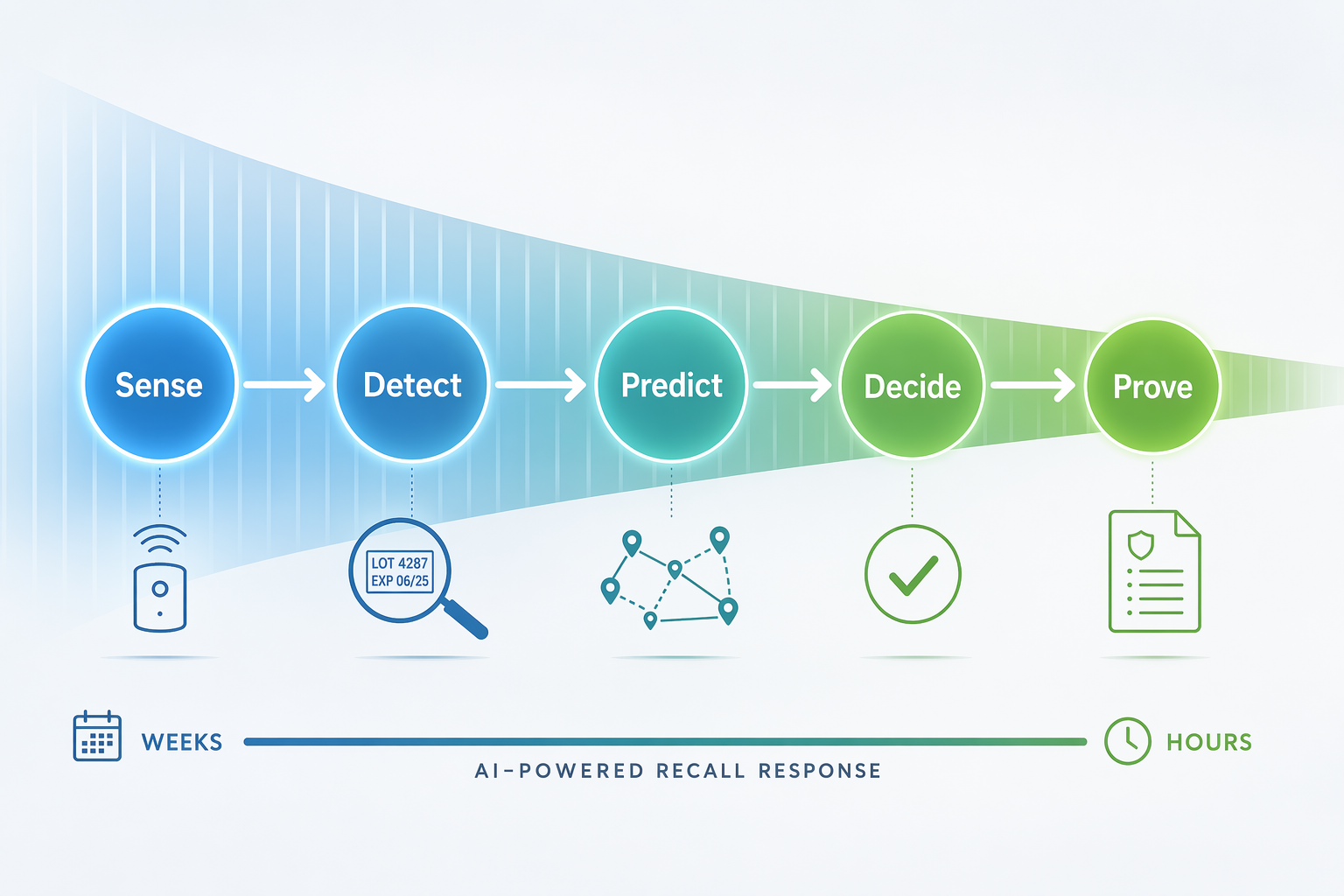
The heavy lift is in detect and prove. Sensing is important: environmental monitoring, process data, temperature excursions, sanitation deviations, complaint spikes, test results, and visual inspection outputs can all create earlier warning. Prediction has value when it estimates which lots, routes, or customers are likely implicated. Decision support matters when the QA director has to choose between a narrow hold, a broader market withdrawal, or a recall.
But detection is where the organization finds the event that matters, and proof is where it earns the right to act narrowly. A model that flags a possible risk is not enough if the plant cannot attach the signal to a supplier lot, a production window, a sanitation break, a set of finished goods, and a shipment list. Likewise, a fast traceback is not enough if the evidence trail cannot survive customer questions, regulator review, or litigation.
| Recall function | Operational question | What shortens the clock |
|---|---|---|
| Sense | What abnormal condition appeared? | Continuous monitoring of process, environmental, quality, and distribution signals |
| Detect | Which lot-level event does the signal belong to? | Automated matching across supplier lots, production records, QA events, and shipments |
| Predict | How far could the issue have traveled? | Scope modeling across shared ingredients, lines, dates, routes, and customers |
| Decide | What action is defensible now? | Risk-ranked options tied to evidence, holds, notifications, and recall classes |
| Prove | Can the company show the chain of custody? | Auditable traceability records and critical tracking events |
This is why AI for recall management should be evaluated less like a forecasting tool and more like an evidence assembly system. The question is not whether it can produce a risk score. The question is whether it reduces the number of manual joins between the first signal and the first defensible lot-level action.
Detect: Turning Signals Into Lot-Level Events
Detection work starts before a recall exists. A finished-product positive, an environmental swab, a supplier nonconformance, a carrier temperature deviation, or a cluster of complaints may be the first signal. In many companies, these events are recorded, but not in a way that automatically links them to the lots that matter.
AI-enabled detection helps when it can reconcile messy operating records: inconsistent supplier lot formats, alternate item names, partial shipment identifiers, handwritten or scanned records, production date ranges, and changes in line status. That is not glamorous work, but it is exactly where recall latency hides. If the system can tell QA that a supplier lot touched three finished-good SKUs across two production dates and one rework event, the discussion moves from investigation posture to action posture.
Computer vision examples suggest that AI inspection is already mature enough to operate in production environments, though vendor-favorable framing should be treated cautiously. PepsiCo has been cited for AI defect detection accuracy of 95% in food production contexts.[3] That kind of capability does not, by itself, initiate a recall. Its recall value appears when the defect signal is captured as a structured event tied to product, line, time, lot, and disposition.
Prove: The Difference Between Fast Search and Defensible Action
Proof is the discipline that keeps faster recall management from becoming faster guesswork. A recall decision has to survive more than internal urgency. It has to support regulator communications, customer notifications, insurance questions, supplier claims, and, in some cases, legal discovery. Faster traceability can also create new governance questions around who saw what data, when, and how decisions were made; those liability implications are worth treating separately in AI food traceability lawsuit risks.
The proof layer depends on critical tracking events being digitized and consistently shared. Receiving, transformation, packing, shipping, and distribution events need to be connected across organizations, not reconstructed after the outbreak team is already asking for answers. AI can help normalize records, identify missing links, and surface contradictions, but it cannot prove a chain of custody that nobody captured.
This is where many recall technology conversations get too optimistic. A model can rank likely affected lots in minutes. It cannot make a supplier share usable event data if the commercial relationship never required it. It cannot infer a clean transformation record from a production day where ingredients were blended, reworked, substituted, or relabeled without disciplined lot controls. The constraint is not only analytical capacity. It is traceability hygiene.
The Walmart Traceback Benchmark Is Powerful, But Narrow
The best-known speed benchmark comes from Walmart and IBM Food Trust, where produce traceback time was reported to fall from 7 days to 2.2 seconds.[3] That comparison deserves attention because it shows what digitized traceability can do when product movement records are structured, accessible, and linked across participants.
It should not be read as proof that any food company can buy software and move from weeklong recall work to seconds. Traceback speed and recall initiation speed are related, but they are not the same metric. Traceback answers where product came from or where it went. Recall initiation requires a defensible judgment that the evidence is strong enough to act, and that judgment may still depend on test confirmation, epidemiological evidence, supplier investigation, or regulator communication.
Still, the benchmark is useful because it sets a ceiling for one part of the process. If traceback can be reduced to seconds under the right data conditions, then the 23-to-31-day blind spot is not an unavoidable law of food safety operations. Some portion of it is record latency, participation latency, and decision latency. AI can attack those delays when the underlying events are already being captured.
What Has to Be in Place Before Hours-Level Response Is Plausible
Hours-level recall response is not a model feature. It is the result of several less exciting capabilities working together:
- Interoperable lot codes that remain usable across suppliers, plants, distributors, and customers
- Digitized critical tracking events for receiving, transformation, packing, shipping, and distribution
- Supplier agreements that require timely quality-status and event-data sharing
- Continuous monitoring that creates structured alerts rather than disconnected observations
- QA governance that defines who can place holds, expand scope, release product, and initiate recall actions
FSMA 204 is part of this backdrop because it pushes the industry toward more disciplined traceability for designated foods, although Deloitte notes a proposed compliance extension to July 2028 and Congressional direction to FDA on the timing.[4] The compliance date matters less than the operating implication: companies that wait to build traceability until a recall has already started will continue to spend the most expensive hours proving basic movement history.
The stronger systems treat recall readiness as a standing data condition. They do not ask whether a supplier can answer a questionnaire during a crisis. They already know whether the supplier’s lot identifiers map to internal item masters, whether quality holds flow into shipment controls, whether environmental positives are associated with production windows, and whether customer-facing shipment data can be filtered by affected lots without manual reconstruction.
The Cost Case Is Really a Scope Case
The industry often uses $10 million as an average direct recall cost benchmark, with the usual caution that the primary study behind the figure is not always visible in secondary citations.[5] That number is useful as a boardroom shorthand, but it can make recall economics look too tidy. The real cost difference between a slow and fast recall is usually scope: how much product is implicated, how many customers must be contacted, how much labor is pulled into record review, how much inventory is destroyed, and how long the brand remains associated with uncertainty.
Consumer behavior adds another reason to care about time. Inspectorio cites NielsenIQ data indicating that 68% of consumers are willing to switch brands after a food safety incident.[5] That figure does not prove that every delayed recall causes an equivalent brand loss. It does show why “we are still investigating” is not a neutral state once the issue becomes visible. A company that can identify, contain, and explain the affected scope sooner has a better operating position than one still reconciling records days later.
The broader public-health backdrop is larger still. U.S. PIRG Education Fund’s 2026 food safety report cites a $75 billion annual cost of foodborne illness, attributed to USDA analysis through Food Institute reporting.[6] That figure should not be treated as savings that AI can simply unlock. It is the scale of the harm faster detection and narrower recalls are trying to reduce.
How to Evaluate AI Recall Tools Without Getting Distracted
A recall management system earns attention when it changes operational timing. Vendor language can make every feature sound like risk reduction, so the evaluation should stay close to the recall sequence. The most useful questions are plain ones:
- How quickly does the system connect an adverse signal to supplier lots, finished-good lots, production windows, and shipment records?
- Can it distinguish product that is implicated from product that merely looks adjacent?
- Does it preserve the evidence trail behind each recommendation, including source records and timestamps?
- How does it handle missing supplier data, conflicting lot formats, substitutions, rework, and partial shipments?
- Can QA place holds, expand scope, notify customers, and document decisions from the same lot-level view?
Those questions keep the focus where it belongs. A system that flags more anomalies may still increase recall workload if it cannot connect those anomalies to action. A system that produces faster search results may still leave the company exposed if supplier participation is incomplete. A system that automates customer notification may still be dangerous if the affected scope is poorly proven.
The practical test is a mock recall with ugly data. Give the system a supplier lot with inconsistent naming, a production day with rework, a QA hold entered late, a distributor shipment split across locations, and one missing external record. Then measure how long it takes to produce a defensible affected-lot list, an excluded-lot rationale, and a customer notification file. That exercise will reveal more than a polished dashboard built on clean demonstration data.
The Measurable Role of AI
AI’s strongest measurable role in food recall management is not preventing every contamination event. No responsible recall system can promise that. Its more credible role is collapsing the uncertainty between contamination and action: sensing signals earlier, detecting the lot-level event faster, predicting the affected scope more narrowly, supporting a defensible decision, and proving the chain of custody without days of manual reconstruction.
The 23-to-31-day blind spot is an estimated range, not a universal baseline for every company or product category.[1] But it gives recall technology a concrete target. If AI-enabled traceability and monitoring can reduce even part of that gap, the consequence is not just a faster report. It is fewer uncertain lots, fewer downstream recalls, less time under investigation, and a better chance of limiting consumer harm.
Hours-level response is plausible where monitoring, traceability, lot discipline, and supplier data-sharing are already being built. Without those foundations, AI mostly speeds up the discovery of how fragmented the recall process still is.
References
- The Anatomy of Failure, Mergen AI, February 2026.
- How AI Is Reshaping Food Safety, IFT Food Technology Magazine, June 2026.
- How AI is Transforming Food Safety, IONI AI.
- Traceability and tracking in the food industry, Deloitte.
- How AI Rewrites Food Supplier Risk Management, Inspectorio / Food Logistics, May 2026.
- Food for Thought 2026, U.S. PIRG Education Fund.
Comments
Join the discussion with an anonymous comment.