
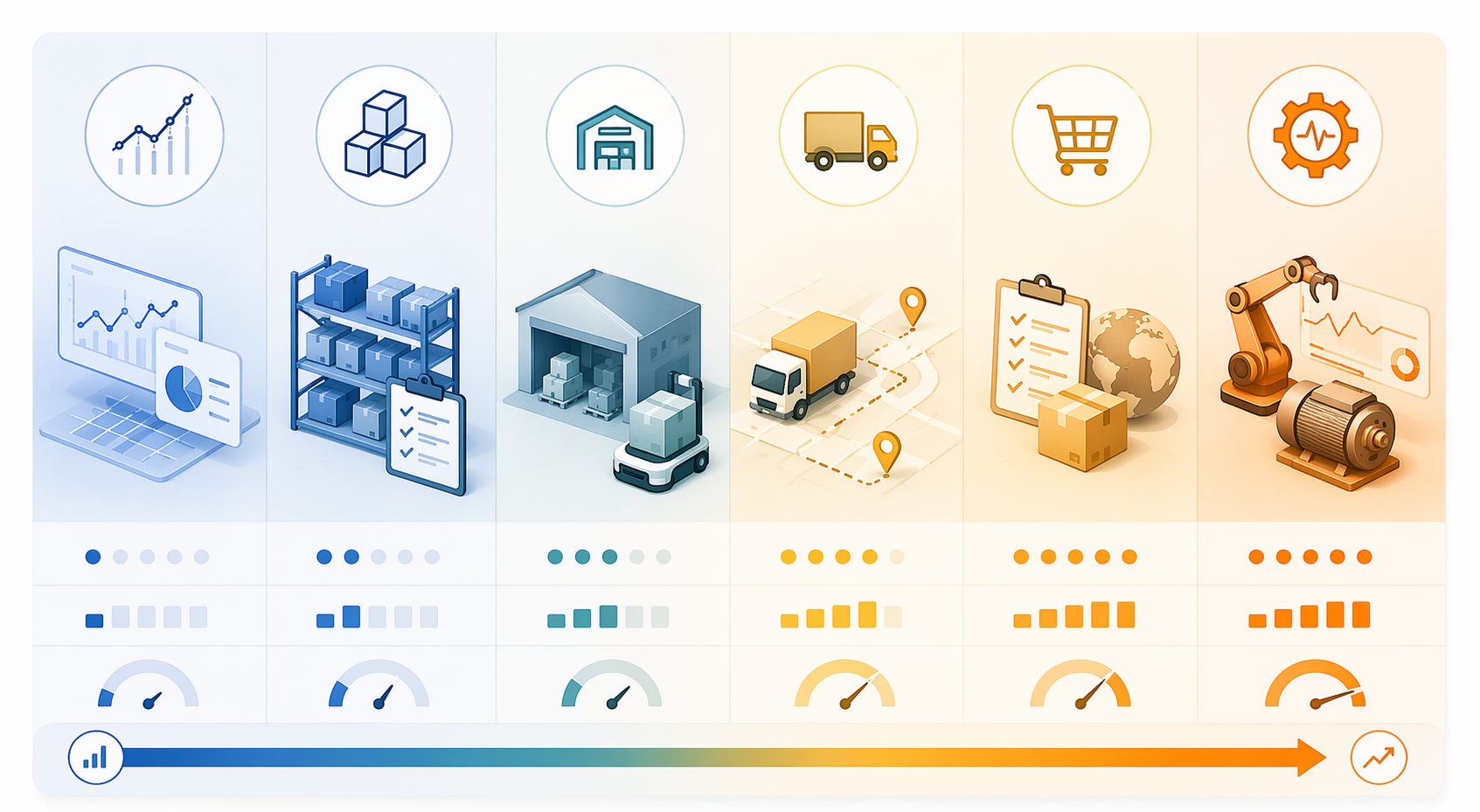
| Function | Best first ML use case | Documented return signal | Maturity | Adoption burden |
|---|---|---|---|---|
| Demand forecasting | ML-assisted forecast generation, demand sensing, exception-based forecast review | 20-50% forecast error reduction reported in McKinsey-cited analysis; Amazon Pharmacy case reports 50% forecast accuracy improvement via Articsledge compilation [1][2] | High | Moderate: depends on clean demand history, calendar/event data, and planner workflow redesign |
| Inventory optimization | Replenishment parameters, safety stock, multi-echelon inventory optimization | 20-30% inventory reduction and 65% service level improvement reported in McKinsey-cited analysis; Walmart case reports 20% stockout reduction via Articsledge compilation [1][2] | High | Moderate: requires agreement on service targets, substitution logic, lead-time quality, and exception ownership |
| Warehouse operations | AI-enabled robotics, slotting, labor planning, pick-path optimization | Amazon robotics case reports $22M annual savings per warehouse and 20% operational efficiency improvement via Articsledge compilation [2] | Medium | High: physical-process dependency, capital intensity, change management on the floor |
| Logistics and route optimization | Route optimization, load planning, dispatch recommendations | UPS ORION reports 10M+ gallons of fuel and 100M+ miles saved annually; Maersk case reports 25% operational efficiency improvement and 15% fuel savings via Articsledge compilation [2] | Medium-high | High: constraints change daily, carrier networks must accept recommendations, and exception handling matters |
| Procurement | Spend analytics, supplier risk signals, assisted sourcing and contract review | 94% of procurement executives report using generative AI tools at least weekly in the AI at Wharton/Hackett Group 2025 survey [3] | Medium | Medium-high: adoption is high, but usage does not by itself prove realized savings or supplier performance improvement |
| Predictive maintenance | Failure prediction, maintenance scheduling, asset health monitoring | Maersk case reports 35% reduction in vessel downtime through AI-driven predictive maintenance scheduling via Articsledge compilation [2] | Medium | High: needs sensor coverage, reliable asset histories, and maintenance teams willing to act before failure |
The comparison starts in a fairly unglamorous place: forecast error, inventory, service, labor, miles, fuel, downtime. That is where machine learning investment in supply chain either becomes useful or becomes another planning-review slide that someone else has to clean up later.
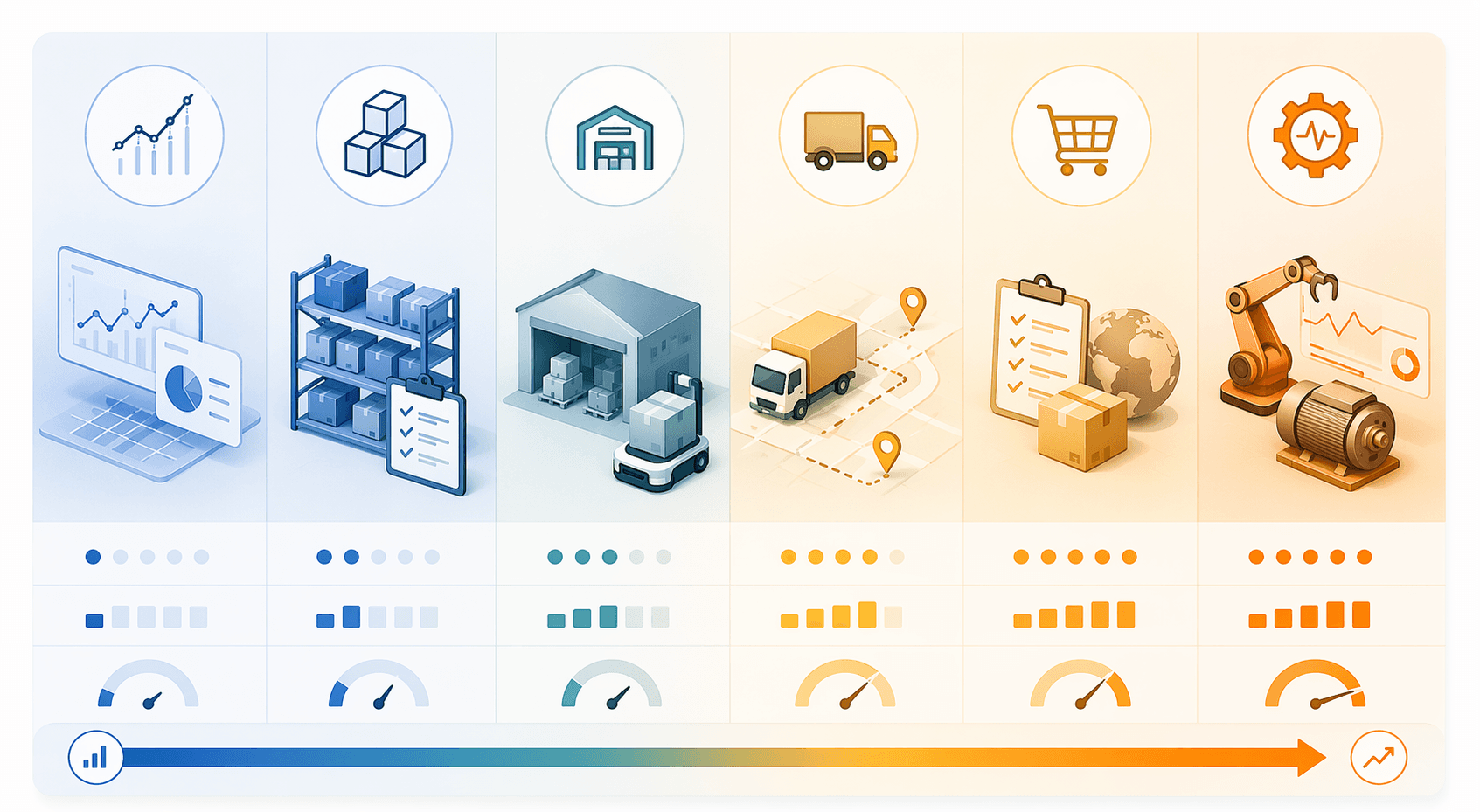
On that basis, demand forecasting and inventory optimization deserve the first serious look in most organizations. They are not easy. They are simply easier to defend because the evidence base is stronger, the benefits land in metrics the business already reviews, and the work can usually begin before the company has rebuilt every operating process around AI.
The broader market can make the decision feel more urgent than it needs to be. Precedence Research estimates the AI in supply chain market at $9.94 billion in 2025 and projects it to reach $236 billion by 2035, a 37.3% CAGR, but market growth does not tell a warehouse manager whether tomorrow’s labor plan will be better or a procurement lead whether a supplier recommendation can be defended to finance [4]. PwC’s 2026 operations survey is more useful here: 57% of operations leaders say they have integrated AI into selected functions, while only about 4% have fully embedded AI, modernized data, and redesigned operating models in tandem [5]. That gap is the adoption problem in one sentence.
Why Forecasting Usually Earns the First Slot
Demand forecasting is the first place many supply chain teams should test machine learning because the pain is already visible. Every planner can point to the consequences of a bad forecast: expedited freight, inventory written off after the season, customer-service escalations, production changes, or a sales team arguing that the number is stale before the meeting starts.
The return case is also unusually direct. McKinsey-cited analysis reports 20-50% forecast error reduction from AI-enabled forecasting, and Gartner projects that 70% of large organizations will adopt AI forecasting by 2030 [1][6]. Those two facts should not be read as the same kind of evidence. The error-reduction range is an effectiveness claim; the Gartner figure is an adoption projection. Adoption may increase because teams feel pressure to keep up, but the budget case still has to rest on whether forecast quality improves enough to change inventory, service, and operating decisions.
That distinction matters because the model is rarely the only constraint. A forecast can be statistically better and still fail operationally if planners do not know when to override it, if promotions are not coded consistently, if new-product history is treated as comparable to mature SKUs, or if the business still rewards local optimism over enterprise-wide accuracy. The machine can reduce part of the noise; it cannot make the demand review honest by itself.
The better entry pattern is narrower: start with a product family, region, or channel where history is usable, service consequences are material, and planners can compare recommendations against the existing forecast process. The point is not to replace the planning team with a black-box number. It is to move human time away from rebuilding the same baseline every cycle and toward the exceptions that actually deserve judgment.
For a deeper treatment of the readiness problems behind this use case, see AI demand forecasting challenges and readiness.
Inventory Optimization Is Where the Forecast Has to Prove Itself
Inventory optimization is the natural companion to forecasting because it tests whether the better signal changes a decision. If the forecast improves but safety stocks, order quantities, lead-time assumptions, and service targets remain untouched, the organization has bought a sharper instrument and left it in the drawer.
Here the documented return signal is strong enough to justify serious attention. McKinsey-cited analysis reports 20-30% inventory reduction with a 65% service level improvement, while the Walmart case in the Articsledge compilation reports a 20% stockout reduction [1][2]. Those are exactly the kinds of numbers supply chain leaders can take into a budget conversation because they connect to working capital and customer outcomes at the same time.
The maturity is high, but the adoption burden is not trivial. Inventory optimization forces decisions that forecasting can sometimes postpone. Which customers or channels get protected when supply is tight? Which SKUs deserve a higher service target? Is the lead-time field trusted, or is it a negotiated fiction? Who owns the exception when the model recommends reducing stock on an item the sales team considers strategic?
Multi-echelon inventory optimization raises the bar further. It can be powerful because it looks across nodes rather than treating every location as an island. It also exposes weak master data, inconsistent substitution rules, and unclear trade-offs between regional availability and central pooling. That is why inventory optimization is often a strong second move after forecast improvement, not because it is less valuable, but because it depends on more cross-functional agreement.
Teams evaluating this path can use AI inventory management use cases and benchmarks for a more detailed inventory-specific view.
The Other Functions Can Pay Off, But They Ask for More Patience
Warehouse operations, logistics, procurement, and predictive maintenance are not second-tier because they lack value. They become harder first moves because the evidence is either more case-specific, the operating constraints are more physical, or the organization has to change more behavior before the model can create repeatable benefit.
Warehouse Operations
Warehouse machine learning is attractive because the operational pain is concrete: labor availability, travel distance, slotting, congestion, pick accuracy, and cycle-time volatility. The Amazon robotics case in the Articsledge compilation reports $22 million in annual savings per warehouse and a 20% operational efficiency improvement [2]. That is a serious return signal, but it is also a case tied to a highly scaled, automation-heavy operating environment. A regional distributor with uneven item masters and manual processes should not treat the number as a plug-in ROI assumption.
The adoption burden rises because warehouse ML touches people, layout, equipment, and daily supervision. Slotting recommendations can be analytically sound and still fail if replenishment paths, labor standards, or space constraints are not reflected in the data. Robotics can improve throughput, but it brings capital planning, maintenance, training, and safety considerations that a forecasting pilot does not.
Logistics and Route Optimization
Logistics is one of the most intuitive places to look for ML because every wasted mile has a cost. UPS ORION is reported to save more than 10 million gallons of fuel and more than 100 million miles annually, while the Maersk route-optimization case reports a 25% operational efficiency improvement and 15% fuel savings through AI route optimization [2]. These are compelling outcomes, especially where network density, route repeatability, and fuel exposure are high.
The friction is in execution. A route recommendation is only useful if dispatchers, drivers, carriers, customer time windows, equipment constraints, and exception rules can absorb it. Logistics ML often crosses organizational boundaries faster than forecasting does. That does not make it a bad investment; it means the readiness test has to include network control, not just algorithm quality. For a function-specific view, see AI in logistics use cases and implementation risks.
Procurement
Procurement is moving quickly, especially around generative AI. In the AI at Wharton/Hackett Group 2025 survey, 94% of procurement executives reported using generative AI tools at least weekly, up 44 percentage points year over year [3]. That is a striking adoption signal. It is not, by itself, proof of savings, supplier resilience, cycle-time reduction, or better negotiation outcomes.
The more defensible early procurement use cases tend to be structured: spend classification, supplier-risk monitoring, contract clause extraction, and guided sourcing analysis. Agentic procurement workflows may become important, but they require governance that many teams are still building. A bad recommendation in procurement does not just create an internal exception; it can affect supplier trust, compliance exposure, and commercial commitments. More detailed procurement coverage is available in AI in procurement use cases and ROI guidance.
Predictive Maintenance
Predictive maintenance can produce large operational benefits where assets are expensive, downtime is costly, and sensor coverage is reliable. The Maersk case in the Articsledge compilation reports a 35% reduction in vessel downtime through AI-driven predictive maintenance scheduling [2]. That kind of result is meaningful, but the conditions matter. Predictive maintenance is not simply a dashboard project; it needs asset histories, failure labels, sensor quality, maintenance discipline, and crews willing to act before visible failure.
For companies with mature asset data, it may outrank forecasting or inventory in urgency. For companies without that foundation, the model will spend too much time learning from incomplete histories and too little time preventing real downtime.
Readiness Changes the Sequence
The useful question is not which machine learning use case is most exciting. It is which use case has enough evidence, enough data, and enough operating support to survive contact with the weekly review.
| If your organization looks like this | Likely first move | Use caution with |
|---|---|---|
| Demand history is usable, planners already run regular forecast reviews, and forecast error drives service or inventory pain | Demand forecasting | Over-automating planner judgment before override rules are clear |
| Forecasting is stable enough, service targets are explicit, and lead-time data is trusted | Inventory optimization | Multi-echelon optimization before node-level policies are understood |
| Warehouse data is strong, process discipline is high, and labor or throughput constraints are material | Warehouse slotting, labor planning, or robotics pilots | Assuming Amazon-scale robotics economics apply to a smaller or less automated network |
| Routes are repeatable, dispatch control is strong, and fuel or miles are major cost drivers | Route optimization | Ignoring driver, carrier, customer-window, and exception constraints |
| Spend data is classified, contracts are accessible, and procurement governance is active | Spend analytics and assisted sourcing | Treating high generative AI usage as proof of realized procurement value |
| Asset data is reliable, failures are labeled, and maintenance teams can act on early warnings | Predictive maintenance | Launching prediction models before sensor and work-order data are dependable |
This is where the maturity conversation becomes practical. Gartner’s 2025 survey of 120 supply chain leaders found that 23% had a formal AI strategy [6]. PwC’s 2026 finding that only about 4% have fully embedded AI, modernized data, and redesigned operating models together should make leaders cautious about adopting several advanced use cases at once [5]. The bottleneck is usually not imagination. It is the ability to make recommendations actionable without creating more exception work than the team can absorb.
Accenture’s 2024 analysis of 1,148 companies found that AI-mature supply chains were 23% more profitable, which supports the broader case for investment [7]. It does not remove the sequencing problem. Mature companies earn more because they combine data, process, talent, and operating discipline; a less mature company cannot borrow that outcome by buying one tool and leaving the surrounding decisions unchanged.
A simple readiness screen is often enough to prevent the worst sequencing mistakes:
- Evidence: Is there source-attributed ROI for this use case, or mostly vendor enthusiasm?
- Data: Are the required histories, attributes, constraints, and exception codes reliable enough to train and monitor the model?
- Decision ownership: Who accepts, overrides, or rejects the recommendation?
- Operating consequence: Which metric changes if the model is right, and who pays if it is wrong?
- Change capacity: Can the function absorb new workflows now, or will the project simply add another review layer?
If those answers are strongest in planning, start with forecasting. If they are strongest in replenishment and service policy, start with inventory optimization. If a logistics or maintenance operation has unusually strong data and urgent cost exposure, it may justify moving earlier. The ranking is not fixed; the discipline is.
For leaders comparing multiple initiatives at once, the AI use case matrix for supply chain investment sequencing and cross-functional AI ROI benchmarks can help separate investment cases that are ready now from those that need better foundations first.
The Practical Sequencing Rule
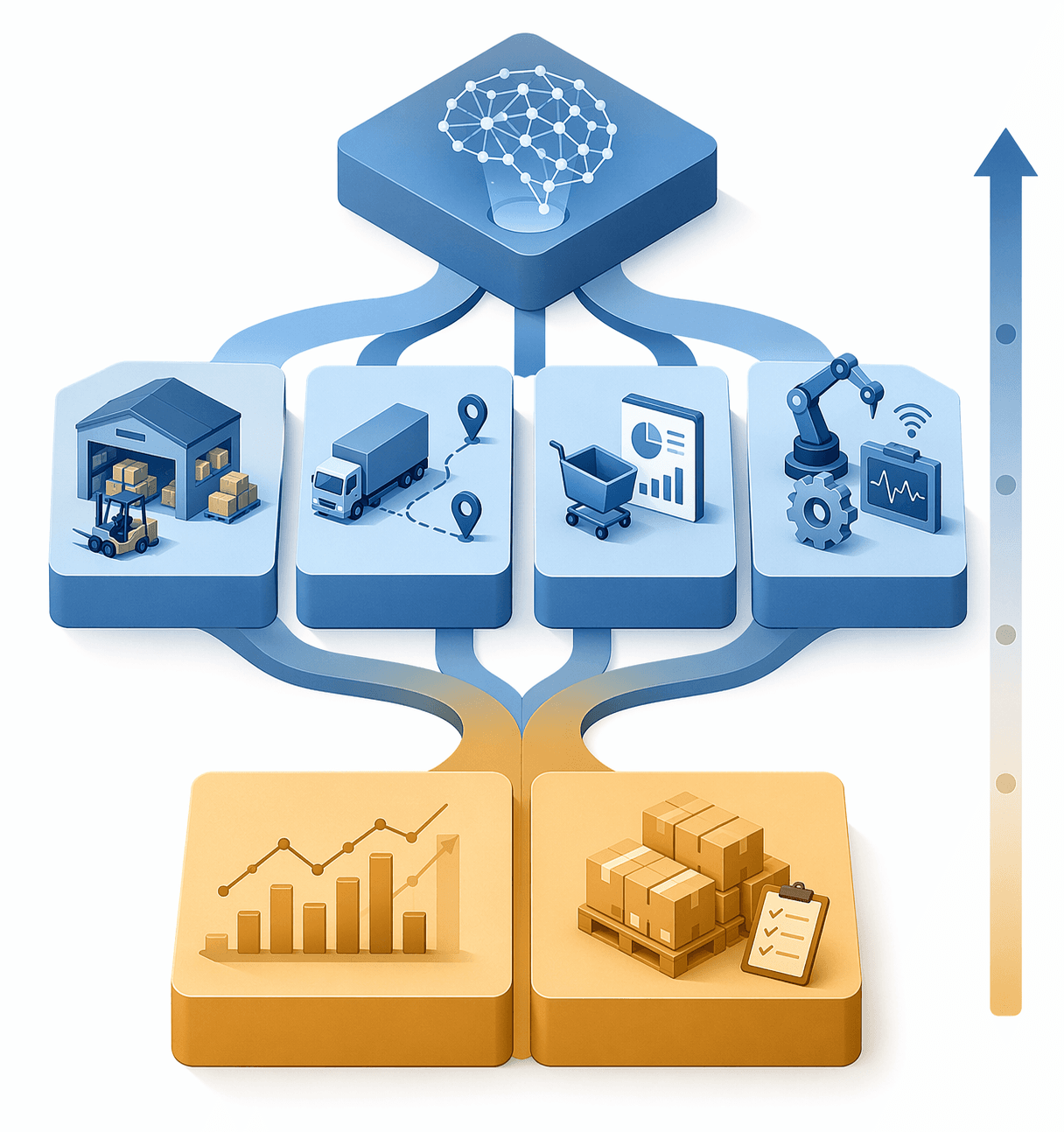
Machine learning in supply chain works best when the first use case combines three conditions: a measurable operational pain, a mature evidence base, and a function ready to change decisions based on the output. Demand forecasting and inventory optimization meet that test most often because the data is closer to the planning cycle, the ROI evidence is stronger, and the consequences can be tracked in familiar metrics.
Warehouse operations, logistics, procurement, and predictive maintenance can be excellent investments when the operating model is ready. They should not be forced into the first wave just because the market is growing or a vendor demo looks complete. Start where the recommendation can be trusted, acted on, and measured. Then move outward as the data, governance, and cross-functional routines can carry the next use case.
References
- McKinsey 2024 analysis of AI-enabled distribution, McKinsey, 2024.
- Articsledge compilation of Amazon, Walmart, UPS, and Maersk AI supply chain case studies, Articsledge.
- AI at Wharton / Hackett Group 2025 procurement generative AI survey, AI at Wharton / Hackett Group, 2025.
- AI in Supply Chain Market Size, Share, and Trends, Precedence Research.
- PwC 2026 Digital Trends in Operations Survey, PwC, 2026.
- Gartner 2025 Survey of 120 supply chain leaders, Gartner, 2025.
- Accenture 2024 analysis of 1,148 companies, Accenture, 2024.
Comments
Join the discussion with an anonymous comment.