
Air cargo is a small slice of global freight by weight and a large slice of commercial pain when visibility fails. It represents under 1% of global tonnage but nearly one-third of total trade value, so a missed flight is rarely just a transportation exception; it can become a production delay, a customer escalation, or an inventory problem with a clock attached to it.[1]
That imbalance would be easier to manage if air cargo visibility were genuinely live. It usually is not. In 2026 reporting cited by Datanet IoT, only 6% of shippers achieved real-time air cargo visibility even though 71% used carrier tools.[2] The uncomfortable gap is the 65% in the middle: teams with access to portals, messages, and dashboards, but not necessarily to a current operational picture.
This is where AI real-time flight cancellation tracking for supply chains needs a sharper definition. For cargo operations, the important question is not only whether an aircraft has been canceled. Passenger disruption tools care about rebooking travelers, seat inventory, and service recovery; that is a related but different operating problem, covered more directly in AI passenger disruption management. Air cargo teams need to know whether a shipment is still on a viable path through FWB, RCS, MAN, DEP, ARR, and DLV, and whether there is still time to intervene before the shipment misses the next controllable handoff.
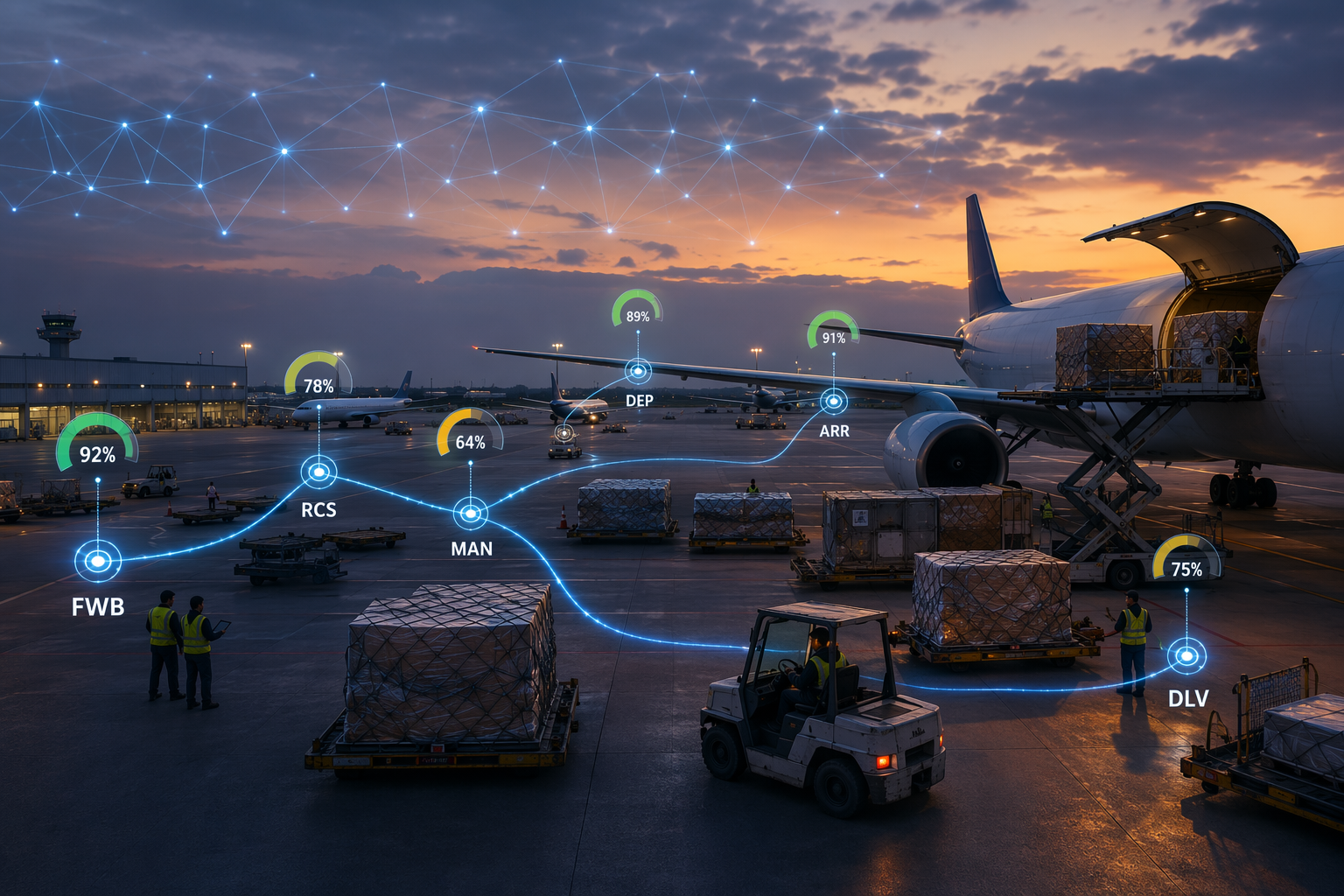
The Blind Spot Is Between the Flight Event and the Cargo Decision
A canceled or delayed flight is only one input. The cargo question is whether the airwaybill, warehouse acceptance, manifest, departure, arrival, and delivery chain can still hold together. A flight can be late while the shipment still makes the connection. A flight can operate while the cargo misses acceptance. A dashboard can show an updated carrier status after the warehouse team has already staged labor, after customer service has promised a delivery window, or after airport storage has started to become a cost exposure.
The practical value of AI is the interval it creates between "something changed" and "someone can still do something." If the model only republishes a cancellation after the airline message lands, it is visibility with better branding. If it detects that the shipment is drifting away from a planned milestone early enough to change a pickup slot, open a reroute, or notify a consignee, it has entered operations.
The workflow is therefore broader than flight cancellation tracking in the passenger sense. It is air cargo disruption tracking, with flight-level status embedded in a shipment-level prediction.
What the Model Has to See
A useful prediction engine does not start with a single airline status feed. It has to reconcile several kinds of evidence that arrive at different speeds, in different formats, and with different levels of reliability.
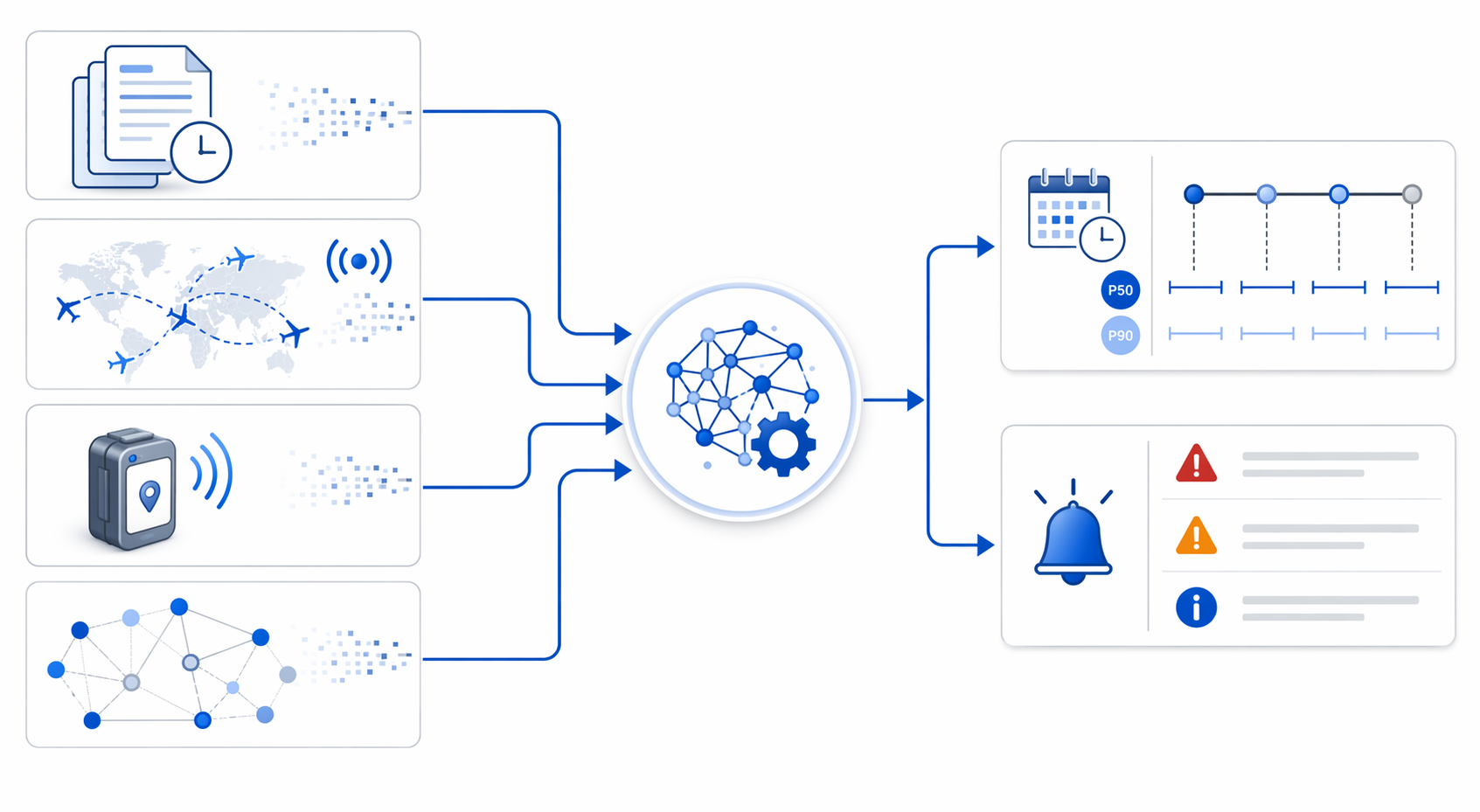
- Historical shipment records show how similar cargo actually moved across lanes, carriers, handlers, cutoff windows, and handoff points.
- Live airline flight feeds show whether the planned aircraft, routing, and schedule are still viable.
- IoT telemetry can add location, dwell, motion, and condition signals that do not always appear in carrier milestone messages.
- Milestone events such as FWB, RCS, MAN, DEP, ARR, and DLV show whether the shipment has actually crossed the handoff it was expected to cross.
- Shared data exchange standards reduce the translation work between airlines, handlers, forwarders, and customer systems.
The most directly documented production example in the current public material is CargoAi's AI Predictive Tracking launch in February 2026. The system is described as using machine learning trained on millions of historical shipments, combined with live flight data, to predict seven milestone timings with P50 and P90 confidence levels; the predictions refresh continuously as new data arrives.[3][4]
That matters because air cargo exceptions often start as small timing changes. A late FWB transmission may compress acceptance time. A delayed RCS may make manifesting uncertain. A flight cancellation may be survivable if the cargo is still early enough to move through an alternate routing. The model is valuable when it treats those signals as connected, not as separate status tiles.
From FWB to DLV, the Prediction Is a Milestone Problem
The cleanest way to understand AI flight disruption tracking for supply chains is to follow the shipment milestones, not the aircraft alone. The aircraft is essential, but the shipment has its own chain of proof.
| Milestone | What operations needs to know | What AI prediction changes |
|---|---|---|
| FWB | Whether the electronic air waybill and booking data are in place early enough for downstream processing. | Flags documentation timing risk before the cargo reaches a later cutoff. |
| RCS | Whether the carrier or handler has accepted the cargo as ready for carriage. | Shows whether acceptance drift threatens the planned flight. |
| MAN | Whether the shipment is manifested on the expected flight or routing. | Connects shipment status to aircraft-level disruption and capacity changes. |
| DEP | Whether the cargo actually departed, not merely whether the aircraft schedule changed. | Separates flight movement from shipment movement. |
| ARR | Whether arrival timing still supports pickup, customs, transfer, or final-mile commitments. | Updates downstream labor and customer timing before the shipment reaches the destination warehouse. |
| DLV | Whether delivery completion is still aligned with the promised service window. | Turns upstream disruption into a delivery-risk forecast. |
The difference between a milestone forecast and a status dashboard is that the forecast carries uncertainty forward. A carrier portal may tell the team that a flight has departed or that cargo has arrived. A predictive model tries to estimate when the next milestone is likely to occur, based on the current state and prior patterns. In CargoAi's documented case, the output includes P50 and P90 confidence levels, which is the kind of detail operations teams need if they are going to decide whether to wait, escalate, or reroute.[3][4]
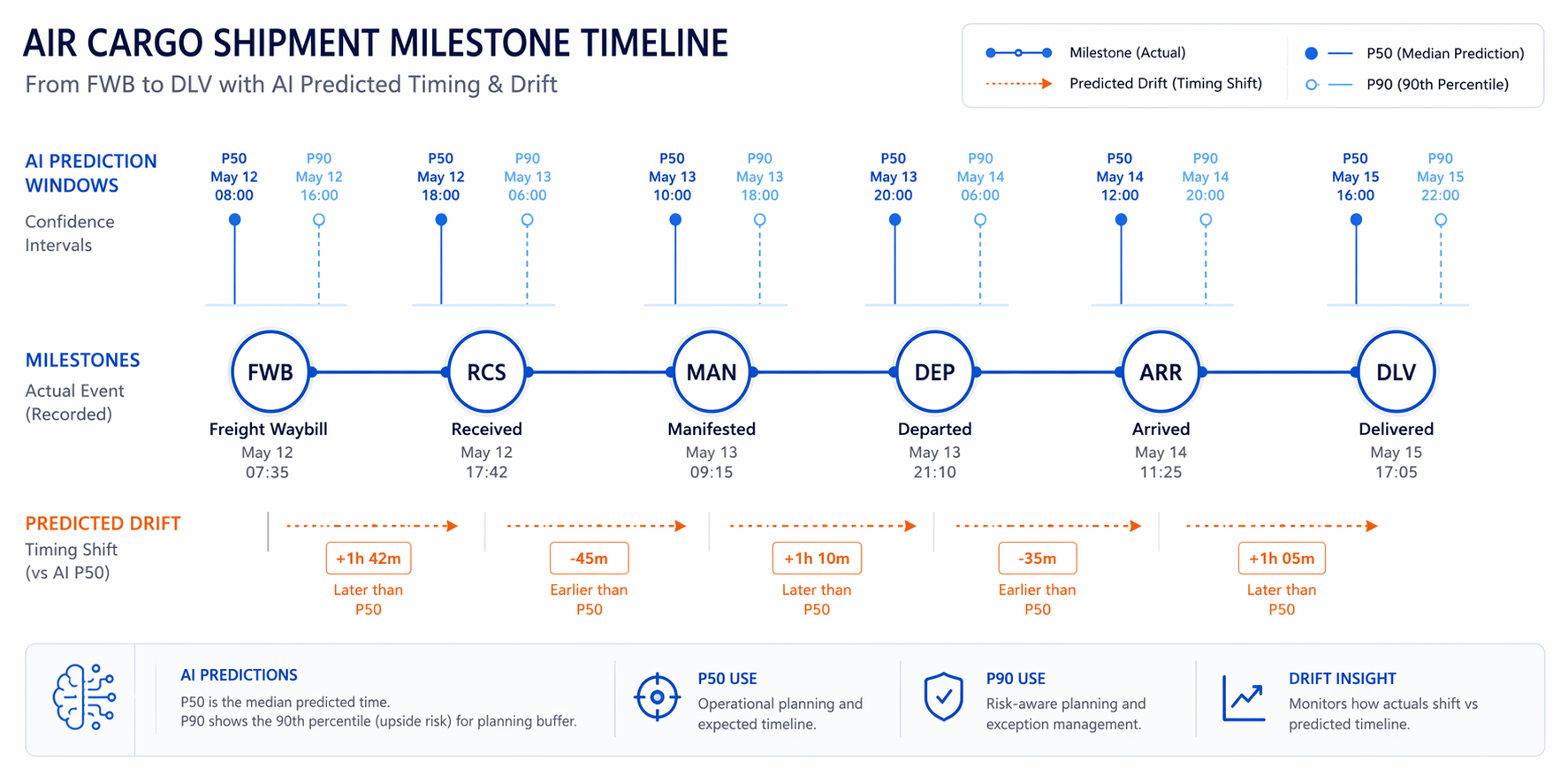
P50 is not a promise. It is a median-style planning point: roughly the time by which the model expects the event to happen in the middle of the probability distribution. P90 is more conservative and more useful when the consequence of being wrong is expensive. A visibility manager might use P50 to update an internal expected arrival time, while using P90 to decide whether the risk is too high to keep promising a downstream delivery window.
This is where the term "real time" should be treated carefully. Real time does not mean every participant sees every truth instantly. It means the prediction is refreshed when new flight, shipment, or sensor evidence arrives, and that the refreshed estimate reaches the operating team while there is still a decision to make.
How a Cancellation Signal Becomes an Earlier Decision
Consider a hypothetical export shipment booked on a time-sensitive air lane. The airline feed indicates the planned flight is at risk or canceled. On its own, that is an aviation event. The cargo model then checks whether the shipment has cleared the milestones that make alternatives possible: whether FWB is complete, whether RCS has occurred, whether the cargo is already built or manifested, whether there is a viable later departure, and whether arrival drift would break the delivery commitment.
The useful alert is not "flight canceled" in isolation. It is closer to: this shipment's expected DEP has moved outside the acceptable window; P90 arrival now threatens the consignee's receiving cutoff; an alternate routing must be opened before the cargo is locked into a poor path. The model turns a flight event into a shipment decision.
That decision can trigger several different responses. A forwarder may request a rebooking before capacity disappears. A warehouse team may avoid staging labor for cargo that will not arrive. A customer service manager may notify the customer with a revised window before the customer discovers the miss. A transport planner may delay a pickup rather than send a truck into airport dwell time. None of those actions require the model to be magical. They require the alert to be specific, early, and tied to a milestone someone owns.
The parallel with other supply chain disruption systems is strong. Highway closure detection and rerouting tools also work by converting a live external disruption into an asset-level decision, as described in AI highway closure detection and rerouting. The air cargo version is less about road geometry and more about handoff timing, carrier messages, and airport process constraints.
Why Confidence Intervals Matter More Than a Red Alert
A binary alert is easy to display and hard to operate. "At risk" does not tell the coordinator whether to call the carrier, move the truck appointment, warn the customer, or wait for the next message. Confidence intervals give the team a way to match action to consequence.
If P50 still fits the plan but P90 breaks it, the shipment may need monitoring rather than immediate rerouting. If both P50 and P90 miss the customer window, delay management starts now. If the spread between P50 and P90 widens sharply after a flight status update, the issue may be uncertainty itself: the team needs better confirmation from the carrier or handler before committing the next leg.
This is also where AI visibility starts to intersect with risk quantification. A lane manager does not need a perfect forecast; they need to know which shipments have enough value, urgency, or cost exposure to justify intervention. For teams building broader disruption models, the same logic appears in AI tornado diagrams for supply chain risk management, where the point is not to eliminate uncertainty but to rank which uncertainty deserves action first.
The Cost Case Comes From Avoided Waiting
Air cargo disruption costs often accumulate in places that do not look dramatic on a flight board. A pickup team waits for cargo that has not arrived. A warehouse shift is planned around stale milestone data. A consignee keeps a receiving dock open for freight that has slipped. A shipment sits because the team learned too late that the arrival window had changed.
The financial exposure can be material. Datanet IoT cites Descartes MacroPoint's finding that airport storage and demurrage costs can exceed $55,000 in just a few days when cargo is not picked up on time.[2] That figure should not be treated as the typical cost of every delay, but it explains why a visibility manager cares about earlier pickup timing changes, not just better post-event reporting.
There is also evidence that AI-based predictive ETAs can outperform carrier estimates, but the claim needs discipline. GPX, citing industry benchmarks, reports predictive ETAs from AI models achieving 40–60% higher accuracy than carrier-provided estimates and links that improvement to reduced detention and demurrage fees.[5] That is a benchmark, not a universal performance guarantee across every carrier, lane, and airport.
The business case is strongest when the organization can attach forecast improvements to specific operating decisions: fewer unnecessary airport pickups, earlier reroute requests, better customer notifications, lower exception-handling time, and reduced storage exposure. If those decisions are not connected to the alerting workflow, better ETA accuracy can become another number admired after the shipment has already failed.
Data Standards Decide How Much Friction the Model Inherits
The prediction layer is only as useful as the handoffs underneath it. Airlines, ground handlers, forwarders, truckers, warehouse systems, and customer platforms have historically exchanged shipment information through a mix of messages, portals, APIs, files, and manual updates. The model can learn from messy data, but it cannot remove every operational consequence of late or incompatible data.
IATA ONE Record is important because it is designed as a shared data layer for air cargo using JSON-LD and an API-first approach, reducing data-format incompatibilities at handoffs between airlines, handlers, and forwarders.[5] In practical terms, a more consistent exchange model can make it easier for prediction systems to understand the same shipment event across different parties without relying on brittle translations.
The constraint is adoption. If one airline, handler, or regional partner still sends incomplete or delayed milestone data, the model inherits that blind spot. IATA ONE Record can improve the architecture, but uneven implementation remains a real deployment risk rather than a footnote.
What to Check Before Trusting the Alert
A polished control tower screen can hide weak evidence. Before treating AI cancellation or disruption alerts as operational triggers, the team should look at the mechanics behind the prediction.
- Data freshness: how quickly flight, milestone, and sensor updates reach the model after they occur.
- Milestone specificity: whether the system predicts shipment events such as RCS, MAN, DEP, ARR, and DLV, rather than only showing aircraft status.
- Confidence output: whether predictions include ranges such as P50 and P90, or only a single ETA.
- Carrier and regional coverage: whether the model performs well on the lanes and partners that matter to the shipper.
- Integration path: whether alerts can reach the TMS, control tower, warehouse, customer service workflow, or automated exception queue.
- Action ownership: whether each alert maps to a person or system that can still change the outcome.
The last point is usually where useful pilots separate from decorative dashboards. If an alert says a shipment may miss DEP, the owner may be an air export coordinator. If ARR has drifted beyond the receiving window, the owner may be customer service or destination operations. If DLV is threatened but the cargo has not yet left origin, procurement may need to approve a more expensive routing. The alert has to land where the decision can still be made.
Where the Current Category Is Still Narrow
It is tempting to describe this market as mature real-time flight cancellation tracking for supply chains. The better description is narrower: production systems are emerging around predictive air cargo milestone forecasting, with flight-level status and cancellation risk as important inputs. CargoAi's February 2026 launch is the clearest documented example in the available public material, but it should not be used as proof that every carrier, region, and trade lane now supports the same level of predictive control.[3][4]
Prediction accuracy will vary by carrier participation, route history, message quality, sensor coverage, and regional ground-handling practices. A model trained on millions of shipments can still struggle where the current data stream is thin or late. A live flight cancellation feed can still be operationally incomplete if it does not connect to shipment acceptance, manifesting, or destination handling.
There is a useful analogy with weather and infrastructure disruption prediction. Models that forecast heavy rain logistics disruption days ahead, or estimate the supply chain effect of a bridge closure, are only valuable when they connect the external event to exposed shipments, facilities, and routes. The same pattern applies here; heavy rain logistics disruption prediction and Tacoma Narrows closure supply chain analysis are different domains, but they share the same operating principle: an external disruption matters only when it is translated into a decision about affected freight.
What Useful AI Flight Disruption Tracking Looks Like
The useful version of AI real-time flight cancellation tracking for supply chains is not a brighter cancellation board. It is a shipment-level prediction system that absorbs historical movement patterns, live airline flight data, IoT telemetry, and standardized milestone exchange, then refreshes expected timings across the air cargo chain.
When it works, the operations team sees the missed-departure risk before the shipment is trapped in the wrong plan. They can reroute earlier, adjust pickup timing, warn customers with a defensible window, and avoid some of the waiting costs that appear when cargo and labor arrive at different times. When it does not work, the dashboard may still look clean, but the control tower is only watching a delayed replay.
The value is real, but it is conditional. Reliability depends on carrier coverage, data quality, regional consistency, milestone specificity, and adoption of shared data standards such as IATA ONE Record. AI can shorten the ugly interval between disruption and action; it cannot compensate indefinitely for handoffs that never report the truth in time.
References
- Cargo in the dark: Closing the air freight visibility gap, StatTimes, 2026.
- Air Cargo Visibility, Datanet IoT, 2026.
- CargoAi utilises AI to predict air cargo shipment delays, Air Cargo News, February 2026.
- CargoAi moves air cargo tracking from visibility to prediction with AI-powered milestone forecasting and alerts, Global Trade Magazine.
- AI Supply Chain Visibility, GPX, 2026.
Comments
Join the discussion with an anonymous comment.