
Seven days is long enough to change a loading plan, pull inventory forward, move appointment times, warn drivers, and call suppliers before everyone is staring at the same flooded interchange. It is not long enough to treat a heavy-rain forecast as certainty. The practical question for AI-supported heavy-rain logistics planning is whether the warning arrives with enough detail to change work before the rain reaches the network.
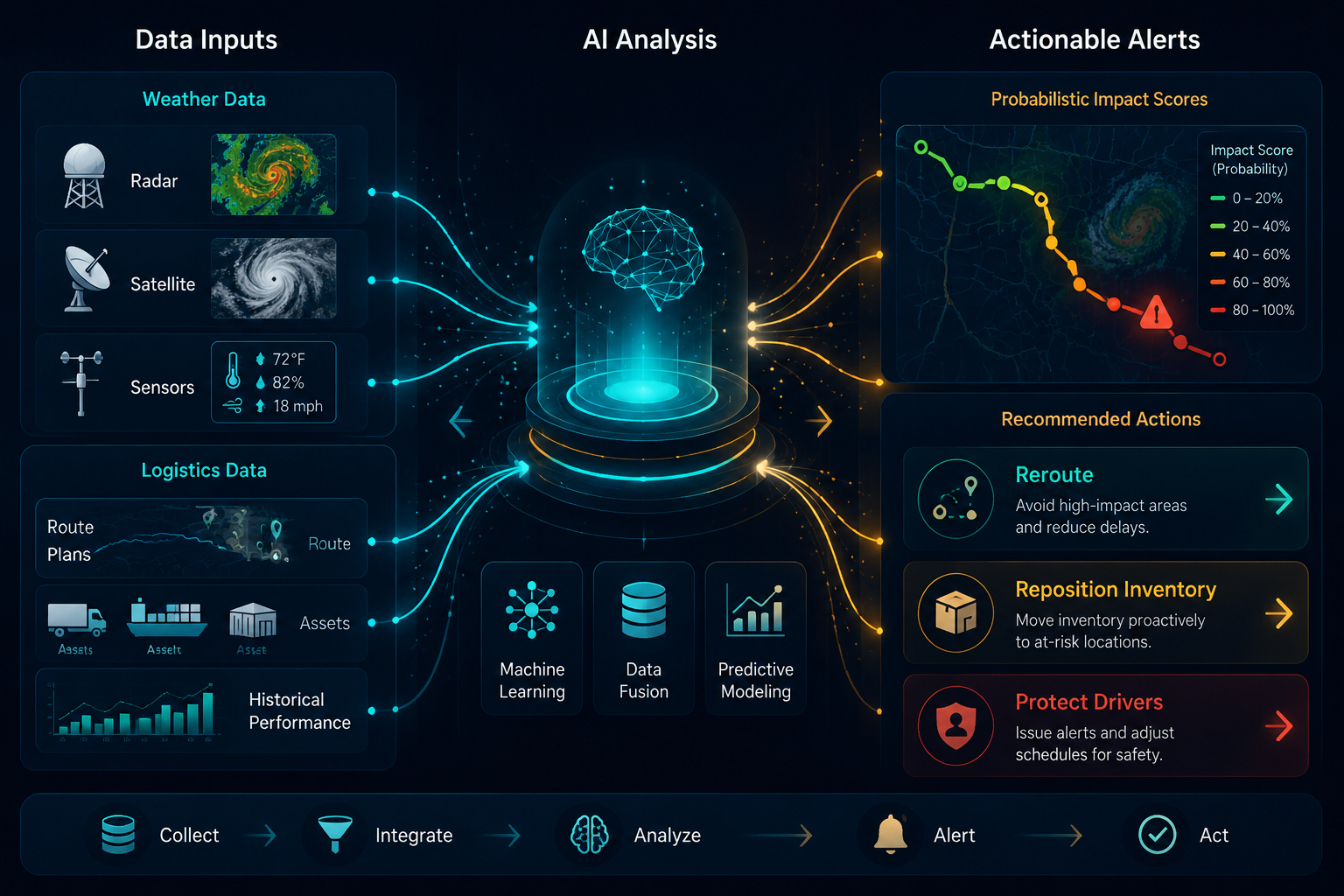
That is where the better AI weather-intelligence platforms now make a credible claim. They do not simply flag a storm cell on a map. They blend multi-source weather data, historical logistics patterns, route and asset data, and machine-learning models to estimate which lanes, facilities, suppliers, and shipment windows are likely to be affected. The useful output is a probability-weighted operational signal: this route is at rising flood risk during this window; this supplier sits inside the projected impact zone; this inventory should move before the cutoff.
The use case matters because heavy rain is not a small weather category inside supply chain risk. Everstream Analytics reports that heavy rain and flooding account for 70% of weather-related supply chain disruptions, and its platform markets a 14-day severe-weather prediction horizon for logistics risk management.[1] In the United States, weather is associated with 23% of road delays, with annual delay costs estimated at $2.2 billion to $3.5 billion.[2] In 2025, extreme weather became the single largest reported cause of supply chain disruption for the first time in nearly a decade, surpassing cyber outages.[3]
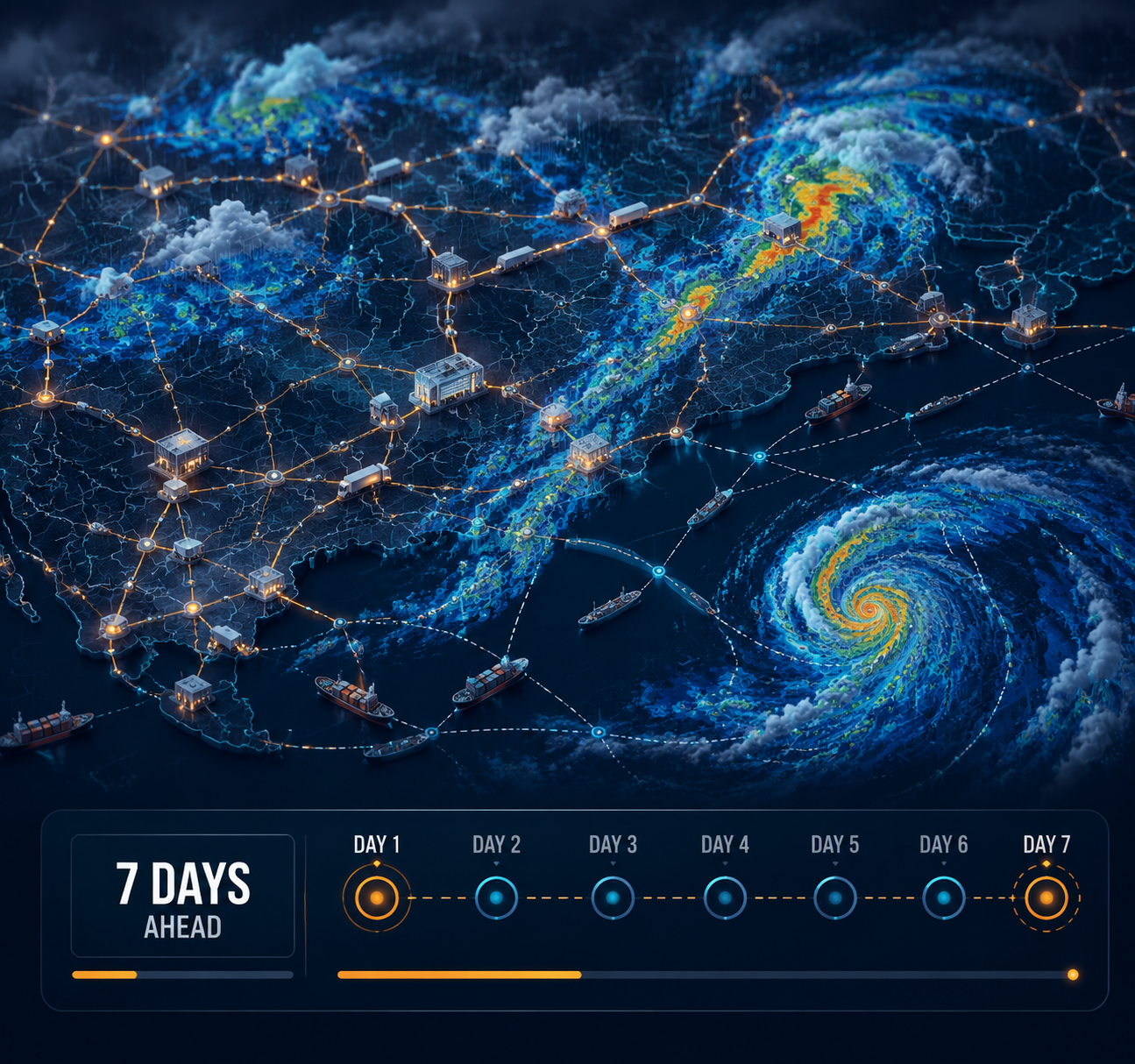
What a Seven-Day Warning Has to Prove
A forecast horizon is not the same thing as operational lead time. A transportation team needs to know more than “rain is possible next week.” It needs to know whether the rain is likely to hit a lane that matters, whether the timing overlaps pickup or delivery appointments, whether the expected duration will outlast a normal delay buffer, whether alternate routes carry their own flood exposure, and whether the shipment can be moved earlier without creating a downstream shortage.
The strongest published claim in the research set comes from a World Certification Institute industry analysis describing a Johnson & Johnson AI system that detected 85% of major weather disruptions an average of seven days before impact.[4] That figure should be read carefully. It is industry-reported through a secondary source, not an independently verified benchmark available from the original operator. Still, it gives risk teams a useful threshold for vendor evaluation: not “can the model predict rain,” but “what share of material disruptions does it detect early enough for us to act?”
The answer depends on whether the platform turns weather into network-specific impact. ClimateAi describes its FICE model as ingesting public and proprietary weather data with customer logistics data to quantify the timing, duration, and magnitude of weather-related disruptions. Its outputs are probabilistic impact scores applied to assets and routes, not deterministic declarations that a specific dock door or road segment will fail.[5]
That distinction is not legal caution; it changes the operating model. A probability score can justify moving high-value or time-sensitive freight earlier while leaving lower-priority freight on the original plan. It can trigger a driver-safety alert for a flood-prone corridor without shutting down an entire region. It can tell procurement to call one supplier before a cutoff while leaving a second supplier alone. The value sits in prioritization, not perfect foresight.
| Signal the platform must produce | Operational decision it can support |
|---|---|
| Probability of heavy rain or flooding by time window | Move pickup and delivery appointments before the highest-risk period |
| Route-level exposure score | Reroute trucks away from flood-prone corridors or delay dispatch |
| Facility or supplier impact zone | Pull inventory forward, split orders, or qualify backup supply |
| Expected duration and magnitude | Decide whether a normal buffer is enough or escalation is needed |
| Confidence level and update frequency | Keep, revise, or cancel the mitigation plan as the forecast changes |
From Warning to Changed Work
The cases that matter are not the ones where a dashboard looked impressive during a storm. They are the ones where someone changed a plan before the impact.
ClimateAi reports that Hitachi used its platform to map cyclone risk in Chennai and pre-schedule deliveries before disruption. The sequence is the important part: an early signal identified the affected geography, the logistics team pulled delivery timing forward, and the company reduced exposure before the cyclone interfered with normal movement.[5] The case is broader than heavy rain alone because it involves a cyclone, but the operational pattern is directly relevant to rain and flood disruption: do not wait for the route to fail before deciding which shipments must move.
ClimateAi also describes a U.S. roofing manufacturer that pre-positioned inventory before Hurricane Ian and later attributed $15 million in additional sales to being stocked when regional demand rose.[5] That number is vendor-reported and should not be treated as a normal return-on-investment benchmark. Its value is more modest and more useful: it shows how a weather signal can become an inventory decision, not merely a transportation alert.
The Cooper University Health Care example is narrower and in some ways more operationally persuasive. Interos.ai reports that Cooper used its catastrophic risk model during Hurricane Idalia to identify three suppliers in the storm’s path and pre-order supplies before cutoff.[6] That is the kind of action a seven-day window is supposed to buy: identify the exposed supplier, decide what cannot wait, and place the order before everyone else is competing for the same constrained capacity.
For teams already building flood playbooks, the prediction layer should connect directly to execution. A companion approach is covered in AI flood disruption planning, where the emphasis moves from early signal to dynamic response rules.
Driver Safety Belongs in the Same Evaluation
A heavy-rain model that protects revenue but leaves dispatchers to improvise around flooded roads is incomplete. The safety use case is not separate from logistics performance; it is part of whether the system is fit for operations.
Geotab cites J.B. Hunt risk evaluation material estimating that weather-related trucking collisions cost $20 million to $40 million per year.[7] The exact exposure will differ by fleet, geography, and operating model, but the decision logic is consistent: if the model can flag high-risk corridors before dispatch, transportation managers can reroute, delay departure, change handoff points, or issue safety instructions before a driver is already committed to a flood-prone route.
This is where probability is useful again. A high-confidence flood-risk score for one leg of a route may be enough to redirect a driver even if the broader shipment remains on schedule. A lower-confidence signal might trigger monitoring rather than intervention. What should not happen is a vague regional weather alert landing in a control room with no lane owner, no escalation rule, and no authority to change dispatch.
What the Platform Actually Has to Connect
The technology stack usually fails in the handoff, not in the meteorology. A model can detect risk seven days ahead and still produce no operational change if it is not connected to the systems where people plan routes, allocate inventory, manage suppliers, and approve exceptions.
At minimum, heavy-rain disruption prediction needs four kinds of operational context. It needs transportation data, including lanes, carriers, appointment windows, equipment, and current shipments. It needs asset and facility data, including warehouses, yards, ports, stores, plants, and cross-docks. It needs supplier records, including sites and upstream dependencies where available. And it needs escalation rules that define what happens when a risk score crosses a threshold.
- Transportation managers need route-level risk inside or adjacent to the transportation management system, not a separate map they have to check manually.
- Inventory planners need enough notice to pull stock forward, split replenishment, or shift allocation before capacity tightens.
- Procurement teams need supplier-site exposure, not only regional storm tracks.
- Safety teams and dispatchers need driver-facing alerts that are specific enough to change routing or departure timing.
The harder work is deciding thresholds before the alert arrives. If a shipment is low margin and easily replaced, a moderate rain-risk score may not justify a costly reroute. If it carries medical supplies, critical parts, or customer-penalty exposure, the same score may be enough to act. The platform can rank risk; the enterprise still has to define consequence.
For teams still building the planning muscle around severe weather, AI storm scenario planning is the adjacent workflow: test the decision rules before a live alert forces them into production.
Why Integration Determines Reliability
Executives often discover that weather intelligence is easier to buy than to operationalize. IBM research cited by Geotab found that 45% of technical executives struggle to translate weather data into actionable insights, and 58% have difficulty integrating weather data into transportation management systems.[8] Those figures explain why two companies can buy similar forecasting capability and get very different outcomes.
The first constraint is data quality. If supplier locations are stored only as headquarters addresses, a flood-risk model may miss the actual manufacturing site. If shipment data is stale, the system can flag yesterday’s route while today’s truck is already somewhere else. If appointment windows are missing, the model can identify a risky lane without knowing whether the shipment will be on that lane during the exposed period.
The second constraint is workflow authority. A risk alert that reaches an analyst but not the dispatcher may produce a report instead of a reroute. A supplier-risk warning that reaches procurement after purchasing cutoffs may be accurate and still useless. A driver-safety alert that cannot be tied to route guidance asks the driver to solve the problem alone.
The third constraint is forecast interpretation. Operators need to understand that a seven-day signal will change as the event develops. That does not make it worthless. It means the response should be staged: early inventory moves for high-consequence exposure, route monitoring as confidence improves, and final dispatch changes as timing and location tighten.
How to Read the Vendor Landscape
The vendor market is broad enough that a directory approach is less useful than a functional one. ClimateAi is strongest in climate and weather impact forecasting tied to timing, duration, magnitude, and asset or route exposure. Everstream Analytics emphasizes supply chain risk monitoring with a longer severe-weather horizon and disruption intelligence. Interos.ai brings supplier and multi-tier risk mapping into the weather-impact discussion, which matters when the exposed node is a vendor site rather than a truck lane.
Resilinc is most relevant where supplier-event monitoring and continuity workflows are already central. WeatherOptics focuses on weather-driven logistics disruption and delay prediction. FourKites and project44 sit closer to real-time transportation visibility, where weather risk can be connected to shipment tracking, estimated arrival changes, and exception management. RoaDo is relevant where dispatch, fleet movement, and route execution need weather-aware operational support.
The selection question is not which vendor has the most dramatic storm visualization. It is which one can connect the alert to the decision that matters in the buyer’s network. A procurement-heavy organization should test supplier-site precision. A carrier or shipper with dense road exposure should test route-level risk and driver alerting. A retailer or manufacturer with seasonal demand swings should test whether the platform can trigger inventory moves early enough to matter.
Teams comparing platforms after validating the use case may need a broader evaluation framework, especially when weather risk is one category among geopolitical, cyber, and supplier risks. The same screening discipline applies in choosing an AI platform for geopolitical supply chain risk: evidence quality, workflow fit, data dependencies, and escalation design matter more than surface-level coverage claims.
What Outcomes Are Reasonable to Expect
Published outcome claims support optimism, but not blank-check confidence. The World Certification Institute analysis cites McKinsey estimates that AI can reduce supply chain errors by 20% to 50% and mitigate lost-sales risk by up to 65%.[4] Those are directional estimates, not guarantees for a heavy-rain program. A company with clean route data, clear escalation authority, and flexible inventory options will be in a different position from one that learns about a flood risk but cannot change carrier bookings or supplier orders.
A more defensible business case starts with avoided manual expediting, fewer emergency carrier substitutions, better on-time performance during rain events, reduced stockout exposure, and fewer driver dispatches into high-risk corridors. The ROI case can include sales protection, as the roofing manufacturer example suggests, but that should be treated as upside rather than the baseline. For a dedicated financial view, see the ROI of AI for supply chain weather disruption planning.
AI heavy-rain prediction is achievable today, and the best evidence supports meaningful lead time in the seven-to-14-day range. The reliability of the outcome, though, depends less on the forecast alone than on whether the enterprise connects probabilistic alerts to routing, inventory, procurement, and safety decisions before the water reaches the road.
References
- Heavy rain and flooding supply chain disruption analysis, Everstream Analytics.
- Weather-related road delay and cost analysis, FHWA/Geotab.
- Extreme weather as leading supply chain disruption cause in 2025, BCI/Tradeverifyd.
- AI supply chain disruption detection and mitigation analysis, World Certification Institute.
- Forecasting and Intelligent Climate Engine logistics disruption cases, ClimateAi.
- Cooper University Health Care Hurricane Idalia supplier risk case, interos.ai.
- Weather-related trucking collision risk evaluation, J.B. Hunt/Geotab.
- IBM study on weather data actionability and TMS integration, IBM/Geotab.
Comments
Join the discussion with an anonymous comment.