
A response to a salmonella egg recall is only as fast as the records behind it. In the August Egg Company outbreak investigated in 2025, FDA traceback work identified eggs supplied by the company as the common source across multiple illness subclusters, and environmental sampling found Salmonella Enteritidis at the firm’s processing facility.[1] CDC reported 134 illnesses across 10 states and 38 hospitalizations in the same outbreak investigation.[2]
Those numbers matter, but they are not the whole operational problem. Once illnesses appear across states, the question inside a food company is painfully specific: which lots moved, through which events, into which customer orders, and what proof can be handed to regulators without a week of spreadsheet archaeology?
The egg recalls that followed made the same point from different angles. Industry coverage tied the broader wave to multiple egg-related recalls, including Country Eggs LLC and Black Sheep Egg Company, and described the pressure created by a category where contamination, distribution scale, and consumer exposure can converge quickly.[3] The useful lesson is not that egg supply chains are uniquely broken. It is that recalls expose every weak handoff that looked tolerable when product was simply moving forward.
The Recall Starts Before Anyone Has a Clean Dataset
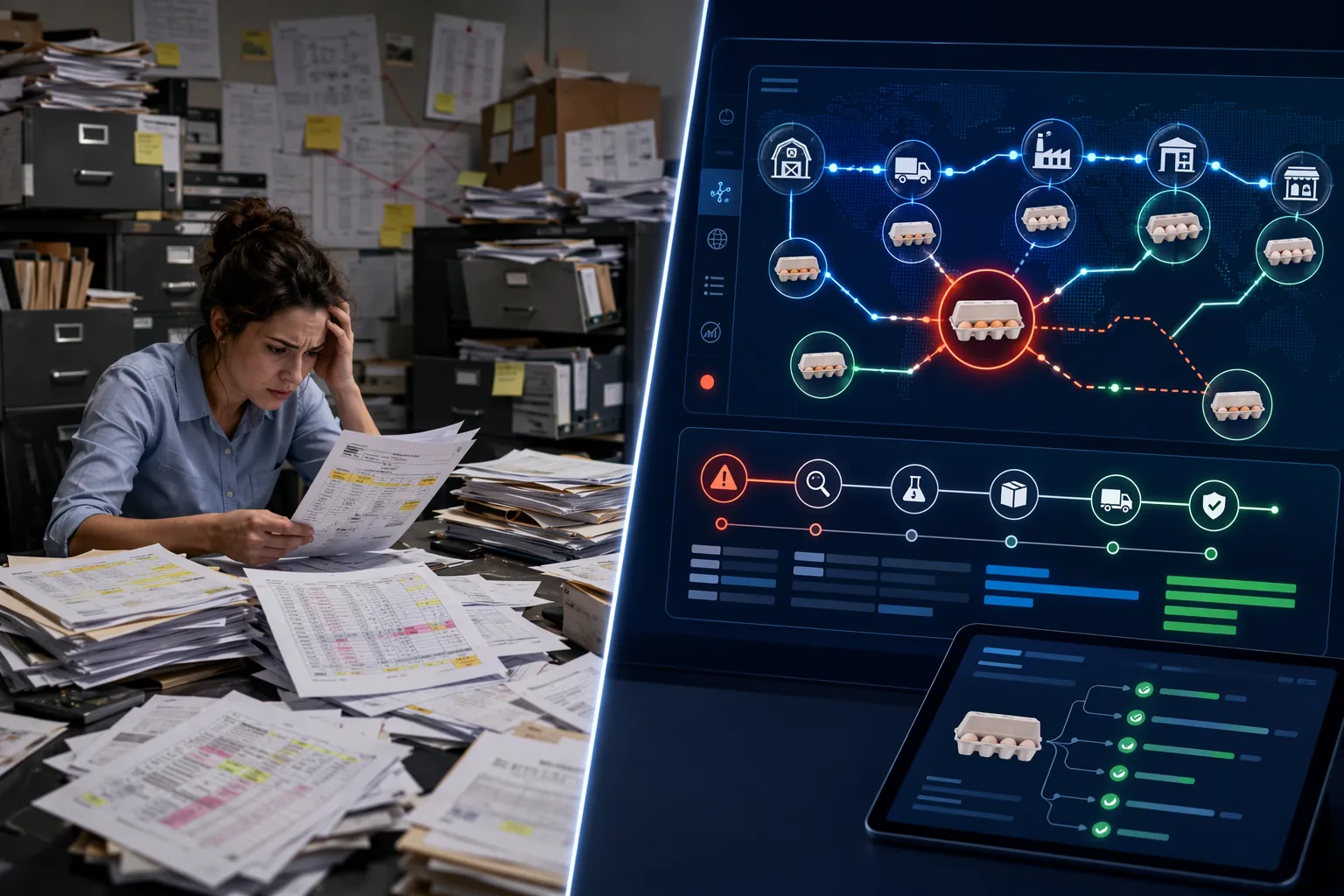
In a calm audit, a facility can often find what it needs eventually. In an outbreak investigation, “eventually” is not a control. FDA and CDC investigators are trying to connect illness patterns, purchase histories, traceback records, facility findings, and distribution paths. The company is trying to determine whether the implicated product is still in commerce, what customers received it, and whether finished goods, repacked product, or downstream ingredients widened the affected scope.
This is where paper-based and siloed traceability systems fail in ordinary ways. A receiving record may show a supplier and date but not a complete lot identifier. A warehouse management system may know pallet movement but not the food safety context. A quality team may have production logs in one format, sales orders in another, and customer shipment details in a third. A distributor may have repacked, relabeled, or split inventory. A trading partner may send a PDF, a spreadsheet, or a screenshot instead of structured data.
None of those gaps sounds dramatic on its own. Together, they create the delay that recall coordinators know too well: people on phone calls confirming lot codes, someone comparing shipping dates against production dates, someone else checking whether a partial code could refer to one day’s production or several. Meanwhile, legal wants defensible wording, sales wants customer lists, executives want a scope estimate, and regulators want records.
FSMA 204 raises the floor for this work because shell eggs are on FDA’s Food Traceability List, making Key Data Elements and Critical Tracking Events directly relevant to egg recall readiness. But the compliance point is secondary. The operational point is sharper: if KDEs are not captured when CTEs happen, the company has to reconstruct the chain under pressure.
What the August Egg Company Case Forced Investigators to Prove
The August Egg Company investigation is useful because it shows the kind of proof chain that matters. FDA did not merely announce a recall and stop there. Its outbreak page described traceback findings that pointed to August Egg Company as the supplier common to multiple illness subclusters, and it reported environmental sampling at the processing facility that matched the outbreak strain.[1]
For a supply chain team, that turns into a sequence of hard questions. Which farms or houses fed the implicated processing run? Which shell egg lots were washed, graded, packed, and shipped? Which customers received them? Did any customer split the lot across multiple DCs or stores? Did any product remain in inventory after public notice? Which documents show the answer rather than merely assert it?
CDC’s epidemiological count gives the work its urgency: 134 illnesses, 38 hospitalizations, and cases across 10 states in the outbreak record.[2] A company that cannot narrow product movement quickly has two bad options. It can recall broadly, pulling safe product and disrupting customers, or it can move slowly while evidence is assembled. Neither option is a traceability success.
Where Manual Traceability Breaks During an Egg Recall
The failure is rarely one missing file. It is usually a chain of small mismatches that become expensive because each one requires human interpretation.
| Recall Question | Manual Failure Point | Operational Consequence |
|---|---|---|
| Which lot is implicated? | Lot codes are partial, inconsistent, or stored separately from production events. | The recall scope expands because the team cannot confidently isolate affected product. |
| Which Critical Tracking Events occurred? | Receiving, transformation, packing, shipping, and holding records live in different systems or paper logs. | Investigators wait while staff reconstruct the chain event by event. |
| Which Key Data Elements support the answer? | Dates, quantities, locations, product identifiers, and trading partner details are incomplete or not machine-readable. | The company spends crisis time cleaning records instead of making decisions. |
| Who received the product? | Customer and distributor data may not preserve the same lot structure used upstream. | Downstream notification becomes slower and less precise. |
| What can be sent to FDA? | Evidence must be copied, reconciled, formatted, and reviewed manually. | The response window is consumed by clerical assembly rather than verification. |
The ugly middle is the part most traceability pitches skip. A dashboard can show red nodes and shipment lines only if the underlying handoffs were captured consistently. If the original records are paper, PDFs, emails, or disconnected partner exports, the “single view” is often a cleaned-up picture after the hardest work has already been done.
What AI-Native Traceability Has to Do Differently
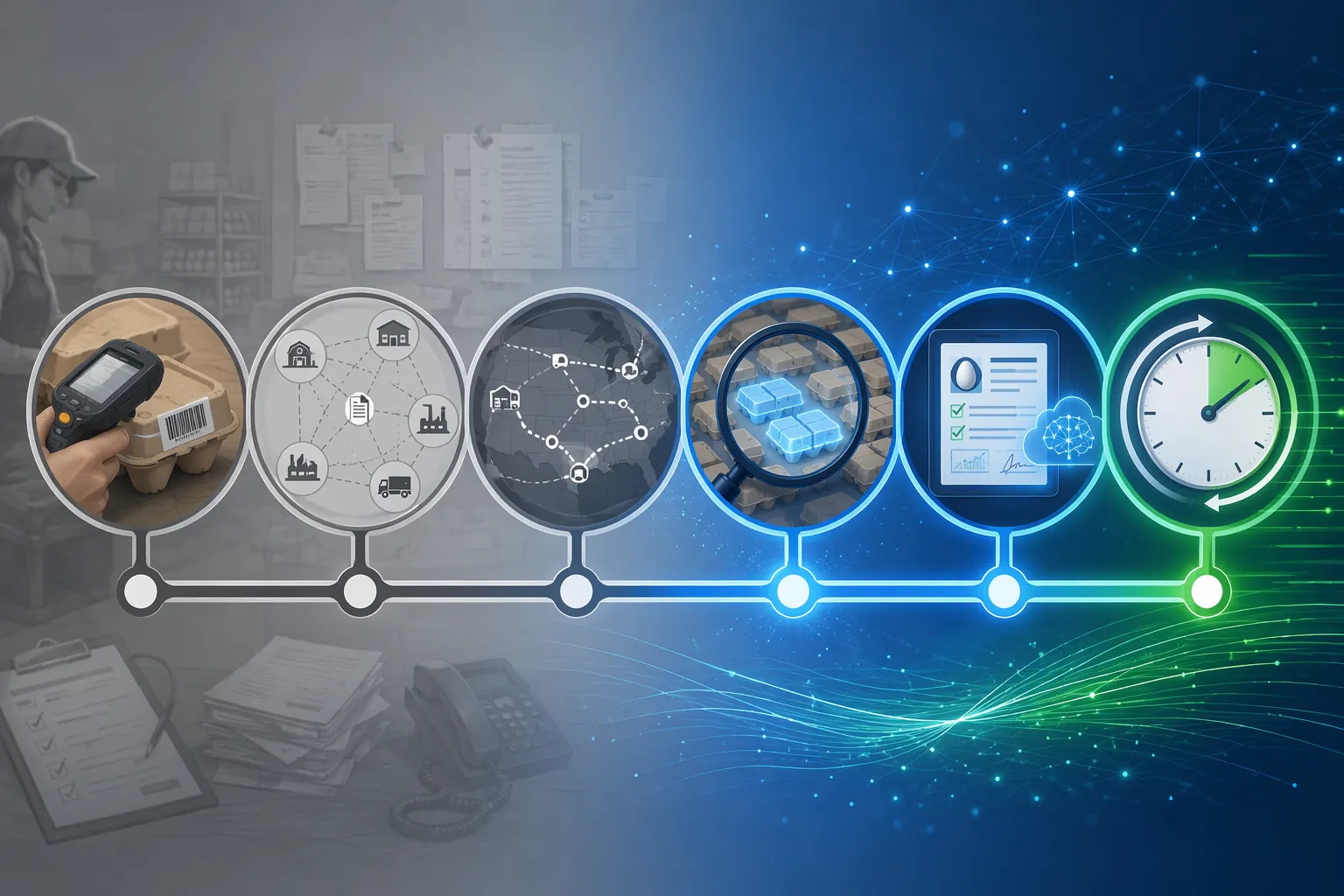
AI traceability is defensible in a recall only when it removes manual evidence assembly. That means the system has to capture structured data as product moves, connect lot identity across trading partners, and generate regulator-ready outputs without asking a recall coordinator to become the integration layer.
Capture KDEs at the moment work happens
The first job is automatic capture. When eggs are received, graded, packed, transformed, shipped, or held, the system needs the relevant KDEs tied to the CTE: product identifier, lot code, quantity, location, date, source, destination, and responsible trading partner. AI can help normalize messy inputs, read documents, flag missing fields, and reconcile variations in naming, but it should not be treated as magic. If a partner never provides a usable lot code, AI can flag the gap faster; it cannot turn a nonexistent record into proof.
Connect lots across systems and partners
The next job is continuity. Egg product can move through farms, processors, packers, distributors, retailers, and foodservice channels. If each organization preserves its own identifier but loses the upstream relationship, traceability becomes a relay race with dropped batons. AI-native platforms are most useful when they maintain the relationship between upstream lots, internal handling events, and downstream shipments even when partner records arrive in different formats.
That is also where 3PL visibility matters. Food Logistics describes AI’s role in recall management for logistics providers as improving visibility across dispersed inventory, shipment status, and customer impact during a recall.[6] The distinction is important: logistics AI does not solve contamination. It helps answer where implicated product is, who touched it, and what should stop moving.
Trace both backward and forward without rebuilding the map
In the August Egg Company investigation, traceback linked illness subclusters to a common supplier, while facility sampling strengthened the connection to a processing environment.[1] A company’s internal traceability system has to support both directions of movement. Backward tracing asks where the product came from. Forward tracing asks where affected product went. Recall scope depends on both.
A manual team may be able to do this, but the process is slow because every step has to be verified against another record. An AI-native system should already know the graph: source lot to production event, production event to finished lot, finished lot to shipment, shipment to customer, and customer to downstream location if partner data is available. The practical gain is not a prettier map. It is fewer hours spent proving the map is real.
Narrow recall scope without guessing
Recall scope is where traceability turns into money, waste, and customer disruption. If a company cannot distinguish affected lots from adjacent production, the conservative move is to pull more product. That may be necessary for safety, but it should not be necessary because records are unusable.
Vendor-published outcomes suggest why companies are interested. Food Industry Executive reported Recall InfoLink claims that recall automation can reduce recall scope by 50–95% and produce up to 90% labor cost savings on recall processes.[4] Those are vendor-reported figures, not independently audited industry benchmarks. Still, they point to a real mechanism: when lot relationships are clean, the company can avoid pulling product that never intersected the implicated event.
Generate the response package while people verify, not type
The response package is where clerical heroics usually surface. FDA-facing documentation has to be accurate, complete, and internally consistent. Customer notifications need the right product identifiers and date ranges. Inventory holds need to reach the right locations. Executives need a defensible scope estimate, not a rough guess from an unfinished spreadsheet.
FoodReady’s case study reports mock recall compression from 4–8 hours to 10–30 minutes, data entry error reduction of 85–95%, and improved audit outcomes across hundreds of facilities.[5] Again, those are vendor-reported results. The credible reading is not that every company will reproduce those numbers. It is that automated record assembly changes the recall team’s task: review exceptions, validate assumptions, and approve communications instead of manually stitching the trace together.
A Practical Recall Workflow
For food safety and supply chain leaders evaluating AI traceability, the useful question is not whether the platform has a recall module. The useful question is what happens in the first hours after a suspected salmonella link.
- Freeze the implicated identifier: product, lot, date range, supplier, facility, or event under investigation.
- Pull all KDEs tied to the relevant CTEs without waiting for manual exports from every department.
- Run backward trace to identify source relationships and forward trace to identify all customers, locations, and open orders.
- Separate confirmed affected product from adjacent product, unclear product, and product blocked only because of missing data.
- Generate regulator, customer, and internal response materials from the same record set.
- Log assumptions and data gaps so the recall decision is reviewable later.
That last step matters. A fast answer built on weak records is not readiness. A good system distinguishes known facts from inferred links, missing partner data, and unresolved exceptions. It should make uncertainty visible early, because hidden uncertainty is how narrow recalls become indefensible.
This is also where broader recall management frameworks help. SupplyChainBrain describes effective recall management in terms of preparedness, communication, traceability, execution, and continuous improvement.[7] Those elements are useful only if they are operationalized. A recall playbook that still depends on five people reconciling spreadsheets is a policy document, not a response capability.
The Business Case Is Built on Fewer Blind Pulls
Investment justification should begin with the failure points, not the software category. The cost of poor traceability shows up as excess product removed from commerce, delayed customer notification, extra labor, regulator friction, and reputational exposure when public health agencies have better evidence than the company can assemble internally.
Vendor-reported metrics can support that case if they are used carefully. Recall InfoLink’s reported 50–95% recall scope reduction and up to 90% labor savings are relevant because they describe recall economics, but they should be tested against a company’s own product mix, partner data quality, and recall history.[4] FoodReady’s reported compression of mock recalls from hours to minutes is relevant because it speaks to response speed, but mock recall performance is not the same as outbreak performance under regulator and media pressure.[5]
The right pilot is therefore not a polished demo. It is a hard mock recall using imperfect data: partial lot codes, a distributor split, a repacked product, a customer that sends a late file, and one intentionally missing KDE. If the platform can show the affected path, isolate uncertain inventory, generate response materials, and document unresolved gaps, it is doing useful recall work.
Companies already exploring adjacent use cases can connect this work to broader recall and contamination programs. ChainSignal’s guide to AI recall management looks at the shift from reactive recall execution to earlier risk detection, while its FSMA 204 traceability analysis explains the regulatory recordkeeping layer in more detail. The egg recall lesson sits between those two concerns: records must be structured enough for compliance and connected enough for crisis response.
What AI Cannot Fix After the Fact
AI traceability has hard limits. It cannot compensate for partners that refuse to share data. It cannot verify a lot relationship that was never captured. It cannot decide food safety risk by itself. It cannot make an overbroad recall unnecessary when contamination evidence justifies caution. It can reduce the time spent finding, cleaning, linking, and formatting records, which is a narrower claim and a more useful one.
That narrower claim is enough. The 2025–2026 salmonella egg recalls showed what happens when illness counts, traceback work, and fragmented supply chain records collide. AI-native traceability is most defensible when it replaces manual evidence assembly with usable lot-level recall response, reduces unnecessary scope, and helps food safety leaders answer regulator-grade questions within hours while staying honest about integration, partner participation, and source data quality.
References
- Outbreak Investigation of Salmonella: Eggs (June 2025). FDA.
- Salmonella Outbreak Linked to Eggs. CDC.
- What’s behind the wave of egg recalls, and why it’s not slowing down. Fast Company.
- Automating Recalls Dramatically Improves Speed, Accuracy, Traceability. Food Industry Executive. June 2025.
- Transforming Food Safety with AI-Native Traceability Across Hundreds of Facilities. FoodReady.
- How AI Helps 3PLs Manage Product Recalls. Food Logistics.
- The Elements of Supply Chain Resilience and Effective Recall Management. SupplyChainBrain.
Comments
Join the discussion with an anonymous comment.