
The 2025 egg recall wave was not just a food safety event. For operators, it was a traceability stress test under real pressure: three Salmonella-related events, more than 239 illnesses, hospitalizations, one reported death, and more than 6 million eggs recalled across a supply chain that still depends heavily on labels, receiving logs, line sheets, repack records, and shipment files being reconciled after the fact.[1][2][3]
That is where the real question for AI traceability in egg recalls begins. AI traceability does not prevent Salmonella from entering a flock, surviving a process gap, or reaching a customer. The narrower and more useful question is whether it can keep a recall from becoming broader, slower, and harder to defend than it needs to be.
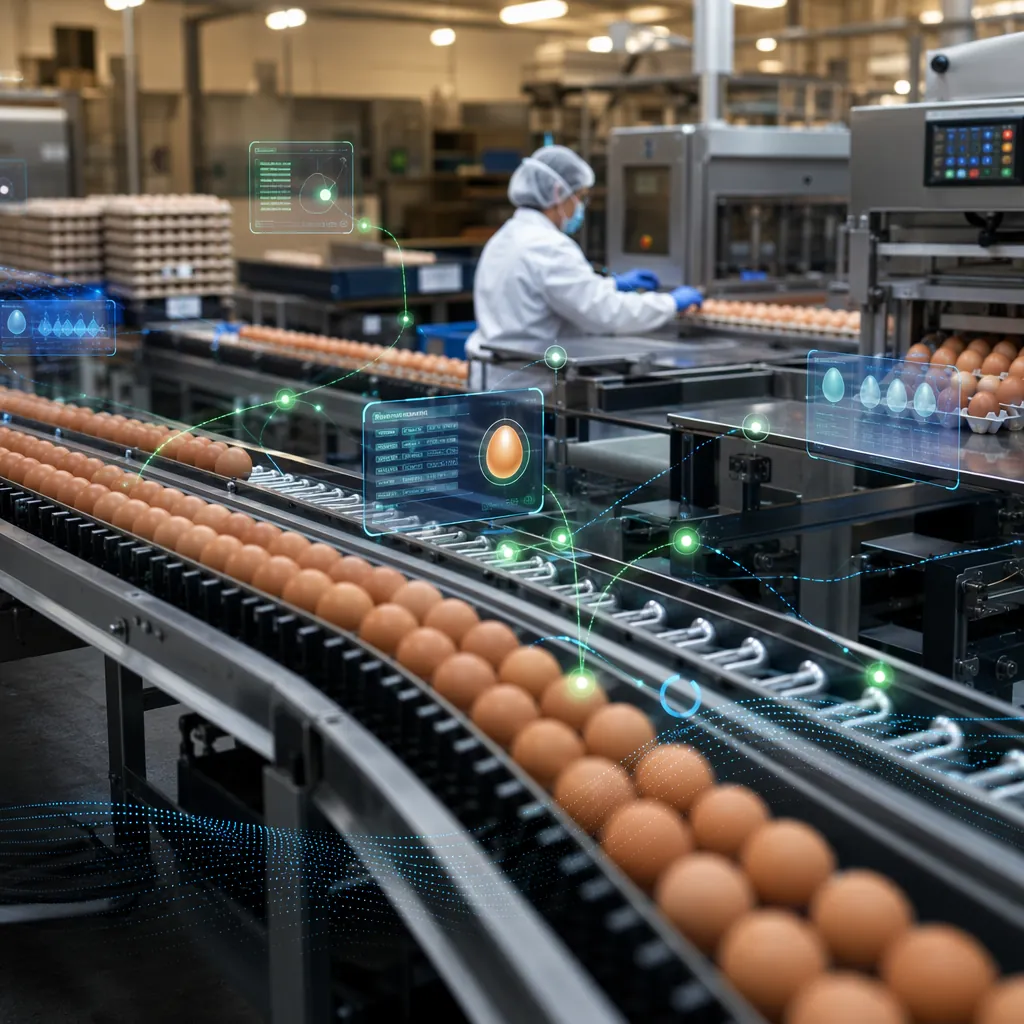
In the August Egg Company outbreak, FDA-linked reporting identified 134 illnesses, 38 hospitalizations, and one death across 10 states.[1] In the Country Eggs outbreak, 105 illnesses were reported across 14 states.[2] Black Sheep Egg Company’s recall involved more than 6 million eggs and received a Class I designation.[3] Those numbers matter because every hour spent defining scope leaves someone deciding whether to hold, ship, rework, repack, or explain why a suspect lot is still moving through the building.
The failure pattern was familiar: traceback took too long, production faults could not be tied cleanly to affected batches, and required traceability data was too dependent on manual capture. AI traceability only deserves serious attention if it changes those three conditions inside the plant and distribution flow, not just on a dashboard demo.
Why Egg Traceback Widens So Quickly
Shell eggs look simple until a recall coordinator has to reconstruct where they came from, what line touched them, what carton they entered, which brand they left under, and which customers received them. A single day can include received eggs from different sources, grading and packing runs, repacking into different customer formats, private-label or multi-brand cartons, and shipments leaving before all quality or investigation questions are closed.
FDA’s Food Traceability List includes shell eggs, which means covered entities must maintain key data elements at critical tracking events such as receiving, transformation, creation, and shipping under FSMA 204.[4] FDA also published shell egg supply chain traceability examples in August 2025, a signal that the agency understood eggs were not a neat one-up, one-down recordkeeping exercise.[4]
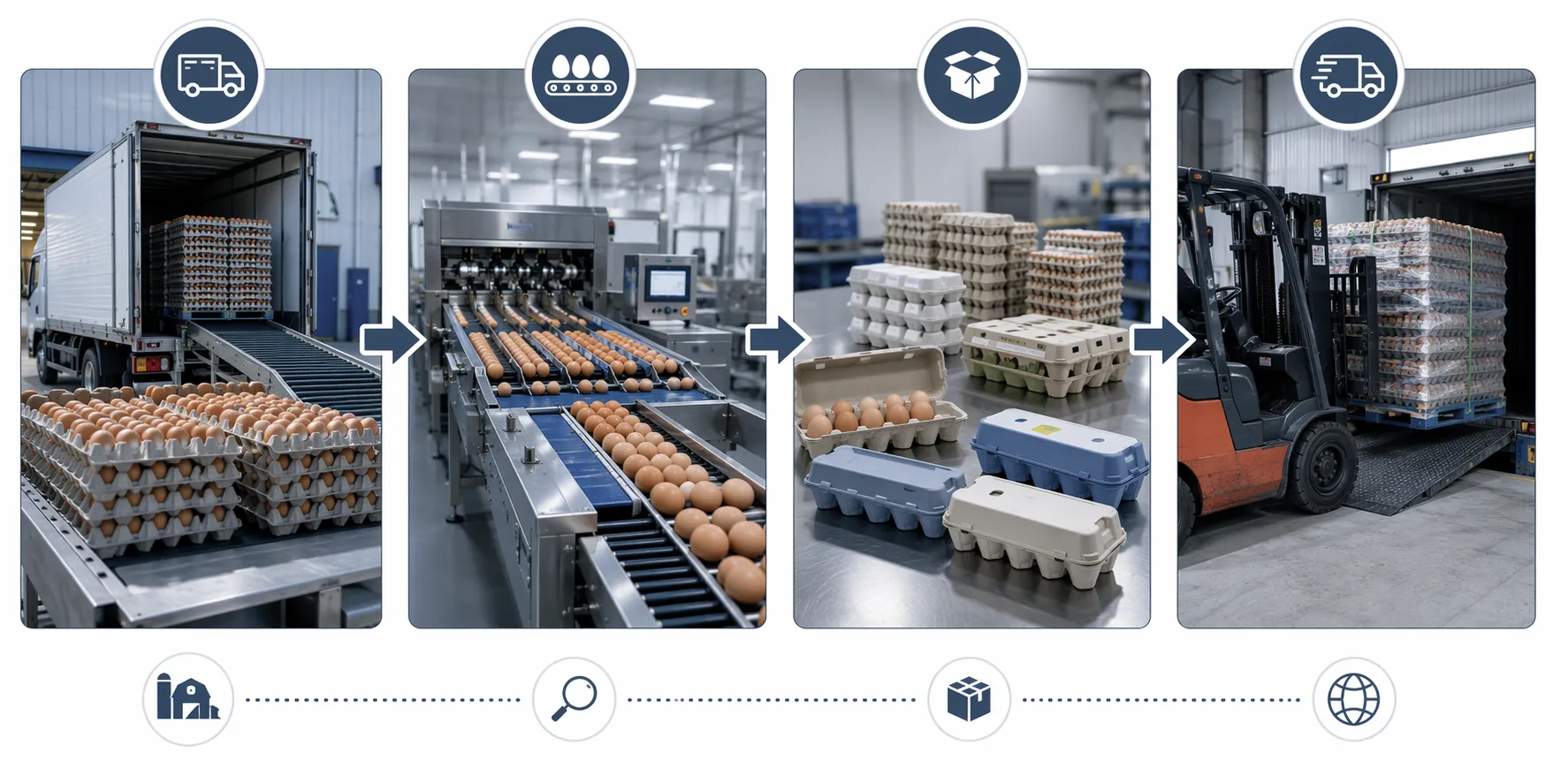
The problem is not that plants have no records. Most do. The problem is that the records are often distributed across ERP, warehouse systems, label software, line paperwork, quality holds, receiving logs, equipment checks, and customer shipment files. When a positive test, illness cluster, or regulatory call arrives, the plant is not simply looking for a lot number. It is rebuilding a chain of custody while production, customer service, inventory control, and regulatory communications are all asking for answers.
That is how a recall scope grows. If the team cannot confidently separate implicated from non-implicated product, the safe operating choice is to hold or recall more. It is expensive, but it is also understandable. Nobody wants to be the person who released product because a spreadsheet looked mostly right at 6 p.m.
Failure Mode One: Manual Traceback Takes Longer Than the Recall Clock Allows
Manual traceback is slow because it asks people to connect records that were not always created to be connected. A receiving record may identify a supplier lot. A grader or packer record may identify a production run. A label system may identify carton codes. A WMS may identify pallets. A customer order file may identify destinations. Each record can be accurate on its own and still fail to answer the recall question quickly: which finished units contain or may contain the implicated eggs?
Oxmaint, in vendor-published food and FMCG traceability material, describes conventional manual traceback as a 48-to-72-hour process and contrasts it with AI-enabled completion in under 4 hours.[5] That should not be treated as an independently audited egg-industry benchmark. It is still directionally useful because the manual time range matches what many recall teams recognize: the first day is often spent gathering records, the second reconciling contradictions, and the third tightening or expanding scope.
FSMA 204 raises the stakes because covered entities must be able to provide required traceability information to FDA within 24 hours of a request, or within another reasonable time to which FDA agrees.[4] A process that depends on two or three days of reconstruction is already misaligned with the response expectation, even before the team gets to customer notification, product disposition, or public-facing recall communications.
AI batch genealogy changes the work when it builds the relationship among input lots, process events, finished goods, pallets, and customers as production happens. The useful output is not a prettier lot tree. It is a defensible answer to a containment question: if this supplier lot, flock source, date code, line, or finished batch is implicated, what exactly did it become and where did it go?
- At receiving, the system ties incoming shell eggs to supplier identity, lot or traceability lot code, dates, quantities, and receiving location.
- During grading and packing, it records which inputs entered which run, line, equipment path, package format, and finished product identity.
- During repacking or creation, it preserves the relationship when eggs move into new carton configurations, brands, or customer-specific packs.
- At shipping, it connects finished product, pallet, order, customer, destination, and ship date without waiting for someone to merge files later.
That is the difference between looking for documents and querying a genealogy. In a mock recall, the first approach asks staff to prove the chain by hand. The second asks the system to show the chain, exceptions included, with an audit trail that quality and regulatory teams can review.
Failure Mode Two: Equipment Events Do Not Follow the Product
Many recall and hold decisions are not triggered by a confirmed pathogen result alone. They can start with a metal detector event, pasteurizer deviation, seal tester failure, temperature abuse question, sanitation break, label mismatch, or equipment maintenance discovery. The traceability challenge is the same: which product was exposed to the condition, and which product was not?
When equipment data sits outside the traceability record, plants often fall back to time windows. If the team cannot tie the event to a batch boundary, the hold expands to a full shift, a full line run, or a broader production day. That may be the right temporary control, but it is a blunt instrument. It ties up good inventory, increases waste, and makes customer conversations harder because the explanation is based on uncertainty rather than product-specific exposure.
For egg producers and processors, this matters because the production path can change quickly. Eggs may move through grading, packing, repacking, and shipping under short shelf-life pressure. A delayed equipment review can collide with finished goods that have already been staged, loaded, or delivered. If the fault record is not connected to the batch genealogy, the recall team has to estimate impact from timestamps, operator notes, maintenance records, and inventory movement.
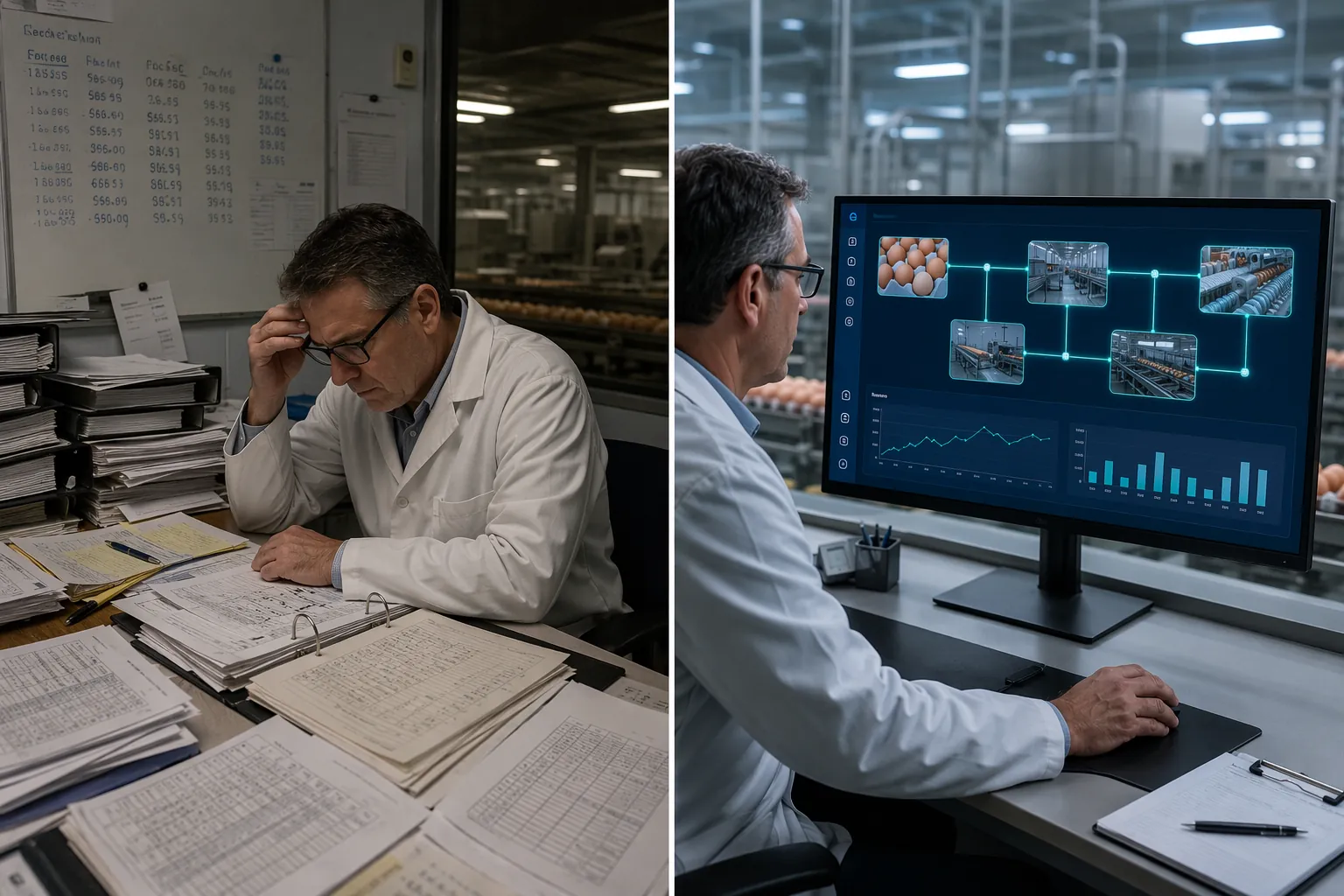
The AI role here is not mystical prediction. It is correlation at operational speed. A traceability layer connected to line equipment, quality checks, maintenance events, label systems, ERP, WMS, and shipping records can identify which batches crossed the affected line segment during the relevant window. If the window changes after engineering review, the impacted product set can update without rebuilding the recall from scratch.
This is also where vendor claims need careful handling. iFactory reports sub-15-second recall identification through AI batch genealogy in food manufacturing contexts.[6] FoodReady reports recall scope reductions of 50% to 95% and mock recall time reductions from 4 to 8 hours down to 10 to 30 minutes.[7] Oxmaint cites a food-sector figure that 56% of recalls expand because companies cannot quickly define scope.[5] These are vendor-reported food-sector metrics, not audited benchmarks from named egg producers. They are useful only after the underlying mechanism is visible: connected batch genealogy narrows scope because it can distinguish exposed from non-exposed product faster than manual reconciliation.
That distinction matters. A system cannot reduce recall scope by 95% just because it has AI in the product name. It can narrow scope when it has complete product movement data, reliable equipment-event timestamps, clean lot transitions, and shipping records tied to finished product identity. Without those inputs, the dashboard will still be waiting for someone to find the missing binder.
Failure Mode Three: KDE Capture Breaks Down in the Daily Flow
FSMA 204 does not ask egg companies to keep a vague sense of traceability. It requires specific key data elements tied to critical tracking events for foods on the Food Traceability List, including shell eggs.[4] The practical burden is that the data must be captured consistently during ordinary operations, not assembled only when FDA asks for it.
The current compliance timeline is not as simple as a static deadline printed on a wall. FDA announced a proposed 30-month extension to July 20, 2028 on August 6, 2025, and Congress directed non-enforcement before that date.[4] As of July 2026, FDA has also held public discussion on lot-level tracking flexibilities, including a June 15, 2026 public meeting.[4] Egg producers should treat the timeline as active but not optional: the direction of travel is still structured, faster, more retrievable traceability data.
Manual KDE capture fails in predictable places. A receiving clerk keys a supplier lot differently than the supplier provided it. A repack record carries forward a date but not the traceability lot code. A label change happens correctly on the floor but does not reconcile cleanly with the production sheet. A partial pallet moves to a different customer order. None of those mistakes has to be dramatic to create recall drag. Small discontinuities become large delays when the team has to prove lineage under a 24-hour request window.
| Critical tracking event | Where manual records often weaken | What AI traceability must capture |
|---|---|---|
| Receiving | Supplier lot, quantity, and receiving date may sit in separate logs or be keyed inconsistently | Standardized inbound identity, supplier link, quantity, location, date, and exception flags |
| Grading and packing | Input lots and finished runs may be recorded on line sheets that require later reconciliation | Input-to-output genealogy, line identity, run timing, equipment path, package format, and operator-approved exceptions |
| Creation or repacking | Brand, carton, and customer-format changes can break the original lot relationship | Preserved parent-child lot relationships across repack, relabel, split, merge, and private-label configurations |
| Shipping | Finished goods may be tied to orders and pallets in systems not linked to production genealogy | Customer, destination, order, pallet, ship date, and finished product identity tied back to source and process history |
The best systems reduce clerical fragility by capturing KDEs as a byproduct of the work already happening: scanning at receipt, equipment integration at the line, label verification at packout, controlled transformations during repack, and shipment confirmation at loadout. AI can help normalize records, flag gaps, detect mismatched relationships, and make traceback queries usable by people who do not have three days to become historians.
FoodReady cites industry surveys indicating that fewer than 40% of affected food companies have systems meeting FSMA 204 requirements, but the underlying survey source is not independently verifiable from the available material.[7] The figure should be read as a vendor-attributed readiness warning, not a settled industry measurement. The operational risk behind it is still real: if KDEs are incomplete during normal production, the plant will not become FSMA-ready during an active recall.
What AI Traceability Can and Cannot Promise
There is a temptation to describe AI traceability as if it replaces recall judgment. It does not. The quality manager still has to decide whether the data is complete enough, whether product should remain on hold, whether a deviation requires escalation, and whether the recall scope is defensible. Regulatory, customer, and public health decisions still depend on facts beyond a lot tree.
What AI can do is remove avoidable delay from the fact-finding. It can surface the implicated genealogy, show where data is missing, preserve who changed what and when, and let the team test alternate scenarios without rewriting the spreadsheet each time. If a supplier lot is implicated, the team can see finished products and customers. If a line event is implicated, the team can see batches that crossed the line during the exposure window. If a repack step split product into multiple brands, the relationship remains visible instead of living in someone’s memory.
The available vendor evidence is mostly food-industry-general rather than egg-specific. iFactory also reports a 90% reduction in scrapped product during recalls and a 12-to-18-month payback for mid-to-large facilities, again as vendor-reported metrics rather than independently audited egg-sector results.[6] That limitation should not be buried. Named egg-producer AI traceability deployments were not available in the source material for this article. Produce, ready-to-eat, seafood, and broader food manufacturing examples can show the method, but eggs bring their own repacking, shelf-life, labeling, and shell egg KDE complexity.
Market data is helpful only as investment context. Towards FnB estimates the AI in food traceability market at $4.92 billion in 2026, with a 15.85% CAGR to $18.51 billion by 2035 and North America representing 42% share.[8] That says buyers are paying attention. It does not prove that a particular system will work in an egg plant where the metal detector, pasteurizer, seal tester, ERP, WMS, label system, and shipping records do not talk to each other.
The practical buying question is therefore less glamorous: can the system identify the implicated batch, explain why it is implicated, show which product is not implicated, and produce an audit trail without sending half the staff into a records search? If not, the plant may have purchased visibility without containment.
How to Judge Readiness Before the Next Recall
A useful traceability review starts with a mock recall, but it should not stop at the usual pass-fail exercise. Time the first answer, then time the defensible answer. The first answer is often a list of likely affected lots. The defensible answer explains source, process path, transformations, holds, shipments, exclusions, and unresolved gaps.
- Pick one inbound shell egg lot and trace it through grading, packing, repacking, finished goods, shipment, and customer destination.
- Pick one finished carton code and trace backward to source, line, production window, and any quality or equipment events that touched it.
- Pick one equipment fault window and identify exactly which batches crossed the affected path, which did not, and why.
- Pick one repacked or private-label order and verify whether the original lot relationship survives the brand and packaging change.
- Ask whether the same report can be produced within the FSMA 204 response expectation without rebuilding data manually.
This is where internal implementation guidance can be useful. A broader FSMA 204 walkthrough, such as How AI Food Traceability Helps You Comply with FSMA 204, can help teams map required data capture to daily operations. A lot-tracking companion, such as How AI Lot Tracking Cuts Recall Response from Days to Minutes, is most useful when the team is testing whether genealogy queries actually narrow containment.
For egg operations, the implementation sequence should follow the product, not the software menu. Start with receiving identity, then line and equipment integration, then transformation and repack genealogy, then shipping linkage, then exception handling and audit reporting. If the system cannot survive a split lot, relabel, partial pallet, hold release, or customer-specific carton change, it will fail in exactly the moments that make egg recalls difficult.
AI traceability can reduce recall response from days to hours and support narrower containment, but only when KDEs are captured in the flow of daily work and production, quality, equipment, warehouse, labeling, and shipping data are integrated before the recall starts. Once the call comes in, the plant should be investigating the problem, not reconstructing the day.
References
- August Egg Company Salmonella outbreak investigation, FDA, June 2025, link
- Country Eggs Salmonella outbreak investigation, FDA, August 2025, link
- What’s behind the wave of egg recalls, Fast Company, 2025, link
- FSMA Final Rule on Requirements for Additional Traceability Records for Certain Foods, FDA, link
- AI Traceability Solutions for Food & FMCG Manufacturing, Oxmaint, link
- Blockchain Traceability in Food Manufacturing, iFactory AI, link
- Transforming Food Safety With AI-Native Traceability, FoodReady, link
- AI in Food Traceability Market, Towards FnB, link
Comments
Join the discussion with an anonymous comment.