
By the time a Cyclospora case reaches an investigator’s desk, the produce timeline is already broken. The lettuce, cilantro, berries, or mixed greens that mattered may have moved through a centralized distribution network, crossed state lines, sat briefly on a retail shelf, been eaten, and disappeared from the consumer’s kitchen before symptoms were severe enough to prompt testing. That is the operating problem behind supply chain traceability during a Cyclospora outbreak in 2026: the evidence is perishable, the illness is delayed, and the records often have to stand in for the product itself.
As of July 13, CDC surveillance listed 1,645 confirmed cyclosporiasis cases, 141 hospitalizations, and cases reported across 34 states; CDC’s health advisory also described domestically acquired cases across multiple states.[1][2] FDA’s active outbreak table showed four concurrent Cyclospora investigations underway.[3] Those numbers should be read as a current snapshot of an ongoing outbreak, not as a closed case file.
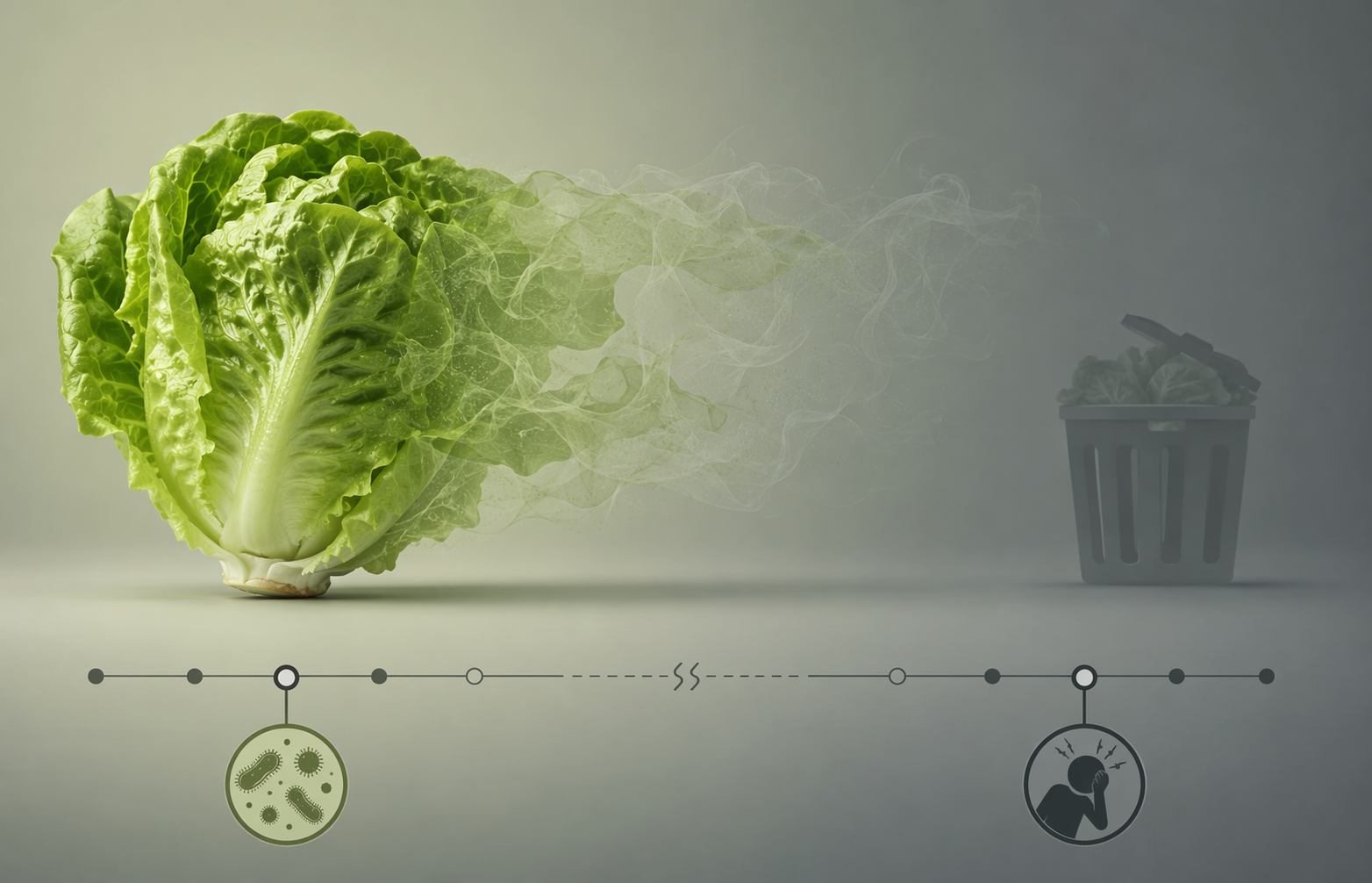
Cyclospora is not just another pathogen name to plug into the same traceback routine. FDA’s Cyclospora action plan states that the parasite cannot be cultured in a laboratory, which removes a tool investigators rely on in many bacterial outbreaks: growing an isolate and comparing it through genomic systems such as whole genome sequencing.[4] CIDRAP’s outbreak analysis points to another constraint: a 1- to 2-week incubation period, long enough for short-shelf-life produce to be consumed, discarded, or washed out of routine retail evidence before the first cases are recognized.[5]
That combination changes the status of supply chain records. In a bacterial outbreak, traceback data can support microbiological evidence. In a Cyclospora investigation, the lot code, harvest date, shipping record, customer distribution list, and retail destination may become the only practical way to narrow the suspect field. If those records are late, incomplete, or trapped in separate portals, the investigation is not merely inconvenient. It is forced to spend its scarcest days rebuilding a map of product that no longer exists.
The outbreak moves faster than the interview cycle
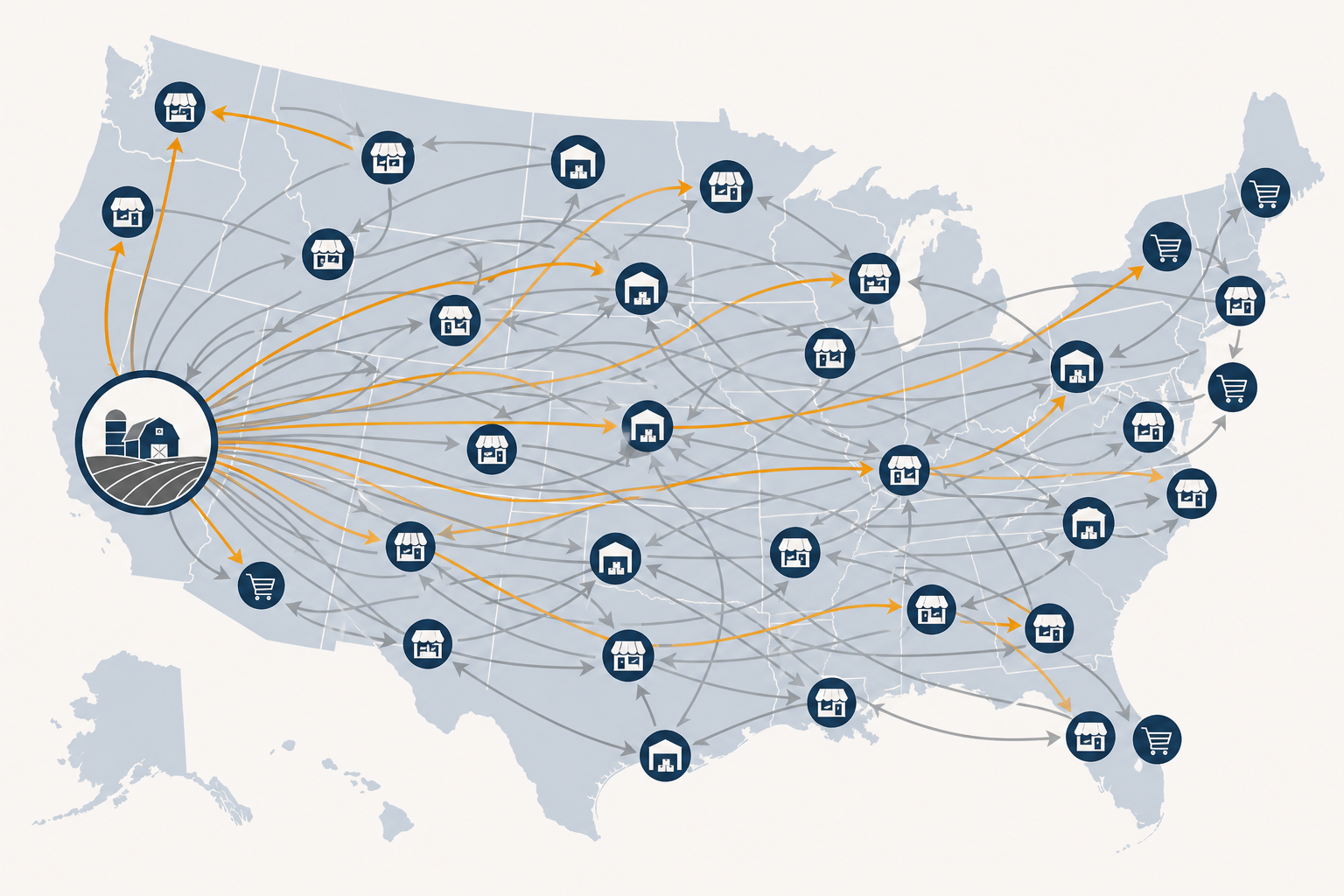
Produce distribution is designed for speed, not retrospective suspicion. Reporting on the 2026 Cyclospora response described how a contaminated farm lot can reach more than 30 states within 48 to 72 hours through centralized distribution hubs, while Michigan’s chief medical executive characterized traceback as “very, very manual” and dependent on “very antiquated data systems.”[6] Those phrases land because they describe the ordinary machinery of an investigation: calls to suppliers, spreadsheet exports, portal screenshots, bill-of-lading searches, label photos, and people trying to reconcile product descriptions that were never meant to serve as forensic evidence.
The consumer side does not repair the gap. Standard grocery receipts generally do not carry produce lot numbers, so investigators may be asking a patient to remember what they ate one or two weeks earlier without the receipt-level evidence needed to connect a specific item back to a specific harvest lot.[7] A shopper may remember “salad,” “lettuce,” or “a taco,” but those are categories, not traceable supply chain events.
This is where many digital traceability discussions become too neat. A traceback chart looks linear after it has been cleaned up for a briefing: farm to cooling, cooling to distributor, distributor to retailer, retailer to consumer. During an active Cyclospora investigation, the working version is messier. Investigators may have overlapping date ranges, substitutions, commingled product, partial customer lists, private-label descriptions, and suppliers who are cooperating but still need time to pull the right record from the right system.
The cost of that mess is visible in FDA’s Foodborne Outbreak Response Improvement Plan. FDA reported that 51 of 116 foodborne outbreak investigations from 2020 through 2025 — 44% — did not identify the food vehicle.[8] That figure does not mean every unresolved outbreak would have been solved by better software. It does mean the system loses many races before it reaches the source, and Cyclospora gives it less time than most.
For AI to help, the records have to be worth computing
Artificial intelligence does not detect Cyclospora in a lettuce shipment by looking at a dashboard. It works only where the input data and the investigative task are specific. For traceback, the useful task is narrower and more defensible: compare many supply chain records quickly enough to identify which lots, suppliers, harvest windows, distributors, and destinations appear repeatedly across cases.
That is why FSMA 204 matters less as a compliance slogan than as data architecture. The useful fields are concrete: farm of origin, harvest date, lot number, grower, distributor, destination retailer, and the key data elements attached to critical tracking events.[9] Without that structure, an AI system is mostly parsing fragments. With it, the system can query comparable events across companies that otherwise describe the same product movement in incompatible ways.
| Traceback Question | Record Field That Makes It Computable |
|---|---|
| Which harvested lots could match the illness exposure window? | Harvest date, lot number, farm of origin |
| Which suppliers appear across unrelated patient purchase histories? | Grower, shipper, distributor, customer records |
| Which retail destinations received overlapping product? | Destination retailer, distribution center, shipment date |
| Which paths deserve first review? | Critical tracking events connected by lot and timestamp |
The point is not to hand the investigation to a model. The point is to stop spending the first stretch of an outbreak turning records into a shape that can be searched. A queryable traceability layer lets investigators ask better questions earlier: which lots intersect the exposure windows, which distribution centers recur across cases, which suppliers appear only after a certain date, and which leads weaken when a lab result or interview detail changes.
Where AI earns its budget in a Cyclospora traceback
FDA’s own improvement plan calls for “more advanced analytical methods and computational approaches to prioritize the highest value traceback leads.”[8] That wording is careful, and it should stay careful. The defensible use case is prioritization, not certainty.
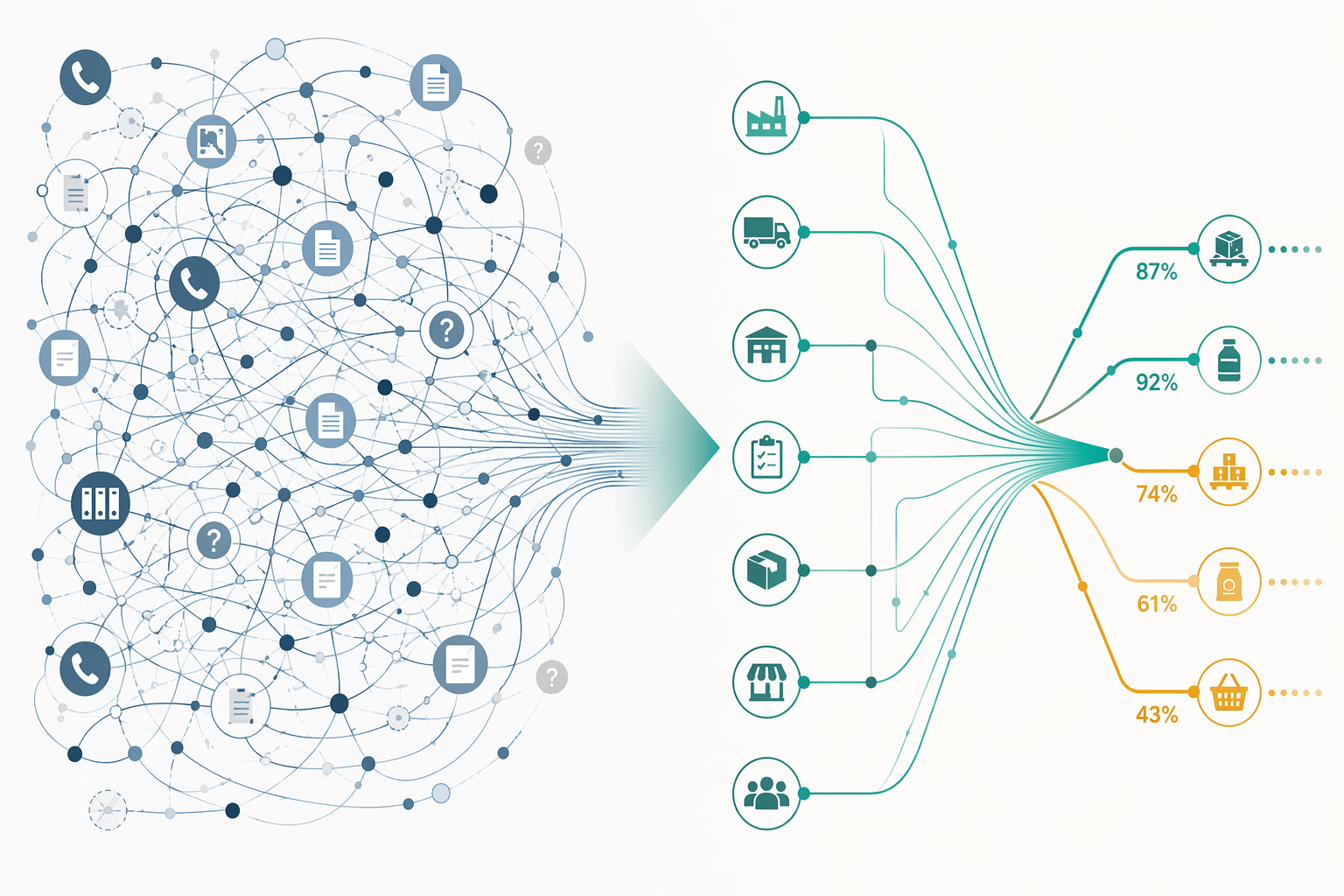
Lot-code pattern recognition is the first practical capability. An AI-assisted system can look across supplier datasets, retailer records, and distribution events for recurring lot identifiers or near-matches that a manual review might miss because the fields are formatted differently. That does not prove contamination. It turns a broad product category into a smaller set of lots and dates that humans can test against interviews, invoices, and sampling results.
Convergence analysis is the second. Instead of treating every traceback leg as equal, the system can identify where independently reported cases begin to share the same upstream node: a distribution center, supplier, harvest window, or farm of origin. In a Cyclospora outbreak, where the organism cannot be cultured and matched the way bacterial isolates often can, that convergence may be the closest thing to an early signal.
Risk scoring is the third, but it needs discipline. A risk score should expose why a lead moved up the queue: overlapping exposure dates, repeated lot appearances, shared distribution nodes, water-risk indicators, or missing records that require follow-up. A black-box score that says “likely source” without preserving uncertainty is not a food-safety tool. It is a liability with a chart attached.
The best version of this workflow does not replace investigators. It gives them a ranked worklist: request these records first, interview these stores next, compare these harvest lots, review this distributor’s outbound shipments, hold judgment on this supplier until the missing dates are resolved. That is how weeks of exhaustive manual reconstruction can begin to compress into hours of targeted analysis, provided the underlying data is standardized and current.
Ambiguity is not a system failure; hiding it is
The Taylor Farms and Taco Bell-related material from the 2026 outbreak should be handled with care. Trustwell described a Cyclospora false-positive incident in which a lab error during the outbreak caused weeks of misdirected traceback effort.[10] That is not a clean morality tale about one grower, one retailer, or one supplier. It is a reminder that investigations can move under uncertainty for a long time, and early leads can later weaken.
Better records do not eliminate that ambiguity. They make it less damaging. If a lead is supported by a specific lab result, a specific lot, and a specific date range, then a corrected lab finding can be propagated through the investigation quickly. If the lead was built through emails, screenshots, and memory, backing out of the wrong path can consume the same people and systems that are supposed to be finding the right one.
This is also where AI systems need a visible audit trail. A model that ranked a supplier high on Monday should be able to show what changed on Wednesday: a corrected test result, a revised shipment file, a newly linked retail destination, or a patient interview that no longer fits the exposure window. Food-safety teams do not just need the latest answer. They need to know which answer was acted on, when, and why.
Prevention data belongs upstream, but it does not replace traceback
Farm-level prevention analytics are worth watching, especially for water. Contract Laboratory describes dead-end ultrafiltration, or DEUF, water testing alongside IoT sensor data from irrigation sources as inputs that can support models for predicting contamination risk before harvest.[11] That is a different job from outbreak traceback. It belongs earlier in the chain, before the product is cut, cooled, packed, and dispersed.
Those upstream signals can still strengthen the same traceability system. A harvest lot connected to a higher-risk water period may deserve faster review if it also appears in multiple case exposure windows. A low-risk water record does not clear a lot by itself. It is one more structured fact in a file that should be queryable, weighted, and open to revision.
The trap is to sell farm sensors as if they make traceback unnecessary. Cyclospora does not give the system that luxury. Prevention, sampling, and traceback have to share data because none of them is complete alone.
The bounded case for AI-powered traceability
For supply chain technology leaders, the budget question should not be whether AI can “solve” Cyclospora. That framing overpromises and invites the wrong vendor demos. The better question is whether the organization can produce standardized, timely, lot-level records that an analytical system can use to shorten the first phase of an investigation.
- The system should ingest FSMA 204-style key data elements without manual reformatting.
- It should connect farm, harvest, lot, distributor, and retail destination records across critical tracking events.
- It should rank traceback leads with explainable factors and confidence levels, not a single asserted answer.
- It should preserve version history when lab results, interviews, or shipment records change.
- It should let public health and food-safety teams query hours-old records during an active event, not wait for a post-outbreak data cleanup.
Cyclospora makes the case unusually clear because it removes shortcuts. The parasite cannot be cultured in the lab, the incubation window outlasts the product, and consumers rarely retain lot-level proof of what they bought. In that setting, AI-powered supply chain traceability is most defensible when it runs on standardized FSMA 204 data, preserves uncertainty, and helps investigators move from exhaustive manual reconstruction to prioritized, queryable leads within hours rather than weeks.
References
- Surveillance of Cyclosporiasis, CDC,
- Health Alert Network (HAN) - 00531, CDC,
- Investigations of Foodborne Illness Outbreaks, FDA,
- Cyclospora Prevention, Response and Research Action Plan, FDA,
- What we truly know about the huge US Cyclospora outbreak — and what we don’t, CIDRAP,
- Cyclospora Supply Chain Technology 2026, No Infection,
- Cyclospora Outbreak 2026: What Consumers Need to Know, Consumer Reports,
- Foodborne Outbreak Response Improvement Plan, FDA,
- Traceability in Action: How Data Drives Outbreak Investigations, iFoodDS,
- Cyclospora False Positive Food Traceability, Trustwell,
- Cyclospora Testing in Fresh Produce: Methods, Challenges, and FDA Compliance, Contract Laboratory,
Comments
Join the discussion with an anonymous comment.