

The useful buying question for demand planning artificial intelligence software is not which platform has the longest feature list. It is which demand behavior the software is actually built to learn from, explain, and act on. A manufacturer trying to reduce excess raw material exposure has a different problem from a grocer managing short shelf life, a retailer dealing with stockout-driven substitution, or a pharma team planning around regulatory events.
That sounds obvious until the demos begin. Then the same phrases appear everywhere: demand sensing, forecast accuracy, inventory optimization, scenario planning. Those are not bad capabilities. They are just too broad to evaluate without naming the demand pattern underneath them.
AI demand planning software usually combines machine learning, statistical forecasting, external signals, exception management, and planning workflow integration to improve forecast quality and planning speed. For a deeper method-by-method comparison, the natural companion piece is AI demand forecasting versus traditional methods. Here, the more practical issue is industry fit: what the system must understand before its accuracy claims mean anything.

Map the industry before comparing the feature list
A fit-first shortlist starts by describing the dominant demand pattern. The table below is intentionally compact. It is not meant to make five industries look equally documented or equally mature. Manufacturing and retail/CPG have stronger available evidence. Automotive and life sciences require more careful questioning because the proof points here are thinner.
| Industry | Dominant demand pattern | AI capabilities to prioritize | What to ask vendors to prove |
|---|---|---|---|
| Manufacturing | Longer planning cycles, capacity constraints, raw material exposure, changing product mix | Granular forecasting, scenario planning, ensemble forecasting, S&OP or IBP integration, inventory-risk visibility | Show cycle-time reduction, excess inventory impact, and how forecasts flow into constrained planning |
| Retail/CPG | Promotions, stockouts, substitution, channel shifts, store or customer-level volatility | Demand sensing, causal signals, substitution modeling, promotion lift and cannibalization logic, channel-aware forecasting | Show how the model separates true demand from observed sales and handles stockout transfer |
| Food & beverage | Perishability, weather sensitivity, shelf-life constraints, SKU-level volatility | Weather-aware forecasting, expiration and shelf-life logic, store or region clustering, short-cycle replenishment signals | Show how forecast changes alter spoilage, service levels, and inventory turns |
| Automotive | Regional variability, aftermarket part intermittency, long lead times, service-level obligations | Intermittent demand forecasting, long-lead-time scenario planning, regional demand sensing, service parts segmentation | Show performance by part class, region, and lead-time band rather than one blended forecast metric |
| Life sciences | Regulatory timing, launch uncertainty, clinical trial milestones, constrained supply and compliance requirements | Event-aware forecasting, launch planning scenarios, clinical and regulatory signal integration, governed workflow controls | Show how assumptions are versioned, reviewed, and tied to regulatory or clinical events |
Across industries, one capability deserves special scrutiny: whether the platform can choose among multiple forecasting methods rather than forcing every SKU, part, store, or customer segment through the same model. Horizon Solutions argues that ensemble approaches, where multiple methods are tested and selected automatically at the SKU or item level, tend to produce more consistent results than single-method platforms.[2] That is a reasonable evaluation lens, especially in portfolios where fast movers, intermittent items, promoted products, and new launches sit in the same planning process.
Manufacturing: planning-cycle compression matters as much as forecast accuracy
Manufacturing is where AI demand planning often becomes concrete fastest, because the forecast is visibly connected to materials, production schedules, capacity decisions, and working capital. A percentage-point forecast improvement is not very persuasive unless it changes what planners can release, buy, defer, or escalate.
IBM’s demand forecasting material cites Novolex, a packaging manufacturer, as reducing excess inventory by 16% and cutting planning cycles from weeks to days after using AI-powered demand planning. The same IBM source says Idaho Forest Group reduced forecasting time from more than 80 hours to under 15.[1] These are vendor-published success cases, so they should not be treated as average implementation outcomes. They are still useful because they connect the software to operating consequences: less excess inventory and fewer planner hours spent producing the forecast.
That distinction matters in both discrete and process environments. In discrete manufacturing, demand planning software may need to support component availability, service-level tradeoffs, and schedule feasibility. In process manufacturing, it may need to respect batch economics, raw material constraints, yield variation, or shelf-life exposure. A generic forecast dashboard will not tell procurement whether to commit to long-lead materials or tell operations whether the demand signal is stable enough to change a production run.
The more useful manufacturing requirement is therefore not simply “improve MAPE.” It is closer to: show how the forecast changes material commitments, capacity scenarios, and S&OP decisions. If the AI model flags demand upside but the plant cannot react inside the relevant lead time, the planning value comes from earlier scenario visibility, not from pretending the schedule is infinitely flexible.
For manufacturing buyers, the vendor proof should include planning granularity. Can the model forecast by product family for executive review and by item, site, or customer for operational planning? Can it distinguish a real demand shift from one large order pulled forward? Can planners override assumptions without breaking the learning loop? Can the system explain which signals changed the forecast enough for a planner to defend the number in S&OP?
Implementation caveats also show up early in manufacturing. AI planning depends on item history, order history, lead times, master data, customer hierarchies, and clean mappings between forecasts and supply decisions. If those foundations are weak, the first project may need to look less like a model deployment and more like a planning-data repair effort. The data readiness assessment for AI inventory optimization is the better next stop for teams that already suspect this is their real bottleneck.
Retail and CPG: observed sales are not the same as demand
Retail and CPG expose the weakness of treating history as a clean signal. A sales history line can be distorted by stockouts, promotions, displays, channel shifts, price changes, competitive actions, store execution, and substitution. The item that sold more last week may not have become more popular. It may simply have been the closest available substitute.
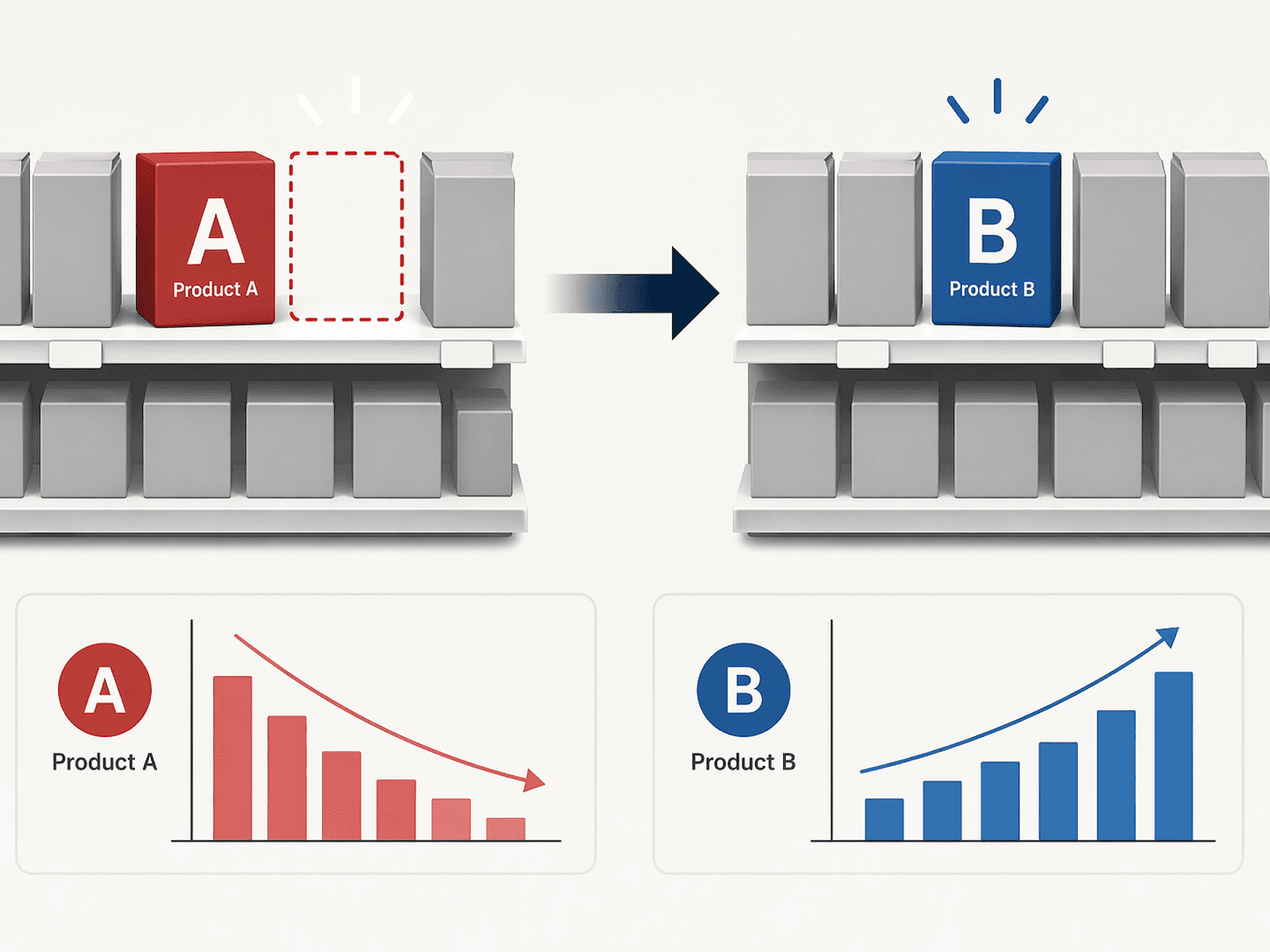
Kumo.ai’s technical discussion of demand forecasting tools calls out this substitution effect directly: when Product A is out of stock and demand shifts to Product B, ordinary time-series models can miss the relationship because they see Product A falling and Product B rising as separate histories rather than connected events.[3] Kumo is a vendor source, but the mechanism is real enough for any retail planner who has watched a shelf gap create strange-looking sales history.
This is why retail AI demand planning should be evaluated on its ability to reconstruct demand, not just forecast sales. The model needs to account for inventory availability, lost sales, substitution groups, promotion calendars, price changes, store clusters, and channel behavior. If it cannot see that a stockout suppressed one item and inflated another, it may reward the wrong product and penalize the right one.
The appetite for AI in this area is not small. Cin7 cites an IBM Institute for Business Value survey in which 88% of retail executives said demand forecasting was a key area for AI improvement.[4] That is an attitude measure, not proof of realized ROI. Still, it signals why so many retail planning teams are being asked to evaluate AI tools now: executives recognize that conventional forecasting struggles when demand is shaped by messy, local, and fast-changing conditions.
Promotion planning is another place where feature labels hide large differences. A light promotion feature may simply ingest a calendar and estimate lift from history. A stronger retail/CPG planning model should help separate baseline demand, promotion lift, cannibalization, halo effects, forward buying, and post-promotion dips. Those effects do not need to be perfect to be useful, but they do need to be visible enough that planners can challenge them.
Channel complexity adds another layer. A national sales spike may come from e-commerce demand, wholesale replenishment, marketplace activity, a retail media campaign, or one customer’s inventory build. If the platform blends those signals into a single forecast, the supply response may be wrong even when the top-line forecast looks acceptable.
For retail and CPG, the vendor demonstration should use uncomfortable data. Ask for a stockout period. Ask for a promoted item with a substitute. Ask for a store cluster or channel where the aggregate forecast looked fine but allocation failed. The best demos in this vertical are not the ones with the smoothest forecast line. They are the ones where the software explains why the history is contaminated.
Food and beverage: perishable demand changes the cost of being wrong
Food and beverage shares some retail and CPG problems, but perishability changes the planning math. A slow-moving industrial component can sit in inventory and still be usable. A fresh product may become waste. A forecast miss can show up as spoilage, markdowns, service failures, or emergency replenishment.
ThroughPut cites Gartner for an approximately 25% median forecast error at the SKU level, but the figure is secondhand in the available materials rather than confirmed from the original Gartner report.[5] It is still directionally useful: SKU-level forecasting is where portfolio averages often stop being comforting. A category forecast may look reasonable while individual items swing enough to create waste or out-of-stocks.
The priority capabilities in food and beverage are therefore narrower than the usual AI checklist. Weather sensitivity matters for many categories, but not as a decorative external data feed. The question is whether weather changes the replenishment decision at the location, SKU, or customer level. Shelf-life logic matters because the forecast must connect to usable inventory, not just total inventory. Short-cycle demand sensing matters when demand shifts faster than the regular planning cadence.
A useful adjacent example comes from ToolsGroup’s Lennox Residential case study. Lennox is not a food and beverage company; the relevance is weather-sensitive planning. ToolsGroup says Lennox improved service levels by 16% and increased inventory turns by 25% using machine-learning-powered cluster analysis across more than 200 micro-climates.[6] Because this is a vendor-published case and from a different sector, it should be used as an analogue for weather-responsive demand segmentation, not as proof that food and beverage firms should expect the same result.
For food and beverage buyers, the better test is operational: when the forecast changes, does the system know which inventory can still be sold, which locations are exposed to spoilage, and which orders should be prioritized? A model that improves forecast accuracy but ignores shelf-life constraints may still push planners toward the wrong replenishment decision.
Automotive: service parts and lead times deserve their own test
Available public evidence is thinner for automotive than for manufacturing or retail, so this section should be read as a requirements lens rather than a case-backed performance claim. Automotive demand planning often splits into very different problems: production-related planning on one side and aftermarket or service parts planning on the other.
Aftermarket parts are especially easy to mishandle with generic forecasting. Demand can be intermittent, regionally specific, and tied to vehicle population, seasonality, repair behavior, warranty patterns, and part supersession. A blended national forecast may hide the fact that one region needs availability and another is carrying slow-moving stock.
Long lead times raise the stakes. If supply cannot react quickly, AI demand planning is less about sensing yesterday’s demand change and more about creating earlier scenario visibility. Buyers should ask vendors to show forecast performance by part class, region, and lead-time band. They should also ask how the system treats intermittent demand, substitutions or supersessions, and service-level commitments for critical parts.
The warning sign is a demo that averages automotive demand into one accuracy number. Service parts planning, dealer replenishment, production input planning, and regional stocking decisions do not fail in the same way. They should not be evaluated as if they do.
Life sciences: the forecast is tied to events, approvals, and governance
Life sciences demand planning is also under-supported by detailed case evidence in the available materials, but the capability profile is distinct. The hard parts are not only statistical. They include clinical trial milestones, regulatory timelines, launch sequencing, constrained supply, market access assumptions, and governance over who is allowed to change the plan.
GroupBWT cites McKinsey Global Institute’s estimate that generative AI could create $60 billion to $110 billion in annual impact in life sciences, with demand forecasting contributing through improved planning efficiency.[7] That is broad context for AI adoption in the sector, not direct evidence that a specific demand planning platform will deliver forecasting ROI in a regulated launch environment.
The vendor questions should therefore focus on event awareness and control. Can the system model launch scenarios around approval timing? Can it incorporate clinical, regulatory, and commercial assumptions without turning them into undocumented spreadsheet logic? Can planners preserve scenario versions and explain why a demand assumption changed? Can the planning workflow satisfy review requirements instead of treating governance as an afterthought?
In life sciences, a black-box forecast can create more friction than value if it cannot be reviewed. The software has to support planning judgment under uncertainty, not merely produce a cleaner-looking curve.
Use benchmarks carefully
A widely repeated benchmark across practitioner sources is that AI-driven forecasting can reduce forecast errors by 20% to 50% and cut lost sales by up to 65%.[4][5][6][7] The range is useful as a directional expectation, but it should not be treated as a guaranteed business case. In the reviewed practitioner materials, the figure appears through secondary sources rather than a directly verified original McKinsey report.
That caveat is not academic. Forecast-error reduction depends on the starting point, data quality, forecast level, planning horizon, item mix, and whether the model is being judged against sales, shipments, unconstrained demand, or operational outcomes. A 30% error reduction on a noisy SKU-level forecast may matter less than a smaller improvement that prevents a production overbuild or improves allocation during a stockout.
Vendor-published success stories should be read the same way. Novolex, Idaho Forest Group, and Lennox are valuable because they show what successful implementations can affect: inventory exposure, planning labor, service levels, and turns.[1][6] They do not establish average results across all companies, data environments, or planning cultures.
What to turn into vendor requirements
After the industry mapping, the evaluation should become more specific, not more abstract. A supply chain director does not need another matrix of generic AI features. Procurement and IT need requirements that can be tested with company data and planning scenarios.
- If manufacturing is the core use case, require evidence for planning-cycle compression, constrained scenario planning, inventory exposure reduction, and S&OP or IBP integration.
- If retail or CPG is the core use case, require substitution modeling, stockout handling, promotion and cannibalization logic, and channel-aware demand sensing.
- If food and beverage is the core use case, require shelf-life-aware planning, weather or local-event sensitivity where relevant, and replenishment logic that distinguishes usable inventory from total inventory.
- If automotive is the core use case, require intermittent demand support, regional service-parts segmentation, long-lead-time scenarios, and performance reporting by part class.
- If life sciences is the core use case, require regulatory-event awareness, launch scenario management, clinical or commercial assumption tracking, and governed workflow controls.
The pilot design should also match the demand pattern. A retail pilot without stockout and substitution history will not test the hard part. A manufacturing pilot that stops at forecast accuracy and never connects to supply decisions will not prove planning value. A food and beverage pilot that ignores shelf life is testing the wrong system. For teams trying to avoid the common gap between a promising model and a working planning process, why most AI supply chain planning pilots stall is the more implementation-focused read.
This is also where broader supply chain AI context can help. Demand planning rarely creates value alone; it affects inventory, replenishment, production, allocation, and service. The related overview of AI use cases in supply chain by function is useful when the buying team needs to decide whether demand planning is the right starting point or one part of a larger roadmap.
The final shortlist should begin with one sentence: “Our dominant demand pattern is ____.” Fill that blank before comparing vendors. Then ask each platform to prove that its models, data requirements, planner workflows, and case evidence fit that pattern. For a more formal scorecard, use the fit-first framework for evaluating AI-powered demand planning software. The best demand planning artificial intelligence software is not the one that claims to sense everything. It is the one that understands the specific way your demand gets distorted before planners have to defend the forecast.
References
- AI demand forecasting, IBM
- Best AI Demand Planning Software 2026, Horizon Solutions
- Best Demand Forecasting Tools, Kumo.ai
- AI Demand Planning: 5 Ways AI Can Improve Inventory Forecasting, Cin7
- AI Demand Forecasting Software for Forecast Accuracy, ThroughPut
- Machine Learning in Demand Planning: How to Boost Forecasting, ToolsGroup
- AI Demand Forecasting, GroupBWT
Comments
Join the discussion with an anonymous comment.