
Gold above $5,000/oz is not just a market headline when a bill of materials carries gold through plating, contacts, connectors, aerospace components, medical-device inputs, or high-reliability electronics. It turns into supplier pass-through language, revised surcharge tables, awkward fixed-price agreement conversations, and a planner asking whether procurement delayed a buy because the chart looked temporarily overextended.
That is the practical reason AI gold price forecasting now deserves a serious look in supply chain procurement. Gold breached $5,000/oz in early 2026, and J.P. Morgan Global Research projected $6,000/oz for Q4 2026 after revising down an earlier $6,300/oz view as conditions around the Iran conflict and Fed policy evolved.[1] At the same time, electronics gold demand rose 3% year over year to 69 tonnes in Q1 2026, with the World Gold Council tying part of that pull to AI infrastructure demand.[2]

The short answer is uncomfortable but useful: AI forecasting is mature enough to inform procurement timing, but not mature enough to own the purchase decision. The models can help a category manager decide whether a 30-, 60-, or 90-day buy recommendation is worth taking to finance. They cannot, by themselves, decide whether the business should lock volume, renegotiate a pass-through formula, hedge exposure, or accept inventory risk.
The useful evidence is short-horizon, not magic
The strongest case for AI in gold forecasting does not come from a chatbot guessing next quarter’s London fix. It comes from purpose-built time-series models that have been tested against traditional statistical baselines.
A Research Square LSTM study by Bilgili and Kuşkaya used 7,979 daily gold-price observations from 1993 to 2024 and reported a test MSE of 0.0001207 on normalized data.[3] That number is not a procurement savings figure, and it should not be treated as one. Its value is narrower: in a controlled historical test, the model tracked the price series closely enough to justify asking whether the signal can improve near-term buying discussions.
Other research points in the same direction. A 2024 PLOS ONE study using a CNN-Bi-LSTM model with automatic parameter tuning reported better performance than traditional ARIMA and GARCH approaches on RMSE and MAPE measures.[4] A 2023 study in Chaos, Solitons & Fractals also found that multiple machine-learning methodologies outperformed ARIMA/GARCH-style methods on gold-price prediction benchmarks.[5] For a procurement team, the takeaway is not that every neural network is superior. It is that the old spreadsheet ritual of extrapolating last month’s trend is no longer the benchmark.

The practical test is whether the model changes a decision before the supplier quote expires. A lower RMSE is academically interesting; a timely alert that gold exposure is likely to move outside an agreed tolerance band is operationally useful. Those are related, but they are not the same thing.
Why 90 days is a real boundary
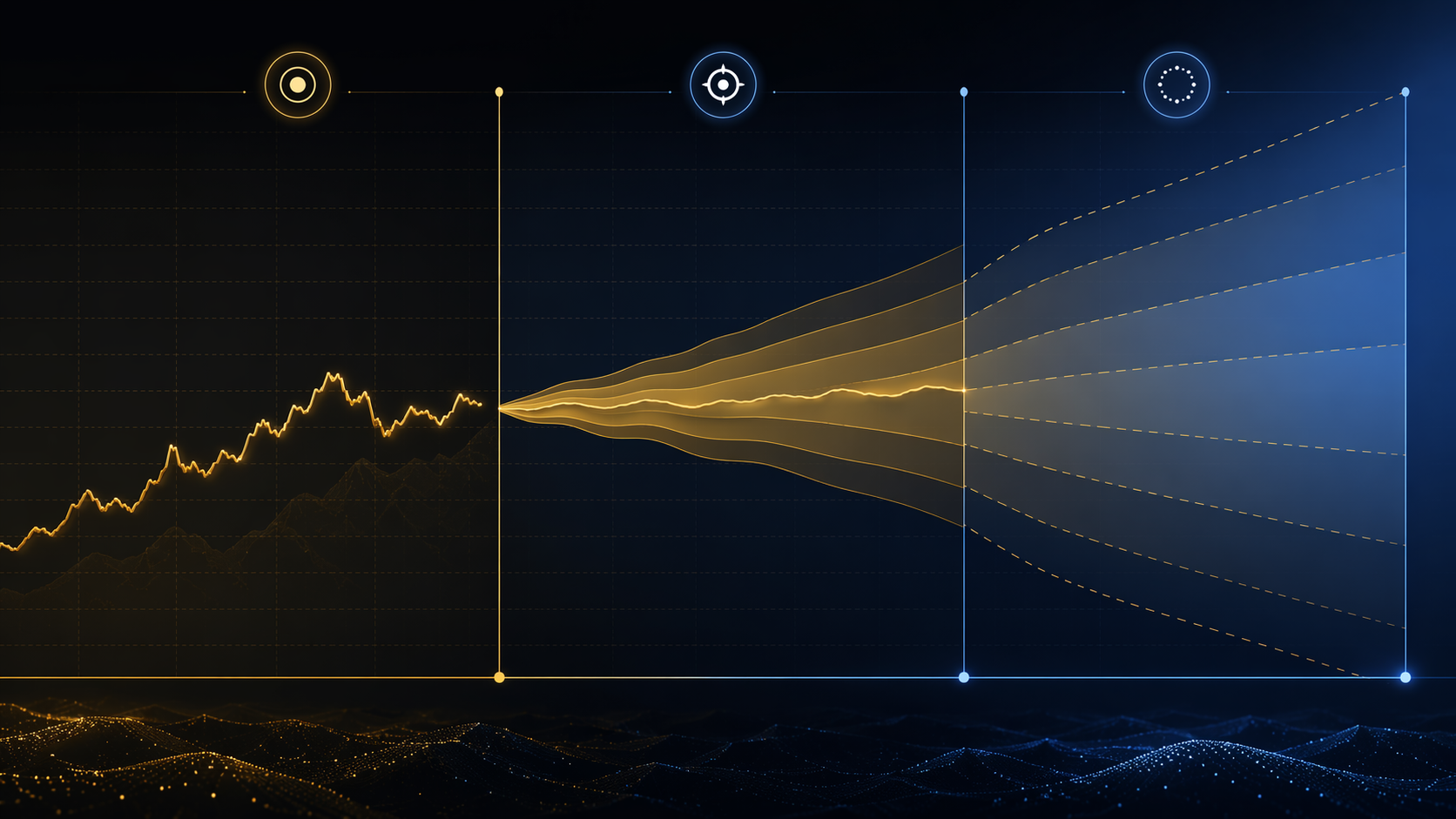
Procurement does not need one forecast. It needs different levels of confidence for different decisions. A 30-day signal can support releasing purchase orders earlier than planned or challenging a supplier’s surcharge timing. A 60-day signal can feed a scenario review with finance and planning. A 90-day signal can frame a hedging conversation or a supplier negotiation, but it should carry wider bands and more explicit caveats.
| Forecast horizon | Procurement use | Decision limit |
|---|---|---|
| 0-30 days | PO timing, expedite or defer decisions, short-term surcharge checks | Useful only if inventory and cash constraints are visible |
| 30-60 days | Scenario review, supplier negotiation preparation, budget exposure updates | Should be compared with contract terms and demand certainty |
| 60-90 days | Hedging discussion, volume-lock evaluation, escalation planning | Needs wider confidence bands and human review |
| Beyond 90 days | Strategic context rather than a buying trigger | Accuracy degradation makes autonomous execution inappropriate |
This is where many AI demonstrations overreach. The model may be technically impressive, but a buyer still needs to know what horizon the output covers, what the error bands look like, and what operational action the forecast is allowed to influence. A 90-day upward signal does not automatically mean “buy now.” It may mean “reopen the pass-through clause,” “prepare a hedge memo,” or “run the inventory carrying-cost tradeoff before approving a forward buy.”
The biggest limitation is what many gold models leave out
The academic gold-forecasting papers reviewed here are univariate: they learn from gold-price history. That makes the benchmark cleaner, but it also excludes drivers that matter in a sourcing meeting, including interest rates, central-bank buying, currency movements, and geopolitical conditions. J.P. Morgan’s own revision from $6,300/oz to $6,000/oz for Q4 2026 is a reminder that macro inputs can change the shape of the forecast even when the model’s historical fit looks strong.[1]
A univariate model can still be useful. Price history contains information, especially over short windows. But it should be treated as a directional timing input, not a complete commodity strategy. If the forecast says prices are likely to rise over the next month while the treasury team is watching a policy-rate shift and the supplier is quoting a new premium structure, the forecast belongs in the room. It does not chair the meeting.
Do not confuse LLM predictions with forecasting models
BullionVault’s 2025-2026 tracking of five AI engines, including ChatGPT-4 Turbo, Gemini, Perplexity, Meta AI, and CoPilot, is useful mainly because it shows what not to overinterpret. ChatGPT-4 Turbo was the closest forecaster in the experiment, but it still underestimated the Q4 2025 rally, with its upper prediction 5% below the actual $4,301/oz average.[6]
That is not evidence against AI forecasting in procurement. It is evidence against asking a general-purpose language model for a price call and treating the answer like a commodities desk output. A supply chain model needs defined inputs, a training method, a forecast horizon, backtesting, error measurement, and governance over how alerts become decisions.
Vendor tools should be judged against the decision they support
Once the model evidence is separated from the chatbot noise, vendor claims become easier to evaluate. The right question is not “Does this platform use AI?” It is “Can this platform produce a gold-relevant timing signal, over the horizon we buy against, with enough transparency to defend the decision after prices move?”
| Platform or evidence source | What the brief supports | Procurement caveat |
|---|---|---|
| Datapred | Metal-specific AI with regime-change detection | Promising fit for commodity procurement, but buyers still need model inputs, horizon, and backtesting details |
| pacemaker.ai | Vendor-reported 97-99% accuracy on commodity categories | Accuracy is a vendor claim cited in a Handelsblatt interview; methodology is not independently verifiable from the brief |
| Smart Cube | Augmented AI models reported up to 92% absolute and 83% directional accuracy | The figures are from crude oil, not gold, so they are a proxy rather than direct gold evidence |
Datapred is the cleanest conceptual fit among the available examples because it is described as metal-specific and includes regime-change detection.[7] That matters in gold because procurement risk often shows up when the market stops behaving like the prior buying cycle. A model that flags a regime shift can be more useful than one that quietly extends a stale trend.
pacemaker.ai’s reported 97-99% accuracy on commodity categories sounds attractive, but the figure is a vendor claim cited in a Handelsblatt interview, and the methodology is not independently verifiable from the available evidence.[8] It may be directionally encouraging. It is not enough, by itself, to justify delegating gold-exposed purchase timing to the system.
Smart Cube’s augmented AI work is also relevant but not directly transferable. The reported performance, up to 92% absolute accuracy and 83% directional accuracy, comes from crude oil rather than gold.[9] Crude-oil forecasting can validate a commodity-analytics capability, but gold has different drivers, market structure, and procurement exposure patterns.
Where the forecast fits in the procurement workflow
A useful AI gold forecast should enter the same workflow where a category manager already weighs supplier terms, demand certainty, inventory risk, and finance policy. It should not sit off to the side as a market dashboard everyone admires and nobody uses.
- Set alert thresholds before the market moves: for example, a forecasted move outside the agreed tolerance band triggers a sourcing-finance review, not an automatic PO.
- Tie each horizon to an allowed action: 30-day alerts may affect release timing, while 90-day alerts may only initiate hedging or contract-structure review.
- Compare model output with supplier exposure language: a forecast is more useful when it is mapped to pass-through clauses, surcharge calendars, and metal-content assumptions.
- Record the decision path: if procurement buys early, delays, hedges, or refuses a surcharge, the model input and human approval should both be visible later.
- Review misses as seriously as wins: a forecast that saves money once but repeatedly creates inventory strain is not procurement intelligence.
This workflow matters because cost exposure is no longer theoretical. Procurement Magazine and Supply Chain Digital have documented supplier pass-through requests and fixed-price agreement erosion following gold’s move above $5,000/oz.[10][11] In that environment, a forecast can support negotiation posture: whether to resist an immediate surcharge, ask for a collar, split volume into tranches, or bring treasury into a hedging discussion.
There is some evidence that synchronized AI and inventory decisions can reduce exposure. Discovery Alert reports 15-25% commodity cost exposure reduction from AI-synchronized dynamic inventory management, although the available material does not provide a named original methodology, so the figure should be treated as directional rather than definitive.[12]
The organization is not ready for autonomous buying
Even if the model is strong, the operating model is not ready to remove human accountability. The RELEX 2026 State of the Supply Chain survey found that 67% of leaders were more confident in AI than a year earlier, but only 10% trusted AI for autonomous critical decisions.[13] That gap is exactly where gold procurement sits.
A category manager can use an AI forecast to defend why a buy was accelerated, why a supplier pass-through was challenged, or why a hedge review was opened. The same category manager should not be told that the model has already committed the company to a volume lock. Gold exposure touches working capital, customer pricing, engineering qualification, inventory shelf life, and sometimes treasury policy. Those consequences need named owners.
The best implementation is therefore deliberately conservative. Let AI produce the timing signal, confidence band, and exception alert. Let sourcing, planning, finance, and treasury decide what the signal means under the current contract, demand plan, and risk policy. That division of labor is not timid; it is how a forecast survives contact with a purchase order.
What a defensible gold-forecasting pilot looks like
A procurement pilot should start with a narrow exposure, not the entire gold category. Pick one or two parts or supplier families where gold content, pricing mechanics, and purchasing cadence are understood. If the team cannot explain how gold moves from market price into the supplier quote, the forecasting layer will look cleaner than the commercial reality underneath it.
- Define the buying decision first: PO timing, supplier surcharge validation, contract negotiation, hedging review, or inventory positioning.
- Set the forecast horizon: 30, 60, or 90 days, with different approval rules for each.
- Require backtesting: compare the model against ARIMA/GARCH or the team’s current baseline on the same historical windows.
- Demand explainable operating inputs: price history may be enough for a short-horizon alert, but macro exclusions must be documented.
- Track decision quality, not only forecast accuracy: savings, avoided surcharge, inventory impact, missed upside, and approval cycle time.
A pilot that only asks whether the model predicted the price correctly will miss the point. The harder question is whether the model improved a decision under time pressure. If the forecast was directionally right but arrived too late for the supplier quote window, it failed operationally. If it was accurate but caused a forward buy that created excess stock, the cost avoidance may be overstated. If it gave an early warning that helped renegotiate pass-through language, it may have succeeded even without a perfect point forecast.
The practical boundary
AI gold price forecasting belongs in the procurement decision-support layer. It can feed scenario reviews, timing discussions, supplier negotiations, inventory tradeoff analysis, and hedging conversations. The strongest evidence supports short-horizon use, especially where LSTM and hybrid deep-learning models beat traditional methods in controlled benchmarks.
The buying authority should remain elsewhere. Category strategy, macro context, supplier terms, demand risk, and company hedging policy still govern the final call. A good model should make that call better prepared, earlier, and easier to defend. It should not make it alone.
References
- J.P. Morgan Global Research gold price projection, J.P. Morgan Global Research, 2026, link
- Gold Demand Trends Q1 2026, World Gold Council, 2026, link
- LSTM gold price forecasting study, Research Square, 2024, link
- CNN-Bi-LSTM gold price forecasting study, PLOS ONE, 2024, link
- Machine-learning methodologies for gold price prediction, Chaos, Solitons & Fractals, 2023, link
- AI gold price prediction experiment, BullionVault, 2025-2026, link
- Datapred metal-specific AI forecasting information, Datapred, link
- pacemaker.ai commodity accuracy claim, Handelsblatt, link
- Smart Cube augmented AI commodity forecasting figures, Smart Cube, link
- Gold price shock procurement impact reporting, Procurement Magazine, 2026, link
- Gold price shock supply chain impact reporting, Supply Chain Digital, 2026, link
- AI-synchronized dynamic inventory management commodity exposure reporting, Discovery Alert, link
- 2026 State of the Supply Chain, RELEX, 2026, link
Comments
Join the discussion with an anonymous comment.