
A limited-time breakfast item gives the forecasting system almost no runway. The first order decision has to be made before the first biscuit, wrap, bowl, or cold brew add-on has a sales record. The selling window may be only 4–6 weeks, while standard machine-learning forecasting for full seasonal recognition may need about 2 years of history.[1][2] That is the cold-start problem in the form restaurant teams actually feel it: the system is being asked to place product into stores before the product has proved anything.
So the practical answer to AI demand forecasting for limited-time breakfast items is conditional. AI can produce a defensible first forecast for a breakfast LTO with zero item history, but not by pretending the new item has a history. It has to borrow from nearby items, learn from the category, and leave room for local correction during the first 1–2 launch cycles.

Why breakfast LTOs break normal forecasting
A standard menu item lets the model learn the rhythm: weekday commute demand, school calendars, weather effects, payday lift, coupon sensitivity, and the difference between a strong opening week and repeat demand. A breakfast LTO does not offer that patience. By the time enough local sales have accumulated to show a clean pattern, the item may already be halfway through its promotional life.
That matters because breakfast is operationally unforgiving. The selling day is compressed. Prep happens early. A missed forecast does not just become a line on a dashboard; it becomes thawed product, shorted stores, a manager asking whether to substitute, and franchisees questioning why they were told to build inventory for a promotion that did not move.
This is also where standard AI forecasting benchmarks need to be handled carefully. Forecasting tools can reduce error on items with history, and that is useful context. Tenzo and Crunchtime report 30–50% forecasting error reduction on standard items with sales history, while Crunchtime also reports that only 28% of operators use AI forecasting tools and that average sales forecast accuracy is 60%.[2][3] Those numbers show why better forecasting matters. They do not prove that a new breakfast LTO can be forecast well unless the system is built for cold starts.
The first forecast has to come from item context
The most important question before launch is not whether the model is “AI.” It is what the model knows about the item before sales begin. A new breakfast sandwich with a spicy chicken filet, premium price point, biscuit carrier, and morning-only availability should not be treated as a blank SKU. It has signals, even if it has no sales.
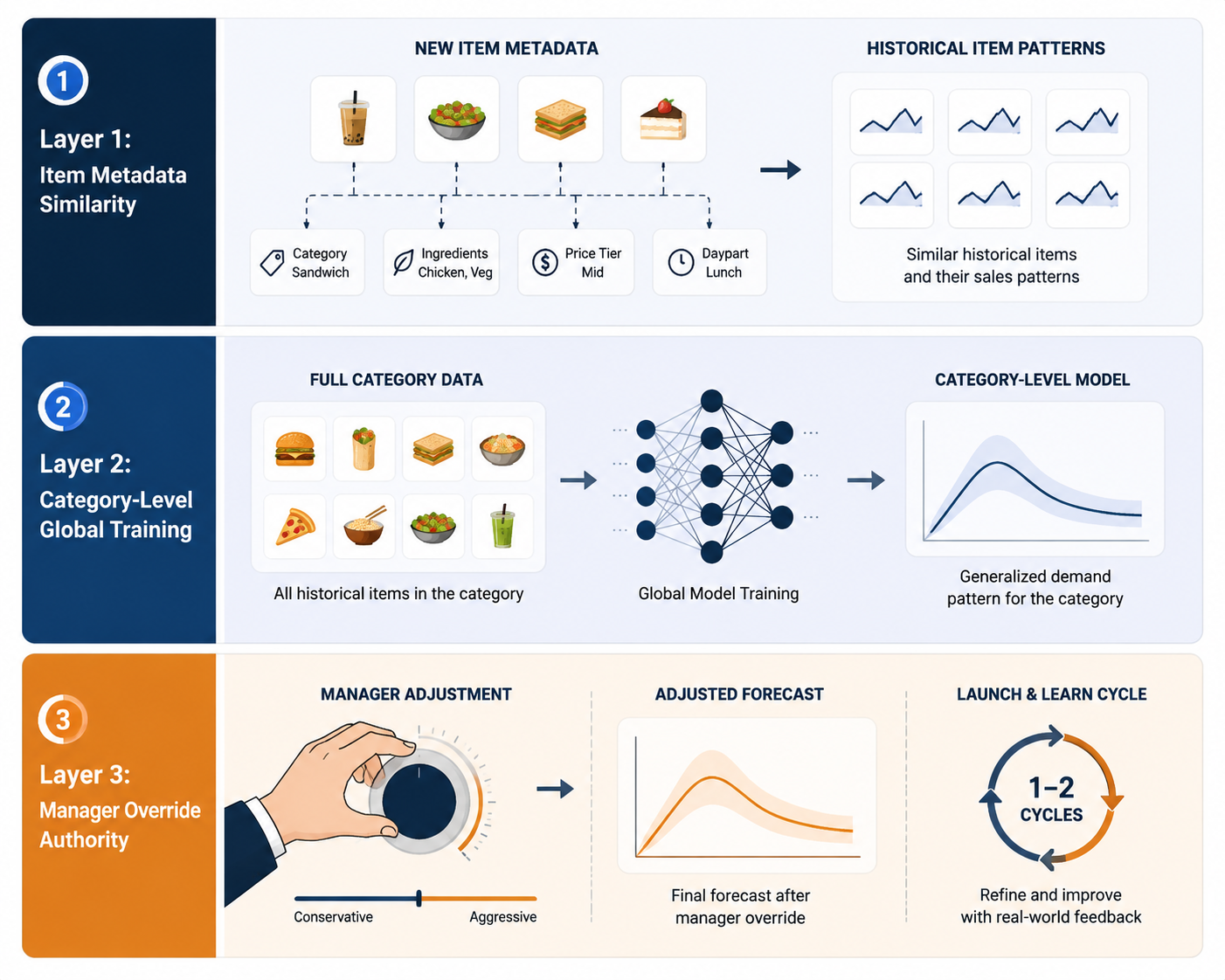
Amazon Forecast’s cold-start approach is the clearest technical example in the available material. The system uses item metadata files alongside target time series so the model can connect a new product to similar historical items. The relevant attributes can include category, ingredients, price tier, and daypart. In Amazon’s 2022 blog post, this metadata-based cold-start method achieved up to 45% better accuracy on new-item forecasts compared with naive baselines.[4]
The phrase “up to” is doing work there. It is not a standing promise that every breakfast LTO will be 45% more accurate. The gain depends on whether the item data is rich, structured, and meaningfully connected to historical products. If the chain only stores the new item as “Breakfast Promo 2026,” there is little for the system to borrow. If it stores category, protein, carrier, sauce profile, price tier, attachment expectations, daypart, and comparable menu families, the model has a better starting point.
| Metadata signal | Why it matters before sales history exists |
|---|---|
| Category | Connects the LTO to sandwiches, bowls, beverages, sides, or another known demand family |
| Ingredients | Helps identify similarity to prior items with the same protein, carrier, sauce, or premium cue |
| Price tier | Separates value traffic from premium trial behavior |
| Daypart | Keeps breakfast behavior from being mixed with lunch or late-night demand |
| Brand or platform | Links the item to prior promotions under the same product platform when applicable |
For a planning team, this shifts some of the forecast work upstream. The menu development record, POS item setup, procurement file, and forecasting item master cannot be treated as separate clerical tasks. If the LTO’s attributes are not captured cleanly before launch, the cold-start model begins with less memory than the organization actually has.
Category memory carries the item until store history arrives
Item similarity gets the model out of the blank-SKU trap, but it is not enough by itself. A chain also needs a model that has learned from the broader product category, not just from one direct predecessor. That is the second layer: category-level global training.
Upshop describes an approach in which models are trained on full product categories so they can generalize to new items within that category.[5] For a breakfast LTO, that means the system is not waiting for one new SKU to produce its own history. It is using what the chain already knows about breakfast sandwiches, premium beverages, sweet baked goods, or whatever category the item belongs to.
This is where comparables need discipline. A maple chicken biscuit may be able to borrow from prior chicken breakfast items, biscuit platforms, sweet-savory promotions, and premium breakfast bundles. A completely new format with no nearby food, price, or daypart analog has much less to stand on. The model can still output a number, but the confidence behind that number should be lower, and the operating plan should acknowledge that uncertainty.
ToolsGroup’s new product forecasting case study supports the broader point that cold-start forecasting can improve when machine-learning methods are designed for new-item introduction. The company reports a 13 percentage-point accuracy improvement in its case study.[6] That is useful evidence for the category of problem, but it should not be stretched into a guarantee for every breakfast LTO. Restaurant breakfast demand has its own operational constraints, and a model trained without relevant item and category structure can still miss badly.
The first 1–2 launch cycles still need manager authority
The third layer is the least glamorous and often the most important on Monday morning: human override authority. Softarex’s reference architecture explicitly recommends wider override authority for managers while local history accumulates.[7] For a short-window breakfast item, that is not a concession that the AI failed. It is a necessary control while the model’s forecast is being tested against local reality.
The override should be structured, not informal. A store manager should not have to fight the system through notes, calls, or end-of-day apologies. The forecast workflow should show the suggested quantity, the reason the model is leaning that way, the comparable items being used if available, and the allowed adjustment range for the first launch cycle. District or planning teams can then review exceptions instead of manually rebuilding every store forecast.
This matters most where the store knows something the central model may not yet know: a road closure near the morning drive-thru, a local employer shift change, a school calendar effect, a competitor opening, or a store-level pattern in breakfast attachment. Those inputs are messy, but they can be real. During the first 1–2 cycles, the local manager is often the only part of the system that has seen the promotion collide with the actual trade area.
After early sales arrive, override rights can narrow. The point is not to let every store permanently freelance the forecast. The point is to give the launch enough supervision while the model converts early demand into local history.
What the operating model looks like before launch
A workable breakfast LTO forecast starts before the item is live. The planning calendar should treat metadata, category mapping, and override rules as launch requirements, not post-launch cleanup.
- Assign the item to the correct category and daypart before the first forecast run.
- Populate item attributes such as ingredients, carrier, price tier, platform, and promotional role.
- Identify comparable products and decide which ones should be excluded because they are misleading.
- Set first-cycle override ranges for stores, districts, or franchise groups.
- Review early sell-through, waste, stockouts, and overrides after the first launch cycle.
That sequence is not complicated, but it is easy to skip under promotion pressure. The item gets built in the POS, the buy is placed, marketing goes live, and the forecast becomes whatever the tool can infer from thin setup data. At that point, even a sophisticated model is working from a weak launch file.
A better workflow makes the first forecast explainable enough for planners and operators to challenge it. If the system is projecting unusually high demand, the team should be able to see whether that comes from a prior premium sandwich, a category trend, a price promotion, or broad breakfast traffic. If the reason cannot be inspected at all, the planner is left with a number that may be technically generated but operationally hard to trust.
The stakes are physical inventory, not just forecast accuracy
Forecast error on an LTO becomes product in a freezer, product on a truck, product thawed too early, or product missing during the breakfast rush. That is why cold-start design deserves more attention than generic AI language.
SynergySuite reports 30–40% waste reduction with AI forecasting across multi-unit portfolios.[8] Using Softarex’s cited waste range of $3,000–$4,000 per month per location, a 20-unit brand would be looking at $720,000–$960,000 in annual waste exposure before any reduction is applied.[7] That does not mean every chain will save that amount from breakfast LTO forecasting alone. It does show why a better launch forecast can matter enough to justify process work upstream.
The downside case is just as concrete. Crunchtime cites media reports that McDonald’s Mighty Wings LTO left approximately 10 million tons of unsold inventory.[3] The lesson is not that every LTO miss will be that visible. It is that a demand miss becomes a supply chain problem very quickly when the product was bought, distributed, and staged for a short promotional window.
Where AI is reliable, and where it is still guessing
AI demand forecasting is strongest for a limited-time breakfast item when the new product has recognizable relatives. A new sandwich on an existing carrier, a beverage extension in a known platform, or a seasonal version of a familiar breakfast side gives the system something useful to compare. Rich metadata and category-level training can turn those similarities into a reasonable opening forecast.
It is weaker when the product is genuinely novel. If the item has no close category analog, no clear ingredient parallel, an unfamiliar price point, or a new daypart behavior, the model may still generate a forecast, but the forecast is less grounded. In that case, the safer operating choice is not to reject AI; it is to treat the first forecast as provisional, tighten monitoring, and make override and replenishment rules explicit.
The conditional answer is the one worth planning around: AI can forecast demand for limited-time breakfast items with zero sales history when cold-start handling is built into the system. The necessary pieces are item metadata similarity matching, category-level global training, and manager override authority during the first 1–2 launch cycles while local history accumulates.
References
- Limited-time offer selling windows, Lamb Weston
- Restaurant forecasting benchmarks, Tenzo
- Restaurant Sales Forecasting and How AI Forecasting is Shaping the Future, Crunchtime
- Generate cold start forecasts for products with no historical data using Amazon Forecast, now up to 45% more accurate, AWS Machine Learning Blog, 2022
- Category-level forecasting approach, Upshop
- Get Started Using Machine Learning for New Product Forecasting, ToolsGroup blog
- AI demand forecasting reference architecture and waste range, Softarex
- AI forecasting waste reduction across multi-unit portfolios, SynergySuite
Comments
Join the discussion with an anonymous comment.