
Supply chain teams do not have a warning shortage. They have the opposite problem: government travel advisories, embassy notices, security alerts, local media reports, social posts, port bulletins, labor updates, and policy rumors arrive faster than most teams can decide whether any of it touches a purchase order.
That is the real question behind ai for supply chain risk management travel advisories. The useful system is not the one that says a country is unstable. It is the one that can read a warning about unrest near a port city, extract the affected place and event, connect it to a supplier site or shipping lane, and tell a logistics manager which shipments, customers, and inventory buffers may be exposed.
The scale explains why this cannot be handled as a manual monitoring task. Everstream Analytics says its global monitoring platform processes 1,000 to 1,500 potential disruptions daily through an AI-powered context engine.[1] Dataminr says its travel risk management product ingests more than 1 million public data sources in more than 150 languages, using natural language processing and entity extraction to surface relevant events.[2] Those numbers are not proof that either platform will make the right call for a particular company. They do show the size of the filtering problem before anyone has even asked whether the alert matters to a supplier, vessel, warehouse, or customer commitment.
The Conversion Problem
A travel advisory usually enters the organization as a safety signal. It may warn employees to avoid a district, reconsider travel, monitor demonstrations, or prepare for transport disruption. For supply chain risk management, that same signal is only the first line of a longer conversion process.
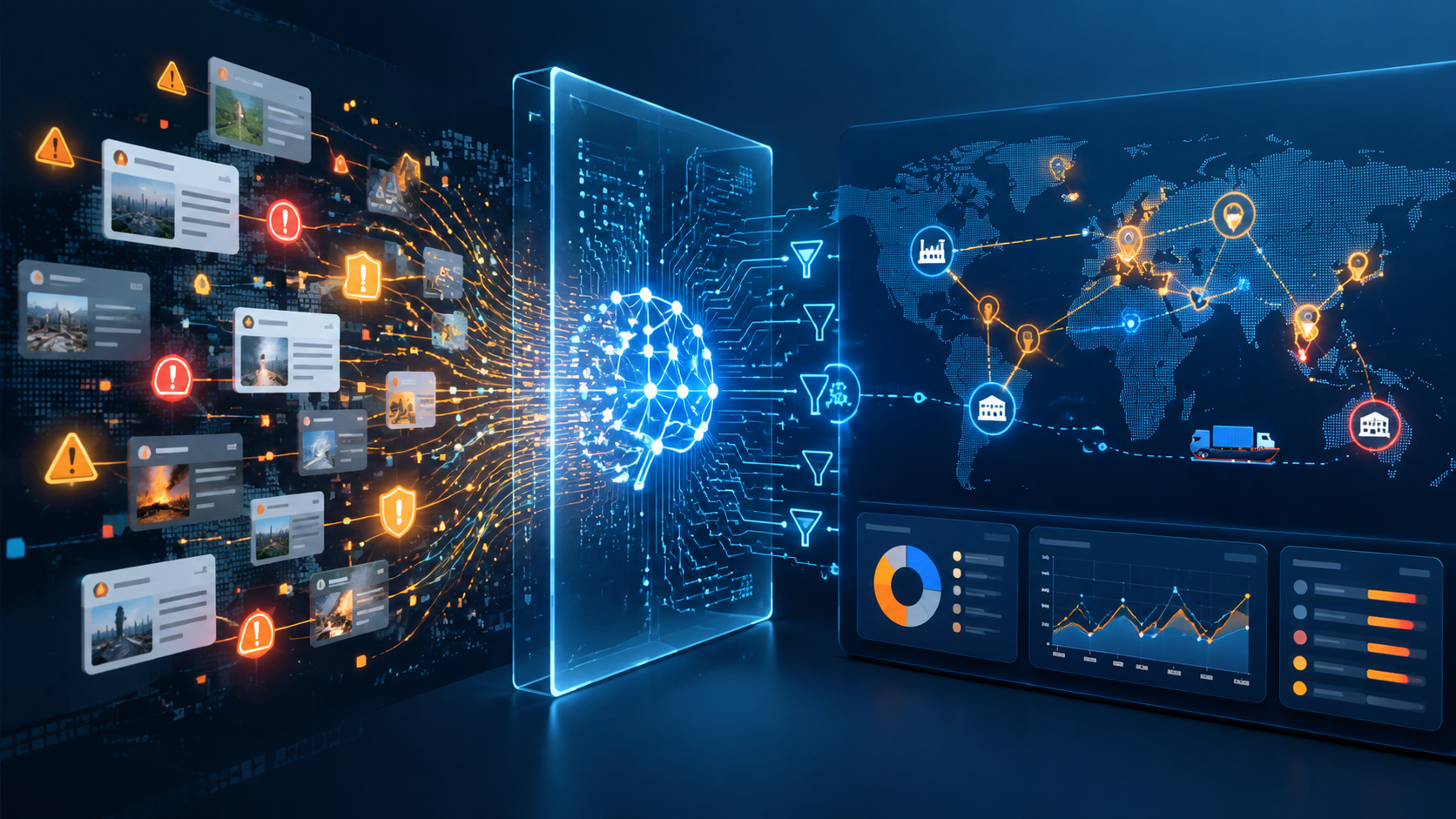
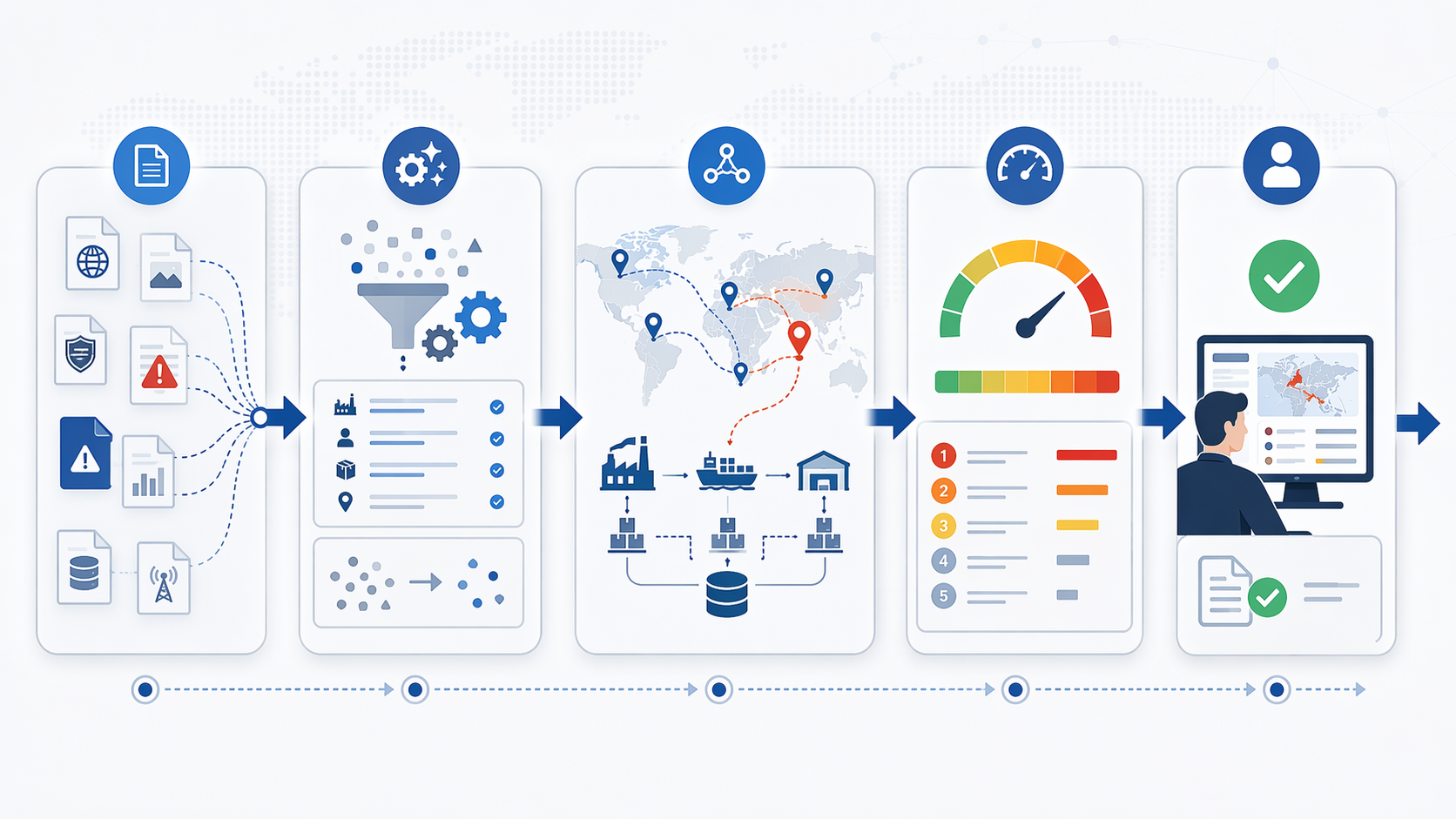
The first useful move is ingestion. AI systems pull in government advisories, security alerts, local public data, weather feeds, port notices, public social data, and geopolitical reporting. The second move is filtering: duplicate reports are collapsed, irrelevant chatter is suppressed, and the system tries to distinguish a broad warning from a concrete event. The third move is entity extraction. A warning becomes more useful when the system identifies named places, facilities, transport links, organizations, dates, commodities, and event types.
That still does not make it supply chain intelligence. A clean event record saying “labor action near a port” is better than a vague country alert, but it remains external information. It becomes operational only after correlation: which supplier sites sit nearby, which shipments are booked through that gateway, which inventory positions depend on the lane, which purchase orders are late enough to lose flexibility, and which customers are waiting.
| Signal Stage | What AI Can Do | What Operations Still Needs |
|---|---|---|
| Travel advisory or security alert | Ingest and classify the event type, place, timing, and source | A mapped exposure to suppliers, routes, inventory, or customers |
| Event filtering | Remove duplicates, suppress weak matches, detect emerging clusters | Thresholds that reflect the company’s lanes and tolerance for disruption |
| Entity extraction | Identify ports, cities, facilities, organizations, routes, and named actors | Clean master data so the entity actually maps to a known supplier or shipment |
| Correlation | Connect external events to supplier footprints and logistics data | Current shipment, procurement, and inventory records |
| Prioritization | Rank likely operational impact | A human review path before escalation or rerouting |
The awkward middle step is where many risk programs either become useful or quietly fail. A dashboard can display a red region on a map and still leave the logistics team asking what to do before the afternoon carrier call. The conversion test is stricter: did the system reduce noise, locate company exposure, support a decision, and preserve enough evidence for a human to challenge it?
Why Country-Level Warnings Are Too Blunt
Country-level warnings have their place. They help travel teams set duty-of-care rules and can give executives a quick sense of baseline volatility. They are poor instruments for deciding whether to expedite one component, shift volume from one supplier to another, or reroute cargo around a port.
Supply chain exposure is uneven inside the same country. A supplier may be far from the unrest named in an advisory. A port may be open while inland transport is constrained. A strike notice may matter only if it touches a specific terminal, border crossing, trucking corridor, or customs process. A policy change may hit one commodity class but leave other flows untouched.
This is where AI earns its keep, if it earns it at all. The relevant task is not to summarize the warning in smoother language. It is to break the warning into operationally searchable pieces: location, event type, severity, affected infrastructure, timing, source confidence, and possible supply chain mechanisms. A civil unrest alert may matter because workers cannot reach a plant, because cargo cannot move through a city, because authorities close a crossing, or because insurance and carrier appetite change. Those are different problems, and they create different decisions.
The Data Graph Under the Alert
Travel-risk intelligence only becomes supply chain intelligence after it is joined to the company’s own operating data. That integration layer is less glamorous than the AI model, and more decisive.
At minimum, the system needs supplier locations that are specific enough to map against local events. A headquarters address is not enough if production happens at a subcontracted plant outside the city. It needs lane and node data: ports, airports, border crossings, consolidation centers, warehouses, and common carrier paths. It needs purchase order and shipment status so the team can tell whether exposure is theoretical or already sitting on the water. It needs inventory data, because a two-week route disruption is a different event for a part with thirty days of buffer than for a part feeding a line with no substitute.
This is also where many vendor demos look cleaner than the working environment. Supplier names are inconsistent across procurement systems. Facility addresses are missing or stale. Logistics data sits with forwarders, carriers, control towers, and regional teams. Inventory positions change faster than risk scores. If the data graph underneath the AI layer is thin, the platform may still produce polished alerts, but the operations team has to rebuild the exposure logic by hand.
The stronger pattern across supply chain risk platforms is therefore not “AI watches the world.” It is “AI watches the world against a mapped network.” Everstream emphasizes global event monitoring and human validation. Dataminr emphasizes broad public-source ingestion and entity extraction for travel risk. Seerist, International SOS Quantum, GEP, Altana, and other platforms approach the problem from different product angles, but the same dividing line remains: external risk signals have to meet operational data before they can change a supply chain decision.
What Prioritization Should Actually Rank
A useful risk score is not a mood ring for geopolitics. It should rank work.
For a supply chain analyst, the immediate queue is practical: which alert needs review now, which one can wait, which one should be routed to logistics, which one belongs with procurement, and which one is noise. A civil unrest advisory near a non-critical sales office may be important for employee safety but irrelevant to inbound materials. A lower-severity transport notice near a sole-source component supplier may deserve immediate escalation.
Good prioritization weighs at least four things: proximity to exposed assets, dependency of the product or lane, available recovery options, and time to impact. A supplier with alternate qualified capacity creates a different response than a sole-source supplier. A vessel already waiting outside a constrained port creates a different response than a purchase order that has not yet been released. A warning with weak sourcing may justify monitoring; a confirmed closure affecting a planned route may justify action.
This is why explainability matters. If a platform escalates an alert, the analyst needs to know whether the score came from source credibility, event severity, asset proximity, shipment value, inventory scarcity, or a combination. Without that trail, the risk score becomes another executive-facing number that does not survive contact with the planner who must decide whether to pay for expedited freight.
Evidence Is Useful, But It Needs Labels
There is evidence that AI-enabled risk monitoring can improve supply chain response, but the labels matter. Everstream has published client outcome claims including a 5% reduction in expedited freight, a 10% on-time improvement, a 30% reduction in revenue losses from disruptions, and 50% to 70% faster impact assessment.[3] Those are vendor-claimed results, not independent benchmark guarantees. They are still directionally relevant because they point to where value should appear: fewer emergency moves, faster impact analysis, better service performance, and less disruption-driven revenue loss.
Preparedness data tells a similar but narrower story. A 2025 Ivalua-sponsored study reported that 98% of fully AI-deployed firms felt prepared for geopolitical disruption, compared with 11% of firms only considering AI.[4] The sample was 100 U.S. procurement leaders, and the finding measures self-reported preparedness rather than actual disruption performance.[4] It is useful adoption context, not proof that AI deployment caused resilience.
The Defense Logistics Agency case shows another kind of scale, in a very different context. DLA reported that its Business Decision Analytics models analyzed 43,000 vendors and flagged more than 19,000 as high risk using government and compliance-related signals.[5] That example belongs in defense procurement, where risk criteria, supplier obligations, and data access differ from commercial manufacturing or retail supply chains. It should not be casually generalized. It does, however, show what risk mapping looks like when the unit of analysis is not a country alert but a vendor population tied to procurement exposure.
Human Validation Is Not a Decorative Final Step
The fastest alert in the room can still be wrong, incomplete, or operationally useless. That was true before generative AI, and it is sharper in 2026. ITIJ’s July 2026 expert coverage of the travel-risk intelligence cycle identifies AI-generated misinformation and synthetic media as emerging validation challenges for travel-risk teams.[6]
For supply chains, the validation burden has two sides. First, someone has to validate the event: whether the source is credible, whether the location is correct, whether an image or post is authentic, whether a reported closure is still active, and whether local authorities, operators, or carriers confirm the situation. Second, someone has to validate the recommended action: whether an alternate route is actually available, whether a supplier can increase volume, whether inventory can cover demand, whether customer commitments need to be reset, and whether the cost of action is justified.
Regional expertise matters here because local context changes the meaning of the same alert. A planned demonstration, a recurring port slowdown, a temporary curfew, a border policy change, and a rumor of escalation do not all deserve the same response. AI can compress the discovery time. It cannot replace the judgment needed to decide whether a signal is credible, whether it touches the company’s network, and whether the proposed mitigation can actually be executed.
A Practical Workflow for Travel-Advisory Risk Signals
The cleanest workflow is not complicated, but it is unforgiving. Each step either reduces distance between warning and decision, or it adds theater.
- Ingest external signals from travel advisories, security alerts, public data, geopolitical reporting, port notices, labor updates, and relevant local sources.
- Extract entities and event attributes, including location, timing, severity, affected infrastructure, named organizations, and source confidence.
- Correlate the event with supplier sites, logistics lanes, shipments, purchase orders, inventory positions, and customer obligations.
- Prioritize by operational exposure, not just geopolitical severity.
- Route the alert to the owner who can act: logistics, procurement, planning, security, legal, or customer operations.
- Require human validation before costly escalation, rerouting, supplier switching, or customer notification.
The handoff is where response time is won or lost. If an alert about unrest near a port reaches only a corporate security inbox, logistics may not see it until carriers have already shifted capacity. If it reaches logistics without supplier and purchase order context, the team may know a port is exposed but not whether the exposed cargo is critical. If it reaches procurement without inventory context, buyers may overreact to a supplier alert that current stock can absorb.
The better alert says something closer to this: a verified security disruption has emerged near a logistics node used by specific lanes; these shipments and purchase orders are exposed; these materials have limited buffer; these customers may be affected if transit slips; these alternate routes or suppliers exist; confidence is high on the event but medium on duration. That is the point at which a travel-risk signal becomes a supply chain work item.
Where the Tools Fit
Different platforms enter this workflow from different directions. Dataminr is often discussed through the lens of real-time public data discovery and entity extraction. Everstream is more explicitly positioned around supply chain risk monitoring, disruption detection, and validation. Seerist and International SOS Quantum are closer to travel and security risk workflows, with asset monitoring and regional intelligence playing a larger role. GEP brings the discussion into procurement risk intelligence. Altana is associated with broader supply chain network visibility.
The evaluation question should not be “which product has AI?” That bar is too low. The sharper questions are whether the tool can ingest the right signals, recognize entities at the right granularity, map those entities to the company’s supply chain, rank alerts by operational exposure, explain why something was escalated, and fit into the workflow where someone can act.
A procurement director evaluating these systems should ask for demonstrations using the company’s own messy data, not a generic map. A logistics leader should test whether the platform can distinguish a warning near a route from a warning that actually affects the route. A risk manager should inspect the human review process: who validates sources, who updates event status, who closes the loop after the disruption, and how false positives are learned from rather than buried.
The Operating Model That Holds Up
The durable model has three parts: AI detection, interoperable operational data, and human regional expertise. Remove any one of them and the early-warning layer weakens.
AI detection handles volume and speed. It reads across more sources than a human team can monitor continuously, spots emerging clusters, extracts entities, and pushes possible disruptions into a queue. Interoperable data gives the alert somewhere to land. Supplier master data, logistics records, shipment status, inventory, procurement commitments, and customer obligations convert the external event into exposure. Human expertise decides whether the signal is credible and whether the recommended action is feasible.
This model is less tidy than a single geopolitical risk score, but it is more honest about how supply chain decisions get made. Leaders may want a clean index. The analyst still needs to know which supplier is exposed, which shipment is vulnerable, which inventory buffer buys time, and which mitigation will create a new problem somewhere else.
AI can turn travel advisories into an early-warning layer for supply chain risk management. It does that when warnings are filtered, mapped, prioritized, and validated against real operating exposure. It does not do that by acting as an automated geopolitical oracle. The value appears in the narrower, harder work: fewer irrelevant alerts, faster impact assessment, clearer ownership, and better decisions before the warning becomes a shipment problem.
References
- Global Monitoring, Everstream Analytics.
- Travel Risk Management, Dataminr.
- Artificial Intelligence’s Role in Supply Chain Risk Management, Everstream Analytics.
- AI Supply Chain Risk Survey, SupplyChain247.
- Utilization of Artificial Intelligence (AI) to Illuminate Supply Chain Risk, Defense Logistics Agency.
- AI and the New Travel Risk Intelligence Cycle, ITIJ, July 2026.
Comments
Join the discussion with an anonymous comment.