
Food recalls usually look sudden from the outside. Inside a plant or distribution network, they are more often the last visible result of smaller misses: an allergen statement that did not carry across every label version, a supplier certificate filed against the wrong lot, a receiving temperature that was seen too late, a vision defect that an operator had to judge at line speed.
That is why the useful question is not whether AI can make the food supply chain look more modern. The useful question is where AI can interrupt the path from a small operational error to a formal recall. In 2025, FDA food and beverage recall analysis counted 320 total recalls, with allergen-related issues making up 45.8% of FDA recall events in the dataset, or 115 of 251 FDA events analyzed by cause.[1] That is not a futuristic problem. It is labels, formulation control, document control, and verification.
The financial stakes are familiar to anyone who has sat through a recall simulation and watched the clock run. Industry recall-cost estimates commonly cite an average direct cost around $10 million, with a meaningful share of recalls exceeding $30 million.[2] Those figures do not include every lost customer conversation, delisting risk, or months of additional scrutiny from a major buyer. They do explain why "faster after the recall" is not enough.
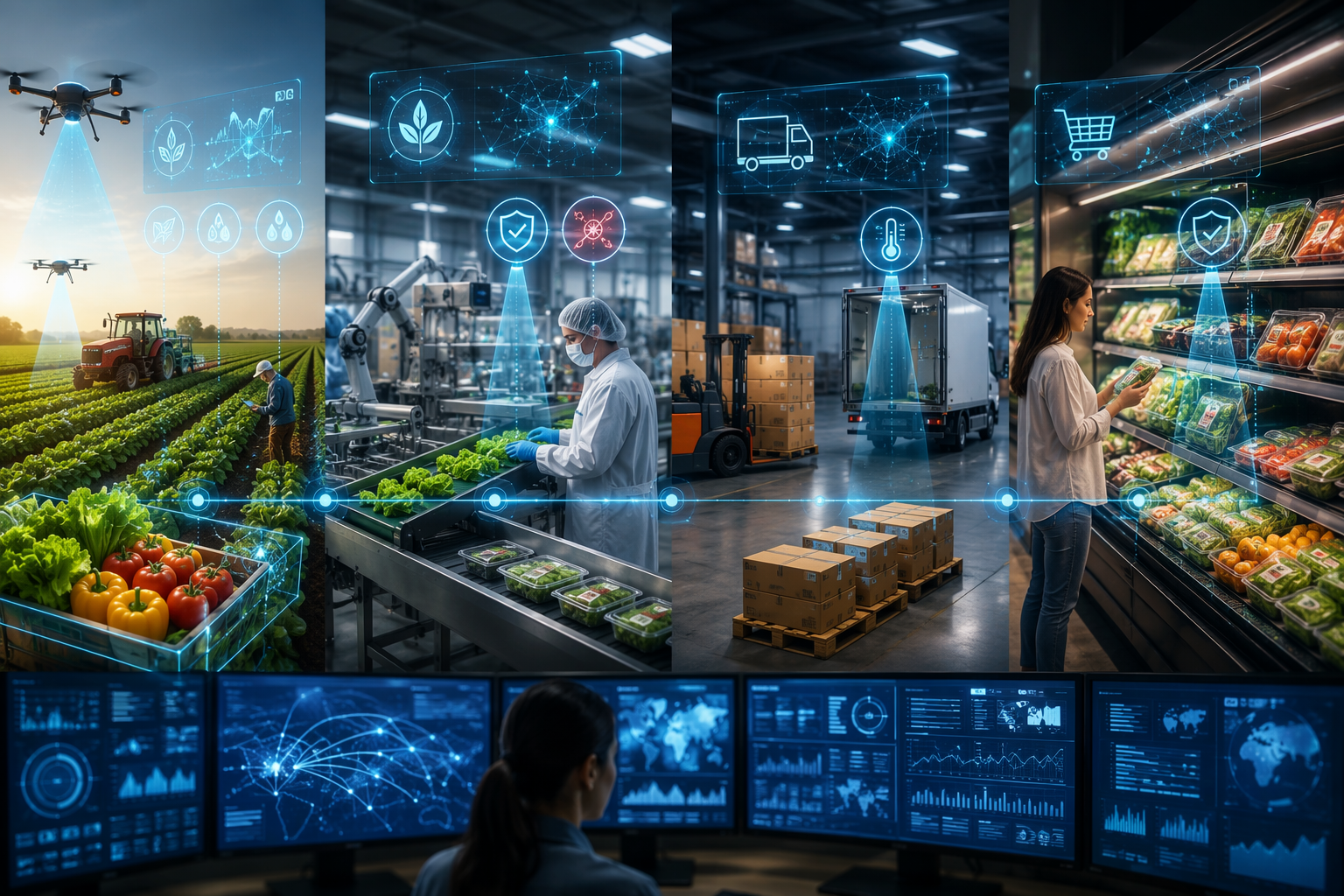
The recall prevention question AI has to answer
A food safety system does not get safer just because more data is collected. The gap is almost always between signal and action. A sensor logs a temperature excursion, but who sees it? A camera flags a defect, but does it trigger a hold or just an alert? A traceability platform stores lot data, but can QA prove which finished goods did not receive the implicated ingredient?
The Institute of Food Technologists describes AI's food safety role through five practical functions: sense, detect, predict, decide, and prove.[2] That framework is useful because it follows the work instead of the software category. It also keeps the evaluation grounded. If an AI tool cannot say which failure mode it reduces, which person acts on the output, and which record proves the action happened, it is not recall prevention yet.
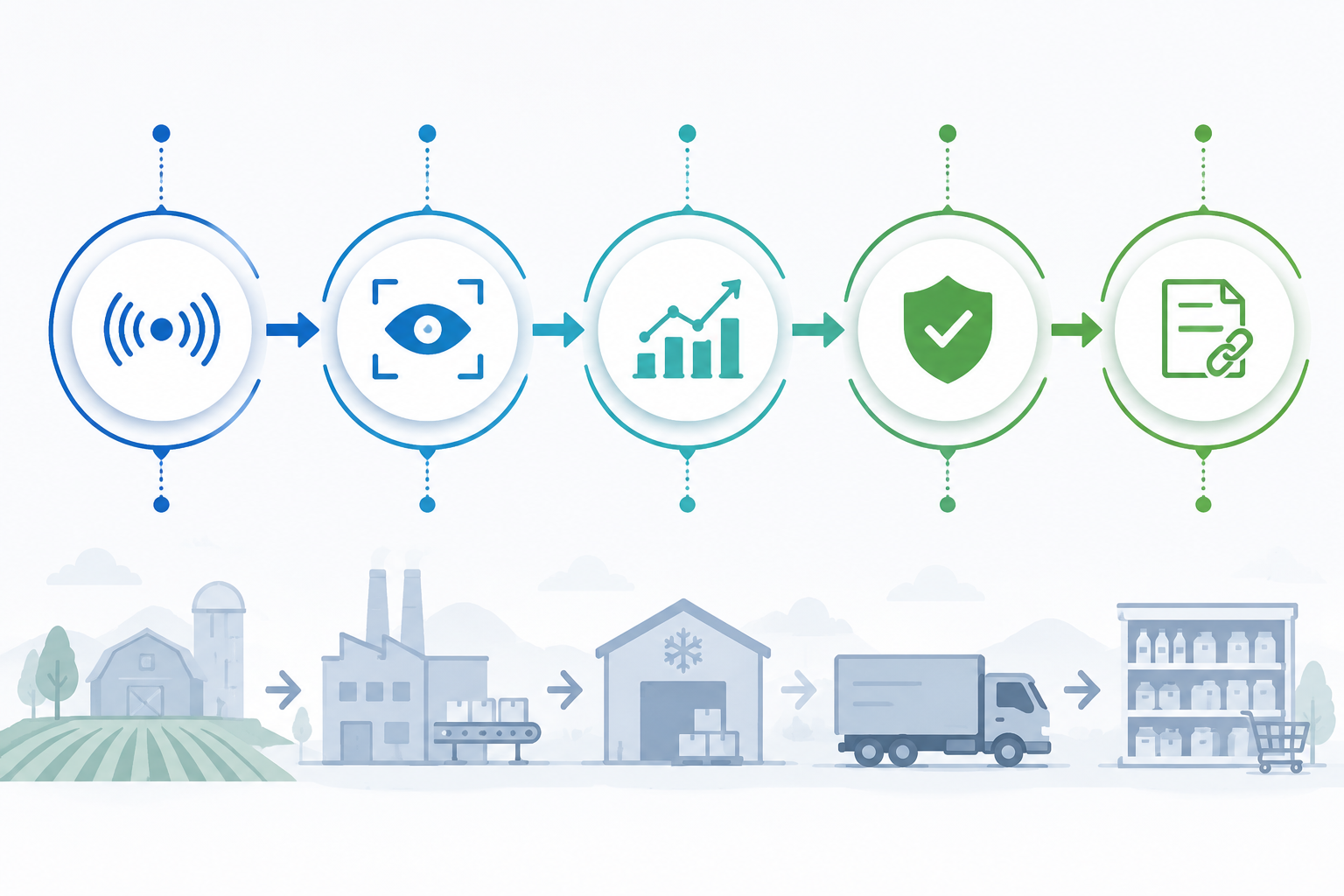
| AI function | What it does in recall prevention | Typical evidence it should leave behind |
|---|---|---|
| Sense | Reads conditions such as temperature, humidity, time, location, equipment state, or storage exposure before they become invisible history. | Timestamped sensor logs, exception records, chain-of-custody data. |
| Detect | Finds visible defects, foreign materials, label mismatches, hygiene deviations, or microbial signals that humans or conventional equipment may miss. | Image records, detection confidence, rejected-unit records, hold-and-release decisions. |
| Predict | Estimates risk before failure is confirmed, such as likely spoilage, shelf-life loss, contamination probability, or high-risk supplier patterns. | Risk scores, model inputs, threshold rules, escalation history. |
| Decide | Routes the next action: hold, release, rework, test, segregate, notify, or investigate. | Corrective-action records, approvals, deviation links, responsible owner. |
| Prove | Shows what happened, what did not happen, and which lots, SKUs, customers, or locations are in scope. | Lot genealogy, audit trail, mock recall results, supplier and customer trace records. |
Where AI fits across the supply chain
Recall risk changes shape as food moves from production to processing, storage, transport, packaging, and retail. AI is not one control point laid over the whole chain. It is a set of controls that should be placed where the specific failure mode appears.
Primary production: earlier signals, still incomplete control
At the farm and ingredient-origin stage, AI is most useful when it connects environmental signals, supplier performance, and incoming quality history. It can help rank lots for additional testing, flag abnormal conditions, and identify suppliers or fields that deserve closer review. This is prevention work, but it is rarely definitive by itself. A risk score at origin is not the same as a verified contamination finding.
The value here is triage. QA teams do not have infinite testing capacity, and receiving teams cannot treat every inbound load as equally risky. Predictive models can help decide where to spend verification effort, provided the model is trained on relevant, current data and the business has already decided what happens when a high-risk signal appears.
Processing and manufacturing: detection becomes the workhorse
Manufacturing is where AI's recall-prevention case is easiest to see because the defects are close to the decision. A camera can inspect a seal, a fill level, a date code, a label, a surface defect, or a foreign material candidate at production speed. If the system is connected to rejection, hold, or line-stop workflows, the signal can remove product from the stream before it enters finished-goods inventory.
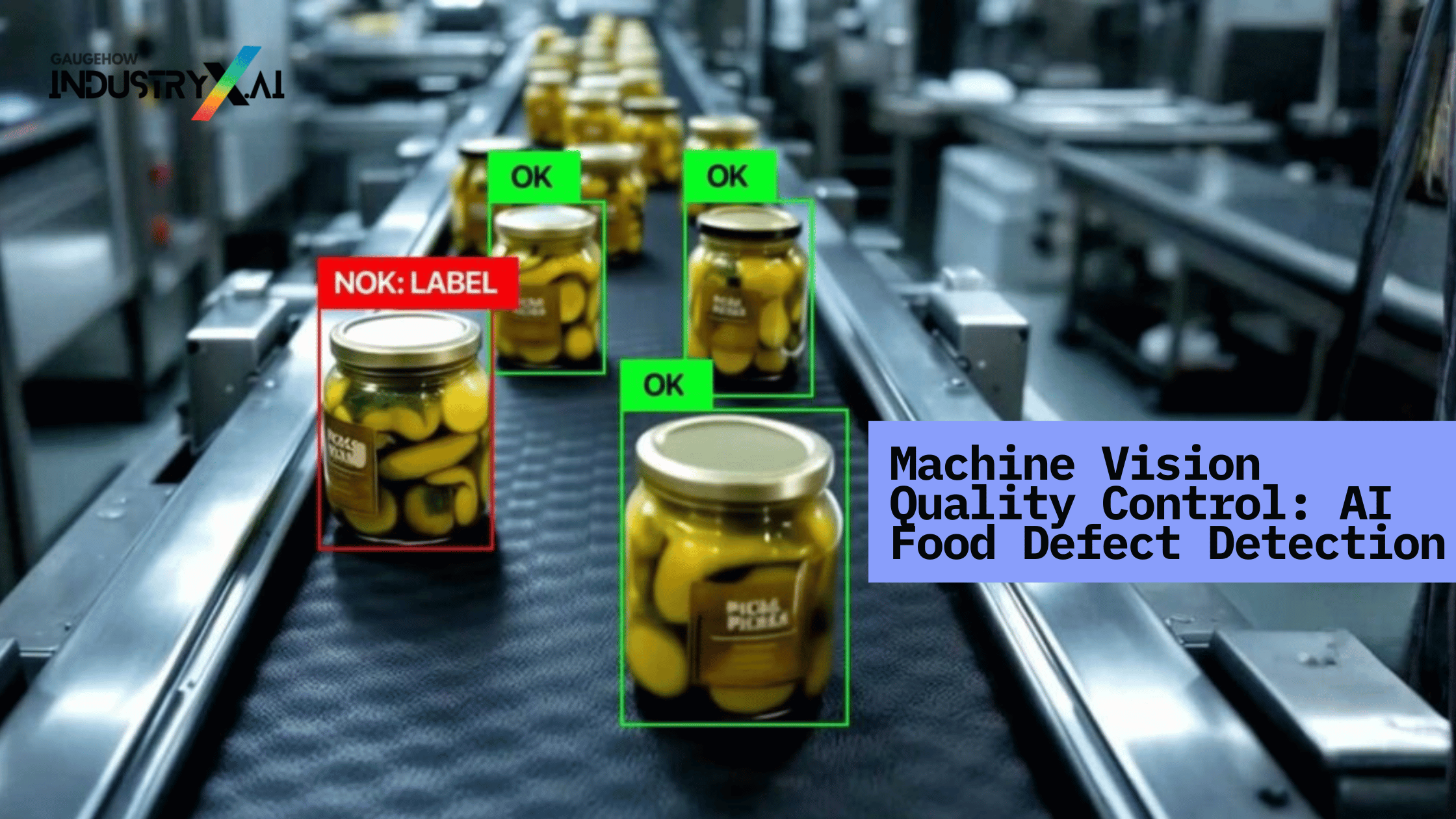
Computer vision matters because conventional inspection has blind spots. AI-based vision systems have been reported to identify soft, low-density foreign materials such as paper, foil, rubber, wood, and colored plastics that X-ray systems and metal detectors may miss.[3] That does not make X-ray or metal detection obsolete. It means vision can close a different inspection gap, especially where color, shape, surface texture, or product context carries the signal.
Vendor and industry reporting also show why manufacturers are interested. PepsiCo has been reported to achieve up to 95% defect detection accuracy using AI visual inspection, while Nestle reported reducing manual checks by 80% in a chocolate facility using AI-powered vision.[4][5] Those figures should be read as deployment-specific, not universal benchmarks. Product type, lighting, line speed, defect definition, sanitation design, and retraining discipline all decide whether a system performs that well on another line.
The boring implementation details are the recall-prevention details. A label inspection model that catches an incorrect allergen panel only helps if the wrong label roll is blocked, affected units are segregated, and the electronic batch record shows when the problem began and ended. A foreign material model only helps if rejected images are reviewable and if repeated detections trigger a root-cause check instead of becoming background noise.
Storage and cold chain: sensing is useful only when excursions get handled
Cold-chain AI usually starts with sensing: temperature, dwell time, humidity, door openings, route delays, and equipment behavior. The recall-prevention value comes when those readings are tied to disposition. A pallet that experienced an excursion needs a decision trail: accepted, tested, downgraded, rejected, or placed on hold. Without that loop, continuous monitoring becomes continuous evidence of indecision.
For a deeper treatment of temperature prediction, shelf-life estimation, and spoilage prevention, see AI-driven food safety optimization for the cold chain. In a recall-prevention program, the key is narrower: make sure excursion data attaches to the exact lot, shipment, location, and release decision that QA may later need to defend.
Transportation: chain of custody has to survive handoffs
Transportation adds the handoff problem. A processor may have good internal records, and a retailer may have good receiving records, while the middle of the route still contains gaps: trailer condition, seal status, mixed-load exposure, dwell time, rejected delivery exceptions, or late-arriving documents.
AI can help by flagging abnormal route and condition patterns, matching documents to the right shipment, and escalating missing custody records before receiving closes the transaction. The practical test is whether a disputed shipment can be reconstructed without searching email threads, PDFs, warehouse notes, and EDI exceptions by hand.
Packaging and retail: the last chance to catch preventable errors
Packaging and retail-facing controls deserve more respect than they often get. The 2025 recall data makes the point: allergen and labeling issues are not rare edge cases.[1] AI-assisted label verification can compare artwork, declared allergens, ingredient statements, date codes, language variants, and SKU-specific packaging rules. That is not glamorous work, but it is exactly where a preventable recall often starts.
Retail and distribution data can also improve containment. If a finished product is later implicated, product-location records, customer shipment history, and point-of-sale or inventory data can narrow the action from broad public withdrawal to specific lots, stores, customers, or date windows. The difference is not just speed. It is fewer uninvolved products pulled, fewer customers alarmed, and better proof for regulators and buyers.
Detection evidence is getting stronger, but not all evidence means the same thing
AI food safety claims need sorting. Some evidence comes from peer-reviewed research, some from operational case reports, and some from vendors describing customer outcomes. All three can be useful. They should not be treated as equally proven.
Microbial detection is a good example. Oregon State University researchers reported a deep-learning method that detected bacterial microcolonies in three hours, compared with days for conventional culture methods, and eliminated food-debris misclassifications that occurred more than 24% of the time in the studied context.[6] That is a serious advance because microbial testing delay is one reason suspect product can sit in limbo or, in worse systems, move before enough information is available.
But the boundary matters. The reported work tested three bacterial strains and three food matrices.[6] That supports a promising research-stage conclusion, not a claim that every food plant can now replace existing pathogen programs with a three-hour AI test. The right operational reading is that faster microbial signal detection is moving closer to practical use, especially where false positives from food debris have made automation difficult.
Vision inspection is more mature in day-to-day plant settings, especially for visible defects, packaging defects, missing or incorrect labels, and certain foreign material classes. It is also where the difference between adoption and effectiveness shows up. A facility can install cameras and still fail if the model is not validated against the actual defect library, if lighting changes are not controlled, or if rejected-unit review is not part of the QA workflow.
| Evidence type | What it supports | What it does not prove by itself |
|---|---|---|
| Peer-reviewed research | Technical feasibility under defined test conditions. | Full production readiness across products, plants, and regulatory programs. |
| Operational case report | Performance in a specific facility, line, product family, or workflow. | Transferability to every plant or SKU. |
| Vendor-reported customer metric | Directional value and possible implementation outcomes. | Independent, audited average performance across the market. |
| Market forecast | Investment momentum and adoption interest. | Food safety effectiveness or recall reduction. |
Traceability is where AI proves the recall scope
Detection prevents some bad product from leaving. Traceability decides how much product gets caught in the net when something still goes wrong. This is the least flashy part of AI food safety, and often the most important after a supplier alert, positive test, mislabeled batch, or customer complaint.
AI-native traceability systems aim to connect supplier documents, ingredients, production runs, finished goods, warehouse moves, shipments, and customer records into a searchable lot genealogy. The word "native" should be treated carefully. The system is only as good as the scanned, entered, integrated, and governed data behind it. If an upstream lot code is missing or a supplier document was attached to the wrong record, AI may help find the inconsistency, but it cannot pretend the missing history exists.
Vendor-reported FoodReady customer data gives a useful directional picture of the operational prize. The company reports that customers reduced mock recall exercises from 4-8 hours to 10-30 minutes, audit preparation from more than 40 hours to 8-10 hours, and data-entry errors by 85-95%.[7] It also reports recall-scope reductions of 50-95%, including a supplier recall scenario contained to 2% of products instead of 40%.[7] These are not independent cross-industry averages, but they point to the part of recall prevention that spreadsheets and binders handle poorly: fast, narrow, documented containment.
The traceability win is not merely finding the bad lot. It is proving the boundary around the bad lot. In an investigation, QA may need to show which finished goods used the implicated ingredient, which did not, which customers received affected product, which inventory remains under company control, and which production windows are clean. That proof can reduce recall scope only when the records are complete enough to be trusted.
FSMA 204 has made the data problem harder to ignore
For companies covered by enhanced traceability requirements, FSMA 204 is no longer a distant planning topic in 2026. The operational pressure is straightforward: capture the right key data elements, preserve them through handoffs, and retrieve them fast enough to support an investigation. AI does not remove that obligation. It can make the work less brittle if it helps classify documents, flag missing fields, reconcile lot movements, and assemble audit-ready records.
The trap is buying a search layer before fixing the data layer. If receiving still accepts incomplete lot identifiers, if production still records rework inconsistently, or if distribution still relies on manual exceptions that never reach the traceability record, AI will mostly accelerate the discovery that the chain is incomplete.
Adoption momentum is real; deployed practice is still thin
Market forecasts show why AI food safety is getting budget attention. BCC Research figures cited by IFT place the AI food safety market around $2.7-$3.1 billion across the 2024-2026 period and project it to reach $13.7 billion by 2030 at a 30.9% compound annual growth rate.[2] More than 60% of current AI adoption in food manufacturing is concentrated in real-time quality inspection and contamination detection.[2]
Those numbers show momentum, not recall reduction. The more important adoption figure is the uncomfortable one: fewer than 30% of global food manufacturers currently use AI for food safety, even though more than 70% report plans to implement it.[2] That gap is exactly where many recall-prevention programs sit in 2026. The use cases are no longer imaginary. The day-to-day deployment discipline is still uneven.
For a QA director, the adoption question is not "Do we have AI?" It is closer to this: which recall failure mode are we trying to reduce, which system of record will hold the evidence, who receives the exception, what authority do they have, and how will we know the model is still performing after packaging, suppliers, lighting, products, or processes change?
- For allergen and label recalls, the starting point is artwork control, label verification, SKU matching, and release authority.
- For foreign material risk, the starting point is defect libraries, validated inspection zones, rejection handling, and root-cause escalation.
- For microbial risk, the starting point is sampling design, environmental history, test turnaround, and clear hold-and-release rules.
- For cold-chain risk, the starting point is condition monitoring tied to lot-level disposition.
- For supplier-driven recalls, the starting point is document matching, lot genealogy, customer shipment records, and mock recall performance.
What a credible AI recall-prevention workflow looks like
A credible workflow starts with a specific hazard or defect, not with a platform demo. Take a hypothetical packaged product line with a known allergen-control risk. The useful AI application is not a generic dashboard. It is a chain of controls: verify the correct label against the scheduled SKU, detect mismatched packaging before case packing, stop or reject affected units, place a controlled hold on the suspect window, and preserve image and batch-record evidence for QA review.
The same logic applies to an inbound ingredient issue. A supplier alert arrives. The traceability system identifies which ingredient lots entered production, which finished goods consumed them, which inventory is still in the warehouse, and which customers received shipped product. AI can help reconcile messy documents and prioritize likely matches, but the recall decision still depends on governed records and accountable release or withdrawal authority.
The best systems do not ask operators to become data scientists. They reduce the number of judgment calls made under fatigue and time pressure. They also leave behind the evidence trail that auditors, customers, and regulators will ask for later: what was detected, when it was detected, who acted, what product was held, what product was released, and why the unaffected product stayed out of scope.
The practical gap
AI can already sense, detect, predict, decide, and prove in ways that reduce recall risk. The strongest near-term cases are not abstract: faster defect detection, better label verification, earlier microbial signals, tighter cold-chain exception handling, and traceability records that narrow the scope of a recall instead of expanding it out of uncertainty.
The main barrier is no longer imagining what AI could do. It is integrating reliable data, workflows, accountability, validation, and adoption discipline into ordinary food safety operations. Fewer than 30% of global food manufacturers have deployed AI for food safety, despite broad implementation plans.[2] Until that changes, the gap between technical feasibility and daily practice will remain the place where preventable recalls keep finding room to start.
References
- FDA Food and Beverage Recalls 2025, Esko.
- How AI Is Reshaping Food Safety, Institute of Food Technologists.
- Seeing Is Saving: How AI-Based Vision Inspection Boosts ROI, Food Industry Executive / KPM Analytics, August 2025.
- How AI Is Transforming Food Safety, IONI AI.
- Harnessing AI Can Help to Ensure Safe Food for Consumers Across the US and Beyond, Food Safety Tech.
- npj Science of Food bacterial microcolony detection study, Oregon State University / npj Science of Food, 2025.
- Transforming Food Safety with AI-Native Traceability Across Hundreds Facilities, FoodReady.
Comments
Join the discussion with an anonymous comment.