
An AI supply chain pilot can be right and still be useless in production. The forecast flags a supplier shortage early. The procurement agent recommends an alternate vendor. The inventory model spots where stock should be repositioned. Then the handoff lands in a CSV file, a planner copies values into SAP, procurement rekeys the vendor choice, and the ERP remains the only system that can actually create the purchase order, transfer order, or schedule change.
That handoff is where ERP integration for AI supply chain tools either becomes an operating capability or becomes another advisory layer. The model may improve the recommendation, but the business value enters through the transactional core: item masters, supplier records, BOMs, lead times, availability checks, approval rules, financial controls, and audit trails. If the integration layer cannot move safely between those records and the AI tool, the project is not really deployed. It is being manually translated.
The scale of that production gap is no longer a side issue. A January 2026 McKinsey report, as summarized by OpenText, identified that only about 40% of companies see enterprise-level EBIT impact from AI, and placed the bottleneck less in AI capability than in the integration layer between AI agents and ERP transactional cores.[1] A separate Deposco analysis cites McKinsey research indicating that organizations with deliberate integration architecture can achieve 2–3x greater AI ROI than those relying on point-to-point connections or batch extracts.[2] Those are useful signals, not universal guarantees. The more practical lesson is that ROI claims should be interrogated at the level of execution path: what exactly reads the ERP, translates the business object, triggers the recommendation, validates the action, and writes back without damaging the system of record?

Production-grade means more than an API connection
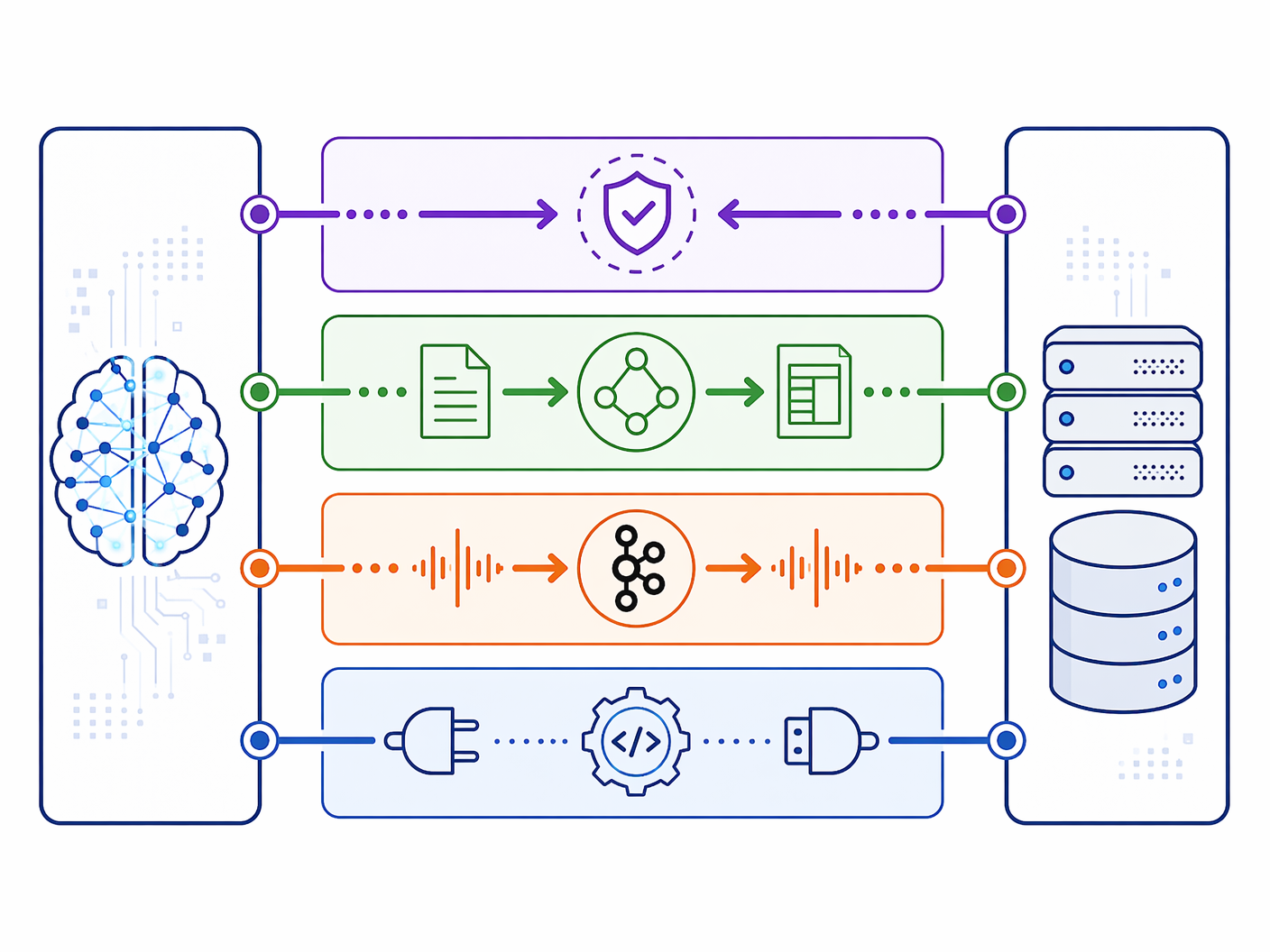
An API call proves that two systems can exchange data. It does not prove that the exchange preserves business meaning, respects ERP controls, or can recover from partial failure. A production-grade integration has to handle four things together: connectivity, events, semantics, and controlled execution.
| Layer | What it must do | What usually breaks first |
|---|---|---|
| ERP connectivity | Expose governed access to ERP records through REST, SOAP, OData, BAPI, RFC, or platform-specific services | The AI tool receives extracts but cannot reliably query current transactional state |
| Event streaming | Turn ERP changes into usable triggers through CDC, message brokers, or event mesh patterns | Recommendations arrive after the planner has already acted, or batch timing creates duplicate work |
| Semantic normalization | Translate ERP-specific structures into AI-readable business objects such as item, supplier, location, BOM, demand, and constraint | The model optimizes against codes and fields that do not mean the same thing across plants, regions, or ERPs |
| Bidirectional action execution | Return approved actions to ERP as purchase orders, transfers, production orders, schedule changes, or exception tasks | Recommendations remain in a side tool because write-back is unsafe, unaudited, or too hard to validate |
This four-tier pattern is synthesized across current integration frameworks that describe ERP connectivity, event-driven integration, semantic mapping, and bidirectional execution for agentic supply chain systems.[1][3][4] The layers are not four independent workstreams to assign to four vendors. They are an operating design. A purchase recommendation is only as reliable as the supplier master it reads, the inventory event that triggered it, the semantic mapping that explains what “available” means, and the write-back path that creates an ERP transaction once the business approves.
The connectivity layer should be boring by design
The first layer is not where the architecture should try to be clever. ERP connectivity should give the AI environment governed, observable access to the records it needs and no more. That usually means using the ERP’s supported integration mechanisms rather than scraping reports, replicating whole databases, or building private shortcuts around the application layer.
For supply chain use cases, the minimum useful surface often includes item and material masters, supplier masters, customer and ship-to data, BOMs, routings, purchase info records, open purchase orders, sales orders, inventory balances, planned orders, production orders, quality holds, lead times, calendars, and cost or approval attributes. The exact list depends on the use case. A demand sensing tool does not need the same write permissions as an agentic procurement workflow. A production scheduling optimizer cannot work from the same thin feed as an executive dashboard.
The practical test is simple: can the AI tool reconstruct the business context a planner would check before acting? If the answer is no, the integration is still an extract, even if it uses modern APIs. A forecast exception without material status, supplier constraints, order policy, minimum lot size, lead time, and open order context is not an execution-ready recommendation. It is a signal for someone else to look up the real answer.
Events decide whether the AI system sees operations in time
Batch integration is still appropriate for some reference data. It is rarely enough for exceptions that decay by the hour: a supplier confirmation change, a port delay, a quality hold, a late work order, a demand spike, or an allocation conflict. Event-driven patterns use change-data-capture, ERP events, Kafka-style brokers, or vendor event mesh services to turn transactional changes into triggers the AI system can evaluate.[4]
The event layer should not simply spray every ERP change into a data lake and call that real time. It needs event contracts. A material availability event, for example, should state what changed, when the ERP committed the change, which business object is affected, which plant or location owns it, and whether the event supersedes a prior state. Without that discipline, downstream agents will act on noisy updates, stale deltas, or duplicate messages.
Event streaming also changes how planners experience the tool. Instead of opening a separate AI dashboard to hunt for recommendations, the workflow can surface a recommendation when a real operational state changes: a supplier misses a confirmation, projected inventory drops below policy, or a production order consumes a constrained component faster than expected. That is the difference between analytics that must be checked and assistance that enters the working queue.
The semantic layer is where most clean demos quietly cheat
ERP data is structured, but it is not automatically intelligible to an AI supply chain tool. “Material,” “item,” “SKU,” and “product” may describe overlapping but non-identical objects. One plant may use a field as a planning attribute, another as a reporting code. A supplier record may represent a legal entity in one context and a purchasing location in another. BOM alternates, phantom assemblies, substitute parts, units of measure, planning calendars, and location hierarchies carry business meaning that cannot be inferred safely from column names.
The semantic normalization layer translates ERP-specific schemas into business objects the AI system can reason over. It maps material master, vendor master, BOM structures, locations, order policies, and constraints into a consistent ontology while preserving the ERP identifiers needed for execution.[3] That last clause matters. A pretty canonical data model that loses the ERP key, plant, company code, or purchasing organization is a reporting model, not an execution model.
This layer needs ownership. It cannot be left as an ETL side effect inside the AI vendor’s connector. Master data owners, planning process leads, integration architects, and ERP functional analysts need to decide which ERP fields become authoritative, which fields are advisory, which conflicts block automation, and which differences are legitimate local variation. If two ERPs define “available inventory” differently, the semantic layer should expose that difference or normalize it through an approved rule. It should not let the model average the ambiguity away.
A useful semantic layer usually has a few visible characteristics:
- Stable business object definitions for item, supplier, location, order, inventory, demand, capacity, and constraint
- Lineage from normalized objects back to ERP tables, APIs, documents, and transaction IDs
- Explicit unit-of-measure, currency, calendar, and time-zone handling
- Rules for survivorship when ERP, planning, WMS, TMS, or supplier data disagree
- Versioning so model recommendations can be traced to the data definitions in force at the time
This is slow work compared with a demo. It is also where a large share of production risk is removed. The AI tool should not have to learn that one division treats consigned stock as available while another excludes it from planning. The integration layer should make that meaning explicit before a recommendation reaches a buyer or scheduler.
Write-back is an ERP control problem, not a feature toggle
The hardest boundary is the return path. Reading ERP data into an AI model creates data governance risk. Writing back creates transactional risk. Once an AI system can create or modify purchase orders, inventory transfers, production schedules, or planning parameters, the integration layer becomes part of the control environment.
OpenText and Panorama both emphasize that write-back introduces requirements around security, auditability, transactional integrity, and integration failure handling that organizations often underestimate.[1][7] In practical terms, the action execution layer needs to answer several questions before the first autonomous transaction is allowed:
- Authority: Is the AI tool allowed to propose, stage, approve, or post the transaction?
- Validation: Which ERP rules, master data checks, tolerances, and budget controls must pass before write-back?
- Idempotency: If the same recommendation is retried after a timeout, how does the system avoid creating a duplicate purchase order or transfer?
- Audit: Can a reviewer see the input data, model recommendation, human approval, API call, ERP document, and exception handling path?
- Rollback: If the downstream transaction fails or is reversed, how does the AI workflow learn that the action did not complete?
The safest write-back design usually separates recommendation, staging, approval, and posting. The AI tool creates a proposed action with a reason code and confidence context. The integration layer validates the proposal against semantic and ERP rules. A workflow engine routes exceptions or high-impact actions to a human. Only then does the ERP receive a transaction through a supported interface, with the AI recommendation ID carried through for traceability.
This design may sound less autonomous than the sales deck. It is often the difference between automation that survives an audit and automation that gets shut off after the first duplicate order.
How the pattern maps to major ERP ecosystems
The architecture looks different by ERP platform, but the same questions remain: how does the AI tool read governed data, receive events, understand business meaning, and execute controlled actions?
| ERP environment | Typical integration shape | Architecture implication |
|---|---|---|
| SAP S/4HANA | SAP BTP, CDS views, OData services, BAPI/RFC where appropriate, event mesh patterns, and SAP’s AI assistant ecosystem | Use standard S/4HANA exposure and event mechanisms where possible; keep semantic mappings close to material, plant, purchasing, and finance controls |
| Oracle Fusion SCM | Fusion SCM APIs, workflow services, and Oracle’s announced AI agent direction for supply chain workflows | Treat agent actions as workflow participants that still need ERP validation, approvals, and transaction traceability |
| NetSuite | SuiteTalk, RESTlets, saved searches, and SuiteScript-supported processes | Be strict about object identity and custom-field semantics, especially in multi-subsidiary or heavily customized environments |
| Microsoft Dynamics 365 | Dataverse, Power Platform, connectors, Copilot-related surfaces, and Dynamics APIs | Use Dataverse carefully as an integration and semantic surface without letting low-code workflows bypass ERP controls |
ERP Today’s coverage of Oracle’s supply chain AI agents notes Oracle’s announcement of more than 50 AI agents across its Fusion Cloud Applications, including supply chain workflows.[5] The same publication has also described event-driven agentic AI patterns where ERP becomes a more active operational participant rather than a passive database.[4] Those developments make the integration layer more important, not less. Native AI features may reduce some connector work inside one ecosystem, but most supply chains still run across multiple ERPs, planning tools, warehouse systems, supplier portals, spreadsheets, and acquired business units.
For readers still comparing platform architecture rather than implementing it, the distinction between AI-native and incumbent supply chain platforms matters because it affects how quickly a tool can act on ERP context. But once the tool is selected, the hard questions converge: supported APIs, event contracts, semantic ownership, permissioning, and write-back controls.
Sequence the integration by operational risk
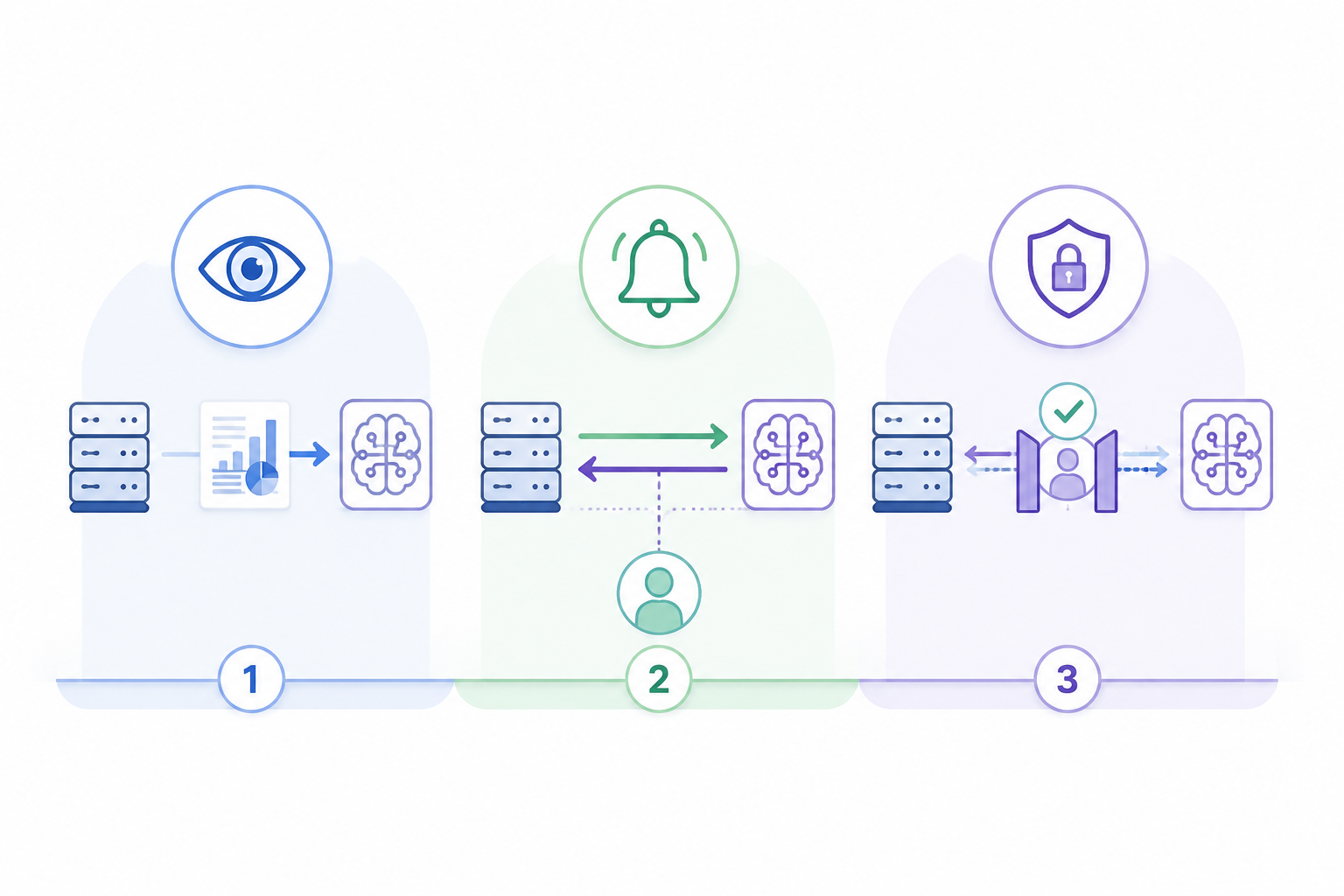
The right implementation sequence is not “dashboard, copilot, autonomous agent” as a maturity slogan. It is a controlled increase in trust. Each stage gives the AI system more operational influence, so each stage requires stronger data quality, permissioning, validation, and rollback design. Zaptiva’s discussion of the AI-ERP divide describes a progression from read-only analytics to event-triggered recommendations and then toward autonomous execution with human-in-the-loop guardrails.[6]
Stage 1: read-only analytics feeds
Start by giving the AI tool reliable, governed read access. At this stage, the system can forecast, classify exceptions, recommend inventory moves, or identify supplier risk, but it does not create ERP transactions. The main implementation work is data extraction, semantic mapping, refresh cadence, lineage, and access control.
This stage is useful because it exposes master data defects without letting them immediately corrupt execution. If supplier lead times are inconsistent, units of measure are wrong, or item-location policies are missing, the AI output will reveal the problem. The team should resist the temptation to paper over those issues inside the model. Fix the source definition or record a deliberate semantic rule.
Stage 2: event-triggered recommendations
The next step is to connect recommendations to operational events. A purchase order confirmation changes. A late shipment event arrives. A production order consumes a constrained component. The AI system evaluates the event, adds context, and sends a recommendation into the planner’s or buyer’s workflow.
This is where many pilots become valuable enough to keep and irritating enough to distrust. If the event is late, duplicated, or semantically weak, planners will keep checking the ERP manually. If the recommendation does not explain which constraint changed, which order is affected, and which action is proposed, it becomes another alert queue. Stage 2 needs event quality, not just model quality.
The workflow should capture planner response: accepted, rejected, modified, deferred, or sent for approval. That feedback is not only training material for the AI system. It is evidence for the integration team. Repeated modification may indicate that the model lacks a business constraint, but it may also indicate that the semantic layer is missing a field planners rely on every day.
Stage 3: guarded write-back
Guarded write-back is where the AI system stops being only advisory. It can stage a purchase requisition, propose a purchase order change, create an inventory transfer request, update a planning parameter, or submit a production schedule adjustment. The guardrails decide which of those actions are posted automatically, which require approval, and which are never allowed.
The first write-back use cases should be narrow, reversible, and auditable. A low-value replenishment proposal inside established supplier, price, and quantity tolerances is a better candidate than an unconstrained supplier switch for a critical component. A staged transfer recommendation with human release is safer than a direct inventory adjustment. The goal is not to look autonomous in a steering committee deck; it is to prove that the integration layer can execute without creating cleanup work for finance, procurement, or planning.
This sequence also keeps ROI claims honest. MLVeda has published architecture-linked claims including 23–31% cost reductions and 300% ROI by year 3, while NetSuite- and McKinsey-cited material has discussed 20–30% inventory reduction in AI supply chain contexts.[3][2] ELEKS reports a single plumbing tools distribution case with 5.76% monthly cost savings and a 50% delivery time reduction.[8] Those figures should not be blended into a generic business case. They are evidence that integration affects economics, not proof that a disconnected recommendation engine will produce the same outcome.
The minimum controls before AI writes to ERP
Before moving from recommendation to execution, the integration design should pass a control review that is specific to ERP transactions. General AI governance is not enough. The question is whether this system can safely participate in supply chain operations where a bad transaction becomes a real order, shipment, schedule, or financial commitment.
- Transactional integrity: ERP posting should succeed or fail in a known state, with no orphaned AI action waiting in a side system.
- Semantic consistency: The action sent to ERP should use approved definitions for item, supplier, location, quantity, unit, date, and constraint.
- Idempotency: Retried calls should update or recognize the same intended action, not create duplicates.
- Permission staging: Read, recommend, stage, approve, and post rights should be separated by role and use case.
- Auditability: Every executed action should connect the ERP document back to the triggering event, input data, recommendation, approval path, and integration call.
- Exception routing: Failed validations should land in a queue owned by people who can fix the business problem, not only the integration error.
A useful design review asks for examples, not architecture slogans. Show a supplier delay event entering the broker. Show the normalized object the AI tool receives. Show the recommendation payload. Show the approval rule. Show the ERP API call. Show the created document. Show what happens when the call times out, when the supplier is blocked, when the quantity violates tolerance, and when the planner changes the recommendation before approval.
What to build in Q3 2026
For most organizations, the Q3 2026 implementation decision is not whether AI supply chain tools are promising. It is whether the integration layer is being built in the same sequence as operational risk. A practical roadmap starts with governed read access and a semantic model for the chosen use case. It then adds event triggers that match real planning and procurement decisions. Only after that should it open guarded write-back paths into ERP.
The build order should follow the transaction you eventually want to trust. If the target is AI-assisted purchasing, start with supplier, material, lead time, open order, price, and approval semantics. Add events for demand changes, supplier confirmations, and inventory exceptions. Stage purchase recommendations before creating purchase orders. If the target is inventory repositioning, start with item-location policy, available inventory, transfer rules, calendars, and transportation constraints. Stage transfer proposals before posting movements.
That discipline keeps the project out of the familiar trap: a sophisticated model wrapped in a brittle connector, with planners doing the real integration by hand. If the AI tool cannot consume normalized ERP context and return governed actions to the transactional core, it remains an advisory layer. Build the integration path in stages that match data quality, permissions, validation, and rollback maturity, or accept that the system will keep depending on manual translation and side-channel execution.
References
- AI, ERP, and Integration: The Missing Link to Value, OpenText
- Platform analysis citing McKinsey research on integrated AI ROI, Deposco
- Architecture framework for AI and ERP integration, MLVeda
- Event-Driven Agentic AI — What Happens When ERP Becomes the Operator, ERP Today
- Oracle AI Agents Help Transform Supply Chain Workflows, ERP Today
- The Great AI ERP Divide and How to Bridge It, Zaptiva
- ERP integration challenges, Panorama Consulting
- AI-powered supply chain optimization case study for plumbing tools distribution, ELEKS
Comments
Join the discussion with an anonymous comment.