
The useful alert does not arrive after the cargo misses uplift. It arrives while the shipment is still tendered, the flight is still on the plan, and the plant, hospital, field engineer, or repair line still believes the promised part will arrive on time. That is the narrow operating window for AI systems predicting supply chain disruption from airport ground stops: turn an FAA restriction into a list of exposed orders before the exception becomes a shortage.
An airport ground stop is usually described in aviation terms: GS, GDP, TMI, NAS status. For a supply chain team, those labels matter only as machine-readable inputs. The working question is simpler: which cargo is now unlikely to move through the planned airport, which downstream commitment depends on it, and what alternate path is still available?
The answer is rarely sitting in one system. FAA traffic management data can show that a gateway is constrained. Weather data can indicate whether the restriction is likely to persist or spread. Cargo tender and milestone data can show whether freight is still at origin, already accepted, built into a unit load device, or waiting for transfer. Inventory data can show whether the receiving site has hours, days, or no practical buffer. AI becomes useful when it joins those signals early enough to change the decision.
A ground stop becomes a supply chain event when capacity disappears from the plan
The cargo consequence is not limited to freighters parked on a ramp. Passenger-flight restrictions can remove belly capacity from lanes that shippers were counting on, and that matters for urgent automotive, pharmaceutical, semiconductor, medical-device, and aerospace movements. During FAA flight cuts reported in November 2025, CNBC said the FAA reduced flights by 10% at 40 airports during a daytime window, while FreightWaves reported that cargo airlines and shippers faced mixed impacts from the same restrictions.[1][2]
Mixed impact is exactly what makes the control problem hard. A systemwide restriction does not hit every shipment equally. One shipment may have two later departures through another gateway and enough safety stock at destination. Another may be the last component needed before a production order can close. A third may be temperature-sensitive and technically movable, but only if the alternate routing preserves handling conditions.
Most transportation management systems can record the failure once the flight is missed. The higher-value pattern is earlier: detect that the probability of missed uplift is rising, attach that probability to actual commercial exposure, and separate cargo that needs intervention from cargo that can absorb the delay.
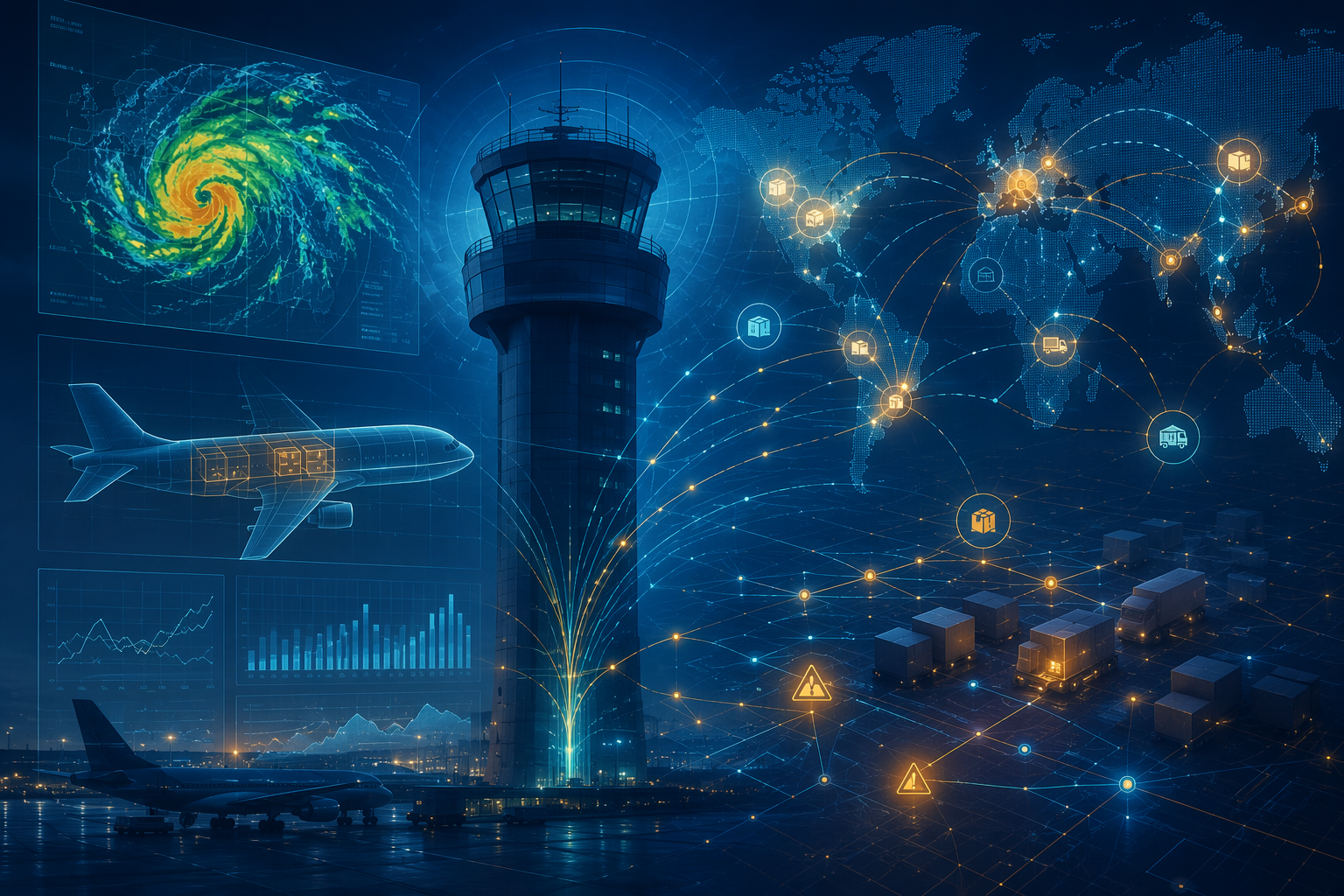
The prediction workflow starts before the exception queue
A practical model does not begin with a generic “delay risk” score. It begins by asking whether a constrained airport touches a shipment that the business actually cares about. That means the AI has to reconcile four layers that often sit in different operating systems.
| Signal layer | What it tells the model | Supply chain decision it changes |
|---|---|---|
| FAA traffic management and airport status | Which airports, flows, and time windows are constrained | Whether planned uplift, connection, or recovery routing is still credible |
| Weather feeds | Whether the restriction may persist, expand, or clear faster than scheduled | Whether to wait, reroute, or pre-book scarce alternate capacity |
| Cargo tender and milestone events | Where the freight sits in the air cargo process | Whether the shipment can still be intercepted, retendered, split, or rebooked |
| Inventory and demand positions | Which downstream node can tolerate delay and which cannot | Whether to spend on expedite, rebalance stock, or accept the miss |
The sequence matters. If the FAA layer says an airport is constrained but the cargo has not yet left the shipper, the response can still be a tendering decision. If the cargo is accepted at the origin warehouse, the response may be a carrier or gateway change. If it is already moving toward a connection airport, the response may narrow to rebooking, recovery trucking, or downstream inventory substitution.
CargoAi’s Predictive Tracking product, launched in February 2026, illustrates the shipment-milestone side of this pattern. Air Cargo News reported that the system uses machine learning trained on millions of historical shipments to predict seven cargo milestones with continuous refresh.[3] That is useful directional evidence, not a guarantee that a shipper can predict every ground-stop consequence. The launch is still early-stage, and the training claim has not been independently validated at scale.
The 24–72 hour window is where the decision quality changes. MarketIntelo’s 2026 airline disruption management AI report cites machine-learning flight-delay prediction accuracy of 82–88% versus 45–50% for traditional methods, and it also reports higher severe-weather prediction ranges for longer lead times.[4] Those figures should be read as market-aggregator benchmarks, not audited proof. Still, they point to the right operating ambition: not perfect foresight, but enough lead time to act before capacity has been consumed by everyone else.
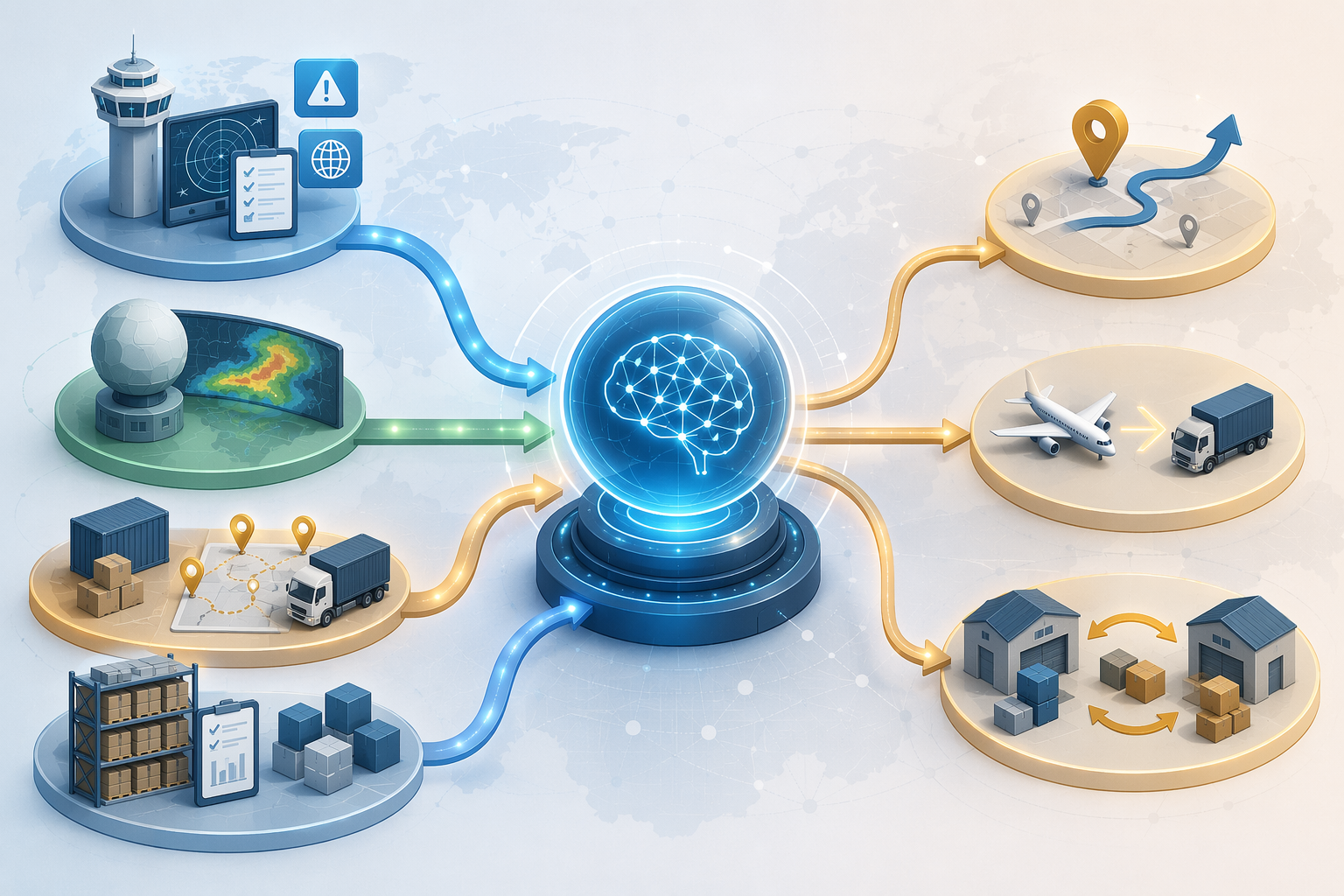
Each data layer changes the answer
FAA status is the first translation layer. A ground stop or ground delay program tells the model that the planned airport flow is no longer normal. The AI does not need to teach the logistics team the procedural difference between GS and GDP; it needs to convert the status into shipment exposure by airport, lane, carrier, cutoff, and scheduled departure.
Weather is the persistence layer. A short-lived restriction with improving weather may justify holding the plan if the receiving location has buffer. Deteriorating weather over a hub corridor is different: alternate gateways can become scarce quickly, and waiting for the first missed milestone may leave only premium options. Severe weather also behaves differently from an administrative or staffing-driven restriction, so one accuracy number cannot carry every cause.
Cargo milestones are the intercept layer. “Booked” cargo is not the same as “accepted” cargo. Accepted cargo is not the same as cargo loaded into a unit or transferred for departure. A model that ignores these distinctions can recommend impossible actions, such as retendering freight that is already inside an airline-controlled process or assuming cargo can be split after consolidation has removed that option.
Inventory is the consequence layer. The same three-hour delay can be harmless for a replenishment shipment and critical for an aircraft-on-ground part or a line-side module with no substitute. This is where a supply chain control tower earns its name: the output is not “flight delayed,” but “shipment A threatens production continuity, shipment B can wait, shipment C should be covered by stock transfer.” Readers evaluating the broader pattern can compare this with supply chain control tower AI use cases, where the same detection-to-response loop appears across other disruption types.
The cleanest implementation joins those layers into an exposure table that operations can trust. It should show shipment ID, part or SKU, committed arrival, planned flight path, constrained airport touchpoint, current milestone, inventory cover, modeled delay risk, recommended action, and the source signals behind the recommendation. Without that source trail, the AI becomes another black-box alert competing with the exception queue.
Network cascades are not airport drama; they are late parts
A ground stop at one airport can damage cargo plans that never had that airport as a final destination. Aircraft, crews, belly capacity, transfer windows, and truck recovery legs all move as a network. OAG, in a 2025 report produced with Microsoft and citing U.S. DOT data, said 60% of flight delays are industry-related rather than weather-related.[5] The point for supply chain teams is that a weather map alone is not enough; operational knock-on effects often carry the disruption after the original trigger has changed.
That is why historical lane performance can mislead during a live restriction. A lane may normally recover well after a short delay, but if aircraft are out of position or passenger schedules are trimmed, the available cargo path may not resemble the historical average. The model has to update continuously as milestones arrive or fail to arrive.
OAG’s collaboration with Microsoft is also a reminder to treat the aviation AI evidence base carefully. It supports the argument that AI can help interpret disruption patterns in flight operations, but it is not an end-to-end study of supply chain inventory consequences from FAA ground stops. The practical takeaway for a logistics leader is assembled from adjacent evidence: aviation disruption analytics, air cargo predictive tracking, and supply chain response automation.
Prediction only pays when it triggers a feasible response
A delay probability without an action path is just a better explanation of yesterday’s miss. The mitigation layer should decide what can still be changed, what it will cost, and who must approve it.
- Automated rerouting: move eligible shipments through an alternate airport, carrier, or connection before constrained capacity disappears.
- Alternate gateway selection: compare cutoff times, handling capability, customs exposure, temperature or security requirements, and recovery trucking distance.
- Mode-shift: switch from air to expedited ground for short-haul lanes when airport congestion makes air slower or less certain.
- Inventory rebalancing: cover the threatened demand from another node and let the disrupted shipment replenish later.
- Priority protection: reserve scarce uplift for cargo tied to production stoppage, patient care, field service, or contractual penalties.
The model should not choose the most expensive rescue move simply because delay risk is high. It should compare risk against consequence. A high-value expedite may be justified for an aerospace service part that holds an aircraft on the ground. The same move may be wasteful for a replenishment SKU with available stock in a nearby region.
Inform Software describes a proactive AI approach to managing aviation disruptions with quantified operational outcomes.[6] That evidence belongs in the response-automation bucket: it shows how decision support can move earlier in the disruption cycle. It does not remove the need for shipper-specific rules around cost authority, inventory allocation, customer priority, and compliance.
For teams exploring more autonomous execution, the boundary between recommendation and action matters. A system may be allowed to auto-book an alternate route under a cost threshold, auto-notify the plant when inventory cover is still safe, or auto-create a task for a logistics manager when the decision exceeds policy. Higher-cost rerouting and customer-allocation decisions still need human review in most operating models. The same governance issue appears in broader agentic AI supply chain deployments.
Different ground-stop causes need different confidence
The November 2025 FAA restrictions are useful because they show passenger-flight cuts can become an airfreight capacity issue, but their government-shutdown context should not be generalized to every ground stop.[1][2] A shutdown-driven restriction, a severe thunderstorm line, an airport IT outage, and a security incident have different signal patterns and different response windows.
| Ground-stop cause | What AI can usually read earlier | Where confidence should be lower |
|---|---|---|
| Weather | Forecast deterioration, airport status changes, carrier recovery patterns, missed milestones | Exact reopening time and downstream capacity after the weather clears |
| Administrative or staffing restriction | FAA traffic management updates, scheduled flight reductions, carrier schedule changes | How airlines allocate remaining capacity across passenger, mail, and cargo priorities |
| IT outage | Airport or carrier operational alerts, milestone silence, abnormal dwell, manual handling delays | Duration and recovery sequencing if systems fail without clean external signals |
| Security incident | Airport status changes, embargoes, screening delays, tender holds | Timing, scope, and cargo release rules when information is intentionally limited |
This is where model governance should be blunt. A prediction screen should distinguish observed facts from inferred risk. “FAA ground stop active” is a different claim from “shipment will miss delivery.” “No acceptance milestone received” is different from “cargo is still at shipper.” If the system collapses those distinctions, planners will either overreact or stop trusting the alerts.
Accuracy metrics also need cause labels. A model that performs well during weather events may not perform the same during an IT outage. A model trained on historical cargo milestones may struggle when a new regulatory or security rule changes handling behavior. Market-wide ranges are a starting point for evaluation, not a substitute for lane-level backtesting against the company’s own shipments.[4]
What an enterprise system needs underneath
The minimum data foundation is not exotic, but it is often messy. The AI needs live or frequently refreshed feeds for airport restrictions, weather, carrier schedules, bookings, tender status, acceptance, departure, arrival, transfer, customs or release milestones where relevant, and inventory positions by node. It also needs business rules: which SKUs are critical, which customers or sites have priority, which lanes allow substitutions, and which cost thresholds require approval.
Data readiness is usually the constraint before modeling sophistication. If shipment IDs do not connect cleanly to purchase orders, production orders, service tickets, or inventory reservations, the system can predict a transport delay but cannot rank business impact. That is a familiar problem in AI inventory optimization data readiness: the model can only optimize against the relationships the enterprise has made visible.
A workable exposure record should answer five questions before anyone opens a carrier portal:
- Which shipment touches the constrained airport or dependent flight network?
- What is the current cargo milestone, and can the freight still be intercepted?
- What downstream order, asset, patient, line, or customer commitment depends on it?
- How much inventory or time buffer exists at the receiving node?
- Which response is feasible within policy, cost, service, and compliance limits?
The best systems expose their reasoning in operational language. A logistics manager should be able to see that a recommendation came from an active FAA restriction, worsening weather, a missed acceptance milestone, no safety stock at the destination, and an alternate gateway with available cutoff. That audit trail is not decoration; it is what keeps automation from becoming unreviewable escalation.
What can reasonably be expected in 2026
No source in the current evidence base proves a complete, audited product category called “AI for supply chain disruption from airport ground stops.” The stronger, narrower conclusion is that several adjacent capabilities now exist: aviation disruption analytics, predictive air cargo milestone tracking, AI-supported disruption management, and supply chain control-tower response logic. Combined carefully, they can move awareness earlier than the missed-flight exception.
MarketIntelo valued the airline disruption management AI market at $3.2 billion in 2025 and projected it to reach $12.8 billion by 2034.[4] That market sizing is less important than the operating pattern behind it. Shippers are trying to buy time: time to protect constrained uplift, time to retender before cutoff, time to move inventory from another node, and time to tell the production planner the truth before the line is waiting.
The reasonable expectation is earlier exposure detection, better prioritization of constrained cargo, and faster response options. AI will not prevent the FAA from issuing a ground stop. It will not guarantee uninterrupted airfreight. It can, however, change when the supply chain sees the problem: not after the carrier milestone fails, but while there is still a decision left to make.
References
- FAA flight cuts air freight capacity, CNBC, November 2025
- Cargo airlines and shippers face mixed impact from FAA flight restrictions, FreightWaves, November 2025
- CargoAi utilises AI to predict air cargo shipment delays, Air Cargo News, February 2026
- Airline Disruption Management AI Market, MarketIntelo, 2026
- AI in aviation operations, OAG, 2025
- A proactive approach to managing disruptions in aviation with AI, Inform Software
Comments
Join the discussion with an anonymous comment.