

The market is already pricing in a large shift toward ai for supply chain optimization: Gartner projects supply chain management software with agentic AI will grow from under $2 billion in 2025 to $53 billion by 2030, a forecast that explains why every planning roadmap suddenly has an “autonomous agent” slide in it.[1] The same conversation carries a much less comfortable number: Gartner also expects more than 40% of current agentic AI projects to be scrapped by 2027 because the business value is unclear and integration costs are too high.[1]
Those two numbers belong together. The first says executives and vendors are moving fast. The second says many teams are about to learn, expensively, that an agent that can recommend an action is not the same thing as an operating model that should let it decide.
In supply chain planning, agentic AI is most useful when it is not treated as a general autonomous planning brain. The more credible pattern is narrower: coordinated agents assigned to specific domains, working from connected planning, procurement, logistics, and inventory data, with guardrails that define what they can observe, recommend, execute, and escalate. Deloitte’s March 2026 framework describes this as domain agents operating inside governed boundaries, not as full enterprise autonomy.[2]
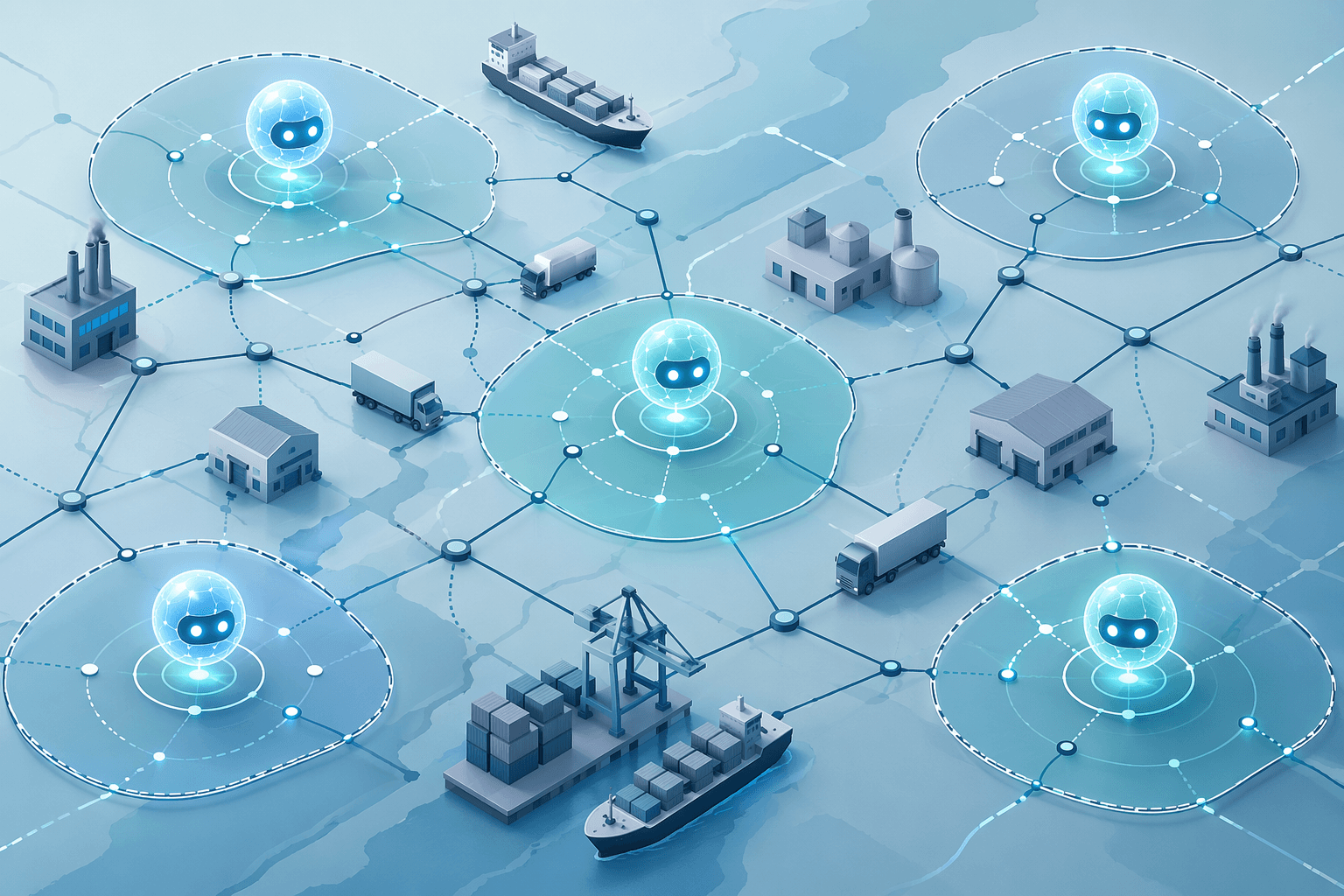
That distinction matters because planning work is full of semi-routine decisions that are painful precisely because they sit between systems: a price variance buried in an invoice line, a supply constraint that no one reconciled back to the demand plan, a late shipment whose root cause is spread across supplier updates, transport events, and inventory allocations. These are good candidates for bounded autonomy. They have observable inputs, measurable outcomes, and a human owner who can still reject the recommendation.
The trust data points in the same direction. RELEX reports that only 10% of supply chain leaders trust AI to make critical decisions without human review, while 54% prefer hybrid augmentation.[1] That is not resistance to technology. It is an operating constraint. If an agent changes a purchase order, moves scarce inventory, or overrides a constraint, someone must know who approved it and why.
Where agentic AI is bounded enough to work now
The most useful early deployments are not organized around a grand promise of autonomous planning. They cluster around work that planning and procurement teams already know is expensive, repetitive, and hard to monitor continuously. Three patterns stand out in the 2026 evidence: purchase optimization, continuous integrated business planning, and autonomous root cause analysis.[1]
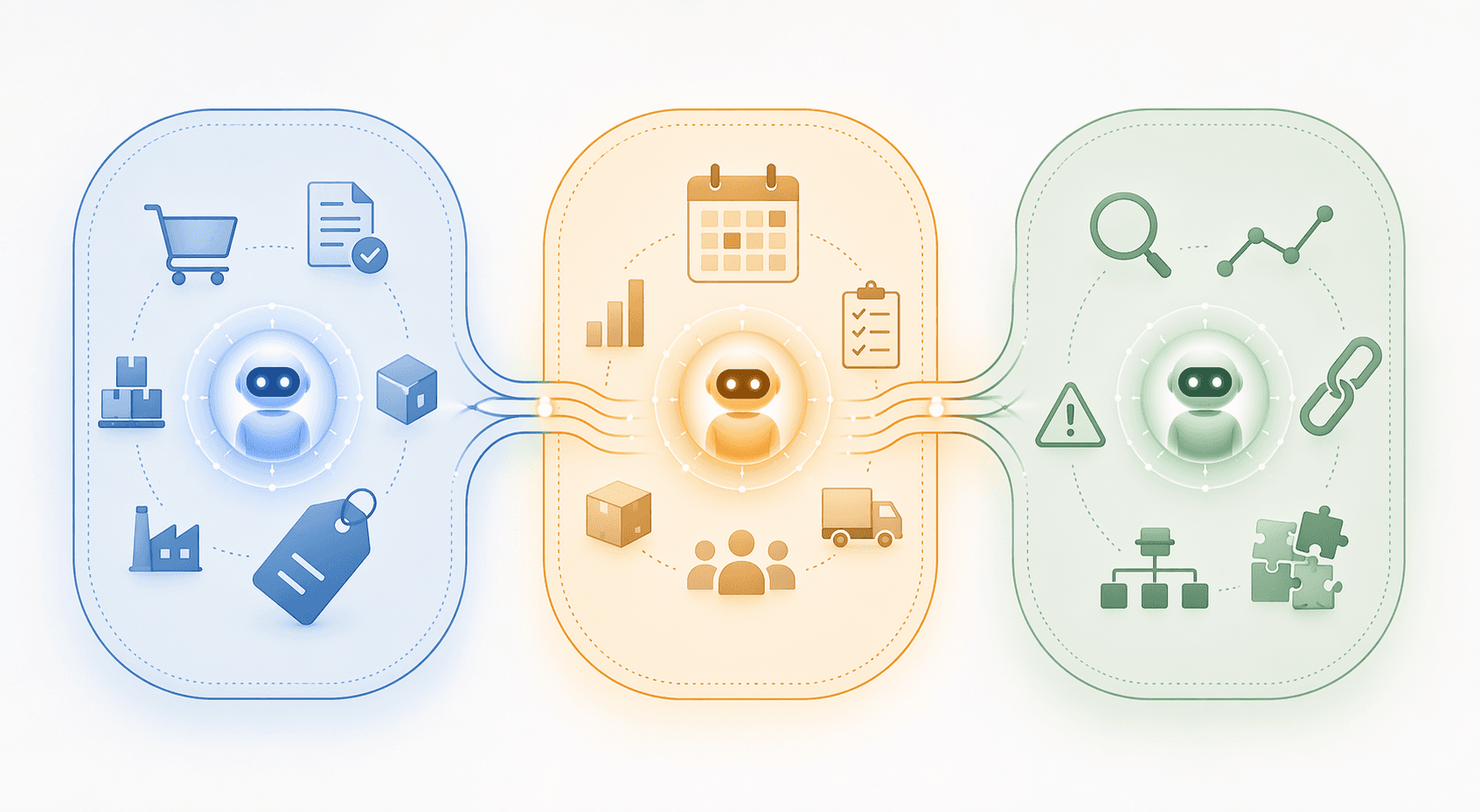
| Domain | Agentic work | Why it is bounded | Governance stop point |
|---|---|---|---|
| Purchase optimization | Find price variance, missed contract terms, and compliance gaps across procurement data | The agent works against contracts, invoices, purchase orders, and supplier records | Human review before supplier dispute, payment adjustment, or PO change |
| Continuous integrated business planning | Keep demand, supply, inventory, and financial assumptions reconciled between formal planning cycles | The agent monitors planning deltas and escalates exceptions against agreed thresholds | Human approval for material plan changes, capacity tradeoffs, or financial commitments |
| Autonomous root cause analysis | Trace disruptions across connected signals and propose likely causes | The agent investigates a defined exception rather than controlling the end-to-end plan | Human validation before corrective action, customer commitment, or supplier escalation |
Purchase optimization: the clearest early value case
Purchase optimization is the least abstract of the three domains, which is exactly why it deserves attention. It does not require an agent to understand the whole business. It asks the agent to compare what the company agreed to buy, what it actually ordered, what suppliers invoiced, and what the contract said should have happened.
That work is tedious when humans do it manually because the losses are often small at the transaction level and large in aggregate. A planner or procurement analyst can catch the obvious exception. The buried variance is different: a price break not applied after a volume threshold, a surcharge that no longer matches the contract, a supplier substitution that changed landed cost, or a recurring mismatch between purchase order terms and invoice terms.
An agentic system can monitor those records continuously and surface exceptions with supporting evidence. It can point to the contract clause, compare the purchase order and invoice, rank the recovery opportunity, and recommend whether the case should go to procurement, accounts payable, or supplier management. RELEX identifies purchase optimization as one of the documented agentic AI deployment areas for supply chain teams, with emphasis on buried price variance and contractual compliance gaps.[1]
The operating boundary is what makes this case stronger than broad “autonomous procurement” language. The agent is not being asked to redesign the sourcing strategy or decide which supplier relationship matters most. It is comparing structured and semi-structured records against agreed commercial terms. The outcome can be measured in recovered working capital, avoided overpayment, cycle-time reduction in variance review, and improved contract compliance.
The guardrail is also straightforward. The agent can identify and rank the exception. It can draft the dispute packet. It can recommend a corrective action. But it should not independently trigger a supplier dispute, alter payment, or modify future purchase orders unless the organization has explicitly approved that level of autonomy for that supplier, category, and dollar threshold.
This is the kind of domain where agentic AI can earn trust without pretending to be a planner. It removes reconciliation labor and exposes leakage that humans are unlikely to review at full population scale. For readers comparing this against broader AI use cases, ChainSignal’s supply chain AI ROI benchmark is a useful companion because purchase optimization should be judged differently from forecasting or network design.
Continuous IBP: powerful, but more dependent on integration quality
Continuous integrated business planning is the more ambitious pattern. The appeal is obvious to anyone who has watched a monthly S&OP deck become stale before the meeting ends. Demand changes, supply constraints move, inventory positions drift, and finance still wants one set of numbers. The work between formal cycles becomes a long reconciliation exercise.
Agentic AI can help by monitoring changes across demand, supply, inventory, procurement, and logistics signals, then identifying when assumptions no longer line up. Instead of waiting for the next planning cadence, agents can flag that a supplier delay changes available-to-promise, that a demand uplift creates a capacity conflict, or that an inventory reallocation protects service for one region while exposing another.
RELEX describes continuous IBP as one of the agentic AI deployment areas emerging in supply chain planning: always-on demand-supply reconciliation rather than a planning process that relies only on periodic review cycles.[1] The promise is not that the monthly meeting disappears overnight. It is that fewer people spend the days before the meeting arguing about which spreadsheet is current.
This is where the boundary becomes more fragile. Purchase optimization can often work against a relatively contained set of procurement and finance records. Continuous IBP touches the planning nervous system. If the master data is weak, if demand planning and supply planning use different hierarchies, if constraints are maintained outside the planning platform, or if finance receives a translated version of the plan late in the cycle, an agent may simply accelerate the spread of bad assumptions.
The better use of autonomy here is graduated. At the first level, the agent observes and explains deltas: what changed, which plan objects are affected, and who needs to review. At the next level, it proposes reconciliation actions, such as shifting demand to an alternate source or rebalancing inventory inside an approved policy. Only later, and only for low-risk decisions with clear thresholds, should it execute changes automatically.
Deloitte’s coordinated domain-agent model is useful here because IBP does not belong to one function. A demand agent, inventory agent, procurement agent, and logistics agent may each understand part of the plan, but the business needs orchestration rules that define which agent’s recommendation wins when service, cost, capacity, and cash conflict.[2] Without that governance, “continuous planning” becomes continuous escalation.
Autonomous root cause analysis: from tracing work to decision support
Autonomous root cause analysis is a cleaner fit for agentic AI because the job begins with a defined exception. A shipment is late. A production order is short. A forecast miss has created excess inventory. A supplier has missed an update. The agent is not being asked to run the supply chain. It is being asked to investigate why a specific disruption happened and what it is likely to affect next.
The manual version of this work is familiar: open the planning system, check the supplier portal, look at transport milestones, ask customer service whether the order has already been promised, pull inventory by location, and then message three people to confirm which record is wrong. The elapsed time is often worse than the analytical time because each handoff waits behind other work.
An autonomous RCA agent can trace the exception through connected signals and assemble a causal chain: the purchase order was acknowledged late, the inbound shipment missed a transfer milestone, the receiving site has no substitute inventory, and two customer orders are now at risk. RELEX frames this as agent-driven discovery replacing manual tracing, reducing investigation effort from days to minutes.[1]
The value signal is time compression. If an analyst no longer spends a day reconstructing the facts, the team can spend that time deciding which customer, plant, supplier, or lane needs intervention. ICRON cites early agentic AI outcomes including up to a 30% reduction in delivery times and a 12% drop in fuel costs, along with a cited survey in which 67% of companies deploying agentic AI in inventory management saw significant revenue increase.[3] Those figures should be read as favorable early signals rather than universal benchmarks, but they are directionally consistent with the mechanism: faster detection, faster exception triage, and less manual coordination.
The governance line is the difference between diagnosis and action. An RCA agent can identify the likely cause, estimate the affected orders, and recommend a mitigation path. It should not automatically expedite freight, reallocate constrained stock, or tell a customer a new promise date unless those decisions sit inside pre-approved limits. The agent’s confidence score is not an accountability structure.
What separates production patterns from fragile pilots
The difference between a useful agent and a fragile pilot usually appears before the model is selected. It appears in the use case definition. A production-ready agentic workflow has a named decision surface, a known exception population, access to the records needed to explain its recommendation, and a business owner who can say what improvement counts as value.
The weak version starts with a broad ambition: make planning autonomous, automate S&OP, optimize the supply chain, or let AI manage exceptions. Those phrases are too wide to govern. They hide the important questions: which exception, which system of record, which threshold, which user, which approval right, which audit trail, and which metric?
A disciplined selection screen does not need to be elaborate. It needs to be unforgiving.
- The input data must be available often enough for agent monitoring to matter.
- The agent’s recommendation must be explainable from records the business already accepts.
- The outcome must be measurable without inventing a new benefits model after deployment.
- The decision surface must be narrow enough to define approval rights and exception thresholds.
- The failure mode must be tolerable, reversible, or caught before execution.
This is also why human review is not a cosmetic concession. RELEX’s trust data shows that supply chain leaders are far more comfortable with hybrid augmentation than with critical decisions made without review.[1] A rollout that ignores that preference will run into adoption resistance even if the model performs well in testing. People do not only ask whether the recommendation is statistically sound. They ask whether they are going to be blamed for accepting it.
For teams building an implementation model, the practical next layer is graduated autonomy: observe, recommend, approve, execute within limits, and only then expand. ChainSignal’s practitioner’s guide to graduated autonomy goes deeper on that operating model, but the core point is simple enough: autonomy should be earned by domain, not granted to the platform.
Data readiness is not a generic maturity score
Many agentic AI failures will be described as model failures when they are really integration failures. Gartner’s projected project scrap rate points directly at unclear value and integration drag.[1] In planning environments, integration drag is not just an IT inconvenience. It changes what the agent can know.
A purchase optimization agent needs contract terms, purchase orders, invoices, supplier identifiers, item hierarchies, and payment records connected well enough to compare them. A continuous IBP agent needs planning assumptions, demand changes, capacity constraints, inventory positions, and financial targets aligned at usable levels of granularity. An RCA agent needs event data, order status, supplier updates, transportation milestones, and inventory availability linked to the same exception.
That means data readiness should be assessed by use case, not by a general enterprise score. A company may be ready for purchase variance detection and not ready for continuous IBP. It may be ready for RCA on a priority lane and not ready for network-wide exception orchestration. Treating all three as the same “agentic AI deployment” is how a credible narrow use case gets buried inside an over-scoped program.
Guardrails have to be operational, not just ethical
Deloitte’s framework is useful because it places agents inside a governed supply chain operating model rather than treating them as independent actors.[2] In practical terms, guardrails should define what the agent can see, what it can change, what it can spend, which policies it must follow, when it must ask for approval, and how its recommendation will be audited later.
A procurement agent might be allowed to draft a supplier recovery claim but not send it. A planning agent might be allowed to recommend a constrained allocation but not commit it to customer service. A logistics agent might be allowed to compare expedite options but not book premium freight above an approved threshold. The important detail is not whether the action sounds low risk in a demo. It is whether the operating policy says the agent has the right to do it.
This is where technology officers and planning directors need to stay aligned. The technology team can build the workflow, integrate the systems, and monitor model behavior. The planning organization owns the decision rights. If those rights are not explicit, every exception becomes a negotiation after the agent has already recommended an action.
The buyer’s line in 2026
Agentic AI in supply chain planning is not broadly production-ready as a general autonomous planning layer. The category is moving too fast, the integration burden is too uneven, and the accountability model is still too often implied rather than designed.
It is credible now in bounded domains. Purchase optimization has a clear decision surface and measurable leakage. Autonomous root cause analysis has a defined exception and a clean time-saving mechanism. Continuous IBP is promising, but it deserves more caution because it depends on connected assumptions across functions that often still operate on different clocks.
The practical question for 2026 is not whether an agent can produce an impressive recommendation. It is whether the organization can define the records, thresholds, review rights, and consequences around that recommendation. Where those boundaries exist, agentic AI can reduce reconciliation work and surface decisions earlier. Where they do not, it mostly gives planning teams a faster way to create another exception queue.
References
- Supply chain AI in 2026. RELEX.
- Resilient by design: The agentic supply chain. Deloitte. March 2026.
- How Agentic AI is Shaping Supply Chain Planning in 2026. ICRON.
Comments
Join the discussion with an anonymous comment.