
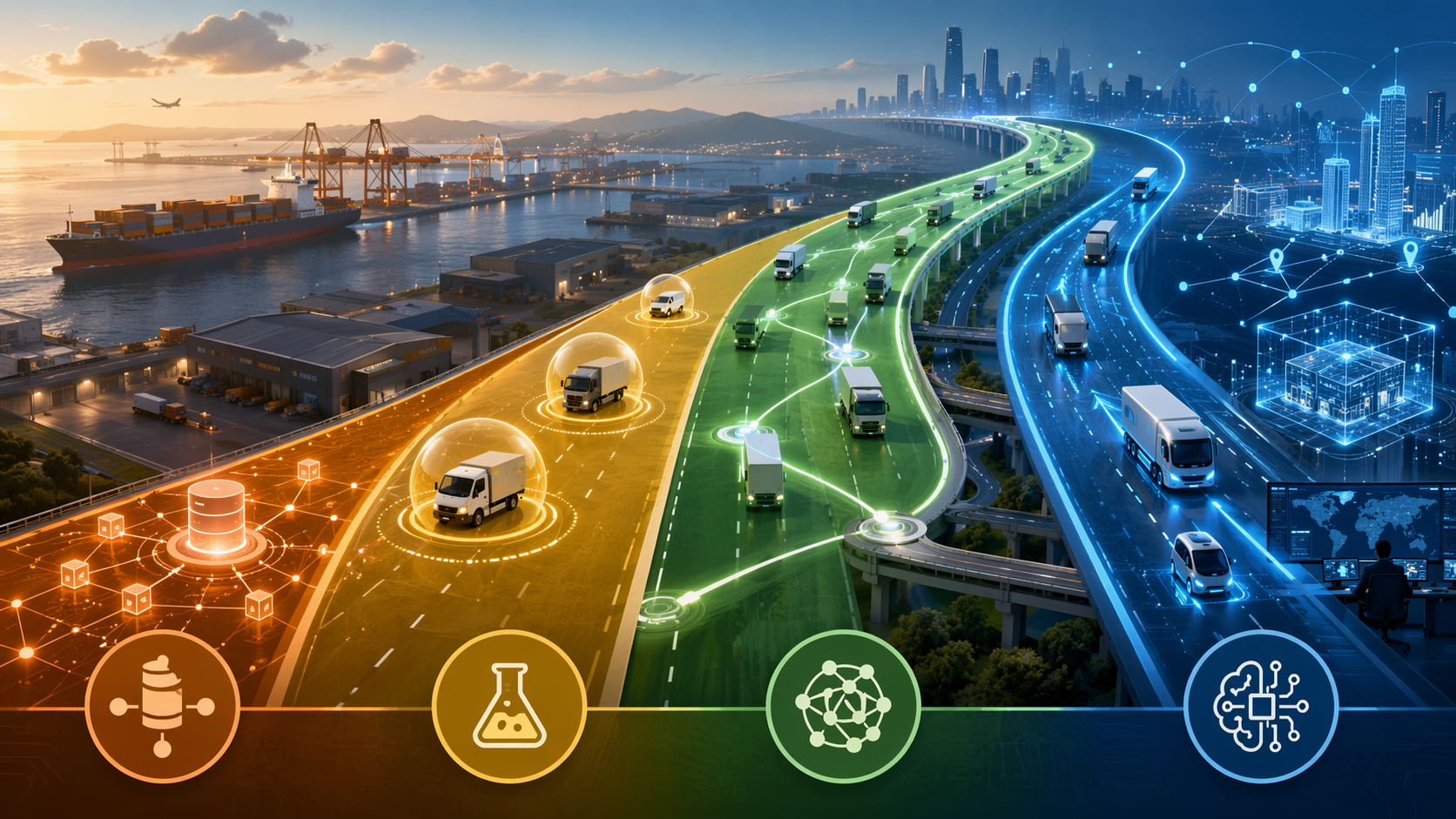
The uncomfortable part of AI in transportation and logistics is not that the use cases are unclear. Route optimization, predictive ETAs, automated exception triage, freight-rate guidance, capacity matching, yard visibility, and warehouse labor forecasting are all practical enough to deserve attention. The harder problem is that many logistics organizations can point to pilots, demos, and steering-committee slides, while far fewer can show that AI has changed daily transportation decisions across the network.
BCG’s 2026 survey of more than 180 logistics executives across Europe, North America, and Asia-Pacific found that 35% of logistics firms were actively deploying AI, yet only 13% reported measurable financial impact; the survey is useful, but its regional weighting means it should not be treated as a perfect global census.[1] Lumenalta, citing IDC via CIO.com, also reports that 88% of AI proofs of concept never graduate to production, a figure worth treating as secondary attribution rather than a direct primary-source benchmark.[2]
That gap is why this needs to be handled as an implementation roadmap, not another use-case catalog. If the question is mainly “which AI applications might matter,” start with a broader view of the AI logistics strategy gap. If the question is “how do we move from experiments to operating impact,” the sequence matters more than the menu.
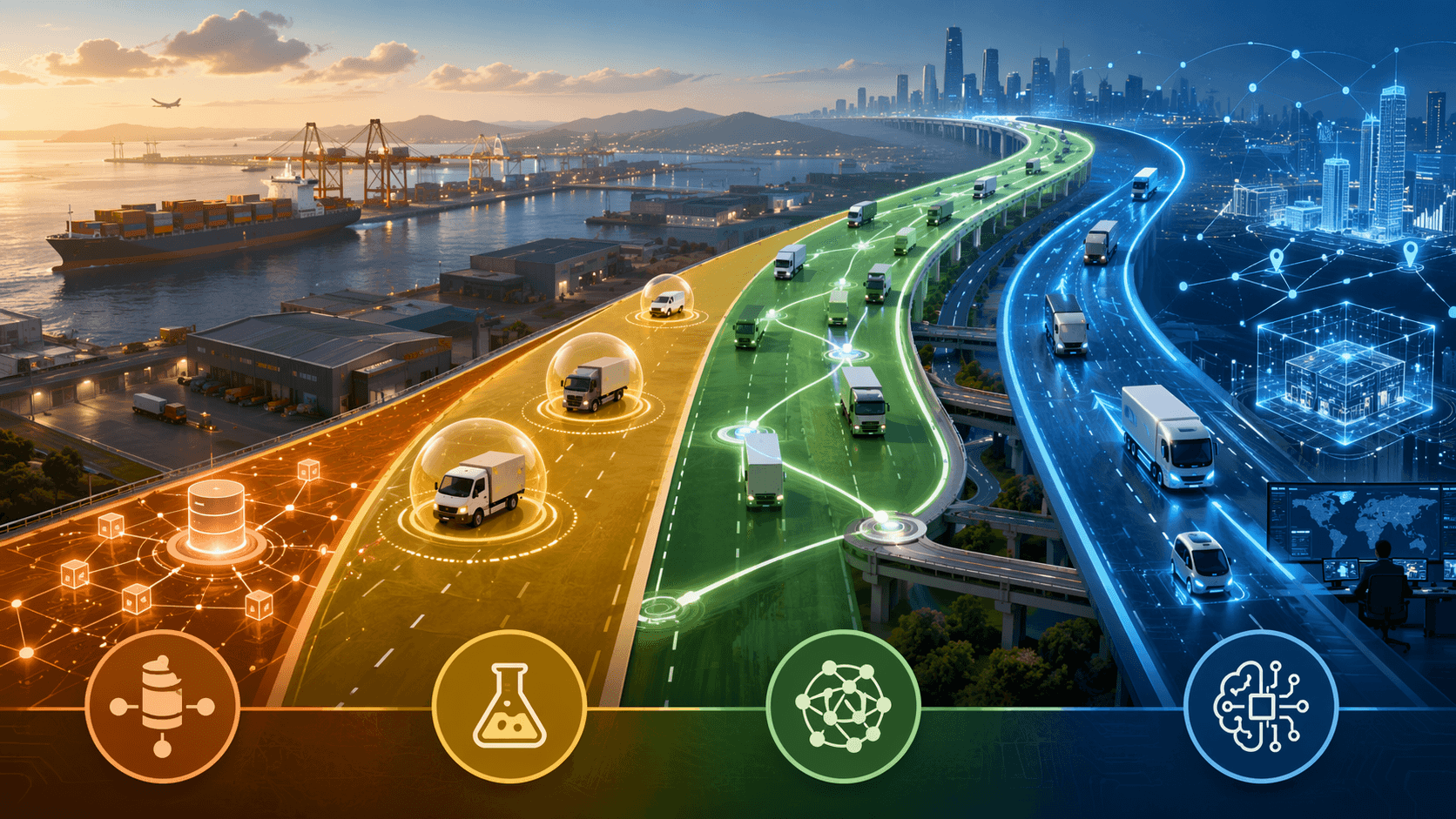
The four-phase roadmap
A workable roadmap for logistics AI should make each phase prepare the organization for the next one. Implement Consulting Group’s AI Acceleration Corridor frames the journey as identify and prioritize, pilot smartly, embed and scale, then measure and expand; it also claims first measurable impact in less than 12 weeks for transport and logistics clients.[3] In day-to-day logistics terms, that becomes a more operational sequence:
| Phase | Typical window | Main job | Do not move on until |
|---|---|---|---|
| Data Foundation | Months 1–3 | Clean up and connect the operating data AI will depend on | Core TMS, WMS, order, carrier, customer, shipment-history, and exception data is usable enough for a narrow pilot |
| Pilot Deployment | Months 3–9 | Test two or three high-value use cases in bounded operating environments | The pilot works inside real dispatch, warehouse, carrier, or customer-service workflows, not just in a sandbox |
| Production Scaling | Months 9–18 | Extend the working pattern across lanes, depots, regions, customer groups, or business units | Governance, integration, training, measurement, and exception handling can repeat without heroics |
| AI-Native Operations | Months 18–36 | Make AI-assisted decisions part of how the network is planned and controlled | Teams trust AI recommendations enough to use them routinely, while humans retain clear override authority |
The windows are not certification gates. A shipper with a modern TMS and disciplined master data may move faster. A 3PL with customer-specific workflows, multiple warehouse platforms, and regional workarounds may need longer before the first pilot deserves the word “production.” The point is not to stretch the program; it is to stop pretending that a model tested on one clean data extract is ready for network rollout.
Phase 1: Data Foundation is where most AI programs either earn the right to scale or quietly become theater
The first phase should feel more like operational plumbing than innovation theater. Transportation and logistics AI depends on the details that live in dispatch screens, warehouse exception queues, carrier portals, rate tables, appointment calendars, accessorial records, driver constraints, customer service rules, shipment histories, and local spreadsheets that were never designed to train or feed a model.
This is why the TMS and WMS discussion belongs at the beginning. Thinking.inc estimates that TMS/WMS integration consumes 30–40% of total AI project cost and 40–60% of project timelines for mid-market 3PLs.[4] Because Thinking.inc is also a consulting provider, those figures should be read as practitioner estimates rather than neutral industry averages. Even with that caveat, they match what many logistics teams discover too late: integration is not a technical footnote after the business case. It is one of the main workstreams.
For route optimization, the model needs more than origin, destination, and mileage. It needs cut-off times, dwell-time patterns, delivery windows, equipment constraints, driver hours, depot capacity, historical traffic behavior, customer-specific service promises, and the local rules dispatchers already know. For predictive ETAs, it needs status events that are timely and consistently defined. For automated exception triage, it needs exception codes that mean the same thing across sites, or at least a mapping that explains where they do not.
The practical work is unglamorous but decisive:
- Inventory the systems that create or modify shipment, order, carrier, rate, appointment, inventory, and exception data.
- Identify which fields are required for the first two or three AI use cases, rather than trying to cleanse the whole enterprise data estate.
- Assign business ownership for ambiguous fields such as delivery failure reason, service-level exception, carrier rejection reason, or late-arrival cause.
- Decide how AI recommendations will return into the workflow: inside the TMS, WMS, control tower, dispatch board, BI layer, email queue, or API-connected decision service.
- Document the human override path before the pilot begins, including who can reject a recommendation and how that rejection is captured for improvement.
The readiness gate at the end of this phase is simple but often revealing. Can operations and IT name the data source of record? Can they explain which fields are trusted, which are patched, and which are missing? Can the recommendation be delivered where a planner, dispatcher, warehouse coordinator, or carrier manager actually works? Can exceptions be captured without creating another side spreadsheet? Can a local team explain the business rule the model is supposed to respect?
If the answer is no, do not call the delay a lack of AI maturity. Call it what it is: the operating data is not ready to carry a production decision. For readers working specifically on transportation management integration, the related guide to AI in TMS goes deeper into route optimization, last-mile delivery, and freight-rate analytics.
Phase 2: Pilot Deployment should be narrow enough to learn and real enough to hurt
A good pilot is not a miniature press release. It is a controlled operating test that exposes whether AI can survive the normal mess of a logistics day without creating more work than it removes.
Select two or three use cases, not eight. They should be valuable enough to matter, narrow enough to measure, and close enough to existing workflows that users do not need to change five systems just to test one recommendation. Common starting points include predictive ETA improvement for a defined customer segment, dynamic route adjustment for a region, automated exception prioritization for a control tower, freight-rate decision support for recurring lanes, or warehouse labor forecasting for a constrained facility. A broader comparison of likely AI returns sits in AI Applications in Supply Chain: A Practical ROI Comparison for 2026.
The pilot environment matters. Lumenalta cites a Rhenus Logistics Digital Transformation Report finding that companies deploying AI during off-peak seasons achieved 45% higher adoption rates and 30% fewer operational disruptions.[2] That should not be generalized as an industry law; it is single-operator evidence. Still, the operating logic is sound. A team is more likely to test a new recommendation flow properly when it is not already drowning in peak-season backlog, driver shortages, customer escalations, and capacity firefighting.
Success criteria need to measure behavior as well as model output. A predictive ETA model that improves accuracy in a test file but is ignored by customer service is not ready. A route optimizer that produces mathematically efficient routes but violates local loading patterns will lose dispatch trust. A freight decision tool that recommends cheaper capacity after the carrier manager has already committed the load is simply late.
| Pilot question | Weak measure | Better measure |
|---|---|---|
| Predictive ETA | Model accuracy on historical data | Reduction in late or unnecessary customer escalations after the ETA is used in the service workflow |
| Route optimization | Distance reduction in a simulation | Planner acceptance rate, override reasons, service adherence, and route feasibility on live dispatch days |
| Exception triage | Number of exceptions classified | Time saved in queue review and reduction in high-priority exceptions missed by the team |
| Freight decision support | Suggested rate variance | Use of recommendations before tendering, with tracked savings, service impact, and carrier acceptance behavior |
A 90-day predictive analytics pilot can be a useful first path when the organization needs a contained starting point; the Predictive Analytics in Logistics roadmap is a narrower companion to this broader adoption plan.
Phase 3: Production Scaling is where the pilot stops being protected
Scaling is not copying the pilot into more locations. It is redesigning the operating pattern so the recommendation, the data feed, the user action, the exception path, the measurement method, and the support model can all repeat without the original project team standing behind the dispatcher.
This is where many pilots collapse. The first lane had clean data because the pilot team cleaned it. The first depot had an enthusiastic supervisor. The first customer segment had clear service rules. The first carrier pool was cooperative. Then the rollout reaches a region with different appointment practices, different exception codes, a legacy WMS, or a planner who has already seen three abandoned “transformation” tools. The model may still be good. The deployment system is not.
Production scaling needs named owners for five things:
- Data continuity: who monitors broken feeds, field drift, duplicate events, stale master data, and inconsistent exception coding.
- Workflow adoption: who ensures the recommendation appears at the decision point, not in a dashboard no one opens during dispatch.
- Operational governance: who approves model changes, business-rule updates, override policies, and new site onboarding.
- Performance measurement: who separates true financial impact from simulation gains, one-off market effects, or temporary labor effort.
- Workforce enablement: who trains users, captures objections, updates standard work, and protects time for teams to learn.
Workforce enablement is not the soft side of the program. Thinking.inc, cross-referencing BCG, reports that logistics companies underinvesting in workforce enablement see 2–3x longer adoption timelines and 40–60% lower realized savings versus business-case projections.[4] Again, that should be treated as an attributed practitioner benchmark, not a universal law. But the direction is hard to dispute: if planners and operators do not understand, trust, and know when to override AI recommendations, scale will stall.
The training should be tied to decisions, not to model theory. A transportation planner needs to know why the system recommends resequencing stops, what constraint it considered, when a customer rule overrides the recommendation, and how to record a rejection. A warehouse coordinator needs to know how labor forecasts affect shift planning and where to flag a special promotion or inventory event the model cannot see. A carrier manager needs to know whether a freight recommendation is based on price, acceptance probability, service history, or a blended score.
DHL’s route optimization results show what scale can look like when AI is embedded into a large logistics network: Lumenalta references DHL-reported annual fuel savings of EUR 180 million and a 14% distance reduction.[2] Those numbers should be read as an upper-bound scale example from a global integrator, not as a target a mid-market operator can paste into a business case. The useful lesson is not the size of the savings; it is the kind of operating reach required to produce them.
At this stage, ROI measurement also needs discipline. Savings from distance reduction, empty-mile reduction, detention avoidance, improved labor planning, or fewer service escalations should be tied to actual operating decisions changed by AI. If the model recommends a better route but the route is not used, there is no operational saving. If a planner follows the recommendation but service deteriorates, the cost has merely moved. For deeper business-case evidence, see Where AI in Supply Chain Actually Delivers ROI.
The gate before moving beyond scaling is less glamorous than most AI steering committees would like. Can a new site or lane be onboarded using a repeatable playbook? Are override reasons reviewed and used to improve the system? Do frontline teams know which recommendations are advisory and which require supervisor approval to reject? Does finance agree with the benefit calculation? Can IT support the integrations after the project team leaves? If those answers are weak, the organization is still scaling a pilot, not running an AI-enabled operation.
Phase 4: AI-Native Operations is a destination, not a launch announcement
AI-native logistics does not mean removing people from every decision. It means the network is managed with AI-assisted sensing, prediction, optimization, and exception handling as part of normal operating rhythm. The weekly planning meeting, the daily dispatch cycle, the warehouse labor plan, the control-tower escalation queue, and the carrier procurement process all begin to assume that recommendations are available, visible, and reviewable.
Mature operators do not ask users to trust a black box on a bad shipping day. They expose the reason for the recommendation, maintain clear override paths, monitor drift, and compare expected benefits with actual operating outcomes. They also stop treating each new use case as a separate science project. The data foundation, integration pattern, governance model, and training method become reusable assets.
Kuehne+Nagel and InPost are useful reference points here less because they prove a single universal ROI pattern and more because they show the direction of operating maturity: AI deployed into logistics workflows, not left as an isolated analytics exercise. The relevant lesson for most logistics leaders is to build the organizational muscle that lets one successful use case make the next one easier.
How to decide whether to move forward, pause, or fix prerequisites
Between phases, the best steering conversation is not “are we excited enough to continue?” It is whether the next operating condition has been created. The following questions work as a practical gate:
- Is the use case tied to a decision that happens often enough to matter?
- Is the required data available, trusted, and owned by both IT and operations?
- Will the recommendation appear inside the workflow where the decision is actually made?
- Do users understand when to accept, challenge, or override the recommendation?
- Can finance, operations, and technology teams measure impact the same way after rollout?
A “no” does not kill the program. It tells the team where to work next. Sometimes the right move is to improve exception coding before expanding automated triage. Sometimes it is to integrate recommendations directly into the TMS rather than asking planners to check another tool. Sometimes it is to slow the rollout long enough to train supervisors, because the supervisor is the person a planner will look to when the recommendation conflicts with local habit.
This is also where logistics-specific AI programs differ from broader supply chain maturity journeys. The physical network pushes back. Trucks are late, drivers time out, warehouse doors fill, customers change appointment rules, carriers reject tenders, and local teams create workarounds when the system does not fit the day. The broader pilot-to-profit supply chain AI journey is useful context, but transportation and logistics scaling has to account for these operating frictions directly.
What successful scaling feels like inside the operation
The clearest sign of progress is not the number of pilots running. It is that the same decision loop improves across more of the network. A planner sees a route recommendation, understands the constraint tradeoff, accepts it or records a reason for rejecting it, and that feedback returns to the model and the process owner. A control-tower analyst sees exceptions ranked by likely customer impact, acts on the highest-risk items first, and the escalation outcome is captured. A warehouse manager sees a labor forecast early enough to adjust staffing, not after the shift has already started.
The organizations that get there tend to be less dramatic than the vendor decks suggest. They sequence the work. They fund integration honestly. They choose pilots that expose real workflow friction. They train the people who carry the decision at 4:30 p.m. on a bad shipping day. They measure whether AI changed the operating decision, not whether the model looked impressive in isolation.
For a deeper look at common failure modes, the analysis of why most supply chain AI initiatives fail is a useful companion. The shorter version for logistics leaders is this: AI changes transportation and logistics only when data, integration, workforce trust, and scaling discipline arrive in the right order.
References
- AI Is Already Moving the Logistics Industry Forward, BCG, 2026.
- Data shows how logistics leaders turn AI into ROI, Lumenalta.
- AI in Transport & Logistics — From idea to first impact in less than 12 weeks, Implement Consulting Group.
- AI in Logistics & Supply Chain — Complete 2026 Guide, Thinking.inc.
Comments
Join the discussion with an anonymous comment.