
Multi-echelon inventory optimization is not a configuration problem — it is a technique-selection problem. The AI methods that work in a pharmaceutical cold chain are not the same ones that work in a spare parts warehouse or a fast-fashion distribution network. The data prerequisites differ. The service-level definitions differ. The failure modes that end implementations early differ. And the organizational conditions required to sustain the model after go-live differ substantially across sectors.
This record addresses that gap. It is organized for practitioners in a specific vertical who need to know whether MEIO fits their operational constraints before committing to deployment — not for practitioners seeking a general introduction to how MEIO works. For the foundational technique overview, applicability conditions, and vertical-agnostic data requirements, see the AI Multi-Echelon Inventory Optimization (MEIO): Use-Case Reference. This record assumes that baseline and builds on it.
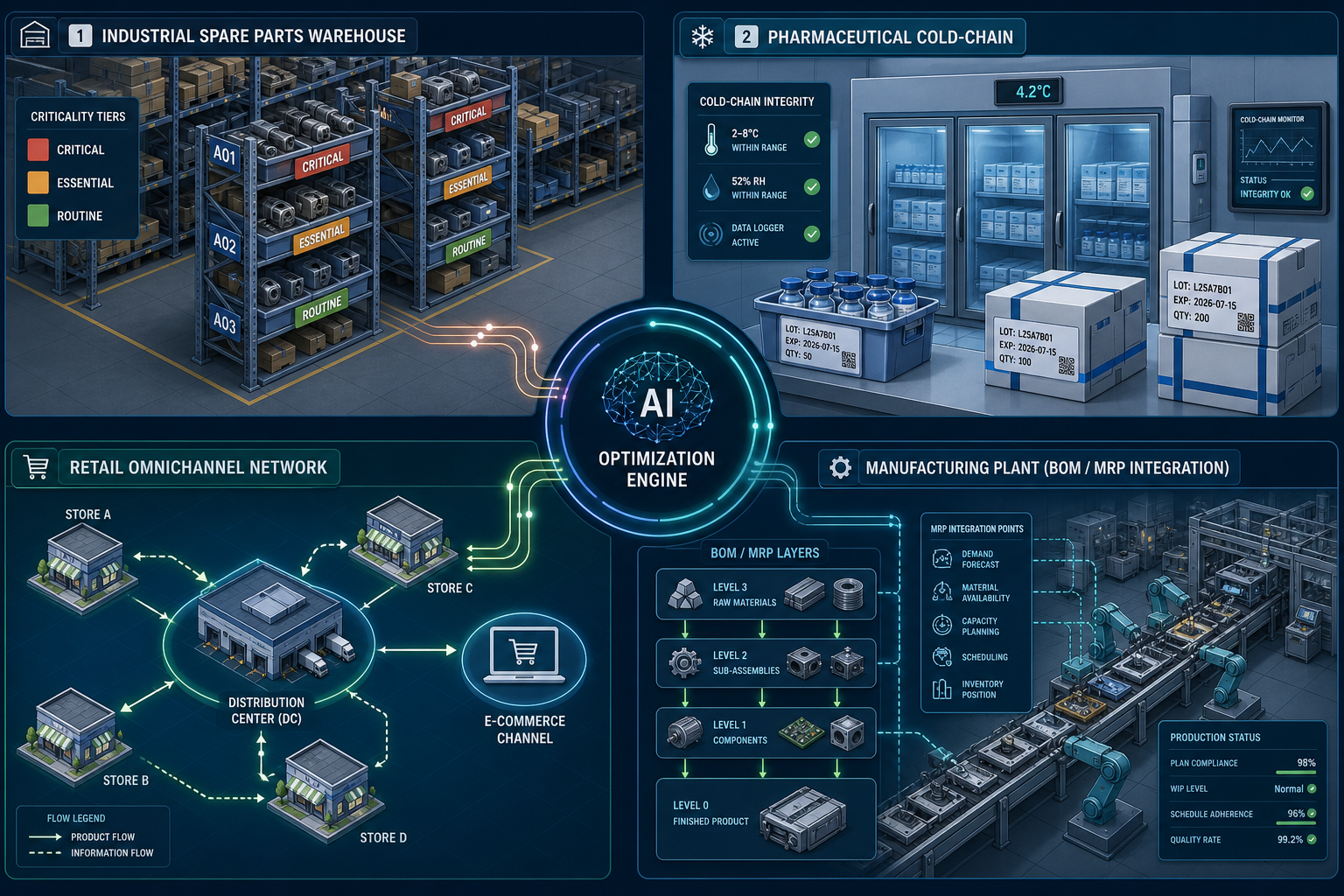
Why Industry Vertical Changes More Than MEIO Configuration
Most MEIO deployment failures are not caused by bad software. They are caused by applying a technique class built for one operational context to a different one — then adjusting parameters when the problem is actually the model architecture.
Stochastic demand modeling with Gaussian assumptions works well when demand is continuous and relatively symmetric — which describes CPG and mid-velocity retail reasonably well. It performs poorly when demand is intermittent and lumpy, which is the norm in spare parts and MRO. Reinforcement learning for autonomous replenishment is emerging in high-SKU retail environments but is not yet a deployable model in pharmaceutical supply chains, where regulatory traceability and human-in-the-loop governance requirements make autonomous optimization impractical at this stage. BOM dependency modeling — essential in discrete manufacturing — is simply absent from standard distribution-focused MEIO implementations.
The four verticals covered here — spare parts and MRO, pharmaceutical, retail and omnichannel, and discrete manufacturing — each require a different answer to the same foundational question: which AI technique class fits this demand structure, this data environment, and these service-level definitions?
Spare Parts and MRO: Intermittent Demand, Criticality Weighting, and Data Deduplication
Spare parts and MRO inventory presents three structural challenges that disqualify standard MEIO configurations before they can be tuned: the demand signal is wrong for Gaussian models, the service priority logic is wrong for ABC classification, and the underlying material data is frequently too corrupted to optimize against.
Intermittent Demand Requires Different Forecasting Architecture
Most spare parts exhibit intermittent or lumpy demand — long periods of zero consumption punctuated by irregular, often large draws. Standard Gaussian-based forecasting, which assumes a continuous and roughly symmetric demand distribution, systematically underestimates the probability of zero-demand periods and overestimates the reliability of average consumption as a planning signal.
The appropriate technique class for this demand pattern is either Croston's method (which separates the demand interval from the demand size into two independent processes) or Negative Binomial distribution models, which accommodate the overdispersion characteristic of lumpy demand. AI-enhanced implementations extend these statistical foundations with ML models trained on historical failure patterns and real-time consumption signals, enabling maintenance-heavy industries to reduce long-tail part inventory by 10–20% while maintaining above 95% service levels for top-critical SKUs — though these figures reflect specific deployment contexts and should not be treated as universal benchmarks.
Criticality-Weighted Safety Stock Is Not ABC Classification
In retail, ABC classification ranks SKUs by sales velocity or revenue contribution. In spare parts, service priority must be driven by equipment criticality — specifically, by the consequence of a stockout in terms of downtime cost, safety risk, and production impact. A low-velocity part that supports a single-point-of-failure machine in a continuous process plant may warrant near-zero stockout tolerance despite moving fewer than five units per year.
AI-driven criticality classification in spare parts MEIO incorporates failure patterns, cost-versus-downtime risk, and lead-time variability to assign buffer priorities. High-criticality SKUs receive priority buffers with near-zero stockout tolerance even when they move rarely. For the upstream lead time data that feeds these safety stock calculations, see the AI for Supplier Lead Time Variability Prediction: Use Case Record.
MRO Data Quality Is a Prerequisite Problem, Not a Tuning Problem
The most underestimated barrier to spare parts MEIO is data quality. Across asset-intensive manufacturers, 40–60% of MRO data is inaccurate or duplicated across ERP systems. Multiple ERP instances create material master silos that block cross-site visibility. When operations cannot trust material data, they overbuy as a hedge — producing bloated warehouses while maintenance teams still face shortages of the specific parts they need.
AI solves both sides of this problem before MEIO optimization can run: automated material recognition matches parts across systems even when descriptions differ, detecting duplicates and equivalencies; cross-site visibility aggregates consumption and inventory positions into a single source of truth across global facilities. Without this deduplication step, MEIO is optimizing against a corrupted signal and will produce recommendations that planners correctly distrust.
A documented example: a top-five global beverage producer with six global zones identified over $115 million in optimization opportunity over three years after unifying material data and enabling predictive optimization based on verified usage and criticality data. This figure reflects a specific program scope at a single organization and should not be generalized as a typical outcome.
Pharmaceutical: FEFO Constraints, Cold Chain Integrity, and Human-in-the-Loop Planning
Pharmaceutical supply chains impose three hard constraints on MEIO that are absent from every other vertical in this comparison: first-expired-first-out inventory rotation, cold chain integrity monitoring, and lot-level regulatory traceability. Each one narrows the deployable AI model and raises the data prerequisite threshold.
The Constraint Stack: FEFO, Cold Chain, and Traceability
- FEFO rotation: Inventory must be consumed in expiration-date order. MEIO recommendations that reposition stock across echelons must account for shelf-life state at each location — a standard stochastic replenishment model that ignores aging risk will generate policies that accelerate waste and increase obsolescence cost.
- Cold chain integrity: Temperature-controlled products require continuous monitoring of storage and transit conditions. The biopharma industry loses approximately $35 billion annually due to cold chain failures including lost product and root cause analysis costs — a figure from a 2019 industry survey that, while aging, indicates the scale of the exposure. MEIO must integrate cold chain integrity signals as a constraint on inventory placement decisions, not treat all storage locations as equivalent.
- Lot-level traceability: FDA DSCSA and EU FMD requirements mandate end-to-end traceability at the package level. Any inventory repositioning decision generated by MEIO must be auditable at the lot level — a requirement that eliminates optimization approaches that aggregate inventory positions without maintaining lot-level master data.
Drug Shortage Pressure Raises the Stakes
The operational context for pharma MEIO is not abstract. At least 216 active drug shortages persisted in the US into 2025 after reaching record levels in 2024 (ASHP data). European pharmacists were spending nearly 11 hours per week managing disrupted supply chain consequences. These figures — which practitioners should verify against current ASHP data before using in planning arguments — reflect a sector where inventory positioning failures have direct patient care consequences, not just financial ones.
The Deployable Model Is Augmentation, Not Autonomous Optimization
Given these constraints, the AI model that is actually deployable in pharmaceutical MEIO is human-in-the-loop decision augmentation — not autonomous optimization. Reinforcement learning for autonomous replenishment, which is emerging in high-SKU retail, is not production-ready in pharma at scale. The regulatory environment, the lot-level data requirements, and the patient safety stakes all require planner review and sign-off on material repositioning decisions.
A supply chain AI copilot model in pharmaceutical planning has been documented achieving 2–3% supply-chain cost reduction, 15% forecast accuracy improvement, and 20–30% reduction in planning workload. These figures reflect a specific implementation context and should be treated as directional, not as guaranteed outcomes.
A documented pharma deployment: a pharmaceutical company whose inventory had doubled from approximately 100 to over 200 days of supply following the pandemic — driven by legacy rules, fragmented spreadsheets, and disconnected assumptions across APIs — resolved the imbalance through an end-to-end AI-driven inventory model that connected testing cycles, lead times, service targets, and production constraints across all echelons, releasing tens of millions from working capital. The specific organization and program scope are not fully disclosed in available documentation; the figure should be treated as illustrative of the problem class, not as a benchmark.
Retail and Omnichannel: POS Demand Sensing, Promotional Uplift, and Echelon Structure
Retail MEIO operates across a store-DC-e-commerce echelon structure where the dominant source of demand variability is not baseline consumption patterns — it is promotional events, seasonal shifts, and localized demand signals that standard replenishment models miss entirely. Getting the demand signal right is a prerequisite to getting inventory placement right.
POS Demand Sensing and Promotional Uplift as Prerequisite Inputs
Advanced demand sensing in retail integrates point-of-sale data, weather patterns, promotional calendars, and social media sentiment to predict localized demand variations. Without these inputs, the MEIO model is optimizing against a demand signal that systematically underrepresents the actual variability drivers. A promotional event that doubles store-level demand for two weeks is invisible to a model trained only on historical shipment data.
Promotional uplift modeling must be integrated as a structured input — not as a manual override after the fact. This means promotional calendars must be available in a machine-readable format, linked to SKU-location combinations, and fed into the MEIO replenishment engine before the event, not corrected for afterward.
For the detailed forecasting methodology that feeds retail MEIO replenishment decisions — including POS demand sensing models and short-lifecycle SKU handling — see Probabilistic Demand Forecasting for Short-Lifecycle SKU Retail. This record does not duplicate that methodology.
Retail-Specific Concerns: Markdown Risk and Fast-Fashion Turnover
Retail MEIO must account for markdown risk and inventory turnover dynamics that are absent from pharmaceutical or spare parts contexts. In fast-fashion and seasonal merchandise, excess inventory at the end of a selling window is not a holding cost problem — it is a margin destruction problem. MEIO in these contexts must balance service-level objectives against the cost of unsold inventory at end of season, which requires a different objective function than standard safety stock minimization.
Stochastic demand modeling suits CPG and retail contexts well because demand, while variable, is generally continuous and can be characterized by probability distributions that reflect real-world volatility rather than average conditions. Reinforcement learning for autonomous replenishment is emerging in high-SKU retail environments but is not yet production-ready at scale — it should be treated as a near-term development direction, not a current deployment option.
For seasonal demand variability and safety stock positioning across store-DC echelons, see AI-Assisted Dynamic Safety Stock Optimization for Seasonal SKUs — this record cross-references that methodology rather than reproducing it.
Discrete Manufacturing: BOM Dependencies, Shared Component Pooling, and MRP Integration
Manufacturing MEIO differs from distribution MEIO in one structural way that matters more than any configuration parameter: the demand for components is derived, not independent. A finished goods demand signal must be decomposed through bill-of-materials logic before component-level inventory optimization can run. Standard distribution MEIO does not account for this.
BOM Dependencies and Shared Component Pooling
When a component is shared across multiple product lines — which is common in discrete manufacturing — standard MEIO will optimize inventory buffers for each product line independently and miss the pooling opportunity. AI-driven MEIO in manufacturing identifies multi-parent components, BOM dependencies, and shared critical parts, then optimizes buffer distribution to reduce overstocking at product-specific locations. This pooling calculation is not a feature addition — it requires a fundamentally different model architecture than distribution MEIO.
MRP Integration as a Hard Prerequisite
Manufacturing MEIO must integrate with MRP logic — specifically, it must receive planned production orders, firm orders, and capacity constraints as inputs before generating replenishment recommendations. Without MRP integration, the MEIO model will generate component-level recommendations that conflict with production schedules, creating the appearance of optimization while actually increasing expediting costs.
Production campaign economics add a further complication absent from distribution contexts. Batch size optimization and setup cost amortization affect the economically rational inventory placement differently than in a continuous replenishment environment. A manufacturing MEIO model that ignores campaign economics will underestimate the cost of small, frequent replenishments and generate policies that erode production efficiency.
In automotive and manufacturing, MEIO requirements extend to multi-tier supplier coordination, component synchronization, and aftermarket parts optimization based on vehicle population analysis and failure rate predictions. For supplier-side lead time data that feeds manufacturing safety stock calculations, see the AI for Supplier Lead Time Variability Prediction: Use Case Record.
Caterpillar's global service parts network — which achieves 98% fulfillment of customer parts orders within 24 hours across manufacturing facilities, regional distribution centers, dealer locations, and customer sites — is a frequently cited reference point for manufacturing MEIO at scale. This outcome reflects Caterpillar's specific network design, decades of parts data, and integrated dealer systems; it is not a replicable benchmark for organizations without comparable infrastructure.
Cross-Vertical Comparison: AI Technique Fit, Data Prerequisites, and Failure Modes
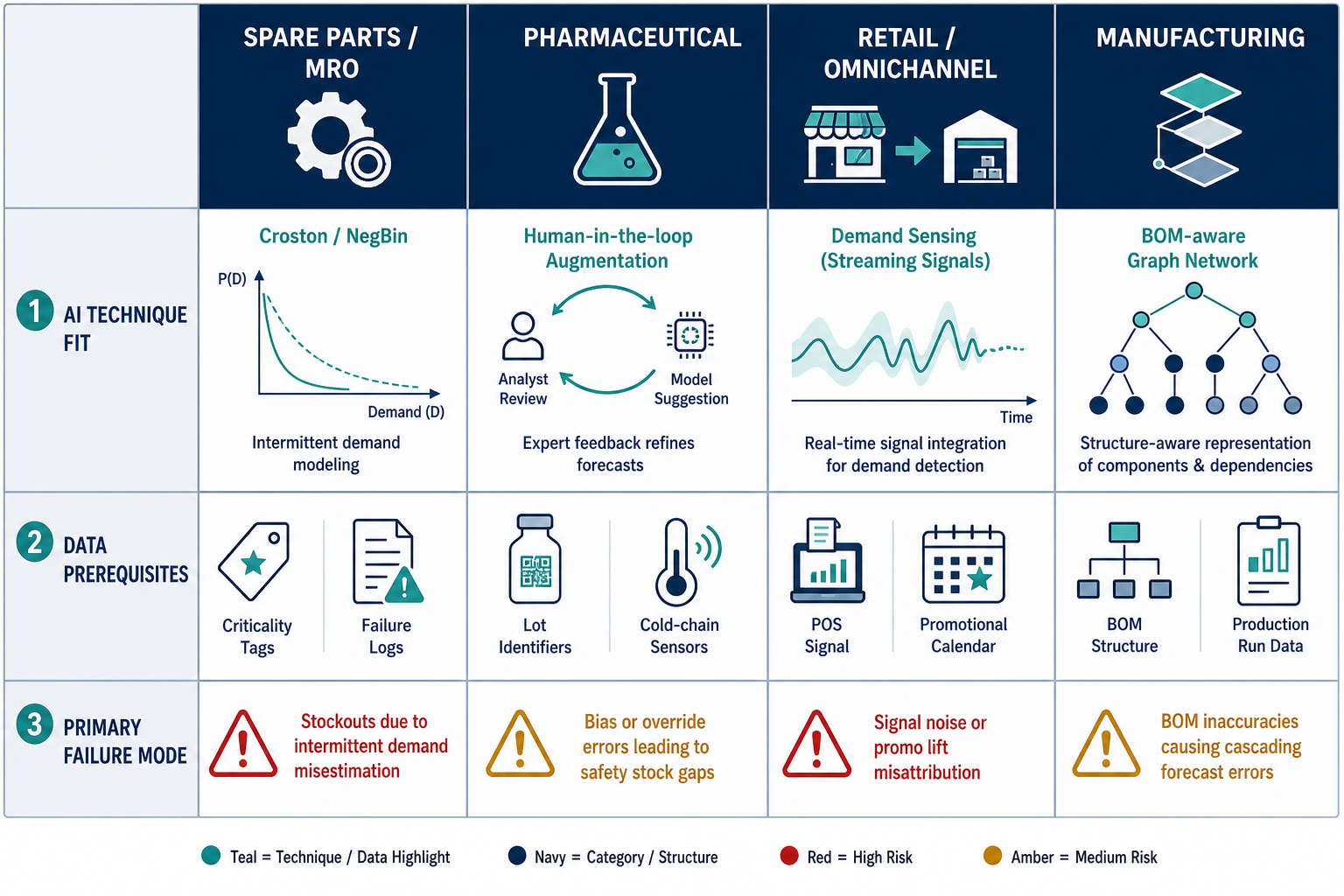
| Dimension | Spare Parts / MRO | Pharmaceutical | Retail / Omnichannel | Discrete Manufacturing |
|---|---|---|---|---|
| AI technique fit | Croston's method or Negative Binomial for intermittent demand; ML-enhanced criticality classification | Human-in-the-loop decision augmentation; FEFO-aware stochastic modeling; not autonomous optimization | Stochastic demand modeling; POS demand sensing with promotional uplift integration; RL emerging but not production-ready | BOM-aware optimization with shared component pooling; MRP-integrated replenishment; campaign economics modeling |
| Minimum data prerequisites | Criticality ratings per SKU; historical failure patterns; deduplicated cross-site material master; lead time history by supplier | Lot-level master data with expiration dates; cold chain monitoring integration; end-to-end traceability linkage (DSCSA/FMD) | POS transaction history (minimum 2 years recommended); structured promotional calendars linked to SKU-location; echelon structure mapped | Verified BOM accuracy; production run history with batch sizes and setup costs; MRP integration feasibility confirmed; supplier lead time data |
| Primary failure mode | Gaussian forecasting applied to intermittent demand; ABC logic substituted for criticality weighting; optimization against duplicated/corrupted material data | Autonomous optimization attempted without lot-level data or human review; FEFO constraints not modeled; traceability audit trail absent | Promotional events not integrated as structured inputs; demand sensing signal incomplete; markdown risk not included in objective function | BOM-unaware model generating conflicting component recommendations; MRP integration missing; campaign economics ignored in replenishment policy |
| Representative outcomes (with scope caveats) | $115M optimization opportunity identified at a top-5 global beverage producer (Verusen; single organization, 3-year program scope) | 2–3% supply-chain cost reduction, 15% forecast accuracy improvement, 20–30% planning workload reduction (pharma copilot model; specific program not fully disclosed); tens of millions released from working capital in one pharma case (Sophus) | P&G: ~20% inventory reduction across participating business units (specific program scope; not full enterprise); broader CPG stochastic MEIO outcomes vary by SKU velocity and promotional intensity | Caterpillar: 15% holding cost reduction and 10% production efficiency gain (SRM Tech; specific network and program scope); J&J: 25% inventory cost reduction and 30% stockout reduction (SRM Tech; specific program scope) |
Practitioner Decision Framework: Vertical-Specific Conditions for MEIO Applicability
The following conditions are go/no-go criteria — not aspirational targets. If a condition is not met, MEIO deployment in that vertical will produce unreliable recommendations or fail to sustain planner adoption. Address the gap before selecting a platform.
Spare Parts and MRO: Go/No-Go Conditions
- Criticality ratings exist for the SKU population: Each part must be classified by equipment failure consequence and downtime cost — not by sales velocity. If criticality data does not exist, build it before deploying MEIO.
- Historical failure pattern data is accessible: At minimum, maintenance work order history linked to part consumption. Without this, the intermittent demand model has no failure signal to learn from.
- Cross-site material data has been deduplicated: If multiple ERP instances exist, material master deduplication must precede MEIO deployment. Optimizing against a 40–60% duplicate rate will produce recommendations that are systematically wrong.
- Predictive maintenance alignment is planned: If the organization has or is implementing predictive maintenance, the MEIO model must integrate planned shutdown schedules so critical parts are positioned before maintenance events, not ordered reactively.
Pharmaceutical: Go/No-Go Conditions
- Lot-level master data is maintained and current: Expiration dates, lot identifiers, and location assignments must be accurate at the lot level. FEFO rotation and regulatory traceability both fail without this.
- Cold chain monitoring is integrated into inventory data: Temperature excursion events must be linked to affected inventory records so the MEIO model can exclude compromised stock from available supply calculations.
- Human-in-the-loop governance is designed into the workflow: The deployment model must include planner review and sign-off on material repositioning decisions. Autonomous execution is not the appropriate model for pharmaceutical MEIO at current AI maturity.
- End-to-end traceability audit trail is confirmed: Any inventory movement recommended by the MEIO system must be auditable at the package level to satisfy FDA DSCSA and EU FMD requirements.
Retail and Omnichannel: Go/No-Go Conditions
- POS signals are accessible at the SKU-location level: Shipment data or aggregate sales data is not a substitute. The demand sensing model requires store-level POS transaction data to detect localized demand variation.
- Promotional calendars are structured and machine-readable: Promotional events must be available as structured data linked to SKU-location combinations and time windows — not as spreadsheets or narrative marketing plans.
- Echelon structure is mapped and agreed: The store-DC-e-commerce echelon structure must be formally defined, including which nodes serve which channels and what the replenishment lead times are between echelons.
- Markdown risk is included in the objective function: For seasonal and short-lifecycle SKUs, a MEIO model that optimizes only for service level without penalizing end-of-season excess will systematically overbuy.
Discrete Manufacturing: Go/No-Go Conditions
- BOM accuracy is verified: The bill-of-materials data that feeds component-level demand derivation must be current and accurate. Stale or incomplete BOMs will propagate errors through every downstream optimization calculation.
- MRP integration is technically feasible: The MEIO platform must be able to receive planned production orders and capacity constraints from the MRP system in near-real-time. Batch integration with multi-day latency will produce recommendations that conflict with active production schedules.
- Production run data is accessible: Historical batch sizes, setup costs, and campaign frequencies must be available to calibrate the campaign economics model. Without this, the MEIO will generate component replenishment policies that erode production efficiency.
- Shared component pooling is identified: Multi-parent components — those used across multiple product lines — must be identified before deployment. If the MEIO model does not know which components are shared, it will optimize each product line's buffer independently and miss the pooling benefit.
Comments
Join the discussion with an anonymous comment.