

The hard part of applying AI in the supply chain is no longer proving that a model can forecast better, recommend an allocation, flag a disruption, or automate a planning step. Most senior supply chain teams have already seen something work in a controlled setting. The harder question is why the pilot did not change the operating rhythm of the business.
That gap is visible in the market data, with an important caveat: the numbers come from different surveys, so they should not be treated as a single matched benchmark. ABI Research found that 94% plan to deploy AI within two years, while Gartner reported in 2025 that only 23% of supply chain organizations had a formal AI strategy.[1] The comparison is still useful because it captures the executive condition many companies are living in: intent is high, pilots are common, and the management system around AI is still underbuilt. For a deeper read on that split, see The Supply Chain AI Adoption Paradox.
The familiar failure statistic should be read in that context, not used as theater. BCG’s 2025 finding, cited by RELEX, is that 85% of AI initiatives deliver close to zero measurable value; RELEX frames the failure as primarily organizational rather than technical.[2] That matches what tends to happen after a steering committee celebrates a promising pilot. The model remains clever. The decision rights stay vague. The planner does not know whether the recommendation is advisory or binding. IT inherits a data reconciliation problem. Finance is asked to validate value after the process has already been redesigned informally. Six months later, the pilot is still admired and still peripheral.

A pilot fails when the enterprise cannot absorb it
A failed pilot is not always a failed technology test. Often it is a successful demonstration trapped inside an immature operating model. The organization learned that the algorithm could do something useful, but it did not decide who would own the new decision, what data would be trusted, how exceptions would be governed, how incentives would change, or what finance would count as value.
Four failure patterns show up repeatedly. The first is deploying technology before defining the business problem with enough operational specificity. “Improve forecast accuracy” is not specific enough. A better problem statement names the planning decision, the latency in today’s process, the cost of that latency, the decision maker, the exception path, and the value measure. Without that, a team can build a technically impressive model that nobody is obligated to use.
The second pattern is bypassing data foundations. This does not mean waiting for immaculate data. PwC’s 2026 Digital Trends in Operations Survey found that 84% of supply chain leaders are comfortable making decisions without perfect data.[3] That is a healthy instinct when the alternative is paralysis. But comfort with imperfect data is not permission to scale AI on unreconciled product hierarchies, inconsistent lead-time logic, unclear substitution rules, or master data that every region interprets differently. Progress can tolerate imperfection; enterprise automation cannot tolerate ambiguity in the fields that drive decisions.
The third pattern is treating AI as a technology upgrade instead of a change to work. Deloitte’s 2026 State of AI work found that worker access to AI rose 50% in 2025, yet insufficient worker skills remained the top barrier to integration; it also found that 84% of enterprises had not redesigned roles or workflows around AI capabilities.[4] That is the access trap. Giving people tools is not the same as redesigning the work they are accountable for.
The fourth pattern is unclear accountability. AI programs stall when the business sponsor believes IT owns adoption, IT believes the business owns process change, transformation owns the meeting cadence, and finance is invited only when someone needs an ROI number. The more agentic the workflow becomes, the less tolerable that ambiguity is. For a companion discussion of why these patterns keep pilots from scaling, see The Execution Gap in AI-Powered Supply Chains.
Use maturity stages to locate the work, not to decorate the roadmap
The following maturity path is a practical way to diagnose where an organization is and what must change next. It is not a universal standard. It draws on maturity thinking from RELEX, Gartner, and Deloitte, and it is most useful when leaders treat it as an operating-model lens rather than a label.[1][2][4]
| Maturity stage | What usually changes | What commonly stalls |
|---|---|---|
| Rigid rule-based systems | Rules, alerts, thresholds, and planning calendars govern decisions. | The business problem is often defined too broadly, and exception ownership is unclear. |
| Foundational specialized AI | Models support bounded decisions such as forecasting, replenishment, allocation, or anomaly detection. | Data definitions, master data quality, and value baselines become the constraint. |
| Assistive and agentic AI | AI recommends, explains, drafts, escalates, or initiates actions within a workflow. | Roles, review rights, skills, and workflow redesign lag behind the capability. |
| Multi-agent orchestration | Multiple AI-enabled agents coordinate across planning, inventory, logistics, procurement, and commercial signals. | Governance, accountability, control points, and enterprise value tracking must operate across functions. |
The table matters because the same AI use case behaves differently at each stage. A demand-sensing model inside a rigid planning process may only create another alert. The same capability embedded in an assistive workflow may change the planner’s daily queue, the escalation path to sales, and the inventory decision reviewed in S&OP. At orchestration level, it may trigger dependent actions across replenishment, deployment, supplier communication, and transportation planning. The technology label is less important than the decision system around it.
Stage 1: Rigid rule-based systems
Many companies begin here even after they have run AI pilots. The core planning system still depends on static thresholds, fixed exception rules, spreadsheet workarounds, and meeting-based reconciliation. AI may sit beside the process, but the actual enterprise decision still follows the older path.
At this stage, the main failure pattern is deploying technology before the problem has been defined. The organization should not start by asking which model to scale. It should name the decision that needs to improve. Is the problem late recognition of demand shifts? Poor inventory deployment across nodes? Slow response to supplier disruption? Excess manual effort in exception triage? Each answer implies a different owner, data dependency, workflow, and value measure.
Governance at this stage is deliberately narrow. Leaders should define the decision boundary, the escalation rule, and the value baseline before widening deployment. A rule-based process can still be valuable if it forces clarity about who decides what. The danger is pretending that an AI recommendation has changed the business when the same unresolved exception is merely being presented in a better interface.
Stage 2: Foundational specialized AI
The second stage is where many supply chain AI programs look most credible. The organization applies specialized models to bounded problems: demand forecasting, replenishment parameters, inventory optimization, promotion response, ETA prediction, or anomaly detection. The pilot is easier to govern because the decision is relatively contained.
This is also where data foundations stop being an abstract concern. If product-location hierarchies are inconsistent, if actual lead times are overwritten manually, if lost sales are not visible, or if supplier constraints live outside the system of record, the model may still perform in a pilot and still fail at scale. The issue is not that the data is imperfect. The issue is that no one has decided which data definitions the enterprise will operationally trust.
RELEX points to examples such as Blount Fine Foods and Rastelli Foods as companies using data maturity and data-driven transformation as part of their AI-to-ROI path; these are useful grounding signals, not proof that every company will follow the same route or achieve the same return.[2] The practical lesson is narrower and more reliable: specialized AI scales better when data ownership, planning definitions, and value baselines are treated as part of the implementation, not as cleanup work after deployment.
A company at this stage should be able to answer five questions without sending the program team on a week-long fact-finding exercise:
- Which business decision does the model improve?
- Which data elements are decision-critical rather than merely useful?
- Who owns those data elements operationally?
- What is the baseline for value measurement?
- What happens when the AI recommendation conflicts with planner judgment?
If those answers are missing, the program is not ready for broad rollout even if model accuracy improved in the pilot. Readers who want a diagnostic view can use A Multi-Framework Diagnostic for Your Supply Chain AI Maturity as a separate self-assessment.
Stage 3: Assistive and agentic AI
The third stage is where the operating model starts to bend. AI no longer only predicts; it assists, drafts, recommends, explains, prioritizes, and in some cases initiates steps for review. Agentic workflows can reduce manual triage and compress the time between signal detection and action. They can also expose every weak handoff the old process had been hiding.
A planner who previously reviewed a full exception report may now receive a ranked queue with recommended actions. A procurement manager may receive a supplier-risk escalation with suggested alternatives. A logistics analyst may see transport exceptions grouped by likely service impact. In each case, the human role changes. The person is no longer only calculating, searching, and reconciling; they are reviewing, challenging, approving, and handling edge cases. That is different work, and it requires different expectations.
This is where the workforce data should reset executive expectations. Deloitte found that only 6% of organizations saw ROI in under one year, with most taking two to four years.[4] The finding should not be read as an excuse for slow delivery. It is a warning against business cases that assume a pilot result will become enterprise ROI inside one budget cycle. The work between those points includes workflow redesign, skills development, adoption management, integration, governance, and value tracking.
The same Deloitte research found that only 20% of enterprises attributed AI initiatives to revenue growth.[4] That does not mean AI cannot affect revenue. It means many organizations have not connected the technology to the commercial and operational mechanisms through which revenue would actually move: better availability, fewer lost sales, faster response to demand shifts, improved service reliability, or more precise allocation during constraint. If the route to value is not named, finance cannot validate it later.
The operating question at this stage is not “Will users adopt AI?” It is “What part of their old job disappears, what new judgment do they exercise, and who will back them when the new workflow produces a different answer?” For more on the human side of this transition, see The People Side of AI Procurement Transformation.
Stage 4: Multi-agent orchestration
Multi-agent orchestration is the point at which AI-enabled components coordinate across domains rather than optimizing inside one function. A demand signal may affect replenishment, inventory deployment, supplier communication, transport planning, and customer allocation. A disruption signal may trigger scenario evaluation, sourcing review, service-risk prioritization, and executive escalation.
The architecture language can sound futuristic, but the management problem is very old: who has the right to change the plan? A composable approach, such as the Bünting Group example noted by RELEX, can help organizations assemble capabilities more flexibly; it does not remove the need to define control points, approval rights, and cross-functional consequences.[2]
At this stage, unclear accountability becomes the limiting factor. If an AI agent recommends shifting inventory from one market to another, the inventory team may see working-capital improvement, the sales team may see service risk, logistics may see cost impact, and finance may see a margin tradeoff. Orchestration does not make those tradeoffs disappear. It makes them faster and more visible. Governance must catch up.
That is why mature supply chain AI is associated with broader enterprise capability, not simply with more deployed tools. Accenture research cited in secondary reporting found that companies with AI-mature supply chains are 23% more profitable and six times as likely to use AI or generative AI widely.[5] The safest reading is not that AI maturity automatically causes that profitability gap. The narrower and more useful reading is that companies able to use AI widely in supply chain tend to have also built the management disciplines that let technology affect enterprise performance.
The four roles that turn maturity into an operating model
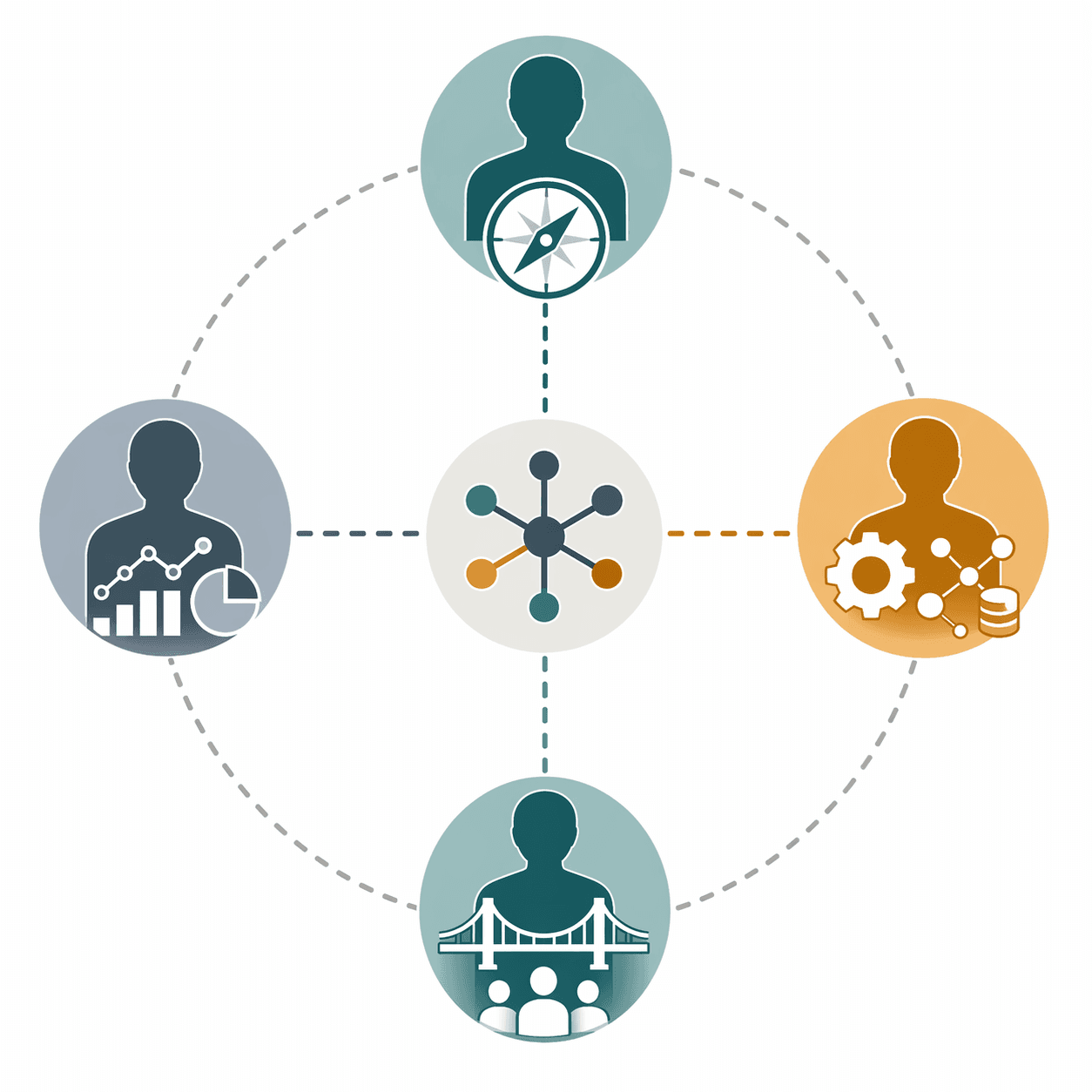
RELEX’s framework identifies four essential transformation roles: Business Owner, Technology Enabler, Change Champion, and Value Tracker.[2] The names are plain, which is part of their usefulness. They force the executive team to stop treating “AI program owner” as a single heroic job title.
Business Owner
The Business Owner owns the decision and the outcome. This is not ceremonial sponsorship. If AI is being used to change replenishment, allocation, forecasting, production planning, or supplier response, the Business Owner must be able to say which decision will change, which exceptions remain human-controlled, and what tradeoffs are acceptable. Without that role, AI teams drift toward building capability rather than changing performance.
The Business Owner also protects the program from generic success metrics. A forecast model may improve accuracy and still fail to reduce waste, improve availability, or lower expediting if the downstream decisions do not change. The owner’s job is to keep the model tied to the operating lever that actually matters.
Technology Enabler
The Technology Enabler owns the architecture, integration, security, data flow, and technical reliability required for scale. This role is often underestimated after a pilot because the pilot team found a way to make the data work. Enterprise deployment is less forgiving. It needs repeatable feeds, monitored data quality, integration with planning systems, access controls, model governance, and a way to support the workflow after the original project team moves on.
This role should not be reduced to “IT support.” The Technology Enabler is the person who can tell the steering team which data shortcuts will break at scale, which architecture decisions create lock-in, and which integration dependencies will determine the rollout pace.
Change Champion
The Change Champion owns adoption as work redesign, not as communications. This role identifies which planners, buyers, schedulers, logistics coordinators, customer service teams, and managers will work differently. It also surfaces the uncomfortable questions: which manual checks go away, which meetings disappear, which approvals move earlier or later, which exceptions are no longer reviewed by default, and which managers will be held accountable for using the new process.
This is where middle management matters. If supervisors still ask for the old spreadsheet “just to be safe,” the new workflow becomes an extra layer. If performance reviews still reward firefighting more than prevention, agentic recommendations will be ignored when they make work less visible. The Change Champion has to remove old work, not merely introduce new tools.
Value Tracker
The Value Tracker owns the measurement routine. This is usually the role that arrives too late. A project reaches the end of deployment, the executive team asks for ROI, and finance is handed a bundle of model metrics, adoption statistics, and anecdotal wins. That is not value tracking. Value tracking begins before rollout with a baseline, a benefits hypothesis, a measurement owner, and a cadence for separating AI impact from other business changes.
The Value Tracker should decide, with the Business Owner and finance partner, whether the program is expected to affect margin, inventory, service, waste, labor productivity, expediting, forecast bias, planner capacity, or some combination of these. Not every benefit needs to be converted into a single ROI number immediately. But every claimed benefit needs a measurement path.
What ROI milestones should look like over two to four years
The Deloitte finding that one-year ROI is uncommon should change the way leaders stage commitments.[4] A two-to-four-year path does not mean waiting years to see whether anything worked. It means using different milestones at different points in the maturity journey.
| Time horizon | What leaders should expect to prove | What should not be overclaimed |
|---|---|---|
| First 6–12 months | Decision focus, baseline, data readiness, pilot validity, workflow fit, and early adoption in a bounded area. | Enterprise ROI or broad financial attribution. |
| Year 1–2 | Repeatable deployment pattern, role redesign, integration stability, planner or manager behavior change, and measurable movement in selected operational indicators. | That access to AI equals adoption, or that model metrics equal business value. |
| Year 2–4 | Scaled benefits across functions or regions, finance-validated value routines, governance maturity, and operating-model durability. | That all value came from AI alone without considering process, data, and organizational changes. |
This timeline is uncomfortable only if the business case was built on a shortcut. A serious AI roadmap can still be impatient. It can require early proof, stop weak initiatives, and redirect funding quickly. What it cannot do is declare enterprise value before the organization has changed the decisions, roles, data flows, and measurement routines through which value is created.
Broad ROI ranges in the market can be useful for sizing ambition, but they should not be used as guarantees. Cost reductions, service improvements, or working-capital gains depend on maturity, data quality, process adoption, and the baseline condition of the business. A company with chaotic master data and inconsistent decision rights is not buying the same outcome as a company with disciplined planning governance.
A practical sequence for moving from pilot to profit
The path does not need to become a giant transformation diagram. It does need to be sequenced. A useful executive cadence looks like this:
- Name the decision, not the technology. Define the operational problem, the owner, the exception path, and the value lever.
- Locate the maturity stage. Decide whether the organization is still rule-based, running specialized AI, redesigning assistive workflows, or preparing for cross-functional orchestration.
- Identify the blocking failure pattern. Do not solve for all maturity problems at once; solve the one that will prevent the next stage from working.
- Assign the four roles by name. Business Owner, Technology Enabler, Change Champion, and Value Tracker must be explicit, not implied.
- Set stage-appropriate milestones. Early milestones should prove decision fit and adoption; later milestones should prove repeatability and finance-validated value.
- Remove old work as new workflows go live. If the old spreadsheet, old meeting, and old approval path remain untouched, the AI layer will become overhead.
This is also where leaders should be honest about readiness. A company can be confident about AI and still be unready for scale. Gartner’s 2025 strategy data is one way to examine that gap more closely; see Gartner’s 2025 Supply Chain AI Maturity Data Decoded and The Gartner AI Strategy Paradox. For a broader maturity companion, see The Supply Chain AI Maturity Playbook.
The executive conclusion is simple enough to say and hard enough to execute: profit does not come from deploying AI more widely. It comes from moving deliberately through maturity stages while fixing the organizational patterns that keep pilots from becoming repeatable enterprise capability.
References
- Gartner Supply Chain AI Strategy Research, Gartner, June 2025, gartner.com
- AI-to-ROI framework, RELEX, relexsolutions.com
- 2026 Digital Trends in Operations Survey, PwC, 2026, PwC 2026 Digital Trends in Operations Survey
- The State of AI in the Enterprise, Deloitte, 2026, Deloitte State of AI 2026
- Accenture AI-mature supply chain research, Accenture, 2024, Accenture research cited in multiple secondary sources
Comments
Join the discussion with an anonymous comment.