

Predictive analytics in logistics usually looks strongest before it touches the operating floor. The demo shows a late shipment before it happens, a route plan with fewer miles, or a demand forecast that smooths inventory. Then the implementation team opens the real data: customer names vary by system, product codes do not match between ERP, WMS, and TMS, delivery timestamps are missing, and nobody agrees whether “on time” means ship date, appointment arrival, proof of delivery, or customer receipt.
That is why the adoption numbers should make logistics leaders both interested and cautious. The 2024 CSCMP State of Logistics figure, as cited by SR Analytics, says 77% of logistics partners are investing in predictive analytics, while Gartner’s 2025 supply chain AI maturity benchmark says only 23% of supply chain organizations have a formal AI strategy, even among organizations already deploying AI.[1][2] In other words, the money is moving faster than the operating system around it.
A 90-day roadmap is not bureaucracy. It is the difference between testing software and changing how planning decisions are made. Measurable ROI within 6–12 months is plausible, but only if the first 90 days produce four things: cleaner data, one focused use case, agreed KPIs, and evidence that planners can compare against current practice.

The 90-day plan at a glance
| Timeframe | Primary work | Decision at the end |
|---|---|---|
| Weeks 1–4 | Audit data readiness: history, fields, codes, ownership, system gaps, KPI definitions | Is the data fit for one narrow pilot, and what must be cleaned before modeling? |
| Weeks 5–8 | Design and build one pilot around a high-cost logistics pain point | Can the model generate usable recommendations against agreed metrics? |
| Weeks 9–12 | Run controlled pilot comparisons against current planning practice | Is there enough evidence to continue into advisory-mode validation? |
| Months 4–6 | Validate in advisory mode beside human planners for 2–3 months | Does the model outperform or usefully support current practice? |
| Months 7–12 | Scale governance, integration, review cycles, and a second use case | Can predictive analytics become part of the logistics management system? |
The table is simple because the work is not. The early weeks decide whether the rest of the program has a foundation or just a presentation deck.
Weeks 1–4: audit the data before debating the model
The first month should feel less like an AI project and more like an operations, IT, and finance reconciliation session. Predictive analytics in logistics depends on historical patterns, but the immediate question is whether those patterns are actually captured in a usable way.
KNIME’s practical guide says teams generally need at least 18–24 months of clean historical data to build reliable forecasts, and that roughly 60% of project time should go into connecting and cleaning data rather than model development.[3] That ratio sounds high only to people who have not tried to match shipment history to order history after three TMS migrations and a warehouse network change.
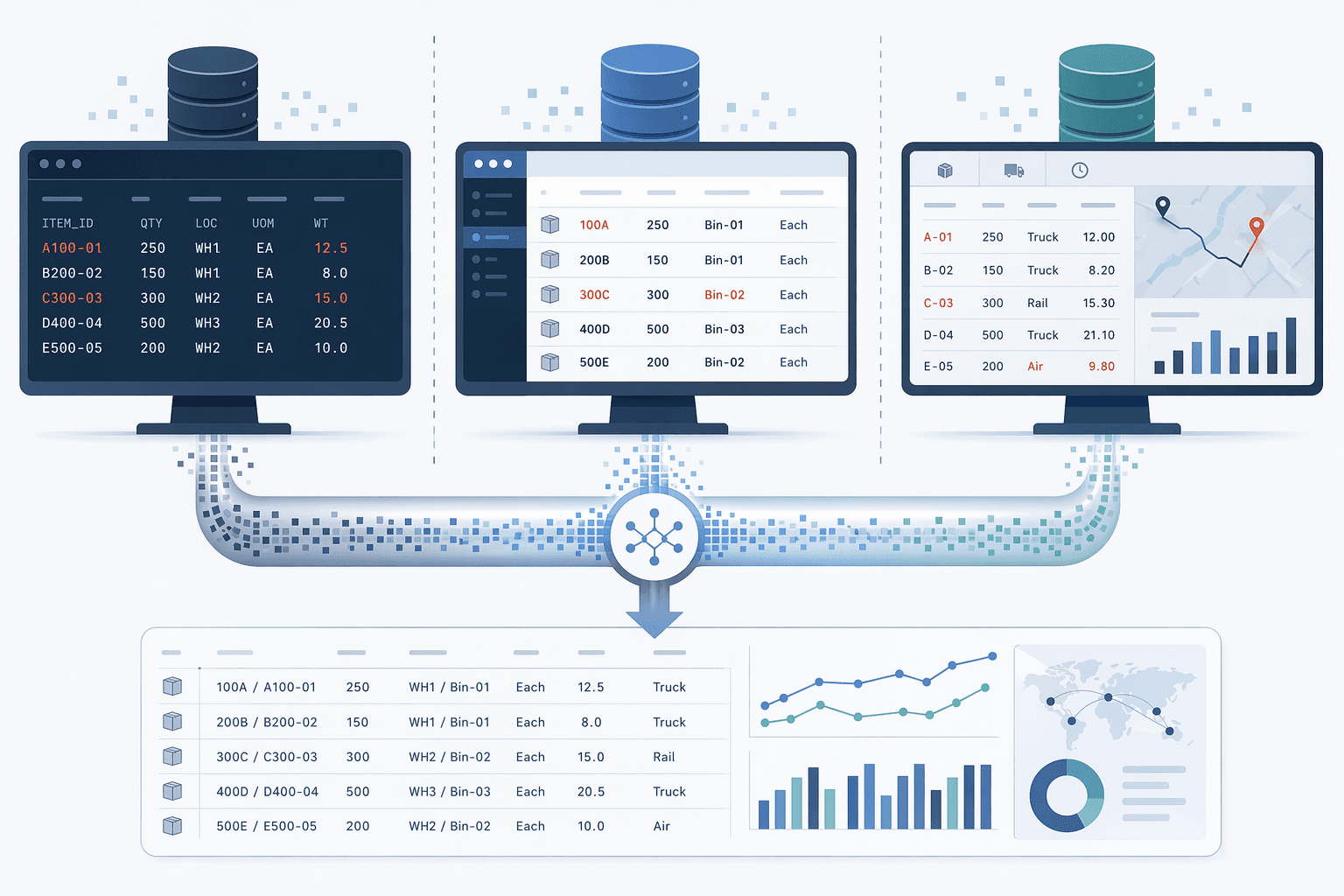
Start with one candidate use case, then audit only the data needed for that use case. A demand forecasting pilot needs order history, promotions or known demand events where relevant, stockout indicators, lead times, and product hierarchy. A route optimization pilot needs shipment origin and destination, time windows, carrier constraints, actual arrival times, route history, and exception reasons. A risk detection pilot needs supplier, lane, carrier, port, weather, transit, and delay history where those signals are available.
Do not begin by asking whether the organization has “data.” It does. The useful questions are narrower:
- How many months of history exist for the chosen lane, SKU family, customer segment, or facility?
- Which system is the system of record for orders, inventory, shipments, delivery status, carrier events, and cost?
- Where do product, customer, facility, and carrier codes fail to match across ERP, WMS, and TMS?
- Which fields are missing often enough to distort the prediction?
- Are exception codes selected consistently by planners, warehouse teams, carriers, or customer service?
- Are actuals captured at the same level as the prediction will be made?
- Who owns each source, and who is allowed to correct it?
The last question is often the most revealing. If logistics owns the KPI, IT owns the pipeline, finance owns the cost definition, and operations owns the exception code, then the pilot needs all four groups at the table before a model is trained. Otherwise the team will discover too late that a “cost reduction” measured in the analytics environment does not tie to finance’s transportation ledger.
Define the KPI as an operating rule, not a label
A KPI definition should tell a planner exactly what counts and what does not. “Forecast accuracy” is not enough. Is it measured at SKU-location-week, customer-SKU-month, or lane-day? Are stockouts excluded or treated as demand signals? Is the baseline a naive forecast, the current planning process, or last year’s actuals?
The same applies to logistics service metrics. “On-time delivery” may be measured against appointment time, requested delivery date, committed delivery date, or proof-of-delivery timestamp. If those definitions are left open, the pilot can look successful in analytics and still be disputed in the weekly service review.
The week-four gate
At the end of week four, the team should not be approving an abstract AI concept. It should approve or reject one pilot-ready data package. The package needs a named data owner, a data-quality issue log, agreed KPI formulas, a baseline period, a list of exclusions, and a decision on whether the remaining gaps are acceptable for a controlled pilot.
This is also the point to kill or defer a weak use case. If a route optimization pilot cannot access reliable time-window, stop-sequence, driver, or delivery-status data, changing algorithms will not solve the problem. If demand history is polluted by unmarked stockouts or one-time commercial events, a forecasting model may learn the noise very efficiently.
Weeks 5–12: run one pilot that operations can actually judge
The pilot should be narrow enough that planners can understand the recommendations and finance can understand the result. SR Analytics describes typical predictive analytics pilots as 8–12 weeks from kickoff to initial results, with typical budgets of $25,000–$75,000 based on its operations experience.[1] Those figures are useful as planning ranges, not as guarantees; scope discipline matters more than the midpoint of the estimate.
Pick one high-cost pain point. Do not run demand forecasting, route optimization, and risk detection simultaneously because all three sound defensible. Each requires different data, different users, and different proof.
| Pilot option | Best fit when | Example success measure |
|---|---|---|
| Demand forecasting | Inventory, service misses, or expediting are driven by poor demand signals | Forecast accuracy improves against the current planning baseline at the agreed planning level |
| Route optimization | Transportation cost, empty miles, service failures, or last-mile constraints are the visible pain | Miles, cost, or late deliveries decrease without creating unacceptable operational exceptions |
| Risk detection | Delays, supplier disruptions, lane volatility, or port and carrier issues create avoidable surprises | Earlier warning increases planner response time and reduces preventable service failures |
A pilot charter should fit on a few pages. It needs the business problem, the planning decision being improved, the users who will see the output, the baseline, the KPI target, the data included, the data excluded, the budget, the time box, and the go/no-go criteria. If the team cannot name the person whose Monday morning work changes, the pilot is still too vague.
For example, a demand forecasting pilot might aim to improve forecast accuracy from 75% to 85%, a type of target cited in SR Analytics’ implementation guidance.[1] The exact numbers must come from the organization’s own baseline. What matters is setting the target before the model runs, not after the team has found the most flattering slice of history.
During weeks five through eight, the data science or analytics team should build the first model, but operations should be involved before results are polished. Planners need to see early outputs and identify recommendations that are technically plausible but operationally unusable: a carrier that no longer serves the lane, a warehouse cutoff missed by two hours, a suggested inventory move blocked by customer allocation rules, or a delivery sequence that ignores local access constraints.
Weeks nine through twelve should compare the model against the current process. That comparison should not be theatrical. Use the same planning level, the same time horizon, and the same definition of success. If planners currently forecast at SKU-location-week, do not claim victory using a monthly regional aggregate. If dispatchers are judged on service and cost, do not optimize only for distance.
This is the point where many pilots stall. The model produces a promising number, but the organization has not decided how the recommendation will enter the TMS, who can override it, how exceptions will be captured, or whether last-mile scheduling can absorb the change. For a deeper treatment of that failure pattern, ChainSignal’s analysis of why supply chain AI pilots stall before production is a useful companion to the pilot design work.
Months 4–6: keep the model advisory until it earns trust
After the first 90 days, the safest next move is usually advisory-mode validation. Run the model beside human planners for 2–3 months and track comparative accuracy, cost, service, and exception outcomes before automating decisions.[1] This period is where planner trust is either built or permanently damaged.
Advisory mode should show the prediction, the current plan, the recommended action, and the reason the model is recommending it. A planner does not need a lecture on model architecture, but they do need to know whether the recommendation is driven by demand change, route congestion, supplier delay history, carrier performance, inventory position, or an unusual order pattern.
The review should capture overrides without treating every override as resistance. Experienced planners know things that systems miss: a customer receiving constraint, a carrier relationship issue, a sales promise, a weather disruption that has not reached the data feed. The useful question is whether those overrides reveal missing data, poor model logic, bad change management, or genuinely better human judgment.
Expansion should wait for measurable improvement. A first use case that shows better forecast accuracy, fewer preventable late deliveries, lower operating cost, or earlier risk detection has earned the right to move toward integration. A pilot that only proves the software can generate predictions has not.
Tool selection matters, but it should not lead the program
The right platform depends on the operating environment and the talent available to sustain it. Visual or low-code platforms can help mixed business and analytics teams build workflows quickly. Enterprise planning suites may fit better when the priority is integration with existing supply chain planning processes. Cloud ML platforms give data teams flexibility and scale. Custom Python or R work can be appropriate when the organization has strong technical ownership and unusual modeling needs.
None of those paths compensates for unclear ownership. A platform decision should follow four questions: Where will the recommendation appear? Who will act on it? Which system records the actual outcome? Who maintains the model, data pipeline, and KPI review after the vendor or project team leaves?
The strongest implementation teams pair supply chain domain experts with data science talent. The domain expert knows which constraints are real, which exceptions matter, and which recommendations will be ignored on the floor. The data scientist knows how to test signal, error, drift, and bias. Finance should be close enough to stop inflated ROI logic before it reaches the steering committee.
What real cases actually prove
Case studies are useful when they show an implementation lesson, not when they are treated as universal outcomes. P&G’s KNIME case study reports that the company reduced data integration response time from more than two hours to instantaneous by connecting more than 10 systems into a single real-time view.[4] The lesson is not that every logistics team will reproduce that result. It is that predictive decisions improve when the organization reduces the time and friction required to see the same operational picture.
Kärcher’s case is closer to the inventory side of the roadmap: KNIME reports a 15% reduction in inventory value while maintaining high service levels through predictive stock recommendations.[5] That kind of result depends on more than a forecast. It requires planners to trust replenishment recommendations, service rules to be explicit, and inventory outcomes to be measured in the same language operations and finance use.
Volkswagen’s case points to a quieter but important source of value: removing manual work from supplier data processes. KNIME reports that Volkswagen eliminated approximately 500 hours of manual supplier data entry work per year.[6] Lindner’s case, meanwhile, reports zero information loss between ERP and logistics systems.[7] These are not glamorous AI headlines, but they are exactly the kind of integration and process continuity that prevents predictive analytics from becoming another disconnected planning artifact.
UPS ORION is the large-scale route optimization example most logistics teams know. Publicly cited savings estimates vary, so the safer way to state the result is as a range: ORION has been associated with annual savings of roughly $100 million to $400 million through predictive route optimization.[8] The important caveat is scale and operating model. Route intelligence creates value when dispatch processes, driver execution, telematics, customer commitments, and exception handling are able to use it.
Business-case ranges are useful only after the scope is clear
ROI benchmarks can help secure leadership attention, but they should be handled with care. McKinsey has reported that AI-based forecasting can reduce errors by 20–50% compared with traditional methods, and that AI-enabled distribution can deliver 5–20% logistics cost reduction.[9][10] SR Analytics cites organizations adopting predictive analytics cutting operating costs by 15–25% within the first year while improving on-time delivery.[1]
Those ranges should not be pasted into a business case as expected savings. A lane-level route optimization pilot, an inventory forecasting pilot, and a supplier risk pilot do not draw from the same cost pool. Some benefits hit the P&L quickly. Others show up as working-capital improvement, service protection, reduced expediting, planner productivity, or fewer avoidable customer escalations.
A credible business case separates hard savings from decision-quality improvements. Hard savings may include freight cost reduction, lower premium transportation, reduced inventory carrying cost, or fewer manual hours. Decision-quality improvements may include earlier warning, better planner prioritization, or more consistent exception handling. Both can matter, but they should not be mixed into one optimistic number.
Months 7–12: turn the pilot into a management system
Scaling predictive analytics in logistics is less about adding use cases and more about installing a repeatable way to manage predictions against actuals. Monthly reviews should compare model recommendations with what happened, where planners overrode the model, where the model missed, and whether the miss came from data quality, changed conditions, weak features, or an operating constraint the model never saw.
The review should include operations, IT, analytics, and finance. Operations explains whether recommendations were usable. IT confirms whether data pipelines and integrations are stable. Analytics monitors performance and drift. Finance validates whether claimed benefits are visible in the agreed cost or working-capital measures. Without that review cycle, the organization has a model, not a discipline.
Only then should the team add the next use case. The second use case should reuse what the first created: data ownership, KPI discipline, planner-facing workflows, exception capture, and review governance. This is where a formal phased strategy matters. ChainSignal’s piece on closing the supply chain AI execution gap covers the strategy-level habits that separate repeatable execution from isolated experiments.
The final standard is practical. If the first 90 days do not produce cleaner data, a focused use case, agreed KPIs, and planner-visible evidence, the organization is not implementing predictive analytics in logistics. It is testing software.
References
- Supply Chain Predictive Analytics: Cut Costs 25% | Guide — SR Analytics
- Gartner's 2025 Supply Chain AI Maturity Data Decoded — ChainSignal
- Predictive Analytics in Supply Chain: A Practical Guide — KNIME
- P&G Case Study — KNIME
- Kärcher Case Study — KNIME
- Volkswagen Case Study — KNIME
- Lindner Case Study — KNIME
- UPS ORION route optimization savings range — SR Analytics
- AI-based forecasting error reduction benchmark — cited via SR Analytics
- AI-enabled distribution logistics cost reduction benchmark — cited via SR Analytics
Comments
Join the discussion with an anonymous comment.