
The AI Execution Paradox: 94% Intent, 23% Strategy, 10% Scale
The numbers tell a story of enthusiasm colliding with reality. According to ABI Research (2025), 94% of supply chain companies plan to deploy AI or generative AI for decision support within two years. Yet Gartner (2025) found that only 23% of organizations have a formal AI strategy in place. The gap between intent and structured execution is not a minor lag — it is the primary reason most initiatives stall before they deliver measurable value.
ChainSignal's earlier analysis, The Gartner AI Strategy Paradox, diagnosed this strategy gap in detail. This article goes deeper — into the specific execution failures that follow when strategy is absent or incomplete. The evidence is sobering: BCG reported in early 2026 that only 10% of logistics companies have scaled generative AI beyond the pilot stage. The technology works. The execution does not.
For CSCOs and supply chain VPs, the stakes are clear. The organizations that bridge the gap between intent and scaled deployment will capture disproportionate advantage as the market matures. Those that do not will find themselves trapped in an endless cycle of pilots that never reach production.
Failure Mode #1: The Data Governance Trap
The most common reason AI projects fail in supply chain has nothing to do with the algorithms. It is data — specifically, the absence of a governed, connected data foundation. A March 2026 report from SCMR, cited by Ariel Software Solutions, found that up to 95% of generative AI initiatives struggled to deliver sustained ROI because they were built on fragmented data, siloed systems, and undocumented workflows.
Consider a typical enterprise landscape: multiple ERP instances from acquisitions, legacy WMS and TMS platforms that do not share a common data model, demand signals scattered across spreadsheets, and supplier data living in procurement systems that have never been reconciled with inventory records. When an AI model is layered on top of this fragmentation, it does not solve the problem — it accelerates bad decisions at machine speed.
The data governance trap manifests in three specific ways:
- Inconsistent master data: Product codes, supplier identifiers, and location hierarchies differ across systems. A model trained on one data set produces outputs that cannot be validated against another.
- Missing data lineage: When a forecast is wrong, teams cannot trace back to the source data or transformation step that introduced the error. This erodes trust and makes model improvement impossible.
- Undocumented workflows: Many planning processes rely on institutional knowledge — planners adjust forecasts based on conversations with sales teams or informal signals from suppliers. AI models cannot replicate what is not captured.
McKinsey's 2024 research on distribution operations reinforces the talent dimension of this trap: only about 30% of distributors say they have sufficient talent to scale AI efforts, and less than 10% have developed an AI roadmap. Without the people who can build and maintain the data foundation, even the best models will fail.
Failure Mode #2: The Trust Gap
Even when the data foundation is solid, a second barrier emerges: trust. According to data cited by Ariel Software Solutions, 25% of executives say trust gaps are the biggest hurdle to achieving AI ROI. This is not irrational skepticism. Supply chain decisions carry high stakes — a wrong inventory recommendation can mean millions in excess stock or lost sales. Black-box models that produce recommendations without explanation are unacceptable in this context.
The trust gap has three dimensions:
- Explainability: Planners need to understand why a model recommends a specific safety stock level or routing change. If the model cannot provide a rationale, the recommendation will be overridden — or worse, blindly followed without understanding the risk.
- Accountability: When an autonomous agent makes a procurement decision that leads to a stockout, who is responsible? Without clear governance frameworks, organizations hesitate to give AI decision-making authority.
- Fear of autonomous decisions: Gartner forecasts that by 2028, 15% of daily logistics decisions will be made autonomously by AI agents. For many supply chain leaders, that timeline feels too fast. The fear is not about the technology's capability — it is about the absence of safeguards and escalation paths.
Building trust requires deliberate design. Human-in-the-loop patterns — where AI generates recommendations but a human planner reviews and approves them — are the standard approach for high-stakes decisions. Over time, as the model's track record accumulates, the loop can be tightened. But skipping this step and moving directly to autonomous decision-making is a recipe for organizational rejection.
Failure Mode #3: The Scaling Wall
The third failure mode is the most frustrating for teams that have successfully navigated the first two. They have cleaned their data, built trust with stakeholders, and demonstrated value in a pilot. Then they hit the scaling wall.
BCG's February 2026 finding that only 10% of logistics companies have scaled generative AI beyond the pilot stage is not a technology limitation. It is an organizational and architectural one. Pilots succeed because they are scoped to a single use case, a limited data set, and a dedicated team. Scaling requires integration with enterprise systems, change management across multiple functions, and operational metrics that were never defined during the pilot phase.
The Deloitte 2025 survey adds a financial dimension: 85% of organizations increased AI investment, yet only 6% saw ROI in under a year. Most achieve satisfactory returns within 2-4 years. The expectation gap between pilot-phase enthusiasm and production-phase patience is a primary cause of scaling failure. When leadership expects quick returns and the organization is not prepared for the integration effort, funding gets pulled before the system has time to deliver.
| Barrier | Root Cause | Impact on Scaling |
|---|---|---|
| Integration complexity | AI models must connect to ERP, WMS, TMS, and supplier systems that were never designed to share data in real time | Pilot works in isolation; production deployment requires months of integration work |
| Change management resistance | Planners and operators trust existing workflows; AI recommendations are seen as disruptive rather than supportive | Adoption stalls; models are built but not used |
| Missing operational metrics | Pilots track model accuracy; production requires business outcomes (fill rates, dwell time, on-time delivery) | Cannot demonstrate business value; funding is redirected |
| Talent gaps | Only 30% of distributors have sufficient AI talent (McKinsey 2024) | No one to maintain, monitor, or improve models post-deployment |
The Four-Stage Implementation Roadmap
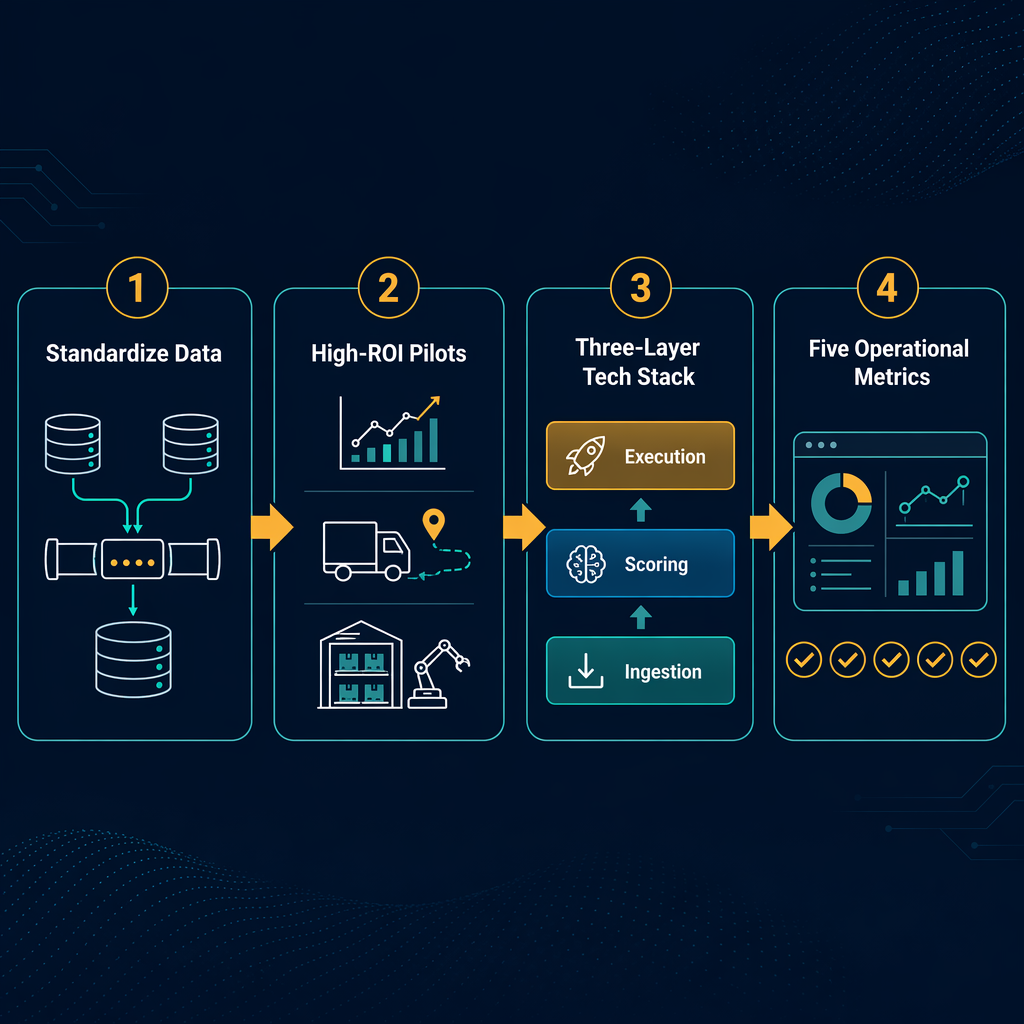
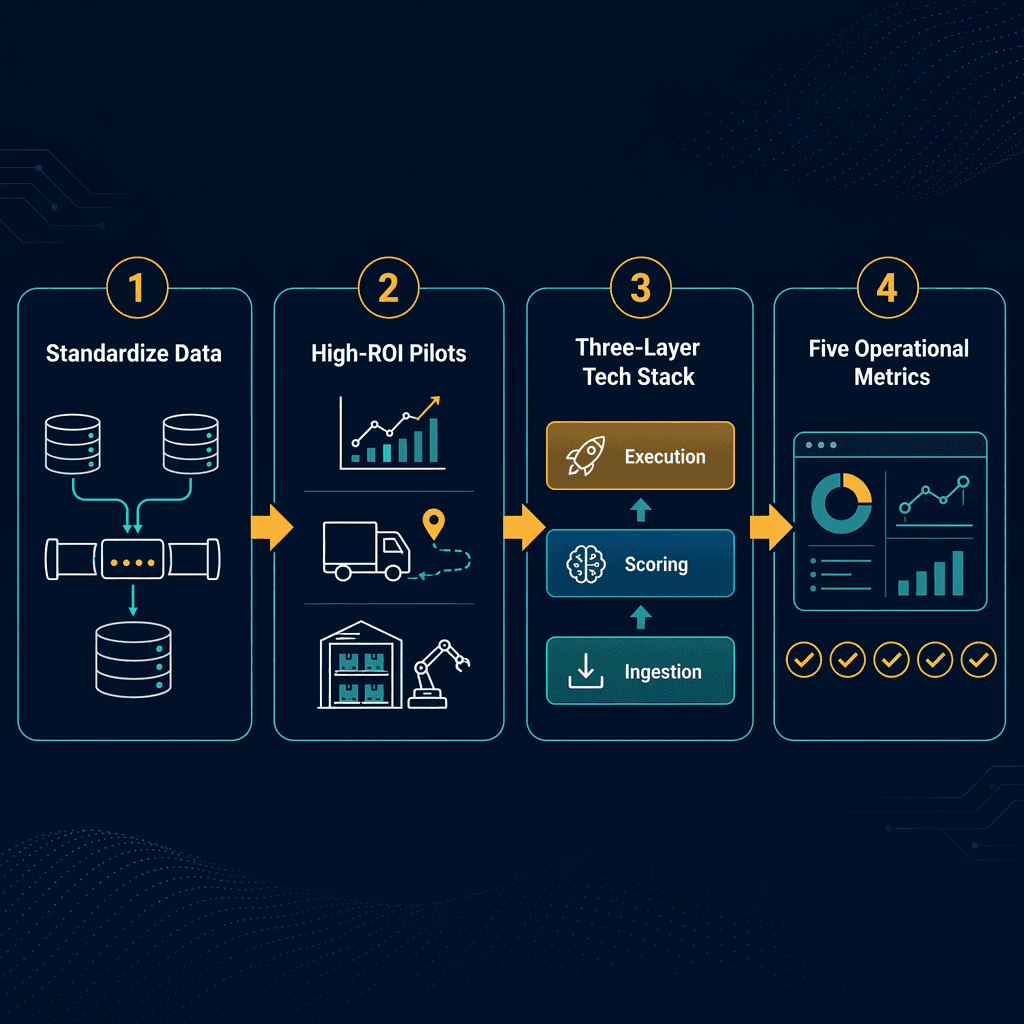
The organizations that successfully scale AI do not follow a single playbook, but they do follow a consistent pattern. Based on the implementation frameworks from Gartner, McKinsey, and the roadmap outlined by Ariel Software Solutions, here is a four-stage approach that addresses the three failure modes directly.
Stage 1: Standardize Data and Assess AI Maturity
Before any model is trained, the data foundation must be in place. This means:
- Establishing a single source of truth for master data (products, suppliers, locations, customers)
- Documenting data lineage for every input that will feed AI models
- Creating data governance policies that define ownership, quality standards, and update cadences
- Assessing current AI maturity against benchmarks — ChainSignal's Gartner's 2025 Supply Chain AI Maturity Data Decoded provides a framework for this assessment
McKinsey recommends starting with one or two low-risk, high-value use cases deliverable within 3-4 months. This is not a full-scale transformation — it is a proof point that builds confidence and organizational muscle.
Stage 2: Run High-ROI Pilots in Demand Planning, Transport, and Warehouse
The highest-impact pilot areas are well-documented. McKinsey's 2024 research quantifies the ranges: 20-50% forecast error reduction in demand planning, 20-30% inventory reduction, and 5-20% logistics cost reduction. These are not guarantees — they are ranges observed across multiple deployments — but they provide a credible basis for pilot selection.
For readers who want to explore specific use cases in depth, ChainSignal's AI Use Case Library covers the ten highest-impact applications across planning, procurement, logistics, and warehouse operations.
Key criteria for pilot selection:
- Data availability: Is the required data already being collected and accessible?
- Business pain: Is there a clear, quantifiable problem that stakeholders want solved?
- Measurable outcome: Can success be defined in operational terms (e.g., forecast accuracy, dwell time, fill rate) within 3-4 months?
- Organizational readiness: Is there a champion who will drive adoption and a team that can support the pilot?
Stage 3: Build a Three-Layer Tech Stack
Scaling requires moving from point solutions to an integrated architecture. The recommended three-layer stack, as outlined by Ariel Software Solutions, separates concerns and prevents the tight coupling that makes scaling difficult:
| Layer | Function | Key Components |
|---|---|---|
| Data ingestion layer | Collects, cleans, and standardizes data from all source systems (ERP, WMS, TMS, supplier portals, IoT sensors) | Data pipelines, data lake/warehouse, master data management, data quality monitoring |
| Model scoring layer | Runs AI/ML models to generate predictions, recommendations, and decisions | ML model registry, feature store, model serving infrastructure, explainability tools |
| Execution layer | Delivers AI outputs to operational systems and human decision-makers | APIs to ERP/WMS/TMS, dashboard and alerting, human-in-the-loop approval workflows |
For readers who need a primer on the ML techniques that power the model scoring layer, ChainSignal's Machine Learning in Supply Chain Management glossary entry covers the key methods and their applications. For those evaluating platform choices, the AI-Native vs. Legacy Supply Chain Platforms comparison provides a structured evaluation framework.
Stage 4: Track Five Operational Metrics from Day One
Most pilots fail to scale because they track model accuracy (e.g., forecast error percentage) rather than business outcomes. The five operational metrics recommended by Ariel Software Solutions provide a direct line from AI performance to supply chain performance:
- Manual touch count: How many human interventions are required per order or per planning cycle? Decreasing this number indicates that AI recommendations are being trusted and adopted.
- Shipment variance: The difference between planned and actual shipment quantities and dates. AI should reduce this variance over time.
- Dwell time: How long inventory sits in warehouses or containers before being moved. Reductions indicate better inventory placement and routing decisions.
- On-time delivery rate: The ultimate customer-facing metric. AI improvements in planning and logistics should translate to higher OTD.
- Customer complaint volume: A lagging indicator that captures the cumulative effect of supply chain performance on customer experience.
These metrics should be tracked from the first day of the pilot, not added after the fact. They provide the business case for continued investment and the early warning system for scaling problems.
Budget Benchmarks: What Realistic AI Investment Looks Like
Building a business case for AI requires realistic budget expectations. The recommendation from Ariel Software Solutions is to allocate 4-6% of annual supply chain revenue for pilot-year AI investment. For a company with $1 billion in supply chain spend, that translates to $40-60 million — a significant but justifiable investment when benchmarked against the potential returns.
The return side of the equation is supported by multiple analyst sources. The table below summarizes the quantified ranges from McKinsey (2024) and Accenture (2024):
| Metric | Improvement Range | Source |
|---|---|---|
| Forecast error reduction | 20-50% | McKinsey (2024) |
| Inventory reduction | 20-30% | McKinsey (2024) |
| Logistics cost reduction | 5-20% | McKinsey (2024) |
| Procurement spend reduction | 5-15% | McKinsey (2024) |
| Profitability advantage (AI-mature chains) | 23% higher | Accenture (2024) |
The market context reinforces the investment case. Precedence Research (2026) valued the AI in supply chain market at $9.94 billion in 2025, with a projection to $236 billion by 2035. Gartner (April 2026) forecasts that SCM software with agentic AI capabilities will grow from under $2 billion in 2025 to $53 billion in spend by 2030, with 60% of enterprises using SCM software expected to adopt agentic AI features by that time.
The 2-4 Year ROI Reality: Managing Expectations for Long-Term Value
The most important number in this entire article may be the one from Deloitte (2025): only 6% of organizations see AI ROI in under a year, but most achieve satisfactory returns within 2-4 years. This timeline is not a failure of the technology — it is the natural maturation cycle of data infrastructure, model tuning, organizational adoption, and operational integration.
Organizations that plan for this timeline from the start are far more likely to succeed than those that expect quick wins and pull funding when they do not materialize. The 2-4 year horizon aligns with the experience of early adopters across industries. It is the price of building a foundation that can scale.
The competitive stakes are rising. Gartner's forecast of a $53 billion agentic AI market by 2030 means that the organizations investing in their data foundation, governance frameworks, and workforce readiness today will be the ones capturing value when the technology matures. Those that wait for the technology to be proven before fixing their foundation will find themselves competing from a position of disadvantage.
The question for supply chain leaders is not whether AI will transform supply chain operations. The evidence from McKinsey, Gartner, Accenture, and Deloitte is clear that it already is, in organizations that have done the foundational work. The question is whether your organization will be among the 10% that scale — or among the 90% that remain stuck in pilot purgatory.
Comments
Join the discussion with an anonymous comment.