
The Paradox: 94% Intent, 23% Strategy
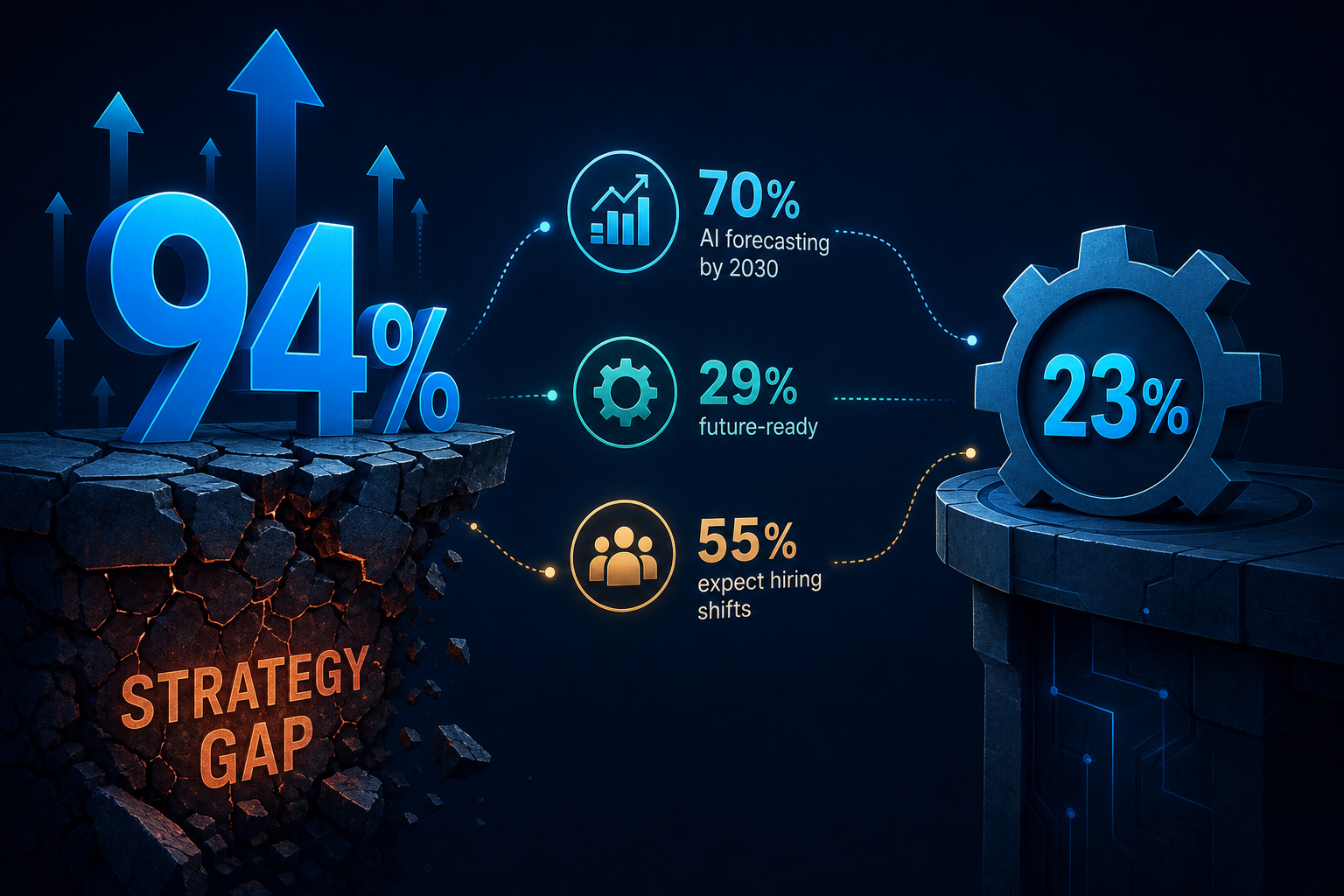
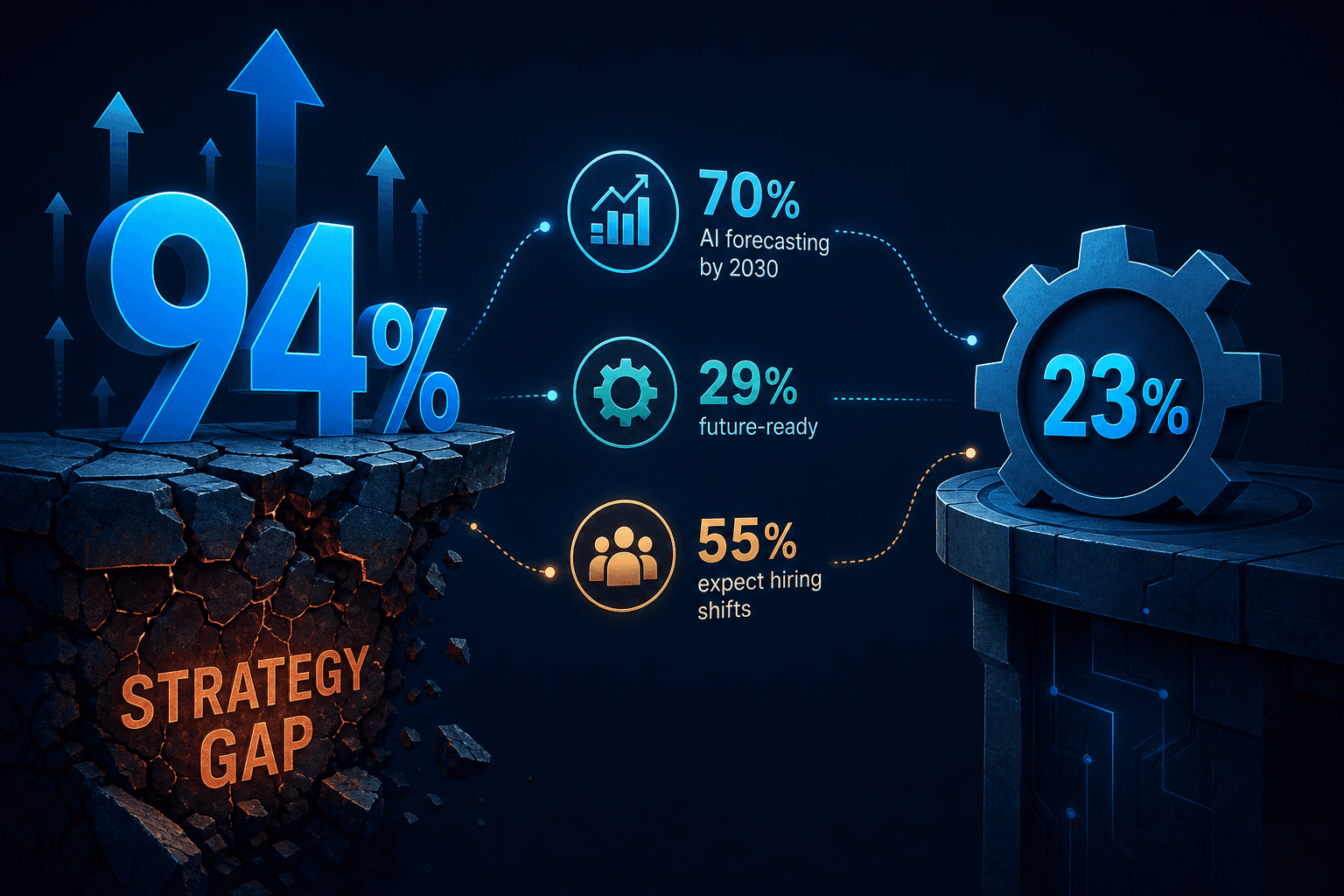
The numbers tell a story that every chief supply chain officer should find unsettling. In a 2025 survey of 490 supply chain professionals across the US, Mexico, Germany, and Malaysia, ABI Research found that 94% of companies plan to use AI or generative AI for decision support within two years. That figure is not an outlier — 91% of the same respondents said they intend to apply AI to demand forecasting, and 85% to inventory management. The intent is near-universal.
Now look at the other side of the ledger. Gartner surveyed 120 supply chain leaders who had already deployed AI within the past 12 months (December 2024–January 2025) and found that only 23% reported having a formal supply chain AI strategy. The remaining 77% are operating without a documented, organization-wide plan for how AI investments connect to business outcomes, data infrastructure, and workforce capability.
This gap between intent and strategy is not a lag — it is a structural failure. When 94% of organizations are moving toward AI but only 23% have a coherent plan, the majority are investing in a way that creates long-term technical debt. Benjamin Jury, Senior Principal in Gartner's Supply Chain Practice, described the consequence directly: CSCOs who take a project-by-project approach risk building what he called "franken-systems" — disconnected tools that cannot scale, integrate, or adapt as the organization's AI ambitions grow.
The stakes are not theoretical. Gartner predicts that by 2030, 70% of large-scale organizations will adopt AI-based forecasting to predict future demand. The organizations that reach that point with a fragmented collection of point solutions will find themselves at a competitive disadvantage to those that built a strategic foundation from the start. The question is not whether to invest in AI — that decision has already been made. The question is whether the investment will produce a coherent capability or a collection of expensive, incompatible experiments.
Root Cause 1: Short-Term ROI Pressure Drives Project-by-Project Investment
The most immediate reason for the strategy gap is the pressure CSCOs face to demonstrate short-term return on AI investments. Gartner's June 2025 survey found that most supply chain leaders fund AI on a project-by-project basis rather than through a defined investment portfolio. Each project must justify itself with a quick payback, which biases funding toward narrow, low-risk applications and away from the infrastructure and capability building that make AI sustainable at scale.
This pattern creates a self-reinforcing cycle. A team deploys a demand forecasting model for one product category and achieves a 5–10% accuracy improvement. The CFO sees the return and approves the next project — another forecasting model, this time for a different region. After three or four such projects, the organization has multiple models running on different data pipelines, with different governance standards, and no shared infrastructure for monitoring drift, retraining, or integrating outputs into the broader planning process.
"CSCOs feel pressure to achieve short-term ROI from their AI investments, but they must ensure these quick wins don't create future constraints." — Benjamin Jury, Senior Principal, Gartner Supply Chain Practice
The "franken-systems" that result are not just inefficient — they actively block the organization from reaching the next level of AI maturity. A demand planning tool that cannot ingest real-time point-of-sale data because it was built on a batch-processing architecture will never support demand sensing. A procurement bot that was trained on one supplier's data without a framework for adding new suppliers will never scale to the full supplier base. The project-by-project approach optimizes for the demo, not for the production system.
The alternative is a portfolio-based investment approach that explicitly balances three categories: quick-win projects that build credibility and fund further investment, infrastructure projects that create shared data and integration capabilities, and longer-term bets on transformative use cases like autonomous planning or agentic AI. Without this portfolio logic, the short-term ROI pressure will always produce the same result: a collection of isolated tools that look good in a slide deck but cannot deliver enterprise-scale value.
Root Cause 2: CSCOs Measure the Wrong Success Metrics
The metrics an organization uses to evaluate AI success reveal its actual strategy — and Gartner's data shows a significant misalignment between what CSCOs measure and what CEOs prioritize. According to the June 2025 survey, CSCOs rank efficiency, decision-making speed, and cost reduction far ahead of revenue growth and innovation when assessing AI outcomes. These are not wrong metrics, but they are incomplete — and they bias the investment portfolio toward incremental improvement rather than transformation.
When AI is evaluated primarily as a cost-savings tool, the natural investment pattern is to fund projects that automate existing processes more cheaply. A warehouse robot that reduces labor costs by 15% gets approved. A dynamic routing engine that cuts fuel spend by 8% gets approved. These are real returns, but they treat AI as a substitute for human labor rather than a capability that enables entirely new operating models — such as same-day delivery networks, personalized assortment planning, or real-time supplier risk mitigation.
| Success Metric | CSCO Priority (Gartner 2025) | Strategic Implication |
|---|---|---|
| Operational efficiency | High | Reinforces incremental, cost-focused projects |
| Decision-making speed | High | Favors narrow automation over capability building |
| Cost reduction | High | Treats AI as a substitution tool, not a transformation lever |
| Revenue growth | Low | Underinvests in AI applications that create new value |
| Innovation / new business models | Low | Misses transformational use cases like autonomous planning |
This metric bias also reinforces the project-by-project trap. Cost savings are easiest to measure at the individual project level. Revenue impact and innovation, by contrast, often require a portfolio of complementary investments — a demand sensing model plus a dynamic pricing engine plus a real-time inventory visibility platform — before the combined effect shows up in top-line growth. An organization that only measures project-level cost savings will never build the portfolio.
The fix is not to abandon efficiency metrics but to add a second tier of success measures that capture strategic outcomes: percentage of decisions informed by AI, speed of response to demand shifts, ability to onboard new suppliers with AI-driven risk scoring, and revenue from AI-enabled services. These metrics force the organization to think about AI as a platform, not a set of projects.
Root Cause 3: Data Readiness Remains a Foundational Barrier
Even when the strategic intent and the right metrics are in place, many organizations hit a wall when they try to operationalize AI: their data is not ready. Gartner's February 2025 survey of 579 supply chain practitioners found that only 29% of organizations have built at least three of the five key competitive characteristics — agility, resilience, regionalization, integrated ecosystems, and integrated enterprise strategy — needed for future readiness. The remaining 71% lack the foundational capabilities that make AI outputs reliable and actionable.
The data readiness problem is particularly acute in procurement. Gartner reports that 74% of procurement leaders say their data is not AI-ready. This is not a minor gap — it is a fundamental blocker for any AI application that depends on supplier data, contract terms, spend classification, or risk scoring. If the underlying data is inconsistent, incomplete, or stored in siloed systems, even the most sophisticated AI model will produce unreliable outputs.
The consequences of inadequate data readiness extend beyond model accuracy. When an AI system produces a recommendation that contradicts a planner's intuition and the planner cannot trace the reasoning back to clean, trusted data, trust in the system erodes. Multiple failed recommendations — even if the model is technically correct but the input data was stale or mislabeled — can kill an AI initiative entirely. Pierfrancesco Manenti, VP Analyst at Gartner, noted that leaders in supply chain performance "shared a commitment to preparation through long-term, deliberate strategies, while non-leaders were more often focused on short-term priorities." Data infrastructure is the quintessential long-term investment that short-term prioritization neglects.
Root Cause 4: Talent and Workforce Strategies Are Not Keeping Pace
The fourth root cause is perhaps the most difficult to address because it involves people, not technology. Gartner's February 2026 survey of 509 supply chain leaders globally (conducted July–October 2025) found that 55% of supply chain leaders expect agentic AI to reduce entry-level hiring needs, and 51% believe it will drive overall workforce reductions. At the same time, 86% agree that adopting agentic AI will require new processes for developing future talent pipelines.
These two findings create a tension that most organizations have not resolved. If AI reduces the need for entry-level planners, procurement clerks, and warehouse supervisors, but simultaneously requires new skills in model oversight, exception handling, and human-AI collaboration, then the workforce strategy cannot simply be "hire fewer people." It must be "hire different people and retrain existing ones."
"The highest performing supply chain organizations are using AI to reinvent how work gets done and how talent is developed. They are not treating AI as a blunt instrument for headcount reduction." — Marco Sandrone, VP Analyst, Gartner Supply Chain Practice
The workforce implications of AI strategy are not a downstream HR concern — they are a core strategic variable. An organization that deploys agentic AI for procurement without redesigning the procurement analyst role will end up with a system that no one trusts and no one knows how to override. An organization that automates demand planning without upskilling planners to interpret probabilistic forecasts will lose the human judgment that catches model failures.
- Redefine entry-level roles: Shift from transactional tasks (data entry, report generation) to exception management and model validation.
- Build AI literacy at every level: Planners, buyers, and warehouse supervisors need to understand what AI can and cannot do, not just how to use a specific tool.
- Create new career paths: Data-savvy supply chain professionals who can bridge operations and analytics are in short supply — organizations need to grow them internally.
- Design human-in-the-loop workflows: Autonomous systems still require human oversight for exceptions, ethical decisions, and strategic trade-offs.
The Gartner survey also found that changes in ways of working driven by AI was cited as the single most influential factor redefining supply chain strategy over the next two years. Organizations that treat workforce transformation as a separate initiative from AI strategy will find themselves with the technology to automate decisions but not the people to govern them.
Gartner's Prescription: The Run-Grow-Transform Framework
Gartner's recommended antidote to the project-by-project trap is the Run-Grow-Transform framework, a structured approach to balancing short-term wins with long-term capability building. The framework divides AI investments into three categories, each with distinct objectives, time horizons, and success metrics.
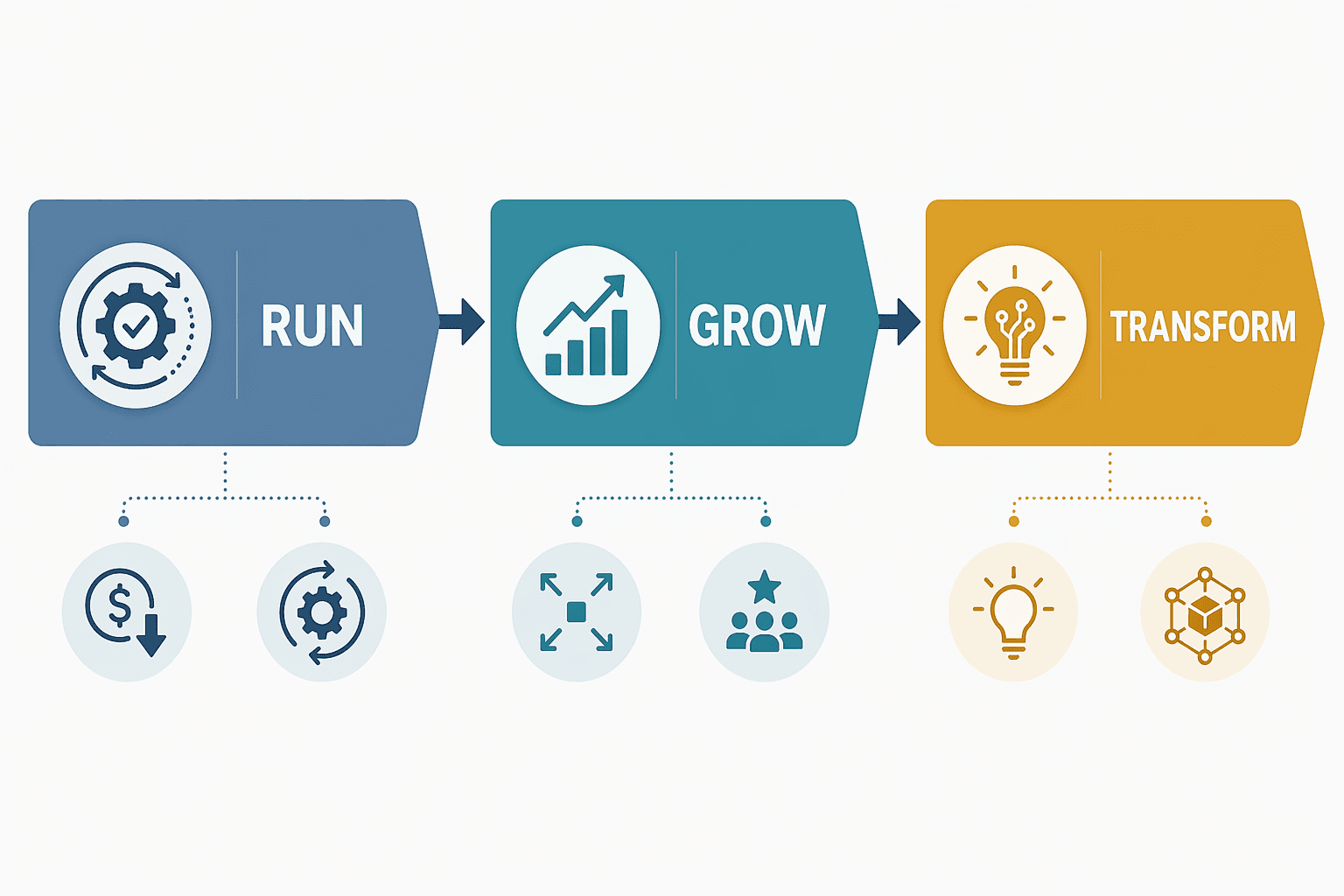
| Phase | Objective | Time Horizon | Example Investments | Success Metrics |
|---|---|---|---|---|
| Run | Operational efficiency and quick wins | 0–12 months | Demand forecasting automation, warehouse robotics, route optimization | Cost reduction, error rate, throughput |
| Grow | Scale proven use cases and build infrastructure | 12–24 months | Unified data platform, integrated planning, supplier risk scoring | Data coverage, model adoption rate, integration depth |
| Transform | Foundational bets on new capabilities | 24–48 months | Agentic AI for procurement, autonomous planning, digital twin | New revenue streams, decision autonomy level, innovation pipeline |
The Run phase is where most organizations are comfortable. It delivers the quick wins that build credibility and justify further investment. But the framework explicitly requires that Run investments be made within a portfolio that also includes Grow and Transform investments. A demand forecasting model (Run) should be built on a data platform that can later support demand sensing and real-time inventory optimization (Grow). The data infrastructure and governance standards established in the Grow phase should be designed to eventually support autonomous planning agents (Transform).
The framework also addresses the metric misalignment problem. Each phase has its own success metrics, and organizations are expected to track all three simultaneously. A CSCO who can show cost savings from Run projects, data coverage improvements from Grow projects, and innovation pipeline progress from Transform projects has a balanced story for the boardroom — one that aligns with both the CFO's short-term ROI expectations and the CEO's growth agenda.
Gartner's CSCO Roadmap (March 2026) reinforces this approach, advising CSCOs to pursue a "two-pronged strategy" — delivering AI-enabled value today through narrow, practical use cases while building the blueprints for tomorrow's AI-driven supply chain. The Run-Grow-Transform framework provides the structure for exactly this dual focus.
Diagnostic Questions for Your Organization
The data and frameworks above are useful only if they lead to action. The following diagnostic questions are designed to help CSCOs and strategy leaders assess their own organization's position relative to the 23% that have a formal AI strategy — and to identify the specific gaps that need to be closed.
- Do you have a documented AI strategy, or only a collection of AI projects? If you cannot point to a single document that defines your AI investment principles, portfolio allocation, data infrastructure roadmap, and workforce plan, you are in the 77%.
- Are your AI success metrics aligned with CEO growth priorities? If your AI dashboard only shows cost savings and efficiency gains, you are measuring the wrong things. Add metrics for revenue impact, innovation, and decision autonomy.
- Is your data infrastructure investment commensurate with your AI ambition? If you are funding AI models but not the data platform, governance, and integration work that makes them reliable, you are building on sand. The 74% of procurement leaders whose data isn't AI-ready are a warning.
- Do you have a workforce plan for agentic AI? If 86% of your peers say agentic AI requires new talent pipeline processes, but your HR plan still focuses on headcount reduction, you are not ready. Define the new roles, skills, and career paths that AI will require.
- Does your AI investment portfolio balance Run, Grow, and Transform? If every AI project in your pipeline has a payback period under 12 months, you are over-invested in Run and under-invested in the infrastructure and innovation that will determine your competitive position in 2028.
The gap between 94% intent and 23% strategy is not inevitable. It is the result of four specific, addressable root causes: short-term ROI pressure, misaligned metrics, data readiness gaps, and workforce unpreparedness. Each of these can be diagnosed and corrected with the right framework and the right organizational commitment. The organizations that close this gap will not just deploy AI more effectively — they will build the supply chain capabilities that define competitive advantage in the next decade.
Comments
Join the discussion with an anonymous comment.