
The uncomfortable control tower question in 2026 is not whether the dashboard can show the late shipment. Most buyers already have some version of that. The question is whether the system changes the work after the alert appears: who decides, how long the decision takes, whether the answer is trusted, and whether anyone still has to stitch together order, carrier, inventory, and customer-priority data on a call.
That is why the market feels crowded and oddly unsatisfying at the same time. The supply chain control tower software market is cited at $8.75 billion in 2026, while 37% of organizations are prioritizing control tower investments; that figure is best read as a software-market estimate, not a total services-and-implementation spend number.[1] At the same time, only 66% of supply chain leaders say they feel future-ready in 2026, down from 73% in 2025.[2] Buyers are still investing, but they are less willing to accept visibility as the finish line.
The demand signal has shifted from monitoring to mitigation. In a 2026 supply chain statistics roundup, 72% of supply chain executives said automated mitigation capabilities are now mandatory, while 67% of enterprises reported stalled ROI on visibility tools because fragmented legacy systems kept them from acting on what they could see.[3] That combination explains a lot of boardroom frustration: the first investment improved the window into the network, but the operating model still depended on manual exception work.

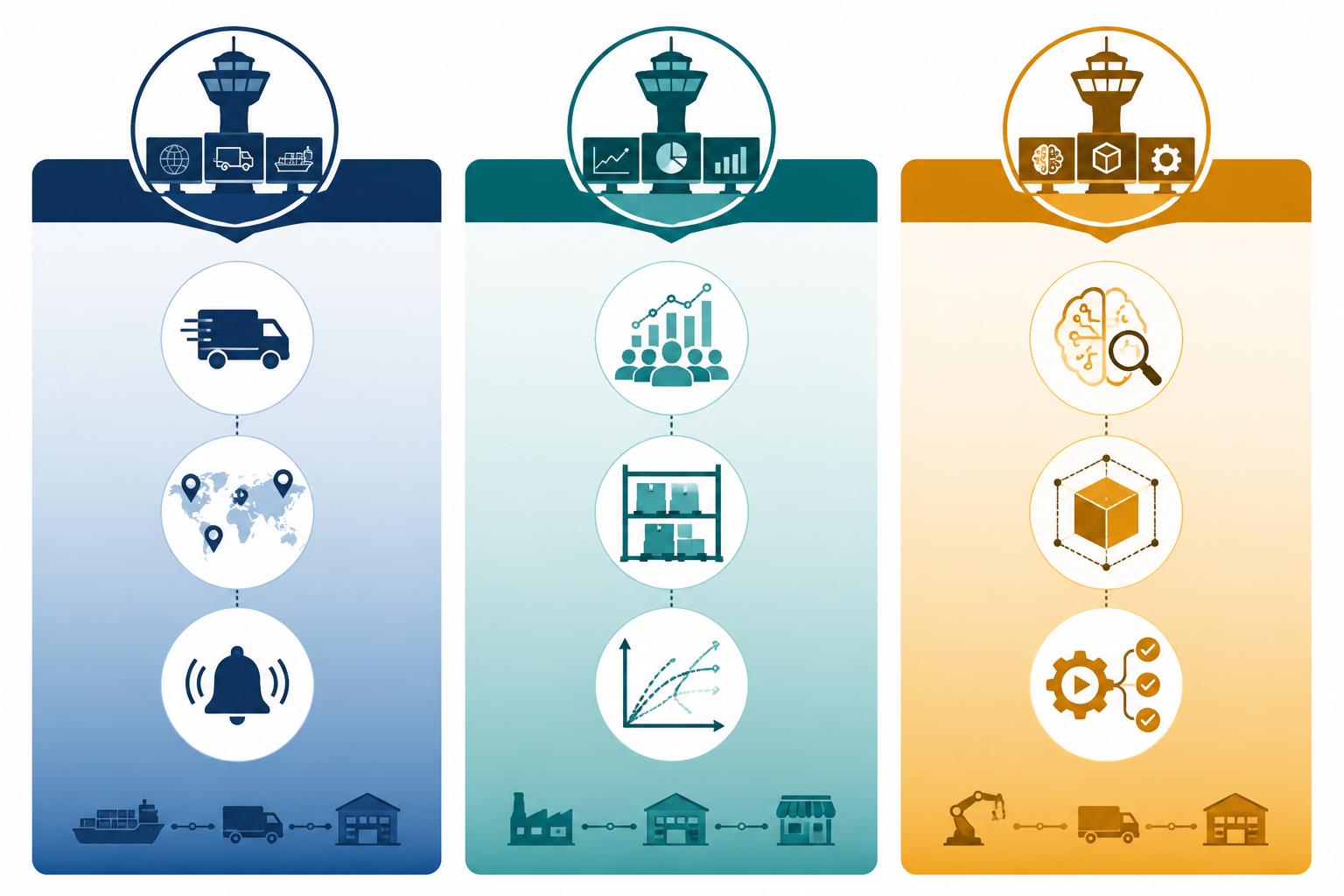
So it helps to stop treating “control tower” as one category. As a buying heuristic, three models are now more useful than one generic label: visibility-led, planning-led, and execution-led. This is not an industry-standard taxonomy, and several vendors span more than one model. But it separates three very different questions: Where is the disruption? What plan should change? What corrective action should happen now?
For a deeper breakdown of control tower capabilities by function, ChainSignal’s guide to the four functional clusters of a supply chain control tower is a useful companion. The decision here is narrower: match the investment to the bottleneck that is actually delaying decisions.
Start With The Bottleneck, Not The Vendor Demo
A clean interface can hide a weak operating fit. A shipment map may be exactly what a fragmented logistics network needs. The same map may be nearly irrelevant to a manufacturer whose main issue is that demand, inventory, and production scenarios are reconciled too slowly. And neither one solves much for a last-mile or field-service operation where the loss happens in the minutes between anomaly detection and dispatch action.
| Model | Primary Bottleneck | Expected Outcome | Data Prerequisites | Common Failure Mode |
|---|---|---|---|---|
| Visibility-led | Teams cannot reliably locate orders, shipments, inventory in motion, or carrier exceptions | Earlier detection, cleaner escalation, fewer blind spots | Carrier, order, milestone, and ETA data integrated with enough consistency to trust alerts | The platform finds problems faster but leaves planners and service teams to resolve them manually |
| Planning-led | Teams see the issue but cannot rebalance demand, inventory, and supply plans quickly enough | Better forecast quality, inventory decisions, and scenario comparison | Demand signals, inventory positions, constraints, and planning master data connected across functions | Scenarios look persuasive but do not flow into execution or accountability |
| Execution-led | Teams know what is wrong but decision latency and exception workload are too high | Autonomous anomaly detection, simulation, recommended actions, and in some cases triggered remediation | High-quality event, order, constraint, policy, and workflow data with governance for automated action | Automation is promised before the data foundation and operating permissions exist |
This is where many control tower buying decisions go wrong. The buyer selects the model that sounds most advanced, then discovers that the organization’s real constraint is two layers lower. A company with inconsistent milestone data does not become autonomous because the platform has an agentic roadmap. A company with decent visibility but weak cross-functional planning does not need another alert stream. A company drowning in repetitive exceptions should be skeptical of any tool that stops at “insight.”
Visibility-Led Control Towers Still Have A Job
Visibility-led platforms are easiest to undervalue after a disappointing first deployment, but that reaction can be unfair. If the core question is still “where is my stuff,” visibility remains the right starting point. For networks with many carriers, facilities, modes, order systems, and customer-service handoffs, basic location and exception integrity is not basic at all.
Project44 and FourKites are common orientation points for this model because their market identity is strongly tied to shipment visibility, tracking, carrier connectivity, and exception alerts. The value is practical: a team stops waiting for a phone call or spreadsheet update and sees likely late freight earlier. Customer service can respond before the buyer asks. Logistics can focus on the exceptions that matter instead of refreshing portals.
But the ceiling is also clear. If the system flags a late inbound component and then a planner has to check the production schedule, a buyer has to confirm supplier options, a transportation lead has to price an expedite, and customer service has to decide who gets notified, visibility has reduced surprise but not necessarily decision latency. The work moved earlier; it did not disappear.
That gap is the reason many visibility investments feel underdelivered even when the platform is working as designed. The tool can expose the exception; the organization may still lack the clean master data, policies, integrations, and authority model required to resolve it. ChainSignal’s analysis of why supply chain control towers underdeliver and how AI fixes it explores that handoff problem in more detail.
Planning-Led Models Solve A Different Delay
Planning-led control towers belong in a different conversation. Their problem is not primarily shipment location. It is decision quality across planning cycles: how demand signals, inventory positions, capacity constraints, service targets, and financial trade-offs are brought into the same planning view.
Blue Yonder, Kinaxis, and o9 are useful reference points here because buyers often associate them with planning, scenario analysis, supply-demand balancing, and cross-functional decision support. A planning-led model helps when the team can see disruption but cannot compare the right options quickly enough. Should scarce inventory protect the highest-margin account, the most strategic customer, the oldest order, or the region with the highest stockout risk? Should a promotion be delayed, a substitute product offered, or production resequenced?
The strongest performance claims in this zone should be treated carefully. McKinsey has reported that AI-driven forecasting can reduce forecast errors by 20% to 50% and cut lost sales and product unavailability by up to 65%.[4] Those are meaningful ranges, but they describe what mature AI forecasting can achieve under the right conditions, not what every planning-led control tower delivers after implementation.
The long-term adoption direction is still hard to ignore. Gartner expects 70% of large organizations to adopt AI-based forecasting by 2030.[5] That matters because planning-led control towers become more useful as forecasting, scenario planning, and inventory decisions move from periodic review cycles toward more continuous sensing and replanning.
The implementation risk is different from visibility-led failure. A visibility platform can disappoint because it alerts without resolving. A planning-led platform can disappoint because it generates scenarios that do not change execution. If planners compare five feasible options but transportation, procurement, manufacturing, and customer teams still operate in separate workflows, the model improves analysis without shortening the path to action.
Execution-Led Models Chase The Highest-Value Gap
Execution-led control towers are where the market’s language has changed most sharply. The promise is no longer just “see earlier” or “plan better.” It is detect the anomaly, simulate the impact, recommend or select the corrective action, and trigger the next workflow with human oversight where risk requires it.
Locus and C3 AI are useful orientation markers for this model because their positioning often emphasizes operational decisioning, AI-enabled orchestration, digital twins, and action triggers rather than only tracking. This is also where agentic AI becomes commercially interesting. ChainSignal’s piece on how agentic AI turns logistics control towers into autonomous orchestrators goes deeper on that shift from alerting to delegated action.
The business case is attractive because exception management is expensive in a way dashboards often conceal. A late container, a missed appointment, a temperature excursion, or a demand spike does not create value merely by becoming visible. Value appears when the system narrows options, identifies the likely downstream consequence, checks constraints, and moves the exception toward resolution before the daily call turns into a negotiation among functions.
Digital-twin and advanced AI deployments show why executives are paying attention. BCG has reported that early adopters of digital twins have seen 20% to 30% better forecast accuracy and 50% to 80% fewer delays and downtime.[6] Those figures should be read as upper-bound outcomes from advanced deployments, not as a generic execution-led control tower guarantee. They require integration depth, model reliability, and operating discipline that many networks have not yet built.
Agentic AI adds another reason to take execution-led systems seriously. Dataiku reports that organizations using agentic AI systems realize double-digit efficiency gains and can reduce decision latency from days to seconds.[7] The latency point matters more than the phrase “agentic.” If an exception used to wait for a planner, dispatcher, or customer lead to gather context, a system that compresses that cycle changes the labor model as well as the response time.
That does not mean full autonomy should be the default setting. Execution-led systems need policy boundaries: which expedites can be approved automatically, which customer substitutions need a human, which inventory reallocations require commercial sign-off, and which disruptions should remain advisory only. The governance question is not whether humans stay involved; it is where human judgment is scarce enough to reserve for exceptions that deserve it. For that design problem, see ChainSignal’s guide to human-in-the-loop supply chain AI oversight.
The Data Foundation Decides How Far You Can Go
The trap is buying the execution-led story while still living with visibility-led data. Autonomous mitigation depends on clean event streams, consistent order and inventory data, usable constraint logic, and workflow integrations that let the system act or at least prepare the action. Without those, AI becomes another recommendation layer that people learn to distrust.
The 67% stalled-ROI figure is the warning label.[3] Fragmented legacy systems do not merely slow implementation; they change what the control tower can safely be asked to do. If carrier milestones are incomplete, inventory positions are contested, or customer-priority rules live in spreadsheets and inboxes, the system may detect disruption faster than the organization can validate the facts.
The adoption milestone is encouraging but not universal. Tradeverifyd reports that 48.7% of organizations have moved from manual data management to AI-powered predictive analytics.[3] That means a large share of the market is still below the maturity level implied by the most ambitious autonomous-resolution pitches.

A useful diagnostic is to ask what happens after a high-confidence alert. If the answer is “someone downloads three reports and starts calling people,” the next investment may need to be integration and workflow plumbing before autonomy. If the answer is “the system already knows the affected orders, service commitments, inventory alternatives, carrier options, and approval rules,” then execution-led capability becomes a more realistic ROI lever.
How To Match The Model To The Buying Case
For a fragmented logistics network, start with visibility-led fit. The business case should be built around milestone quality, ETA reliability, exception prioritization, customer communication, and fewer blind spots across carriers and modes. Do not overpay for autonomous orchestration if the organization still cannot trust the location and status data that would feed it.
For an organization with recurring demand-supply mismatches, planning-led fit is stronger. The business case should focus on forecast improvement, inventory availability, scenario comparison, and faster planning alignment. This model is especially relevant when the most expensive decisions are made before logistics execution begins: allocation, replenishment, production sequencing, promotion timing, and service-level trade-offs.
For an operation buried in exceptions, execution-led fit is the more compelling target. The business case should measure decision latency, manual touches per exception, avoidable expedites, service recovery speed, and the percentage of disruptions that can move from detection to approved action without a full human escalation chain.
- If the team argues about facts, buy for visibility and data integrity first.
- If the team agrees on facts but argues about trade-offs, buy for planning and scenario quality.
- If the team agrees on the answer but acts too slowly, buy for execution and workflow automation.
- If the vendor demo assumes clean data you do not have, treat the projected ROI as a future-state case, not a first-phase commitment.
Vendor shortlisting should come after that diagnosis. SAP-centered environments may reasonably evaluate ecosystem-native options such as SAP Supply Chain Control Tower for standardized SAP shops. Teams comparing specialist providers can use ChainSignal’s AI logistics companies buyer’s guide once they know which operating constraint they are buying against.
The Investment Judgment
Execution-led control towers offer the most compelling autonomous-resolution upside because they attack the gap between seeing disruption and doing something about it. That is where decision latency, exception workload, and avoidable service failures accumulate. As control towers move from dashboards to decision engines, that gap will define much of the next ROI cycle; nShift’s 2026 framing of the market also describes this shift from dashboard-centric visibility toward decision support and action.[8]
But the most advanced model is not automatically the right model. Fewer than half of organizations appear to have crossed from manual data management into AI-powered predictive analytics, and many of the strongest AI and digital-twin outcomes come from mature environments rather than average deployments.[3][6] For those buyers, the better first move may be data integration, planning alignment, or a narrower execution pilot with explicit human approval gates.
The purchasing question, then, should be sharper than “Which control tower is most advanced?” It should be: “Which control tower removes the bottleneck we actually have?”
References
- control tower market sizing, prioritization rates, and provider landscape, Locus/Inbound Logistics, 2026.
- executive sentiment survey — future-readiness decline, Blue Yonder, 2026.
- 79 Supply Chain Statistics To Know in 2026, Tradeverifyd, 2026.
- forecast error reduction ranges, gen AI documentation efficiency, McKinsey.
- long-term AI-based forecasting adoption projections, Gartner.
- digital twin performance outcomes, BCG.
- agentic AI efficiency and latency gains, supply chain AI trends, Dataiku, 2026.
- Supply chain control tower 2026: dashboard to decision, nShift, 2026.
Comments
Join the discussion with an anonymous comment.