
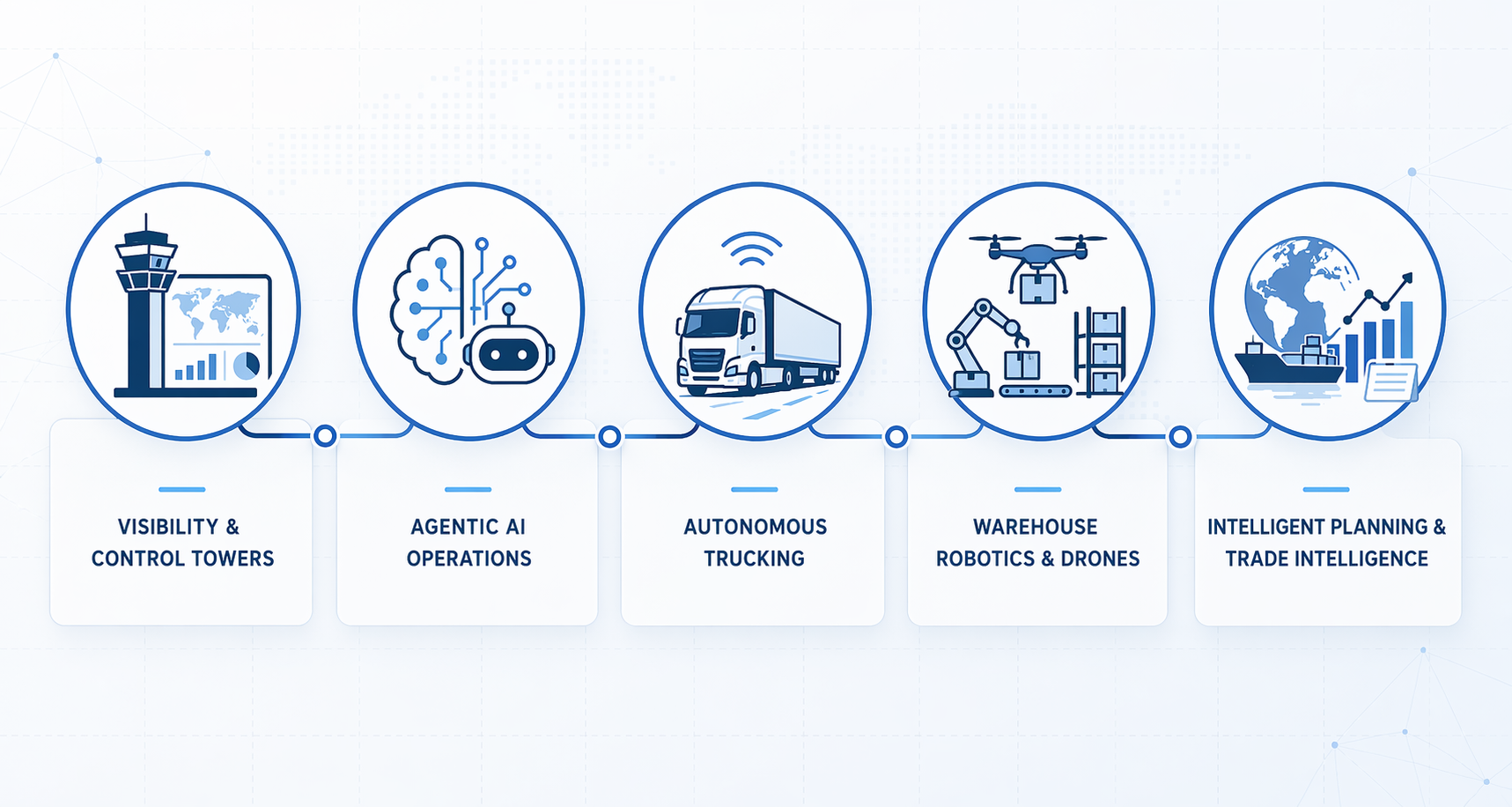
Search for an AI logistics company and the shortlist gets messy fast. One vendor is selling shipment visibility. Another is automating freight quotes and appointment scheduling. A third wants to put autonomous trucks into a fixed middle-mile lane. A warehouse platform is pitching drones for cycle counts. A trade-intelligence company is mapping buyer-supplier relationships several tiers deep. Those are not interchangeable buying decisions.
The useful first cut is functional: what operational job is the AI supposed to take over, accelerate, or improve? Only after that should a procurement team compare vendors, funding, customer references, integrations, and proof-of-concept scope.
Start with the job, not the logo
The market is growing quickly enough to attract every kind of vendor label. DataM Intelligence estimates the AI logistics market at $21.7 billion in 2025 and projects roughly 42% compound annual growth to $435.6 billion by 2033.[1] Gartner separately forecasts supply chain management software with agentic AI rising from less than $2 billion in 2025 to $53 billion in spend by 2030.[2]
That context explains why the category feels crowded. It does not tell a shipper which platform should sit between the TMS and carrier network, whether warehouse inventory accuracy is the better first use case, or whether the data is clean enough for autonomous appointment scheduling. Oracle cites McKinsey early-adopter findings of 15% lower logistics costs and 35% better inventory levels, but those figures trace to earlier waves of AI adoption and should be read as directional evidence, not an implementation guarantee for a 2026 proof of concept.[3]
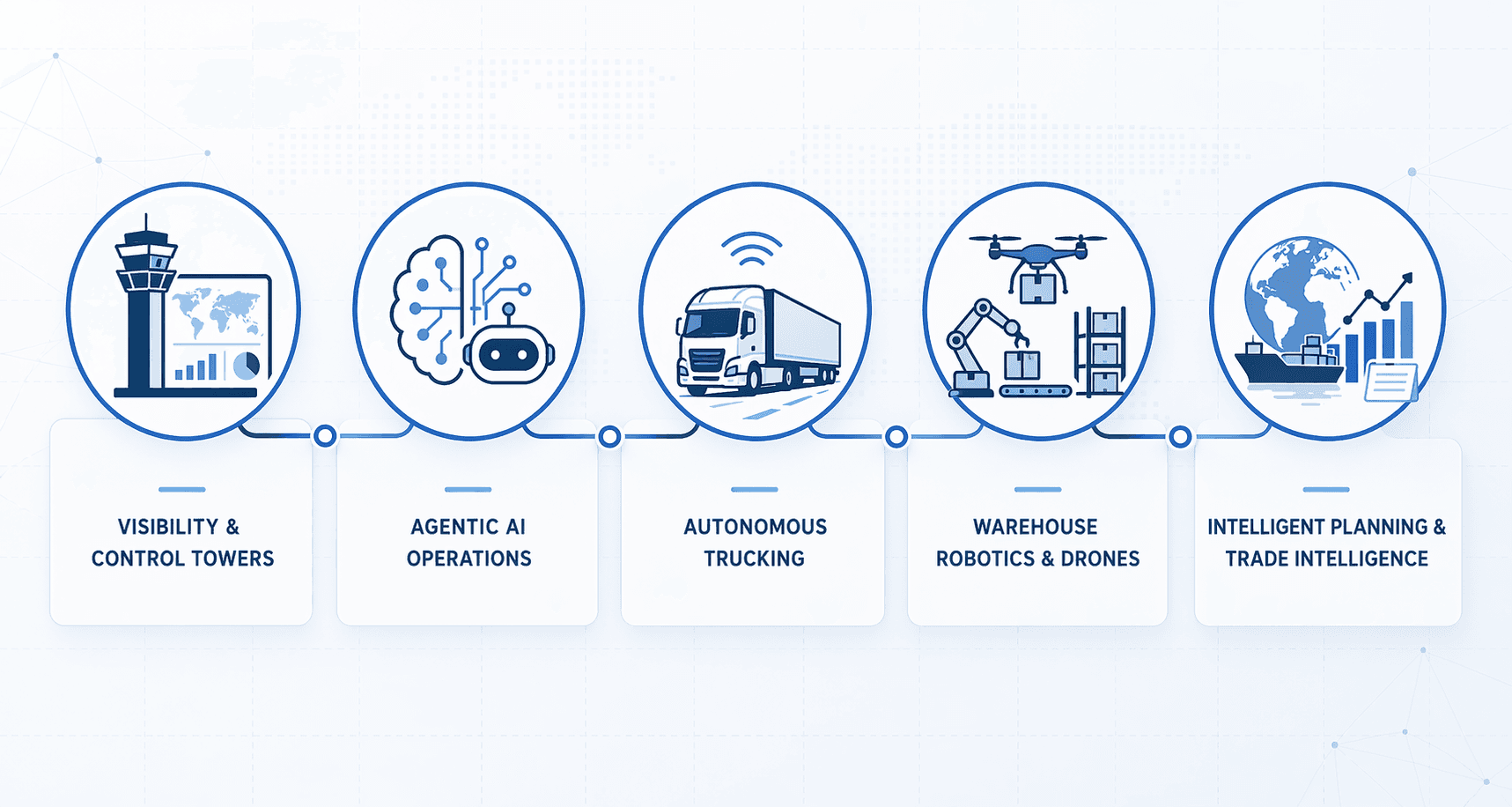
| Functional category | Operational problem it addresses | Data the vendor typically needs | Representative companies | Most useful ROI signal to ask for |
|---|---|---|---|---|
| Visibility & control towers | Late shipments, exception overload, customer-service noise, fragmented ETA data | Carrier feeds, shipment milestones, order data, facility events, customer-service workflows | FourKites | Response-time reduction, exception-resolution speed, percentage of shipments covered |
| Agentic AI operations | Manual quoting, tendering, order entry, appointment scheduling, carrier matching | Rates, shipment history, carrier capacity, TMS data, facility calendars, business rules | C.H. Robinson, Uber Freight | Tasks automated, labor hours saved, load-acceptance time, empty-mile reduction |
| Autonomous trucking | Driver-constrained, repetitive middle-mile transportation on defined routes | Lane maps, route conditions, safety case data, dispatch plans, facility handoff processes | Gatik | Route reliability, safety performance, fleet deployment scope, operating-domain fit |
| Warehouse robotics & drones | Cycle counting, inventory accuracy, picking or fulfillment labor constraints | WMS data, location master data, SKU attributes, facility maps, inventory records | Gather AI, Nimble | Inventory accuracy lift, cycle-count labor reduction, fulfillment cost reduction |
| Intelligent planning & trade intelligence | Supplier risk, trade compliance, disruption exposure, network planning blind spots | Supplier records, shipment histories, customs and trade data, product and facility relationships | Altana | Mapped network coverage, disruption savings, compliance or planning decisions improved |
Visibility and control towers: see exceptions early enough to act
Visibility platforms are often grouped with execution automation, but the workflow is different. A control tower is valuable when the logistics team is drowning in status checks, late alerts, carrier pings, and customer-service escalations. The AI may prioritize exceptions, draft responses, summarize shipment status, or recommend the next action, but the center of gravity is awareness and coordination rather than autonomous freight execution.
FourKites is the clearest sourced example in this category. The company says it tracks more than 3 million shipments daily and has introduced AI Digital Workers named Tracy, Sam, Alan, Polly, and Cassie across logistics, procurement, and customer-service workflows. At Coca-Cola, FourKites says Tracy reduced “where’s my truck” response times from 90 minutes to seconds.[4]
That is a meaningful operational signal because it names the queue being compressed. A customer-service team waiting 90 minutes for shipment status is not merely suffering from a dashboard problem; it is carrying delay into retailer communication, dock planning, and escalation management. A seconds-level response changes who waits and which conversations can happen before a miss becomes a fire drill.
The buyer caveat is that visibility AI is only as useful as its event coverage and workflow attachment. If shipment milestones arrive late, facility events are missing, or customer-service teams still live outside the platform, the AI will produce cleaner summaries of incomplete reality. For this category, a demo should show the actual exception path: which event triggers an alert, what the system infers, who receives it, what message gets drafted, and where the resolution is written back.
Agentic AI operations: automate repetitive freight work
Agentic logistics AI is the most tempting category to overbuy because the word “agent” can hide a wide range of capabilities. Some systems draft a recommendation for a human. Others execute defined steps inside business rules. A smaller number can complete operational tasks across quoting, tendering, scheduling, or carrier communication with limited intervention. Gartner’s 2026 warning about “agent washing” is useful here: buyers should ask what decisions the agent actually makes, which actions remain human-reviewed, and where the system is merely packaging automation with a newer label.
C.H. Robinson provides unusually concrete evidence for this category. The company says it has more than 35 AI agents and has automated more than 3 million shipping tasks, including more than 1 million price quotes and more than 1 million orders. It also reports 25,000 appointments scheduled per week, 600 labor hours saved daily, loads accepted for more than 5,200 customers in under 90 seconds compared with four hours manually, and a 30% productivity increase.[5]
Those metrics matter because they sit inside freight operations rather than around them. Quoting, order entry, appointment scheduling, and load acceptance are dispatch-desk workflows with handoffs, rules, exceptions, and time pressure. If a vendor can show the before-and-after path for those tasks, procurement can evaluate operational fit instead of listening to a generic autonomy claim.
Uber Freight is another useful reference point, especially for managed transportation and network optimization. The company says it operates more than 30 AI agents, has moved $1.6 billion in freight through its AI infrastructure, reduced empty miles from 30% to 10–15%, serves one in three Fortune 500 companies, and manages nearly $20 billion in freight.[6]
The empty-mile figure is the important one to unpack. It points to network-level matching and utilization, not just faster office work. A shipper evaluating Uber Freight should therefore separate two questions: whether the AI improves the administrative workflow around freight and whether the freight network itself has enough density in the relevant lanes to change utilization outcomes.
For agentic AI operations, the proof-of-concept should not be scoped as “show us your agents.” It should be scoped around a named workflow: spot quote turnaround, tender acceptance, appointment scheduling, order creation, accessorial handling, or exception communication. The buyer should ask for baseline volumes, average handle time, exception rate, human-review threshold, write-back method, and escalation logic.
Autonomous trucking: a narrower fit, but a real logistics category
Autonomous trucking belongs in an AI logistics company landscape, but it should not be evaluated like software that can be piloted against a few data feeds. The deployment question is physical: route, operating domain, facility process, safety case, vehicle availability, regulatory posture, and contingency handling.
Gatik is the representative company here. Fast Company reported that Gatik has a five-year deal with Loblaw for 50 autonomous trucks by the end of 2026, described in the source as the largest planned autonomous truck deployment in North America.[7]
The buyer relevance is strongest for repetitive middle-mile networks where the route is constrained and the handoffs are stable. A retailer moving goods between distribution centers and stores on known lanes has a very different evaluation path than a shipper looking for flexible over-the-road capacity across a fragmented network. Here, the shortlist should begin with lane suitability before vendor preference.
Warehouse robotics and drones: inventory accuracy and fulfillment labor
Warehouse AI is easy to blur into logistics AI because both affect service levels. The operating environment is different. These vendors work inside the four walls: aisles, racks, bins, pick paths, cycle counts, fulfillment cells, and WMS records. The business case usually starts with labor availability, inventory accuracy, or throughput.
Gather AI is a good example of a focused warehouse automation case. Inbound Logistics lists Gather AI as a Carnegie Mellon University spinout and reports 70% improved inventory accuracy, a 75% reduction in cycle-counting hours, and a $40 million Series B in February 2026.[8]
Those outcomes are not the same as general warehouse transformation. They are most relevant when the current pain is inventory record reliability and the labor spent verifying it. A buyer should examine how the drone or robotics workflow reconciles observations with the WMS, how exceptions are reviewed, and whether location master data is accurate enough for automated counts.
Nimble sits closer to autonomous fulfillment. Fast Company reports that Nimble’s fully autonomous warehouses reduce fulfillment costs by 40%, and notes a $106 million Series C at a $1 billion valuation, with Marc Raibert of Boston Dynamics and Stanford AI professor Fei-Fei Li on the board.[7]
That is a different buying motion from adding drone-based cycle counting to an existing warehouse. It touches facility design, SKU mix, order profiles, service promises, robotics maintenance, and exception staffing. The right question is not whether warehouse robotics “uses AI.” It is whether the facility’s operational pattern matches the automation model.
Intelligent planning and trade intelligence: map the network blind spots
Some AI logistics companies do not automate a dispatch action or move a carton. They make the supply network more legible. That matters when disruption exposure, supplier relationships, trade compliance, or product provenance is the problem. The output may be a risk signal, compliance view, alternate-source analysis, or network map rather than a scheduled appointment or a robot action.
Altana is the clearest sourced example here. The company says it has raised $322 million in total, reached a $1 billion valuation, maps more than 140 million buyer-supplier relationships and 2.8 billion shipments, has a Product Passport adopted by U.S. Customs and Border Protection, and has saved users more than $2 billion in disruptions.[9]
Those figures point to a planning and intelligence layer rather than a transportation execution tool. A shipper should look at whether the platform can connect the company’s own supplier, shipment, product, and facility records to the external graph with enough confidence to support decisions. If the internal supplier master is fragmented, the first project may be data alignment before any advanced risk modeling pays off.
This is also where internal stakeholders multiply. Logistics may care about disruption exposure. Procurement may care about supplier relationships. Compliance may care about product origin. Finance may care about tariff or risk cost. The platform’s value depends on whether those teams can agree which decisions the intelligence will change.
Representative AI logistics companies by category
| Company | Best-fit category | What to evaluate first | Documented signal from available sources |
|---|---|---|---|
| FourKites | Visibility & control towers | Shipment coverage, exception workflows, customer-service integration | 3M+ shipments tracked daily; Coca-Cola response time cut from 90 minutes to seconds |
| C.H. Robinson | Agentic AI operations | Which freight tasks are automated and which remain human-reviewed | 3M+ tasks automated; 25K appointments per week; 600 labor hours saved daily; under-90-second load acceptance for 5,200+ customers |
| Uber Freight | Agentic AI operations / managed transportation | Network density, carrier matching, managed freight scope, empty-mile impact | $1.6B freight moved through AI infrastructure; empty miles reduced from 30% to 10–15% |
| Gatik | Autonomous trucking | Route fit, safety case, facility handoffs, deployment geography | Five-year Loblaw deal for 50 autonomous trucks by end of 2026 |
| Gather AI | Warehouse robotics & drones | Inventory accuracy baseline, cycle-count labor, WMS reconciliation | 70% improved inventory accuracy; 75% reduction in cycle-counting hours |
| Nimble | Warehouse robotics & autonomous fulfillment | SKU and order-profile fit, facility implications, fulfillment cost baseline | Reported 40% fulfillment cost reduction for fully autonomous warehouses |
| Altana | Intelligent planning & trade intelligence | Supplier and shipment data quality, compliance use case, planning decision ownership | 140M+ buyer-supplier relationships; 2.8B shipments; $2B+ disruption savings claimed |
For a broader planning-versus-execution split, see AI Supply Chain Companies: Planning vs. Execution. For deeper deployment examples, the companion guide AI Logistics Companies in Action: 10 Real-World Deployments is the better place to compare case-level outcomes.
What should keep a vendor off the shortlist
A vendor can have credible AI and still be wrong for the first project. The fastest way to waste a proof of concept is to shortlist across categories because all the companies appear in an “AI logistics” search result.
- The vendor cannot name the workflow. “Improves logistics productivity” is too broad. “Automates appointment scheduling for this facility type using these calendar rules” is testable.
- The autonomy boundary is vague. If the system recommends, drafts, approves, tenders, schedules, or books, each action should be separately described.
- The data requirement is discovered after contracting. Carrier feeds, facility calendars, SKU locations, supplier records, and shipment histories are not small implementation details.
- The ROI claim comes only from a vendor-published buyer guide or broad market survey. Vendor guides can be useful for vocabulary and feature coverage, but promotional ROI claims need deployment-level confirmation.
- The integration plan stops at “we have APIs.” The buyer needs to know which system of record receives the write-back, who handles exceptions, and how auditability works.
- The customer evidence is outside the buyer’s operating pattern. A dense managed freight network, a fixed middle-mile route, a high-volume fulfillment facility, and a global trade-compliance use case do not prove the same thing.
A practical shortlisting framework
A defensible shortlist usually has three to five vendors inside one functional category, not ten vendors scattered across the market. The following sequence keeps the evaluation tied to operations instead of brand momentum.
1. Name the pain point in operational language
Replace “we need AI in logistics” with the queue or metric that hurts: tender acceptance is slow, customer service waits for shipment status, cycle counts consume too many hours, dock appointments require manual back-and-forth, empty miles are too high, or supplier disruption exposure is poorly understood. The wording should point to one category.
2. Check whether the data already exists where the AI needs it
Visibility AI needs reliable shipment events. Agentic freight operations need rates, rules, orders, carrier capacity, and appointment data. Warehouse robotics need location and inventory records that match the physical building. Trade intelligence needs supplier, product, facility, and shipment records that can be resolved into a network. If that data is incomplete, the project plan should include remediation work rather than pretending the AI layer will solve it by itself.
3. Ask for the decision boundary
For every AI action, ask whether the system observes, predicts, recommends, drafts, executes, or escalates. The difference matters. A tool that flags a late shipment changes monitoring. A tool that rebooks freight changes execution. A tool that schedules dock appointments changes facility coordination. Each step has a different risk profile and audit requirement.
4. Evaluate integration depth before model sophistication
A model that cannot write back to the TMS, WMS, ERP, yard system, customer-service platform, or supplier master may still be useful, but it will leave work on the desk. Integration maturity determines whether the operation sees automation or another screen to monitor.
5. Match the proof of concept to a measurable before-and-after
The best pilots have a baseline and a narrow operating lane. For a visibility platform, measure response time and exception closure. For agentic freight execution, measure task volume, handle time, acceptance time, and human-review rate. For warehouse robotics, measure count accuracy, hours spent, and reconciliation quality. For planning intelligence, measure the decisions changed by the network view, not just the number of entities mapped.
6. Use funding and market recognition as secondary signals
Funding freshness can indicate runway and hiring capacity. Market lists can surface vendors procurement has missed. They should not outrank functional fit, integration evidence, and customer deployments that resemble the buyer’s own operation. A well-funded warehouse robotics company is not a substitute for a visibility platform if the immediate pain is customer-service response time.
How to choose the right AI logistics company
There is no universal best AI logistics company because the category is not one category. FourKites, C.H. Robinson, Uber Freight, Gatik, Gather AI, Nimble, and Altana are solving different operational problems with different data burdens and deployment risks.
The right first move is to decide whether the operation needs visibility, execution automation, physical autonomy, warehouse accuracy, or planning intelligence. Then evaluate only vendors whose documented deployments match that problem and whose data requirements the organization can realistically meet.
References
- AI in Logistics Market, DataM Intelligence.
- Gartner Forecasts Supply Chain Management Software With Agentic AI Will Grow to $53 Billion in Spend by 2030, Gartner, April 7, 2026.
- AI in Logistics, Oracle.
- Supply Chain AI Automation: Beyond Logistics, FourKites.
- AI Performs Over Three Million Shipping Tasks, C.H. Robinson.
- A New Era for Logistics: Uber Freight’s AI-First Platform, Uber Freight.
- Logistics Most Innovative Companies 2026, Fast Company.
- Top 100 Logistics IT Providers, Inbound Logistics.
- Altana Announces $200M Series C at $1B Valuation, Altana.
Comments
Join the discussion with an anonymous comment.