
The old supplier-selection rhythm was easy to recognize: a sourcing manager opened with a known incumbent list, pulled scattered supplier records from ERP and spreadsheets, asked analysts to search for alternatives, waited for qualification data, then spent days reconciling basic facts before anyone could make a sourcing decision. For procurement teams using AI in product selection and supply chain partnerships, that rhythm is being compressed most visibly at the front of the workflow. McKinsey research cited by Veridion says AI can reduce supplier discovery from three months to hours, while eliminating more than 40 hours of manual filtering by scanning millions of suppliers against precise criteria.[1]
That is the part worth paying attention to first. Not because speed alone makes sourcing better, but because supplier discovery has always carried hidden labor: normalizing company names, checking certifications, excluding irrelevant geography, chasing missing capabilities, and deciding whether a supplier is genuinely qualified or simply well described online. AI is useful when it removes that dead work and leaves the procurement team with a better decision set.

Where AI Changes the Supplier-Selection Workflow
Supplier selection used to look like a sequence of handoffs. Discovery moved to evaluation, evaluation moved to risk review, risk review moved to negotiation, and only then did contract teams start comparing clauses against policy. AI does not remove those stages. It changes how much information each stage can process, how quickly weak options are filtered out, and how early risk enters the conversation.
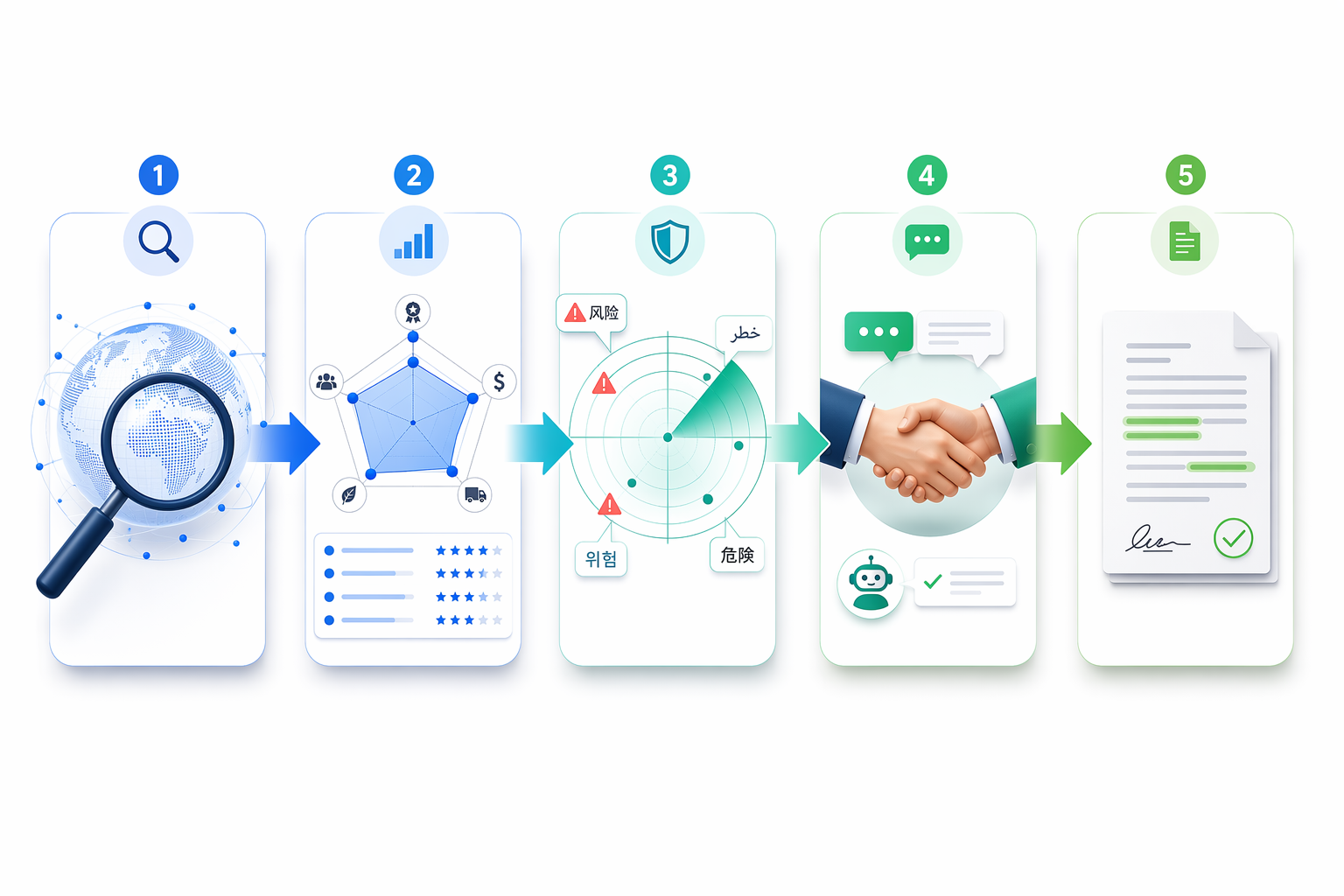
| Workflow stage | What AI changes | What still needs human control |
|---|---|---|
| Discovery | Scans large supplier universes against category, geography, capability, certification, and risk criteria | Define what a qualified supplier actually means for the category |
| Scoring | Compares suppliers across many dimensions at once instead of relying on a narrow spreadsheet view | Set weights, explain trade-offs, and test whether scores match procurement priorities |
| Risk monitoring | Tracks external signals continuously instead of waiting for periodic reviews | Decide escalation thresholds and who owns supplier-risk response |
| Negotiation | Runs structured, rules-based outreach for suitable supplier segments | Approve negotiation boundaries and review exceptions |
| Contract analysis | Extracts clauses, flags deviations, and compares terms against policy | Confirm legal, finance, and commercial judgment before commitment |
Discovery Becomes a Search Problem, Not a Memory Test
The first operational change is the move from relationship-memory sourcing to criteria-based search. A category manager can ask for suppliers that meet specific requirements, and the system can scan a far larger universe than a human team could reasonably review manually. The better implementations do not merely return a long list. They reduce noise by checking whether the supplier appears to match the relevant buying need, location constraints, certifications, and risk exclusions.
This matters most in categories where the incumbent base is stale or where disruption has made old supplier assumptions unreliable. A team looking for alternate electronic components suppliers, packaging converters, or logistics partners does not need an AI tool to tell it that more options exist. It needs a qualified short list fast enough to affect the sourcing event.
The caution is obvious to anyone who has cleaned supplier masters: a faster search over bad data only produces a larger pile of questionable records. Discovery acceleration depends on supplier data that can be matched, deduplicated, classified, and connected to the right category logic. If the organization cannot tell whether two records describe the same supplier, whether a facility belongs to the parent company, or whether a certification is still valid, AI will not make the sourcing decision cleaner by default.
Scoring Expands Beyond Price and Familiarity
Once the candidate pool improves, scoring becomes the next pressure point. Ivalua describes AI evaluating suppliers across more than 60 data points at the same time, including financial health, ESG compliance, certifications, delivery performance, and related supplier attributes.[2] That breadth is not a decorative feature. It changes which suppliers survive the first round of evaluation.
In a manual process, teams often overweight the fields that are easiest to compare: quoted price, current supplier status, basic capacity, and whatever performance history exists in the system. AI can widen that field of view, but it also makes the scoring model more consequential. If financial distress is weighted lightly, a low-cost supplier may rise. If delivery reliability or labor exposure is weighted heavily, the same supplier may fall. The model is not just calculating; it is expressing procurement priorities.
That is where many teams discover the uncomfortable part of AI-assisted supplier evaluation. They have to write down trade-offs that used to live in meeting notes, buyer experience, or executive preference. What matters more in this category: landed cost, resilience, ESG evidence, payment terms, technical capability, regional diversification, or speed to qualify? A scoring engine can compare suppliers across dozens of dimensions, but procurement still has to defend why those dimensions matter.
For teams still selecting platforms, this is also where software evaluation has to become more procurement-specific. A generic AI interface is not enough if the tool cannot handle category taxonomies, supplier hierarchies, risk attributes, workflow approvals, and audit trails. A practical procurement AI buyer assessment should test how the system scores suppliers, explains recommendations, and handles exceptions before it is embedded in sourcing decisions; broader selection criteria are covered in the AI procurement software buyer's guide.
Risk Monitoring Moves Into the Selection Window
Supplier risk used to enter too late. A sourcing team found a promising supplier, negotiated commercial terms, and then risk review surfaced a labor issue, environmental concern, financial warning, or compliance gap. The result was either delay or a reluctant exception. AI changes the timing by pulling external risk signals into selection while the field is still open.
Audi’s use of Prewave is a useful example because it is not framed as a one-time supplier check. Veridion describes Audi using Prewave to monitor suppliers across more than 50 languages for labor violations, environmental hazards, and financial distress signals in real time.[1] That is a different operating model from annual questionnaires or periodic database refreshes.
The value is not simply that the system sees more news. The value appears when risk signals change who gets escalated, who gets re-scored, and who needs a mitigation plan before award. A supplier that looks attractive on price and capability may still require a different decision if the risk model identifies credible distress signals. A supplier already in the approved base may need review before receiving more volume.
Continuous monitoring also creates a governance burden. Someone has to decide which alerts matter, which are false positives, which categories require immediate action, and when a sourcing event should pause. Without that operating design, the team gets more signals but not necessarily better decisions.
Negotiation Automation Works Best When the Boundaries Are Clear
The most vivid supplier-selection case is Walmart’s deployment of Pactum for automated supplier negotiations. Veridion, citing Harvard Business Review coverage, reports that Walmart used Pactum AI to run 2,000 simultaneous supplier negotiations, with a 68% close rate, 3% average savings, and a 35-day payment-term extension.[1]
Those figures should be read as documented results from a known deployment, not as a universal savings promise. The operational lesson is more specific: automation can handle structured negotiations where the company has clear commercial boundaries, acceptable trade-offs, and enough supplier volume to justify a repeatable process. It is much less convincing when a negotiation depends on strategic partnership terms, technical co-development, constrained capacity, or a fragile supplier relationship.
The human work does not disappear; it moves upstream. Procurement has to define which suppliers are eligible for automated negotiation, which terms the system can vary, how concessions are valued, and when the interaction gets routed to a buyer. Finance may care about payment-term movement. Operations may care about service commitments. Legal may care about nonstandard clauses. If those boundaries are not designed, automated negotiation can create cleanup work for the very functions it was supposed to help.
Contract Analysis Is the Later Extension, Not the Starting Point
Contract review is a natural extension of AI-assisted supplier selection because award decisions eventually become obligations. Ivalua reports that AI contract analysis tools can reduce review time by up to 60% by extracting clauses, flagging deviations, and comparing language against policy.[2] That can matter in high-volume sourcing environments where legal and procurement teams repeatedly review similar supplier terms.
The connection to supplier selection is practical. A supplier that scores well commercially may introduce unfavorable liability, termination, audit, data, or payment language. AI can bring those issues forward earlier, especially when contract data is linked back to supplier records and sourcing events. But contract analysis should not be mistaken for final judgment. It helps reviewers find deviations; it does not decide whether a deviation is acceptable in context.
The Capability Is Ahead of the Operating Model
After seeing the workflow, the strategy gap becomes harder to dismiss. Gartner’s 2025 survey of 120 supply chain leaders found that only 23% of organizations that had already deployed AI had a formal AI strategy.[3] That denominator matters. This is not a claim about every supply chain organization in the market. It is narrower, and in some ways more troubling: even among organizations already using AI, formal strategy is still uncommon.
That gap explains why the same technology can produce very different outcomes. One procurement team uses AI to build a cleaner supplier short list, document why each supplier scored where it did, monitor risk signals, and route exceptions to the right owner. Another team buys a tool, connects partial data, accepts opaque recommendations, and then spends the next sourcing cycle debating whether the output can be trusted.
The failure pattern is rarely that the demo was unimpressive. It is that the organization treated AI as a feature addition rather than a procurement operating change. The implementation risks are familiar: poor data ownership, weak process redesign, unclear accountability, and benefits cases that assume adoption without changing the work. For a deeper look at those patterns, see why AI in supply chain projects fail.
What a Procurement-Specific AI Strategy Has to Cover
A vague enterprise AI mandate will not tell a sourcing manager how to handle a supplier that scores high on cost and capability but low on labor-risk signals. It will not decide whether ESG evidence outweighs delivery performance in a critical category. It will not explain a recommendation to a supplier, an executive sponsor, or finance. Procurement needs its own strategy because procurement decisions combine market data, supplier relationships, risk appetite, commercial trade-offs, and contractual obligations.
- Usable supplier data: supplier records must be deduplicated, classified, connected to category structures, and kept current enough for scoring to mean something.
- Explicit scoring criteria: the organization must define which dimensions matter by category, how they are weighted, and when a low score blocks award.
- Decision governance: buyers need to know when AI recommendations are advisory, when escalation is required, and who can override a score.
- Human review points: automated discovery, scoring, negotiation, and contract analysis still need accountable owners for exceptions and final commitments.
- Benefit measurement: teams should track cycle time, supplier quality, negotiated value, risk escalations, and review effort rather than relying on generic productivity claims.
This is also where ROI discipline matters. A sourcing AI program should not be justified only by market excitement or a vendor’s broad automation claim. The business case has to connect the tool to measurable work: fewer manual filtering hours, faster qualified short lists, better supplier coverage, improved risk visibility, shorter contract review, or higher negotiation throughput. Procurement teams building that case can compare assumptions against broader procurement AI ROI evidence before committing to a full rollout.
A Pilot Should Test Decisions, Not Just Outputs
A useful pilot does not ask only whether the system can find suppliers. It asks whether the procurement team can use the output in a real sourcing decision. That means choosing a category with enough supplier complexity to matter, but not so much strategic sensitivity that every recommendation becomes an exception. It also means defining the baseline before the pilot starts: how long discovery takes, how many suppliers are reviewed, how many are qualified, where risk review enters, and how contract deviations are handled.
The pilot should force the uncomfortable questions early. Can the tool explain why one supplier outranked another? Can buyers adjust or challenge scoring logic? Are risk alerts specific enough to act on? Does automated negotiation stay within approved limits? Does contract analysis reduce review effort without hiding commercially important language? If the answers are unclear in a pilot, they will not become clearer at enterprise scale.
A 90-day pilot can be long enough to test the operating model if the scope is controlled and the measures are concrete. The point is not to prove that AI can generate recommendations. The point is to prove that procurement, finance, legal, risk, and operations can use those recommendations without creating a parallel manual process. A practical pilot structure is outlined in the procurement AI ROI 90-day pilot strategy.
Market Growth Is Real, but It Does Not Solve Readiness
The market context is large enough to explain why procurement leaders are under pressure to act, but it should not be overread. OpenSky Group’s roundup cites Precedence Research estimating the AI-in-supply-chain market at $9.94 billion in 2025 and projecting it to reach $236 billion by 2035 at a 37.3% CAGR.[4] Other market estimates use different definitions of what counts as supply chain AI, which is why market-size comparisons often vary widely.
For a sourcing leader, the useful question is narrower than the market forecast: which part of supplier selection will improve, who will trust the recommendation, and what process will change as a result? A large market can fund better tools, but it cannot clean a supplier master, define category-specific scoring logic, or decide when a buyer may override an AI-generated ranking.
The Advantage Goes to Teams That Redesign the Work
AI supplier selection is no longer speculative. Documented deployments and current procurement platforms show real capabilities: supplier discovery compressed from months to hours, evaluation across more than 60 dimensions, risk monitoring across more than 50 languages, automated negotiations at large volume, and contract-review acceleration.[1][2]
The harder question is whether the organization can absorb those capabilities without turning speed into faster confusion. The winners will not be the teams that simply add an AI tool to the existing sourcing process. They will be the teams that redesign supplier data, scoring governance, risk escalation, negotiation boundaries, and decision accountability around the new pace of the work.
References
- How Can AI Help With Supplier Selection? — Veridion
- The Role of AI in Sourcing and Procurement [2026] — Ivalua
- Gartner 2025 survey of 120 supply chain leaders — Gartner, 2025
- Supply Chain AI Statistics — OpenSky Group
Comments
Join the discussion with an anonymous comment.