
According to a 2025 MIT Sloan study, 95% of AI procurement pilots fail to scale. That number is not a typo. I have seen this pattern myself: a team picks a flashy demo, runs a three-month trial on a narrow category, gets promising results, and then hits data integration hell or change-management resistance when they try to roll it out. The pilot works. The production deployment does not. The failure rate comes from cross-industry AI pilots, but procurement has its own version: 74% of procurement leaders say their data is not AI-ready, per Gartner’s 2025 Leadership Vision for CPOs. That is the single biggest reason AI for procurement pilots stall.
This article does not pretend every use case is equally ready. Instead, it ranks six common procurement AI applications by how fast they pay back, and then gives you a 90-day pilot framework that addresses the data-readiness gate before you even start. The goal is not to avoid failure at all costs — it is to fail fast, learn, and build the business case for the right next step. But I want to be upfront about the numbers: the ROI figures below come from aggregated McKinsey and BCG implementation data as reported by supplychainaipro.com. They are directional, not guaranteed. The real takeaway is the relative order.
Six Use Cases, Ranked by Payback Speed – and Why You Shouldn't Trust the Percentages Blindly
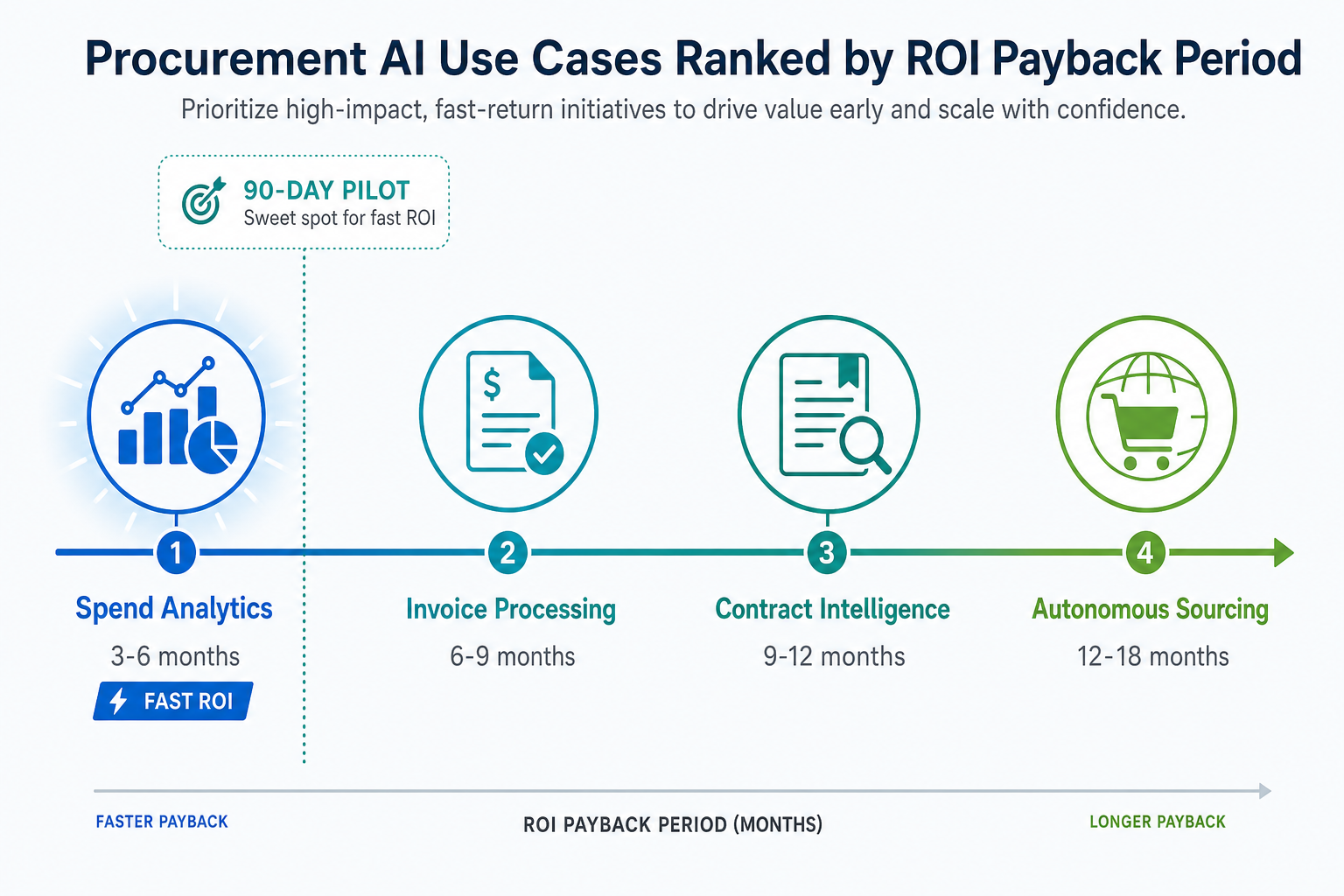
The ROI ranges in the table below come from high-adoption environments — companies that already had clean spend data and executive sponsorship. I present them as directional ranges, not promises. Look at the “Source confidence” column: moderate means the data comes from consulting aggregations, not independent peer review. Low means vendor-reported outcomes. I wouldn't build a business case on the high end of these unless your data is clean and you have sponsorship. The ranking itself is useful for prioritization.
| Use case | Payback period | First-year ROI range | Source confidence |
|---|---|---|---|
| Spend analytics and classification | 3–6 months | 300–500% | Moderate – aggregated consulting data |
| Invoice processing / AP automation | 6–9 months | 200–400% | Moderate – mixed vendor and consulting data |
| Contract intelligence | 9–12 months | 150–300% | Low – limited independent validation |
| Autonomous sourcing agents | 12–18 months | 100–250% | Low – early-stage implementations |
| Supplier risk scoring | 12–18 months | Variable | Low – mostly vendor-reported outcomes |
| Full source-to-pay transformation | 18–24 months | 500%+ three-year | Low- moderate – multiple case studies |
Spend analytics and invoice processing sit at the top for a reason: they work on structured, owned data and directly reduce manual touchpoints. I’ve seen a team cut classification time by 60% with a decent tool — but only after they spent six weeks normalizing supplier names and categories. That cleanup time doesn't appear in the 3–6 month payback estimate. It’s a hidden cost that many articles gloss over.
The 74% of leaders whose data is not AI-ready is the real bottleneck. If you pick a category with messy spend data, you’ll spend months cleaning it before the AI can run. That shifts the payback period to the right. The ranking holds — spend analytics is still the fastest — but the actual ROI depends entirely on your starting point. A 300% return assumes you already have clean data and a sponsor who can push adoption. If you don’t, expect closer to the lower end of the range.
What to Do in 90 Days – If Your Data Is Ready
Most 90-day pilot frameworks assume you can select a category with clean data. If you can’t, the first step isn’t a pilot — it’s a data readiness assessment. Quick checklist:
If the answer to any of these is no, spend the first 90 days on data cleanup. That is honest advice, not a consulting upsell. If you jump into a pilot with bad data, you’ll either fail or get misleading results that waste everyone’s time. Start with spend analytics on a single category where the data is clean. Prove it works, measure the actual time saved, then use that data to justify the next investment.
The 95% failure rate isn’t a reason to avoid AI. It’s a reason to start with the use cases that have the shortest payback, the lowest data complexity, and the most accountable sponsors. Spend analytics and invoice processing fit that profile. The rest can wait until you’ve built the data readiness and change muscle.
Comments
Join the discussion with an anonymous comment.